
📦 Aren’t You Dead?
America declared the catalog obsolete, built ten thousand shopping malls, invented the internet—and brought the whole damned store back to our front door.

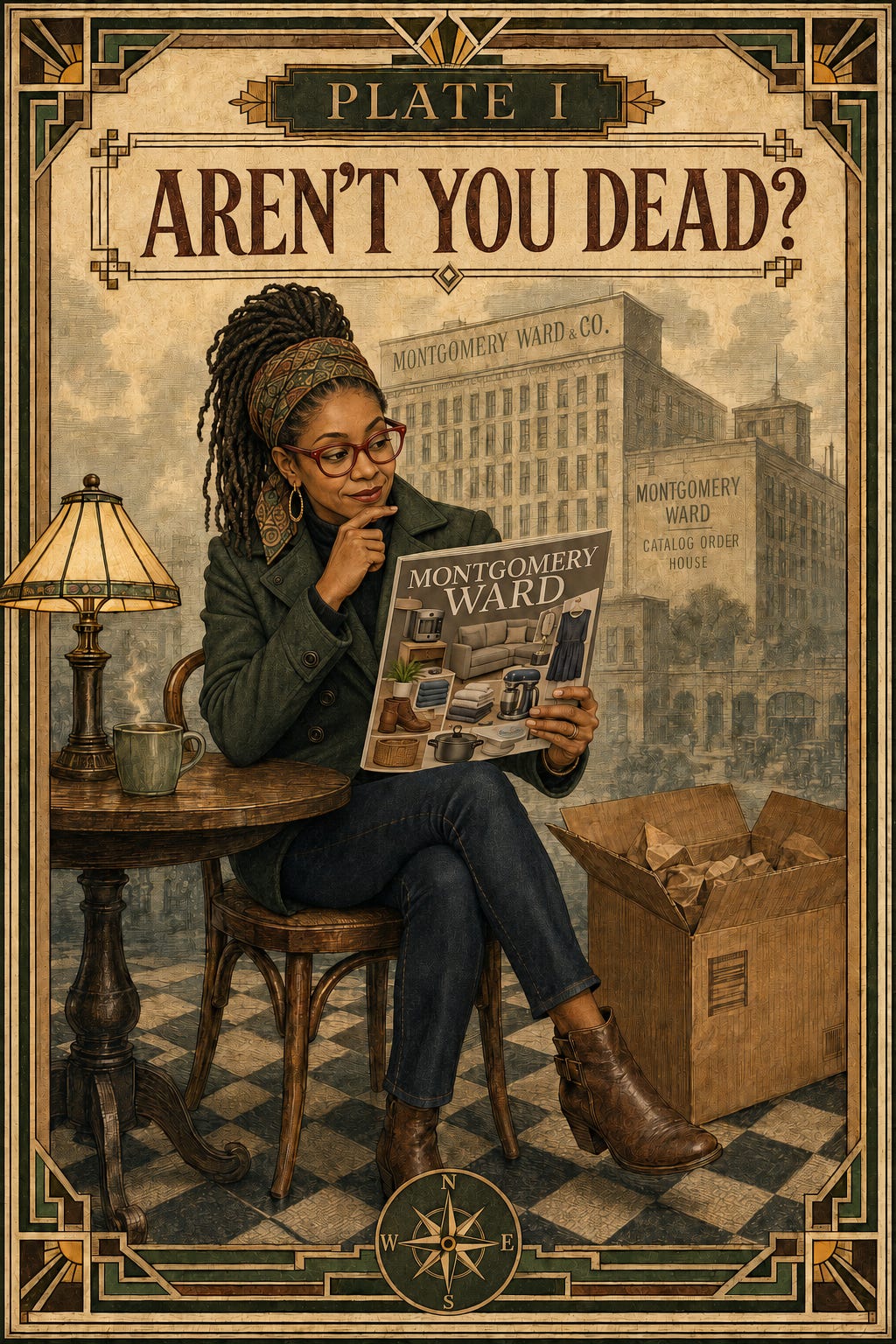
Amazon did not kill Montgomery Ward. It proved that Montgomery Ward had been right all along.
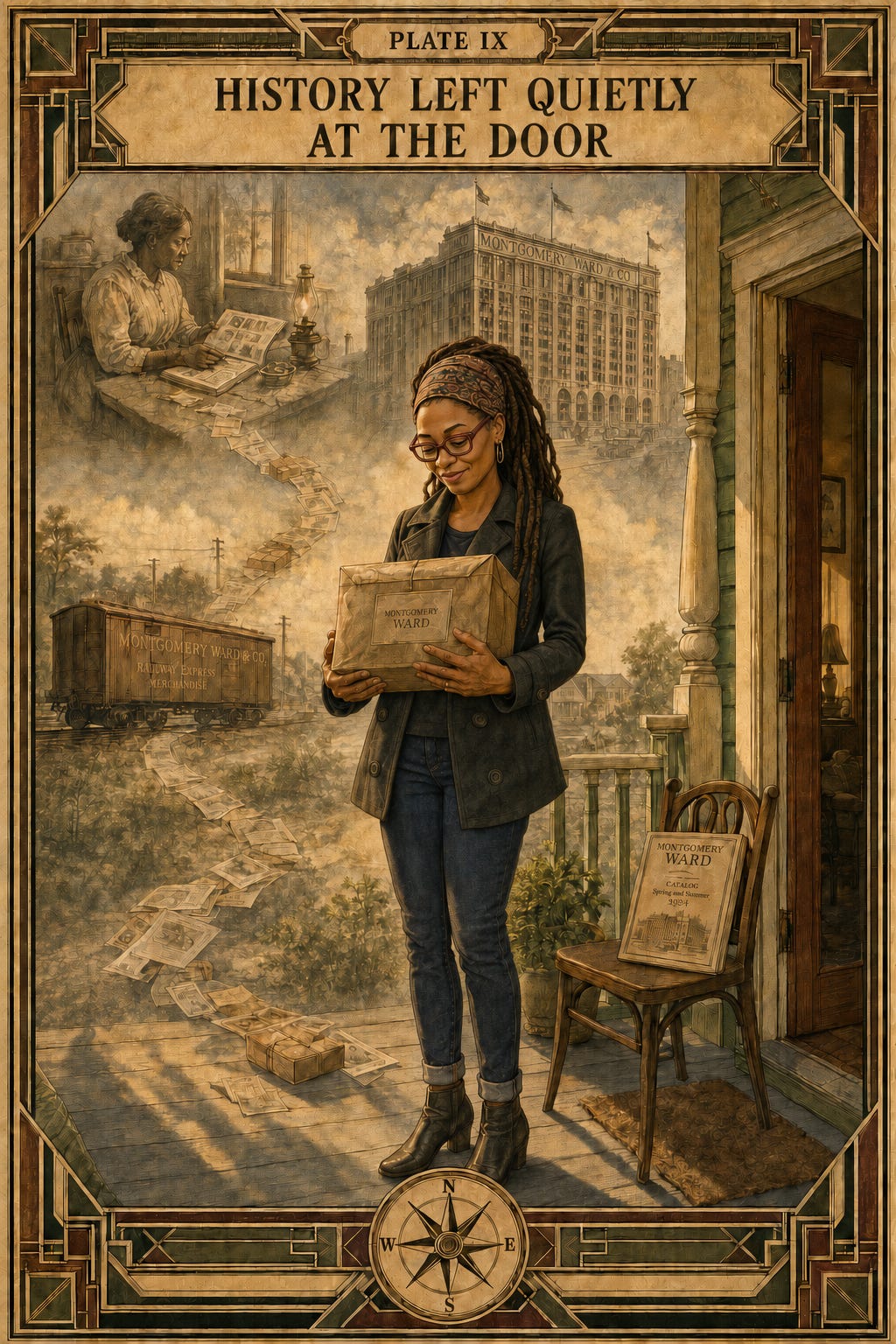
A Montgomery Ward catalog came into my hands the other day.
A real one.
Not a commemorative reproduction from the Museum of Vanished American Commerce. Not a yellowed relic found beneath somebody’s dead grandmother’s sewing machine. Not an artifact being offered on eBay for forty-seven dollars plus shipping because it once contained an advertisement for foundation garments.
An actual, present-day Montgomery Ward catalog.
I looked at it for a moment and thought:
Aren’t you dead?
I could have sworn Montgomery Ward had gone off to that great shopping mall in the sky, somewhere beyond Sears, Woolworth, Emporium-Capwell, and the fellow who used to repair televisions.
But there it was—alive enough to sell me a bedspread.
And I found myself wanting to order something.
I did not particularly need anything. That has never stopped an American consumer before, and I saw no reason to let it stop me.
But my desire was not entirely about shopping.
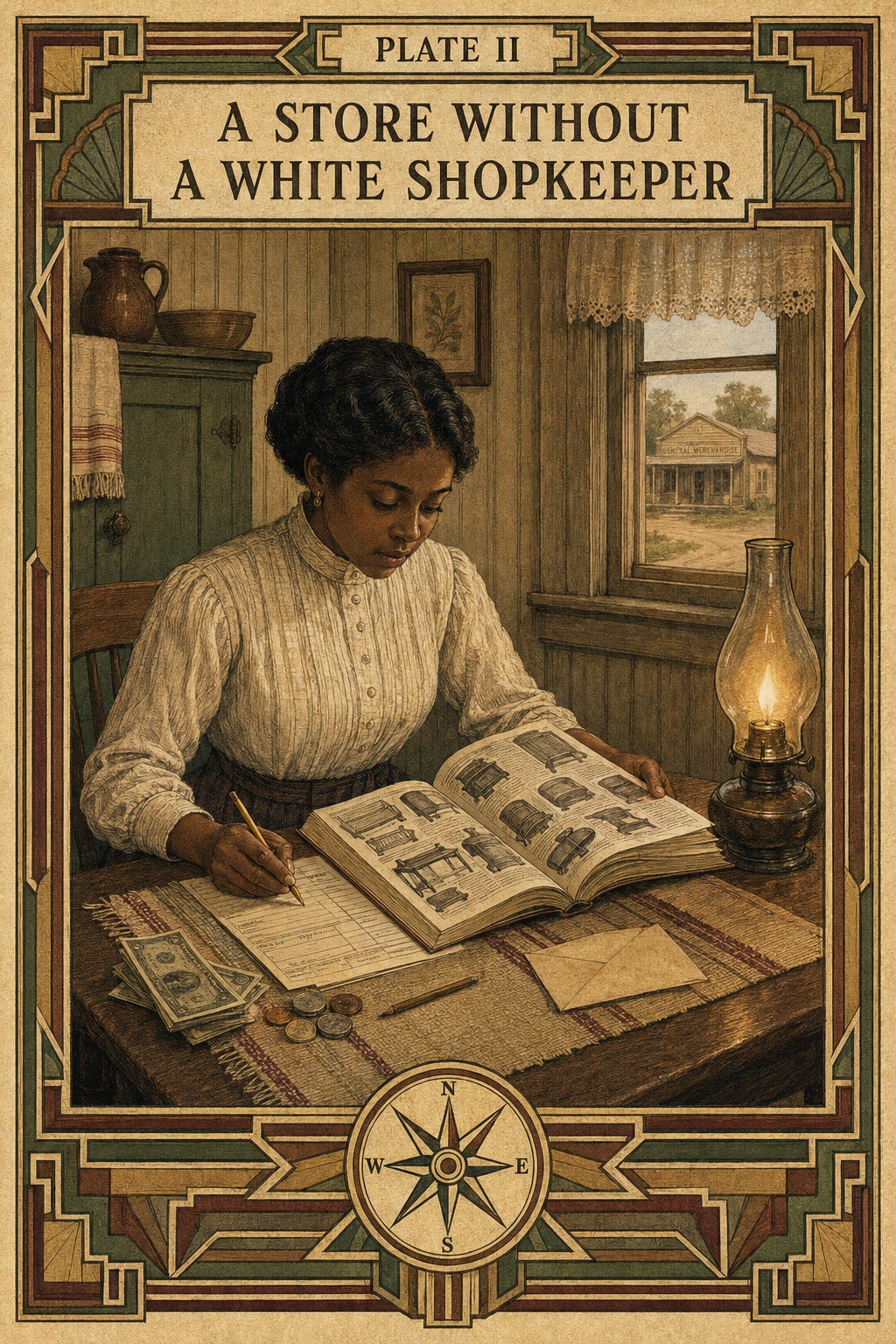
I wanted to order something because I imagined that one of my African American ancestors might once have sat with a Montgomery Ward catalog open across her lap.
Perhaps she studied its pages at a kitchen table somewhere in Louisiana. Perhaps she looked at dresses, shoes, linens, cookware, furniture, farm tools, or one of those marvelous contraptions advertised as capable of performing fourteen household tasks while taking up no more room than a respectable hatbox.
Perhaps she counted her money twice.
Perhaps she placed an order.
I do not know whether my ancestors ever bought anything from Montgomery Ward. Their receipts, if they existed, are gone.
But I know that catalogs like this one reached families like mine.
And for a Black family in the rural South during the early twentieth century, a catalog could mean considerably more than shopping.
🛍️ A Store Without a White Shopkeeper
Under Jim Crow, even buying an ordinary household object could require a performance of submission.
A Black customer entering a white-owned country store might be expected to wait until every white customer had been served. She might be shown inferior merchandise, charged an inflated price, refused certain goods, addressed disrespectfully, or made to understand that some things were simply not intended for people like her.
The indignity was built into the transaction.
The merchant stood between the customer and the marketplace. He controlled the goods, the prices, the credit, and the terms upon which another human being would be acknowledged.
Then came the catalog.
The catalog did not look across the counter and decide whether you belonged.
It did not make you stand aside while somebody else was served.
It did not examine your skin before showing you the better shoes.
It did not decide that the blue dress was too fine for you.
You could look.
You could choose.
You could count your money.
You could write down the number.
You could send away for what you wanted.
The person processing the order in Chicago did not need to know that you were Black.
Now, we should not romanticize this. Montgomery Ward was not operating an underground branch of the civil-rights movement. It was selling merchandise. Its early system generally required cash, which placed many goods beyond the reach of impoverished sharecroppers. The better-documented story of catalog shopping under Jim Crow belongs to Sears, which extended credit and sometimes took deliberate steps to help Black customers bypass hostile local merchants.
But Montgomery Ward offered the same fundamental passage around the gatekeeper:
A stated price.
A private choice.
A direct transaction.
A measure of dignity.
More than a century later, I can sit with the descendant of that catalog and make a choice of my own.
That alone is enough to make me want to order something.
But there is another reason.
Montgomery Ward may be one of the few American companies to return from the dead and discover that the rest of the country has finally caught up with it.
📖 The First “Everything Store”
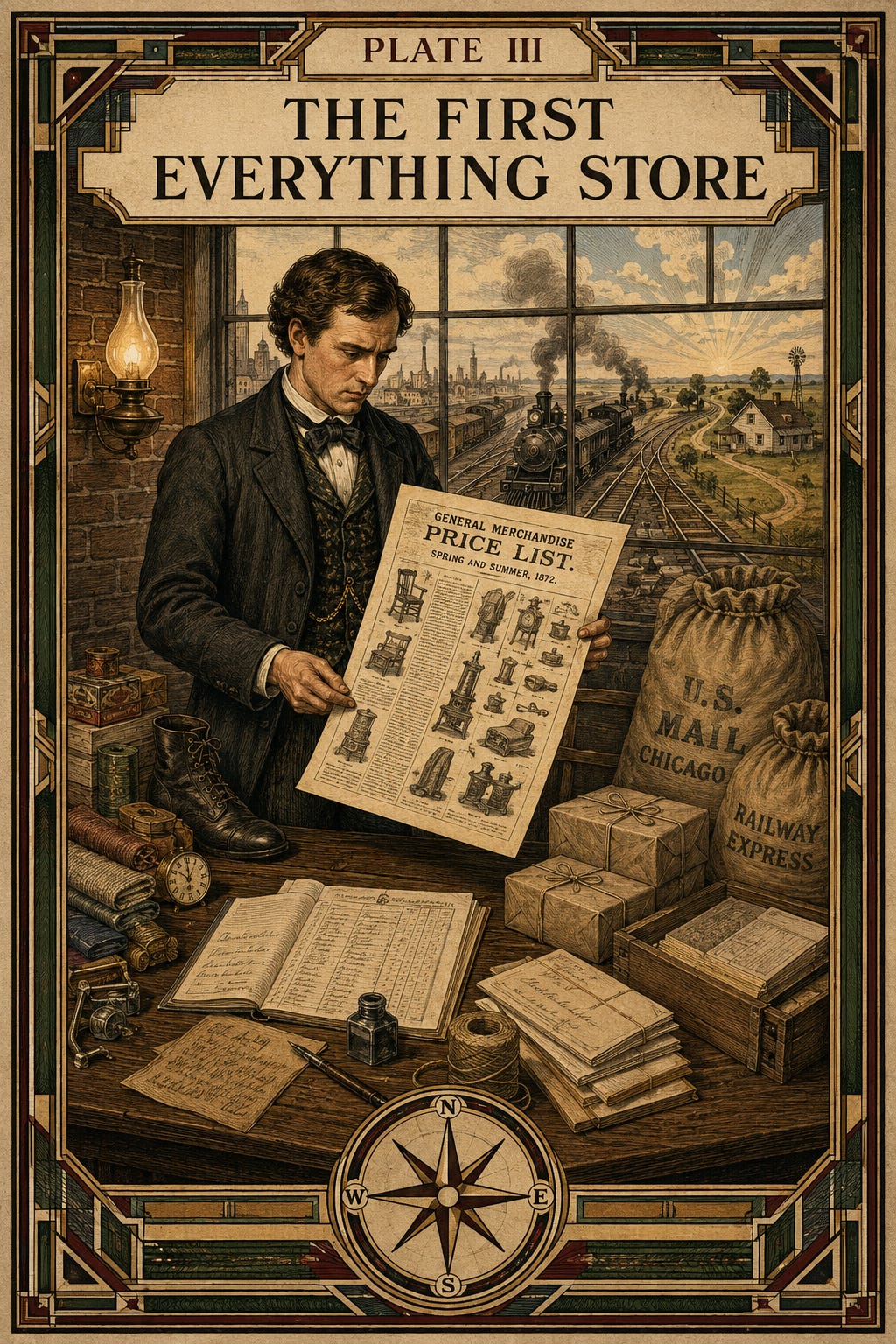
Aaron Montgomery Ward began his mail-order business in Chicago in 1872.
His first catalog was not the enormous illustrated “wish book” later remembered by generations of American children. It was a single sheet listing 163 items.
One sheet.
No search engine.
No customer reviews.
No photograph of Aaron Montgomery Ward standing beside a stack of boxes looking pleased with himself.
Just merchandise, prices, instructions—and an idea.
Ward had spent time traveling through rural communities, where he saw that customers frequently depended upon local merchants who offered limited selections at high prices. Every additional middleman added another cost before the product reached the person who actually needed it.
Ward proposed eliminating the middleman.
The merchandise could be purchased in volume, gathered in a distant warehouse, described on paper, ordered from home, and transported by railroad and mail.
The customer would not have to go to the store.
The store would come to the customer.
This was an astonishing proposition in 1872.
It remains an astonishing proposition today, although we now call it “free delivery” and become indignant if the package takes longer than twenty-four hours.
The Montgomery Ward catalog grew from one sheet into a book of hundreds of pages offering thousands of products. It became part store, part household manual, part entertainment, and part illustrated encyclopedia of American desire.
People who lived hundreds of miles from the great commercial streets of Chicago or New York could suddenly see what the rest of the country was buying.
They could furnish a room.
Dress a family.
Equip a farm.
Order a stove.
Purchase a musical instrument.
Imagine a different life.
The catalog did not merely sell objects.
It sold access to the national marketplace.
That ought to sound familiar.
💻 Amazon Printed on Paper
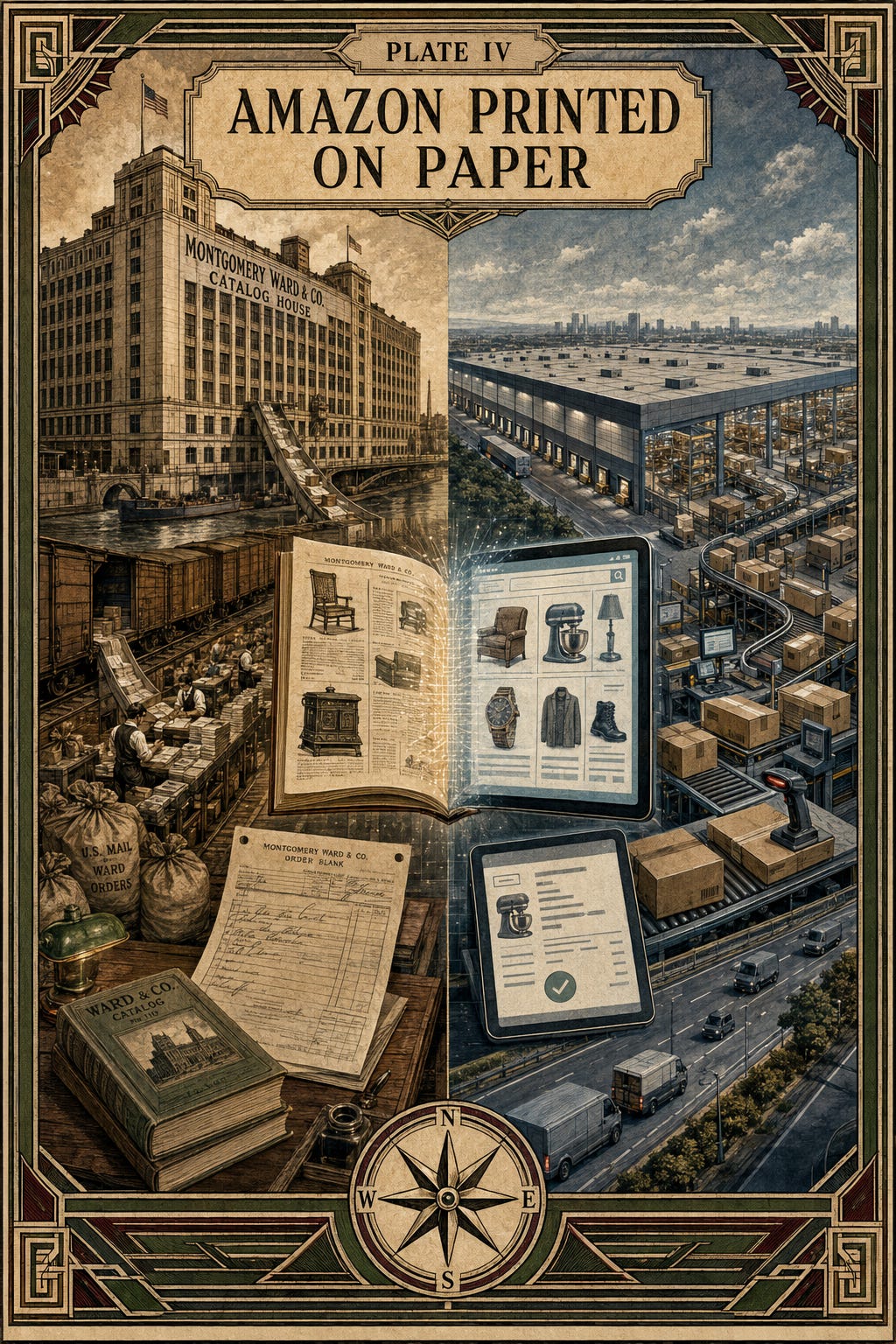
Long before Amazon placed a fulfillment center beside every interstate and a cardboard box upon every porch, Montgomery Ward had already assembled the essential machinery of shopping from home:
A vast inventory gathered in central locations
Thousands of products arranged into categories
Written descriptions of merchandise
Fixed prices
Remote ordering and payment
Warehouses designed for rapid processing
A national transportation network
Satisfaction guarantees
Customers who might never see the seller—or the product—before buying it
Amazon did not invent this model.
Amazon put it on a computer.
The printed catalog became a website.
The index became a search bar.
The paper order form became the BUY NOW button.
Letters from satisfied customers became online reviews written by people named “MountainDad47.”
The railroad warehouse became the fulfillment center.
The parcel post became the delivery van.
The catalog clerk became an algorithm that follows you around for three weeks because you once looked at a lamp.
Amazon’s catalog is faster, larger, searchable, and nearly infinite. But the fundamental transaction would have been perfectly recognizable to Aaron Montgomery Ward:
Look at merchandise from home.
Choose what you want.
Send payment to a distant company.
Wait for the goods to arrive at your door.
The screen is not the opposite of the catalog.
The screen is a catalog whose pages never end.
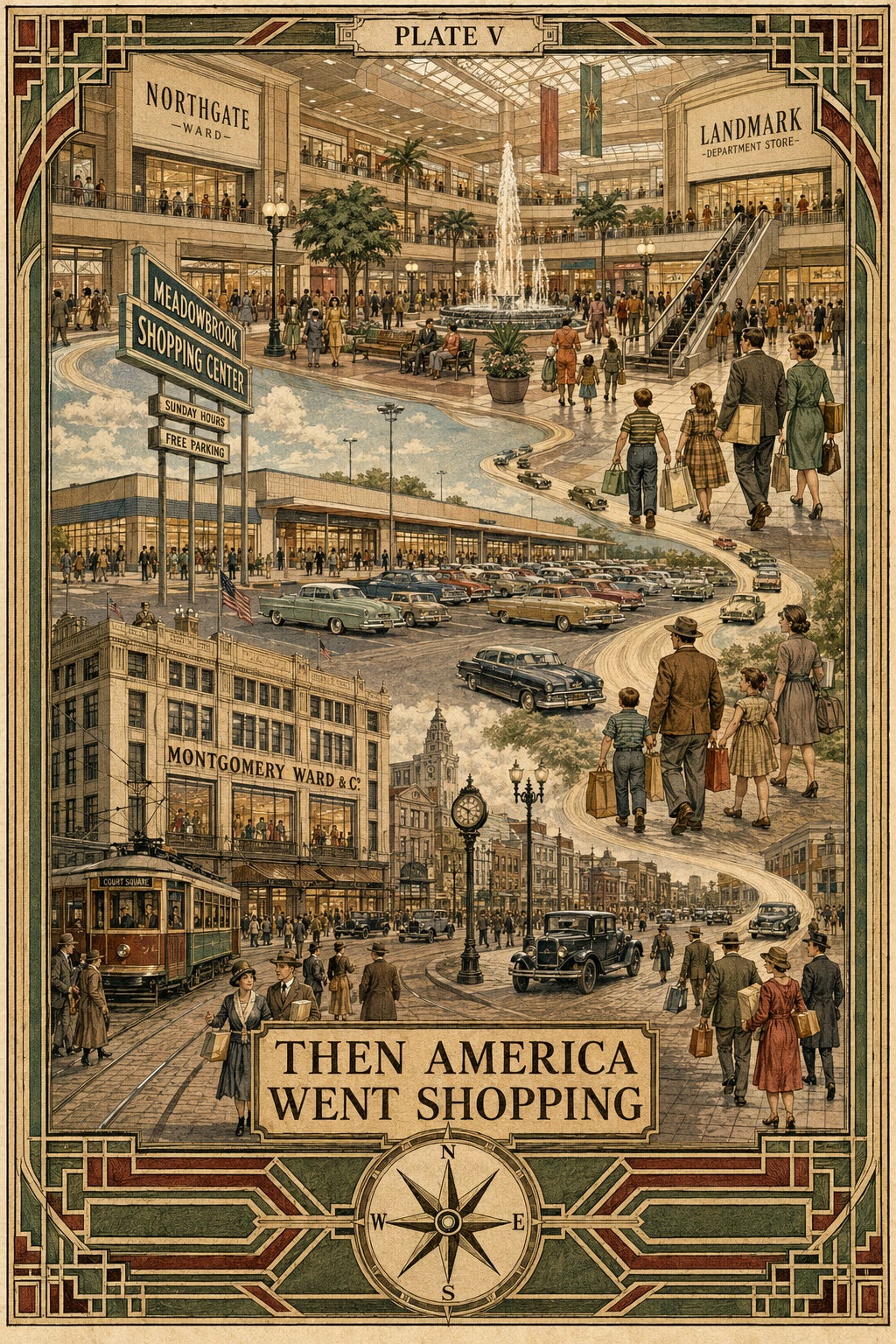
🏬 Then America Went Shopping
The peculiar part of the Montgomery Ward story is that the company eventually wandered away from the very idea that had made it revolutionary.
Montgomery Ward began opening stores in the 1920s. Within a few years, hundreds of them appeared across the country.
The company that had eliminated the store became a department-store empire.
This transformation changed American architecture.
The catalog business had required enormous warehouses, railroad sidings, loading platforms, conveyors, packing rooms, sorting systems, offices, and postal operations. Montgomery Ward built some of the largest reinforced-concrete commercial structures in American cities.
The department-store business required display windows, showrooms, escalators, elevators, appliance floors, automobile-service departments, garden centers, and parking lots.
Then came the enclosed shopping mall.
The department stores sat at the ends as anchors. Smaller shops lined the climate-controlled corridor between them. The mall borrowed the features of a traditional downtown—the street, the plaza, the fountain, the bench, the café—and placed them inside a privately owned building.
The public square had become a shopping opportunity.
America fell in love.
We drove downtown.
Then we drove to the suburban shopping center.
Then we drove to the enclosed mall.
Then we drove to Walmart, Target, Costco, and Home Depot.
We constructed millions of square feet of stores surrounded by parking lots large enough to be seen from the moon, all so that we could personally retrieve the things we had once ordered from home.
The catalog began to look old-fashioned.
In 1985, after 113 years, Montgomery Ward discontinued its original catalog.
Apparently, the future belonged to the store.
The company struggled against Sears, Walmart, Target, and other retailers. It filed for bankruptcy in 1997, briefly reemerged, and announced its liquidation in 2000.
The remaining stores closed in 2001.
Montgomery Ward was dead.
Except for the name.
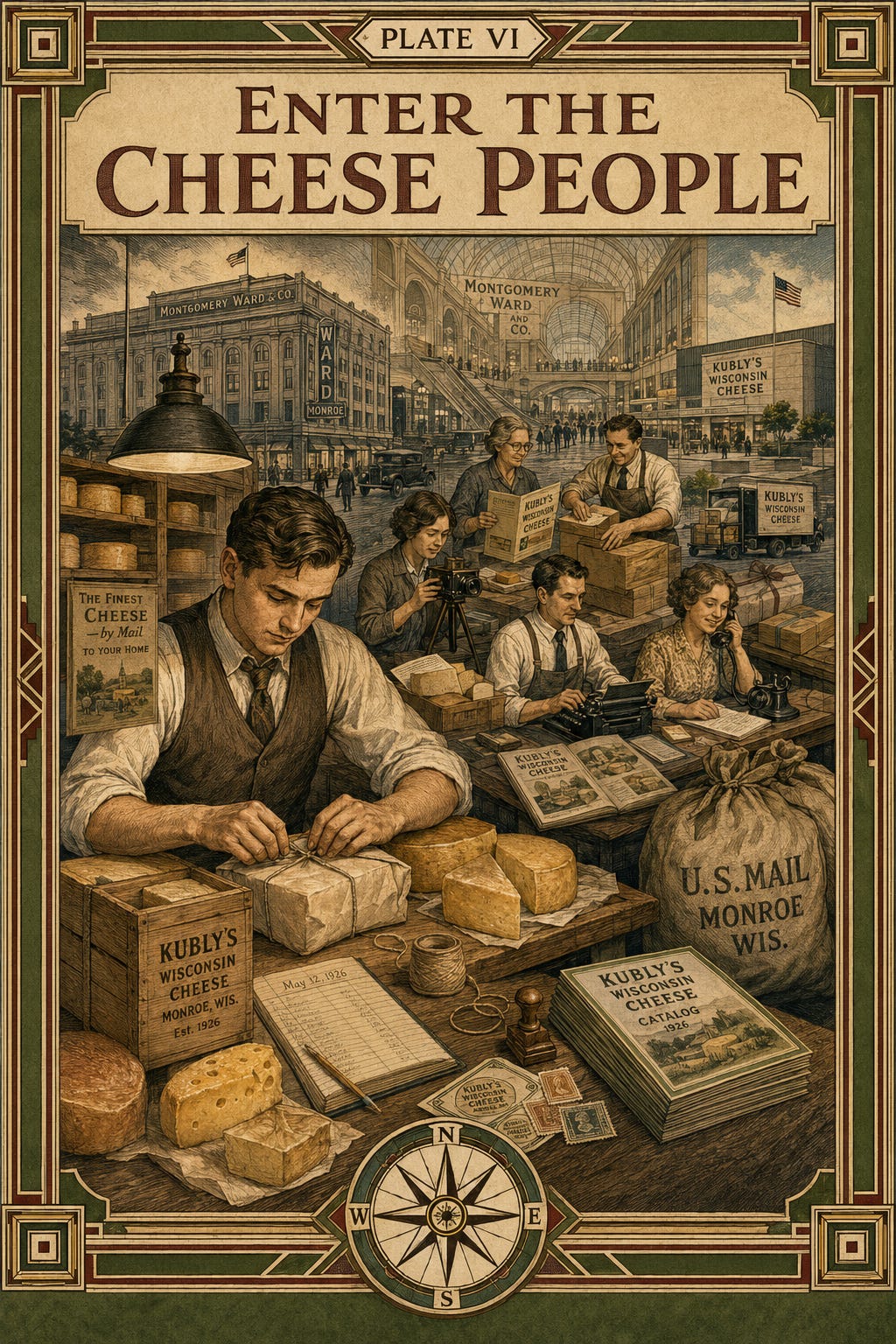
🧀 Enter the Cheese People
The present Montgomery Ward is not the original corporation magically restored to life.
After the liquidation, a company founded by catalog marketer David Milgrom acquired the Montgomery Ward and Wards trademarks. The familiar name was revived as a catalog and online business without physical department stores.
Then, in 2008, Montgomery Ward was acquired by The Swiss Colony—the Wisconsin mail-order company founded by Ray Kubly in 1926.
That date deserves a second look.
In 1926, Montgomery Ward began its great expansion into physical stores.
Also in 1926, Ray Kubly began selling Wisconsin cheese by mail from his family’s basement.
Montgomery Ward moved away from its catalog heritage and toward department stores and shopping malls.
The Kubly family remained in direct marketing.
They kept mailing catalogs.
They sold cheese, sausage, chocolates, pastries, clothing, furniture, housewares, and all sorts of things Americans could send to relatives at Christmas instead of visiting them.
The little cheese business grew into Colony Brands, a privately held company that remains owned by the Kubly family. Its collection of catalog and online businesses now includes The Swiss Colony, Seventh Avenue, Ginny’s, Country Door, Ashro, Monroe & Main, The Wisconsin Cheeseman—and Montgomery Ward.
The company that abandoned the catalog was ultimately acquired by a family that never stopped believing in it.
You could not arrange a more appropriate ending if you hired a novelist.
The body of the original Montgomery Ward is gone.
The name survived.
The idea survived.
And the catalog merchants inherited it.
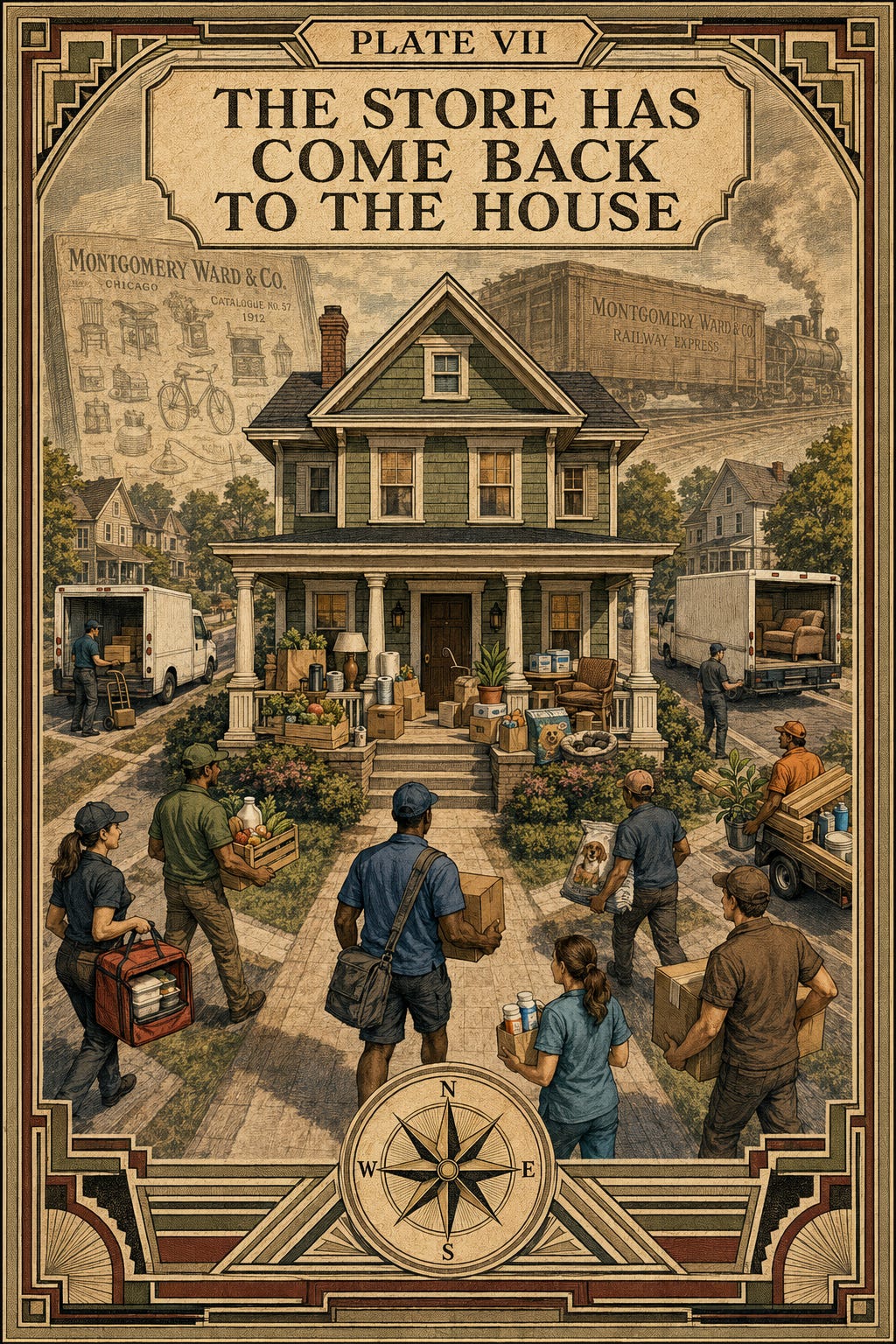
🚚 The Store Has Come Back to the House
Now we arrive at the truly absurd part.
Everything comes to the door again.
Amazon brings books, clothing, electronics, soap, furniture, groceries, office supplies, and nearly anything else that can be placed inside a cardboard box.
DoorDash brings dinner.
Safeway and Lucky bring groceries.
Target brings toiletries and household supplies.
Home Depot delivers appliances, lumber, plants, toilets, bags of cement, and enough building material to add an unauthorized room to the back of the house.
Pharmacies deliver prescriptions.
Pet stores deliver dog food.
Office suppliers deliver printer paper.
Restaurants that never employed delivery drivers now send food through an app.
Everybody is in the mail-order business.
Every retailer has been compelled to become Montgomery Ward.
We once believed that the catalog was obsolete because we had stores. Then Amazon persuaded us to sit at home looking at pictures of merchandise again.
It called the pictures “product listings.”
It replaced page numbers with hyperlinks.
It added a button.
It promised faster delivery.
And America announced that the future had arrived.
But the future looked suspiciously like 1872.
America declared the catalog dead, spent the twentieth century building department stores and shopping malls, and then rebuilt the catalog on the internet.
We have returned to the doorstep.
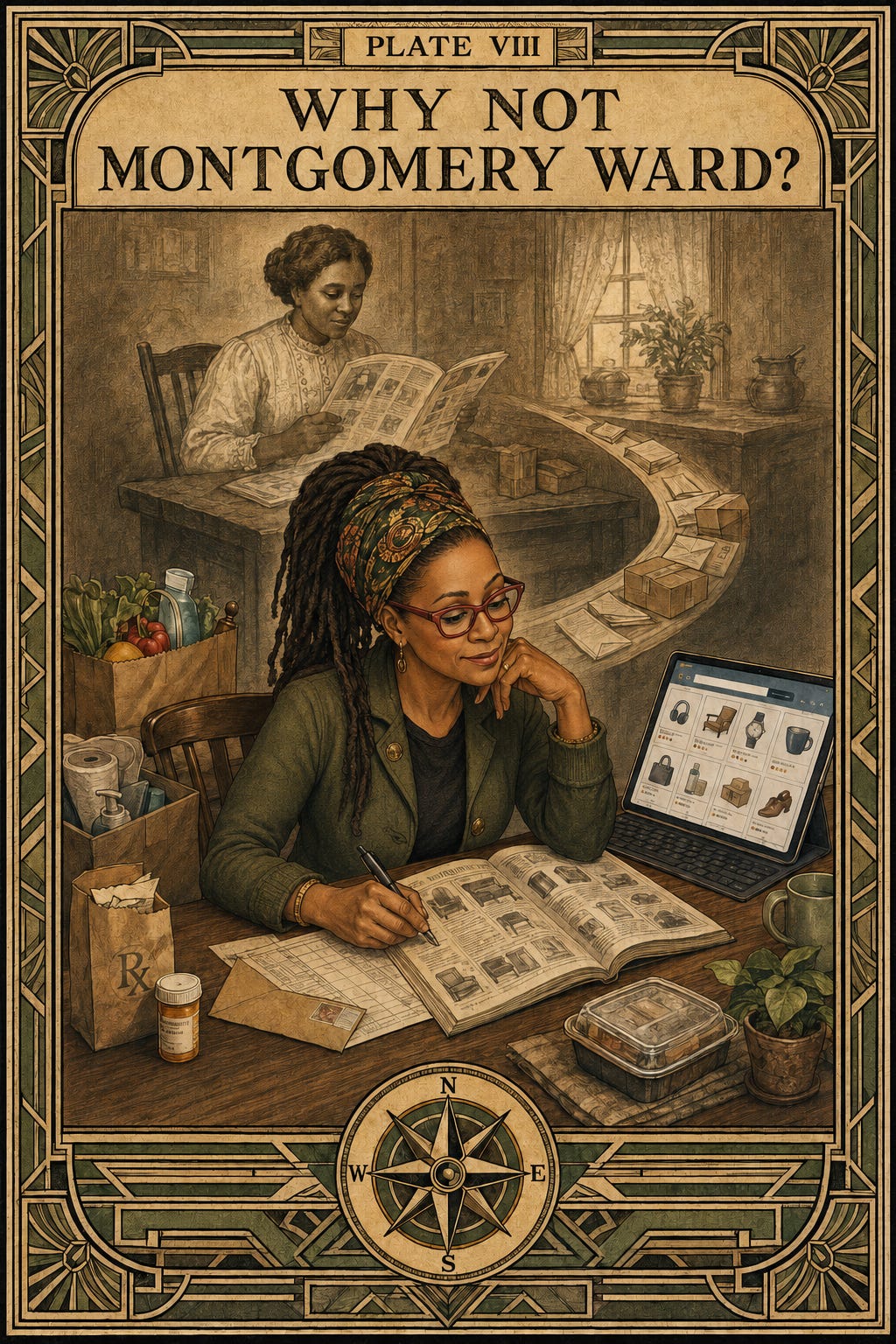
📦 Why Not Montgomery Ward?
That brings me back to the catalog in my hands.
Why shouldn’t I buy from Montgomery Ward?
I already buy from Amazon, Target, Home Depot, Safeway, Lucky, and restaurants through DoorDash. Every one of them is practicing some version of the Montgomery Ward model.
Montgomery Ward merely has the decency to admit that it is still a catalog.
Ordering from it today would not support Aaron Montgomery Ward’s original company. That company is gone. I would be buying from the modern Montgomery Ward operated by Colony Brands and owned by the Kubly family.
Still, the symmetry pleases me.
A nineteenth-century business taught Americans to shop from home. It abandoned the catalog, built stores, entered malls, collapsed, and disappeared.
Its name was rescued by a family of catalog merchants.
Meanwhile, the rest of American commerce reorganized itself around home ordering and doorstep delivery.
Montgomery Ward did not return to a world that had moved beyond it.
It returned to a world that had circled back to meet it.
So I believe I will order something.
Not because Montgomery Ward needs rescuing.
Not because the past was better.
It most certainly was not.
I will order something because I can imagine one of my ancestors opening a catalog and discovering, amid all those illustrated goods, a small territory in which she could exercise choice.
I will order something because choosing freely was once an act of resistance.
And because sometimes history does not return as a monument, a museum exhibition, or a brass plaque fastened to an old building.
Sometimes it returns as a catalog.
Sometimes it comes in a cardboard box.
And sometimes history is left quietly at the door.
〰️ ✦ 〰️
A Kimberly Twain Observation
America spent more than a century improving upon Montgomery Ward’s original idea, only to arrive at Montgomery Ward’s original idea.