

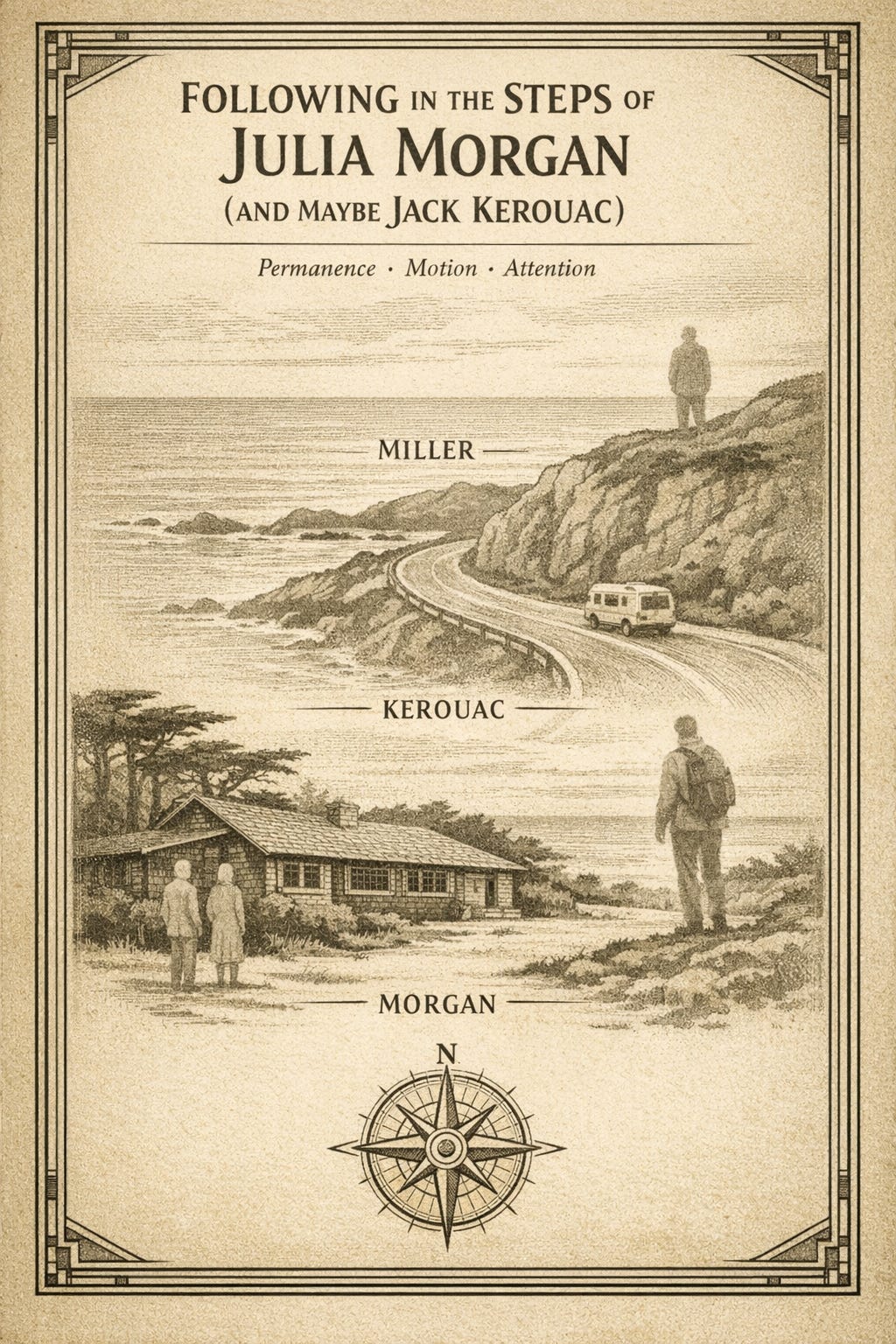
There are two kinds of pilgrims in America, and neither of them thinks of themselves as religious.
The first travels with plans. She believes in measurements, materials, and the radical idea that something well made might still be standing after the fashions that dismissed it have died of embarrassment. She builds not to announce herself, but to solve a problem and then leave quietly. Her name is Julia Morgan.
The second travels because standing still feels like a form of dishonesty. He believes in motion, confession, and the road as a long, unfinished sentence. He mistrusts foundations, especially the literal ones, and prefers revelation at fifty miles an hour. His name is Jack Kerouac.
I have been following both, which may explain why I am neither lost nor entirely found.
I’m on vacation, moving down Highway 1, that famously scenic strip of road that makes Americans believe, briefly, that we are a serious civilization. We stop in Monterey. Then Pacific Grove. Then Asilomar.
Asilomar is one of those places that does not brag, which is how you know it was built by someone who knew what she was doing. Between 1913 and 1928, Julia Morgan designed sixteen buildings here. Eleven remain standing today, which is a better survival rate than most ideas from the early twentieth century. They sit low against the dunes and the cypress trees, as if they’ve learned the sensible habit of not arguing with the landscape.
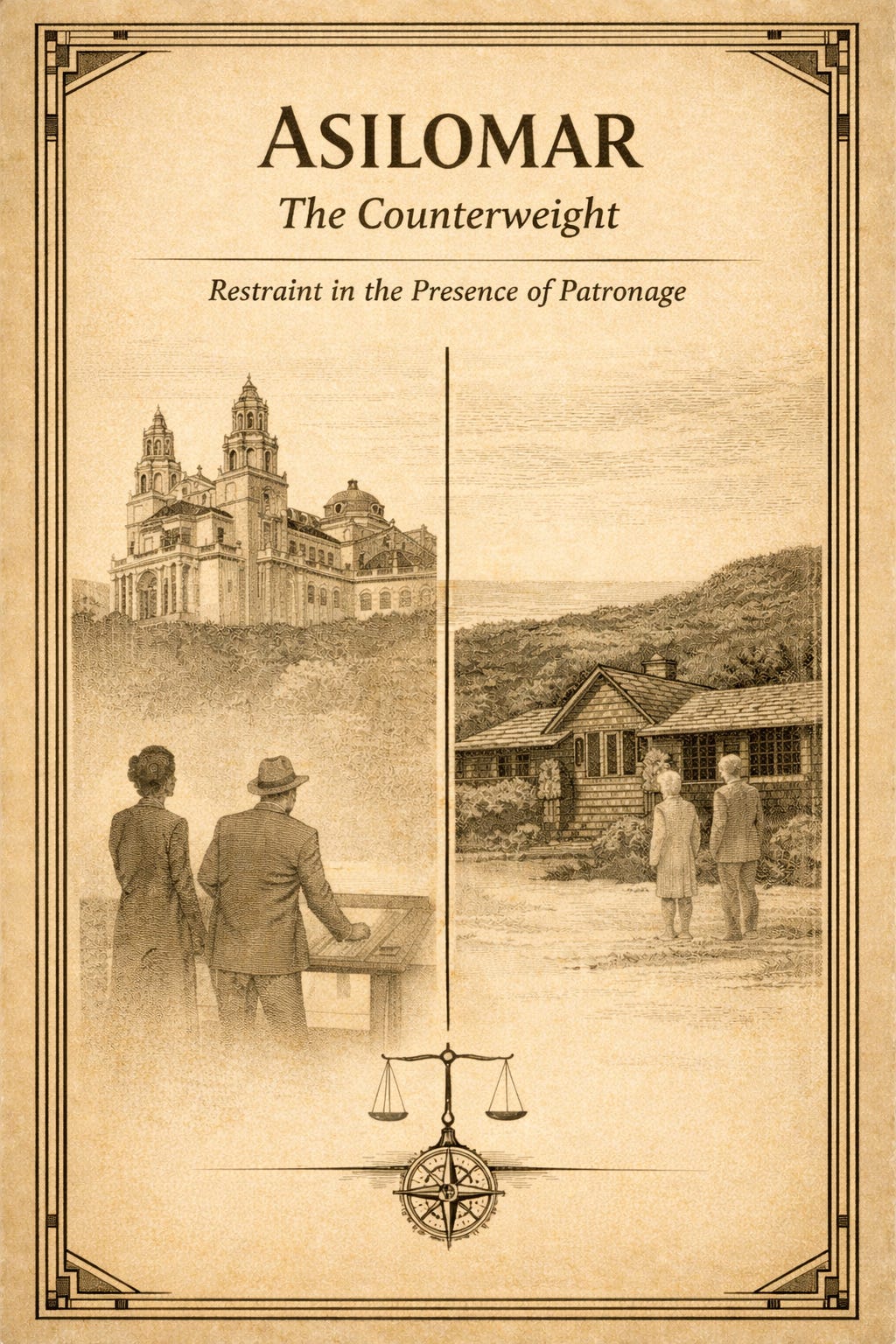
The project took shape under the influence of Phoebe Hearst, whose patronage supported much of Morgan’s work across California. Morgan would later design Hearst Castle, a commission so theatrical it has managed to distract generations from the fact that its architect also knew how to design restraint. Asilomar is the counterweight to that myth.
These buildings were not meant to dominate the coastline. They were meant to hold people. This is an increasingly rare ambition.
Morgan also designed several homes in Monterey, and as we move through Pacific Grove I find myself studying rooflines like a detective with a personal interest in the case. Once you learn her grammar, it’s difficult not to suspect her everywhere. The proportions. The calm. The refusal to shout.
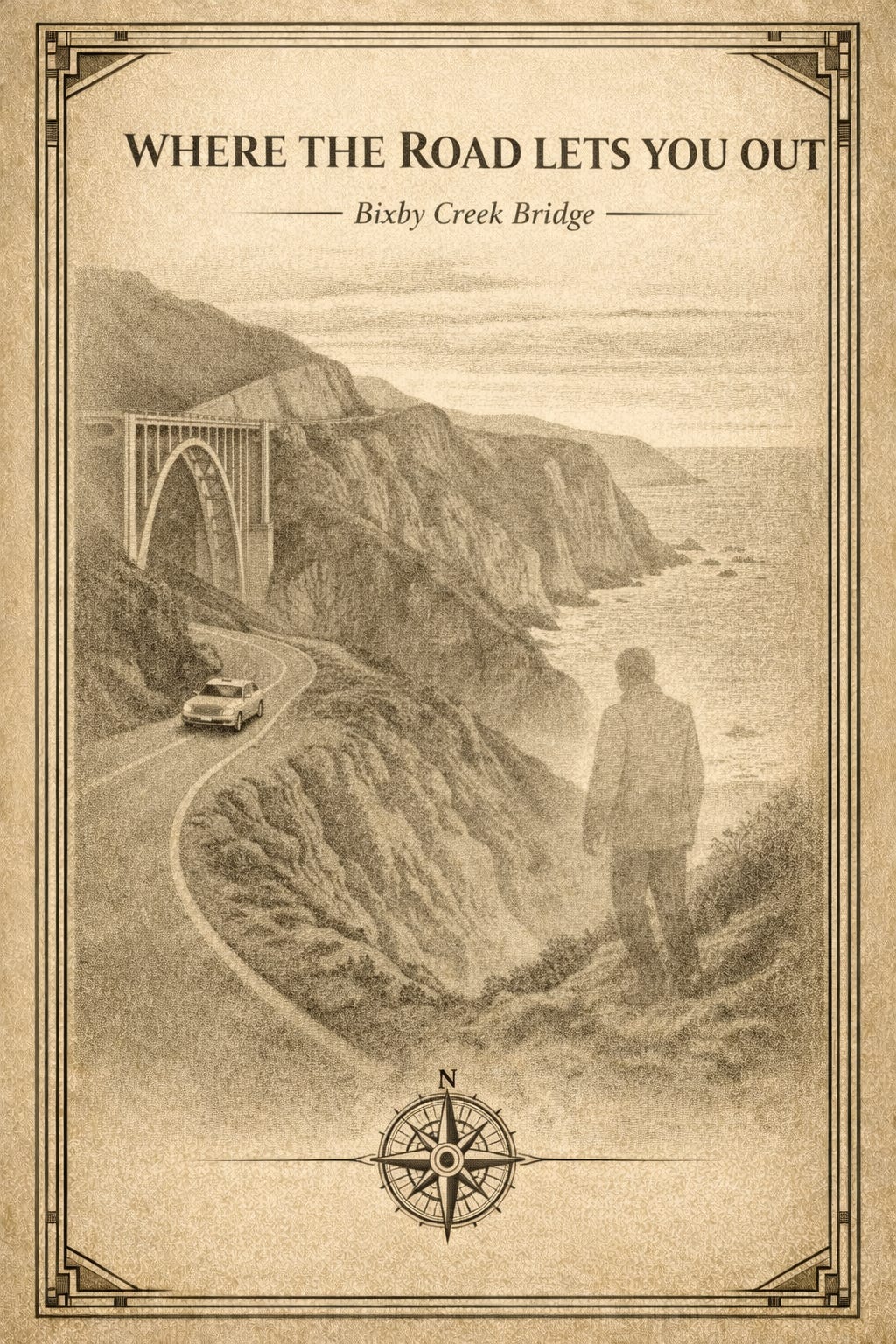
Meanwhile, the road continues south, and with it comes the ghost of Jack Kerouac.
Big Sur is where he wrote some of his most famous work, including Big Sur, the book that finally admitted the road does not cure what it exposes. I keep thinking about the story of him taking a taxi out here in the middle of the night, fleeing San Francisco, fleeing himself, hoping geography might succeed where reason had failed.
It rarely does.
We are not arriving by taxi in the dark. We are in a camper van called a Pleasure-Way, a name that feels like something Twain would have enjoyed for its quiet absurdity. We park near the beach. We make espresso. Civilization wobbles, but the coffee is excellent.
From where I’m sitting, I can see a building in the distance that may be one of Morgan’s. I can’t confirm it, but it has the look of competence, which is its own signature. It doesn’t ask to be admired. It simply persists.
As the road bends toward Big Sur, a third presence insists on joining the conversation.
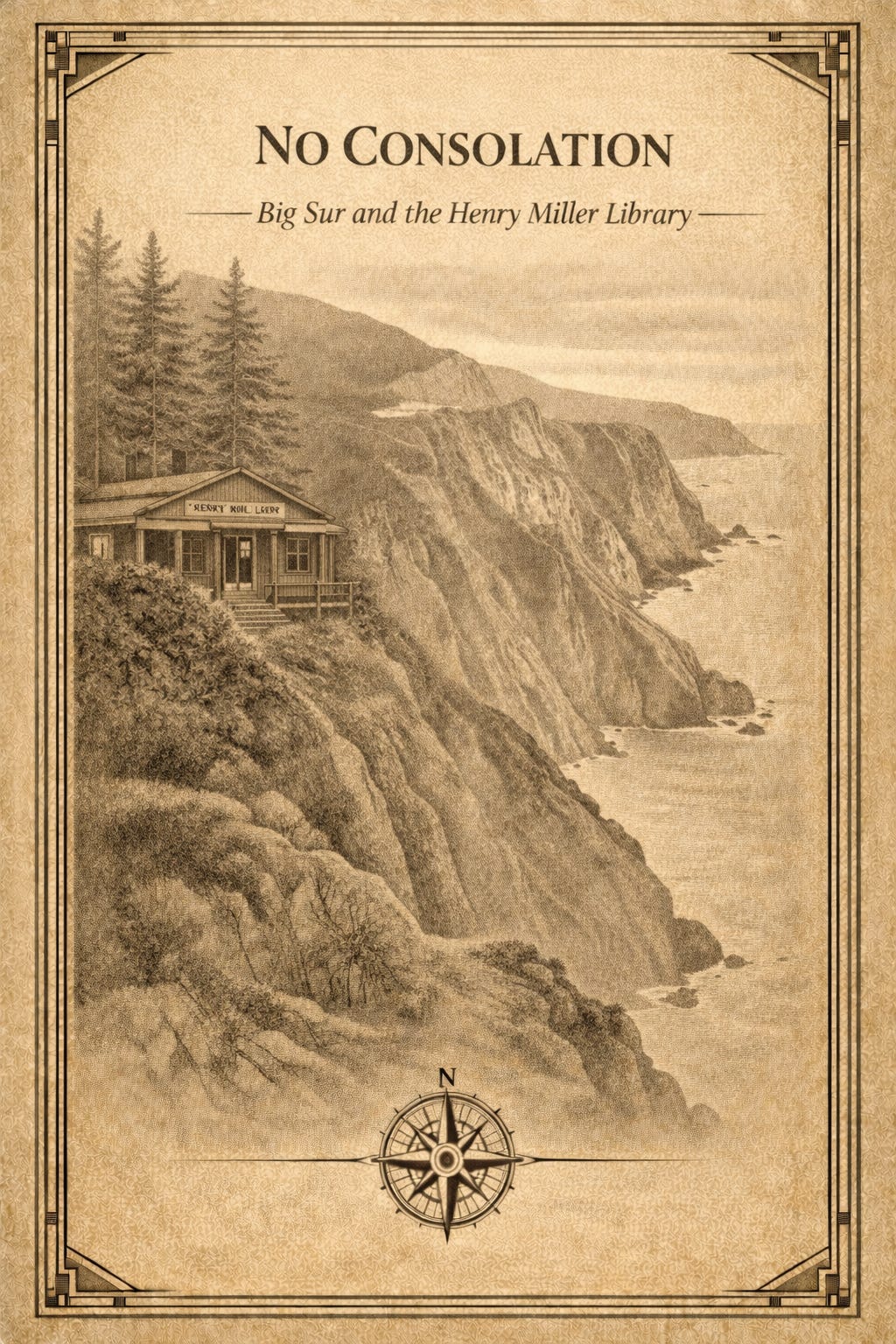
Henry Miller was up here too.
He didn’t come for the view. He came to strip himself down to the studs. Big Sur suited him because it refused consolation. The cliffs are too abrupt, the ocean too indifferent, the isolation too complete. It is not a place that pretends art will save you. It merely dares you to be honest.
Before architecture school, before professional language and structural logic took over my days, I was shaped by writers like Miller and Kerouac. They arrived first. They taught me that art was not polish but exposure. That rebellion was not noise but refusal. That beauty was not decoration but intensity.
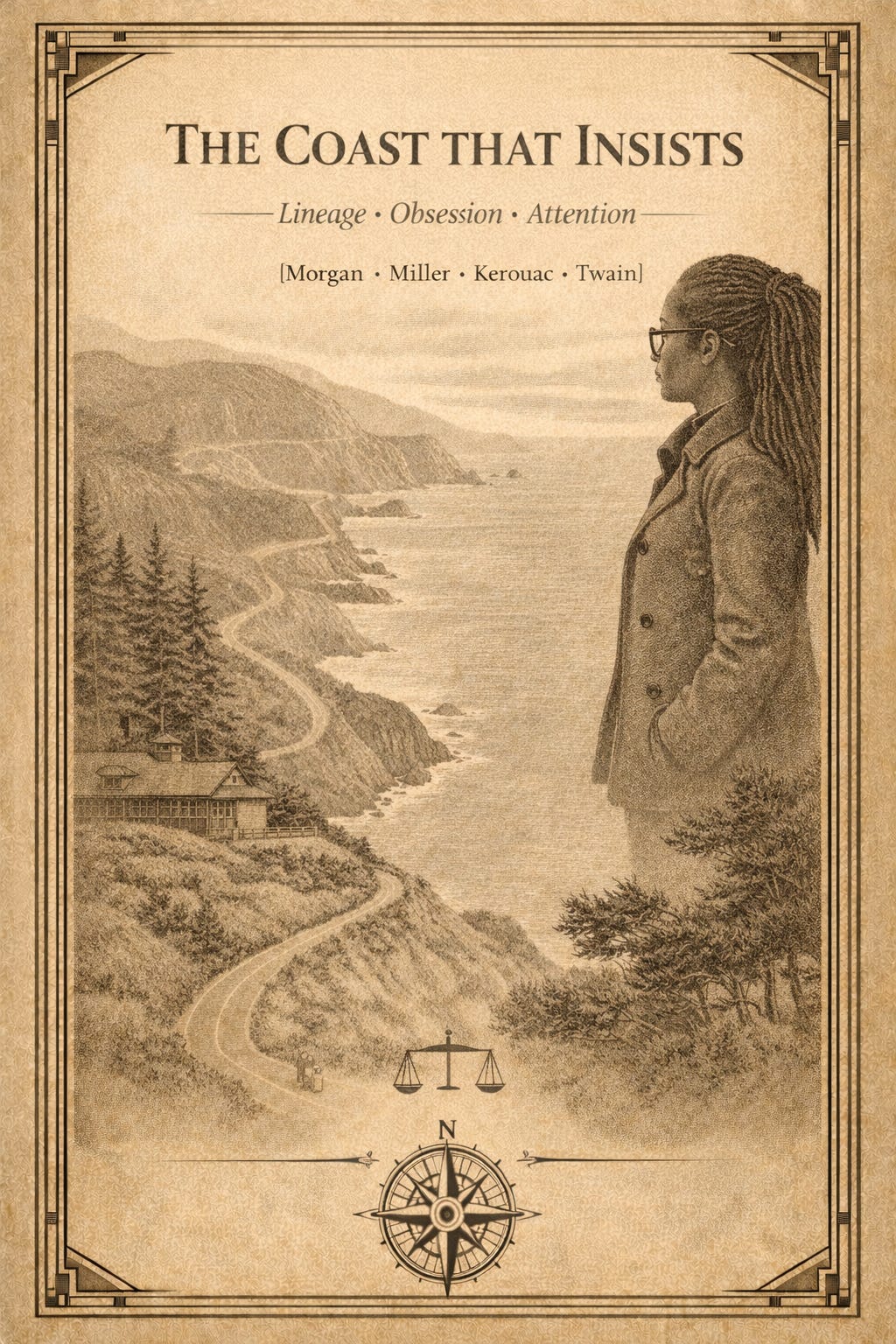
In a way, though, Julia Morgan brought me to them.
I traveled up and down Highway 1 because of her. To and from Hearst Castle. Through Monterey. Through Pacific Grove. Through Asilomar. Visiting everything in between. Only later did I realize I was tracing a second lineage alongside the architectural one. A literary geography. A coast populated by people who believed culture moves forward only when someone is willing to be unreasonable about it.
Morgan. Miller. Kerouac.
All Californians.
All by the sea.
All responding, in their own way, to the problem of how to live honestly at the edge of a continent.
I suppose I obsess about life, art, rebellion, and beauty because I still believe that obsession is the engine. That culture doesn’t advance by consensus or comfort. It advances because a few people insist on depth when the world is rushing toward convenience.
Which leaves me with the question this coastline keeps asking, without ever answering:
Where is that energy now?
Who is pushing culture forward?
And who is quietly pushing it into the toilet in the name of efficiency, monetization, and speed?
The Pacific, as always, declines to comment.
It simply keeps moving, unconcerned with our eras, our scenes, our theories. It waits for the next group of stubborn people to arrive and argue with it seriously.
And here I am, somewhere between permanence and motion, architecture and confession, drinking espresso by the sea, trying to remember that paying attention has always been a form of resistance.
.