

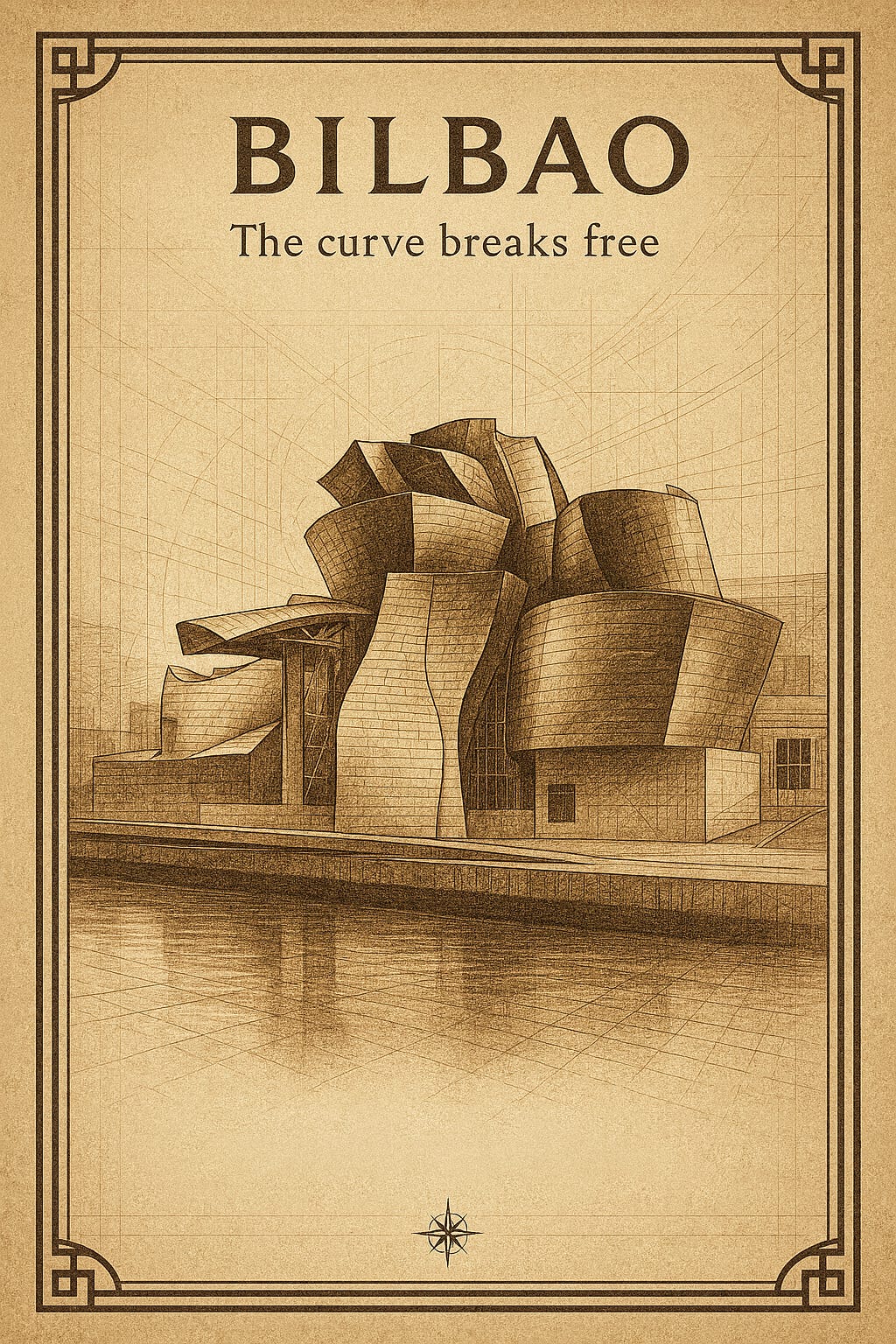
Before Gehry:
Buildings were straight.
Elevations were polite.
Engineers slept at night.
After Gehry:
Metal started behaving like fabric.
Curves became legal.
Architects learned to flirt with gravity.
Engineers filed for hazard pay.
🧠 Why Gehry Is the Godfather of Parametricism
It wasn’t Gehry’s style that changed the world.
It was his method.
To build impossible curves like the Bilbao Guggenheim, Gehry’s team hijacked aerospace software (CATIA) and forced it to speak architecture. They used it to map:
• splines
• surfaces
• curvature flows
• structural stress patterns
• material tolerances
This wasn’t “parametric design.”
This was the proto-algorithmic dawn, smuggled in years before Grasshopper crawled out of its digital egg.
Gehry revealed that computers could:
• calculate impossible forms
• fabricate custom panels
• optimize structures on the fly
• translate pure gesture directly into architecture
He cracked the egg, and out spilled:
Zaha
Patrik Schumacher
Blobitecture
Half of Beijing’s skyline
Gehry didn’t use parameters.
He designed so wildly that the world had to invent parametrics to keep up.
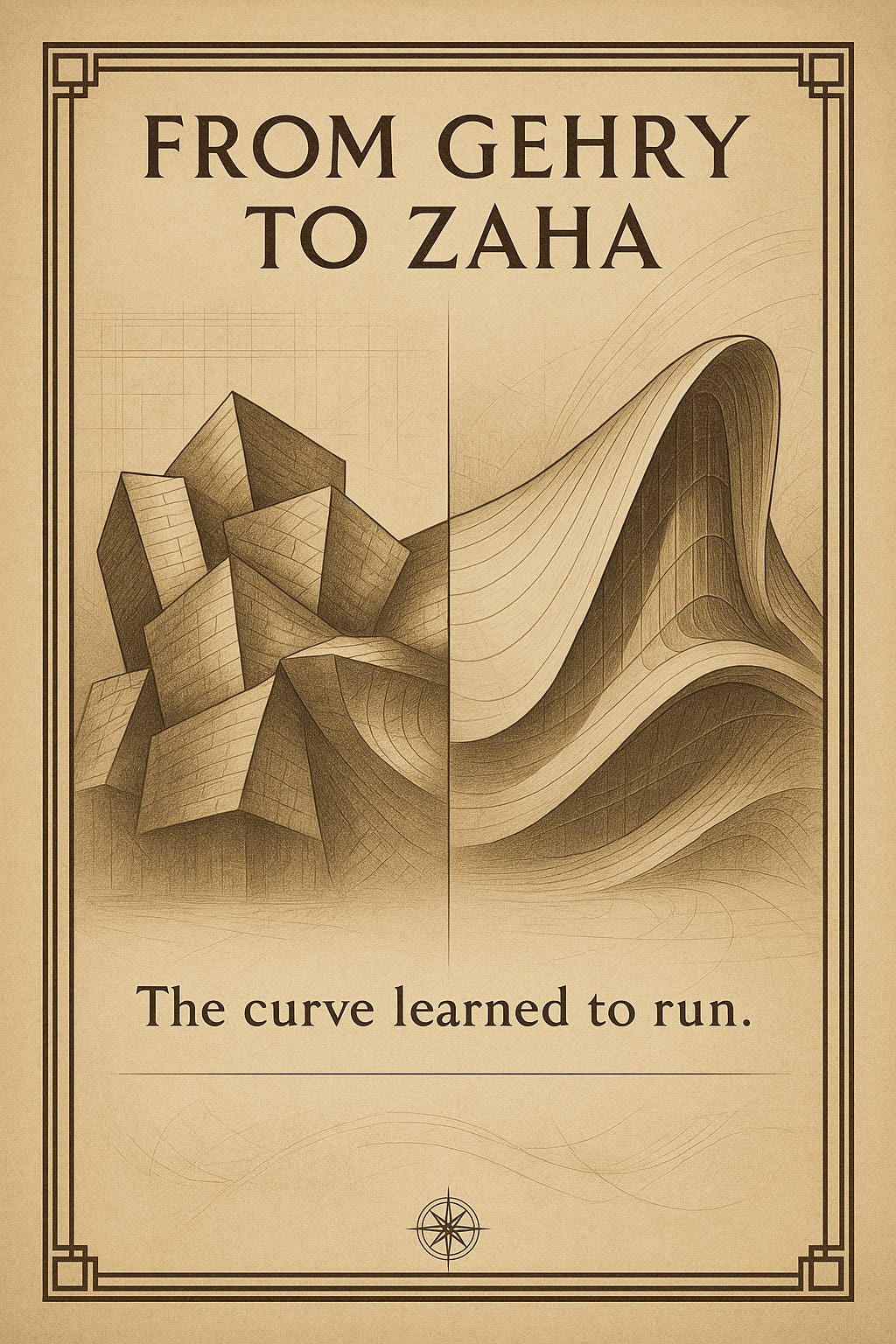
🌀 China looked at Gehry and said: “We’ll take… all of that.”
Because Gehry proved:
Curves sell tickets.
Icons generate tourism.
Architecture is branding.
A skyline is a press release.
China, in the 2000s, needed exactly that.
And they had the budget to turn metaphor into megaproject.
Suddenly every city wanted:
• swoops
• cantilevers
• alien geometry
• NURBS surfaces
• titanium dreams
Without Gehry, Beijing might still be boxes.
Very confident boxes, but boxes nonetheless.
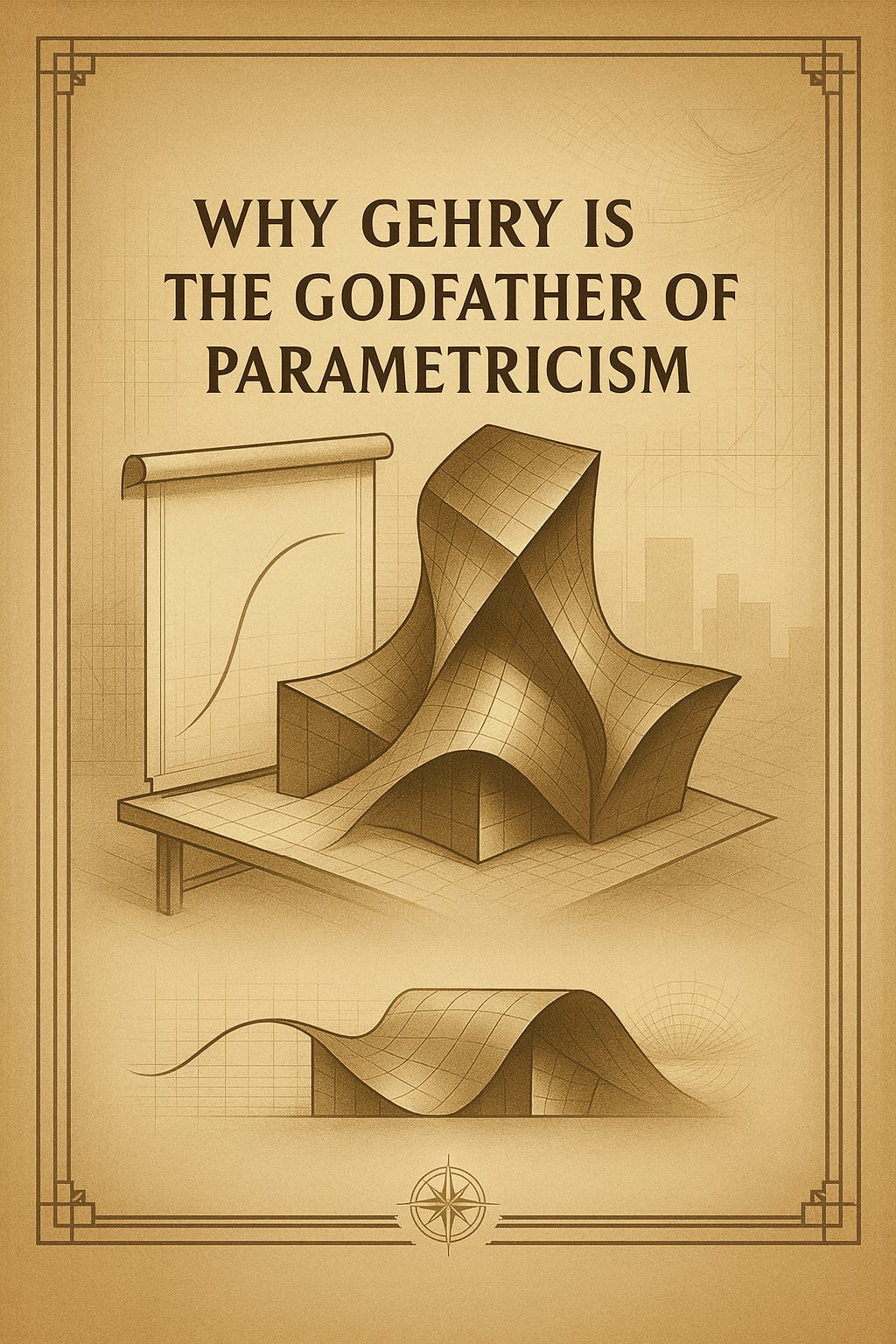
🧩 The Gehry → Zaha → China Pipeline
It goes like this:
Gehry makes buildings dance.
Engineers panic.
Software evolves.
Zaha and Schumacher sharpen their digital scythes.
Parametricism becomes a global religion.
China commissions 10,000 buildings that look like liquid steel.
All because one man asked:
“What if architecture could wrinkle?”
✨ But here’s the part they never tell you.
In Sketches of Frank Gehry, Gehry and Sydney Pollack confess a startling truth:
Both lived with a persistent fear of being found out —
that someone would eventually tap their shoulder and say:
“You don’t actually know what you’re doing.”
This wasn’t false modesty.
It was the psychological piston behind their creativity.
Gehry begins every project stripped of certainty, convinced that this might be the one that exposes him as an amateur. Pollack says he felt the same for every film.
That fear — that intimate, generative tremor — is what made them both dangerous.
Because when you believe you must earn your legitimacy again, every time, you innovate as if your life depends on it.
Gehry’s insecurity became a global software update.
Pollack captured the truth:
mastery isn’t confidence.
Mastery is risk, repeated.
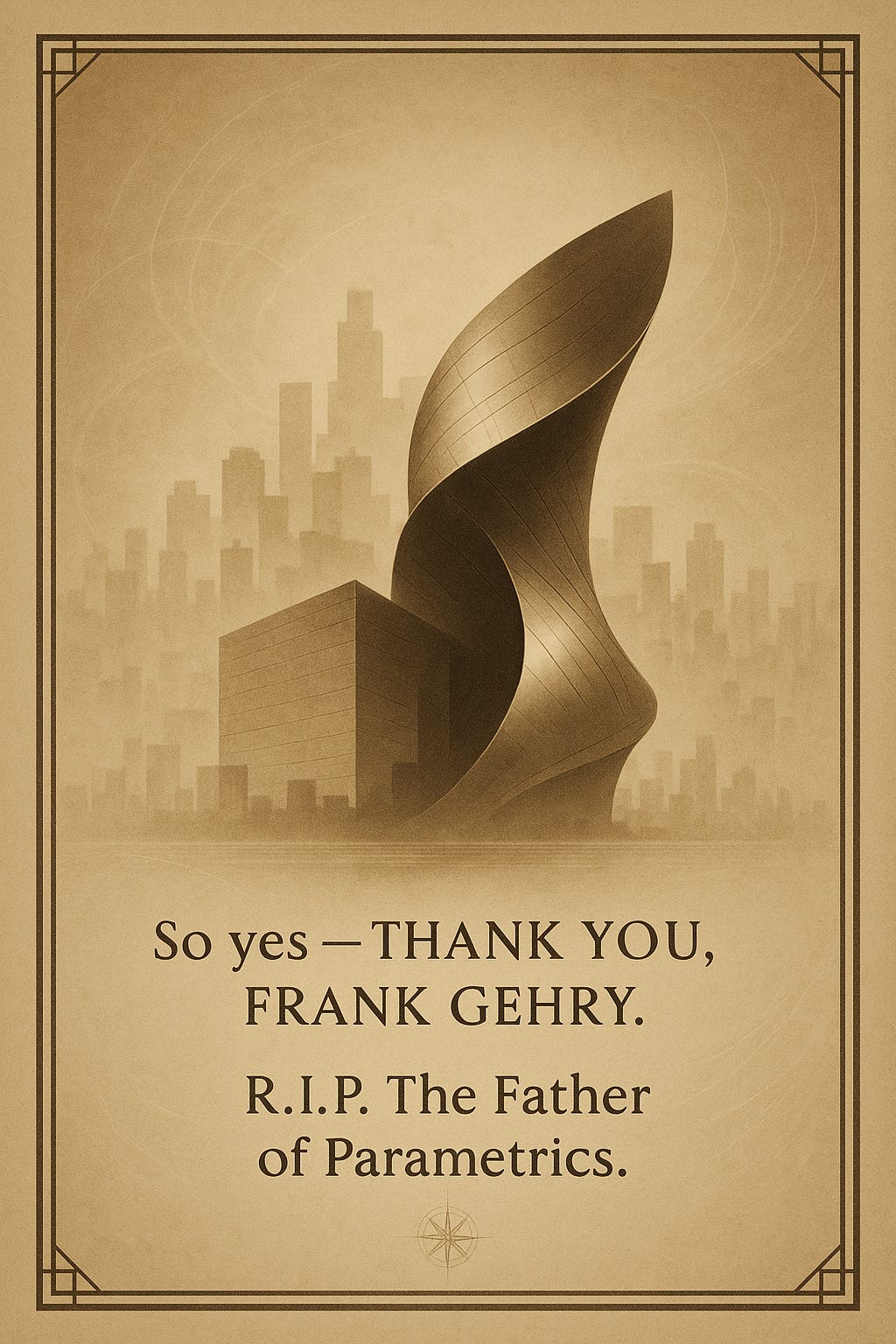
🌟 So yes — thank you, Frank O. Gehry.
R.I.P. The Father of Parametrics.
You didn’t just inspire a new aesthetic.
You altered the physics of the profession.
You made architecture wilder, stranger, riskier.
You forced technology to evolve just to keep up.
And China, ever opportunistic, seized your revolution
and built an entire skyline out of it.
A butterfly flaps its wing in Santa Monica.
A hurricane forms over Shenzhen.
And suddenly the planet’s cities bend toward the improbable.