

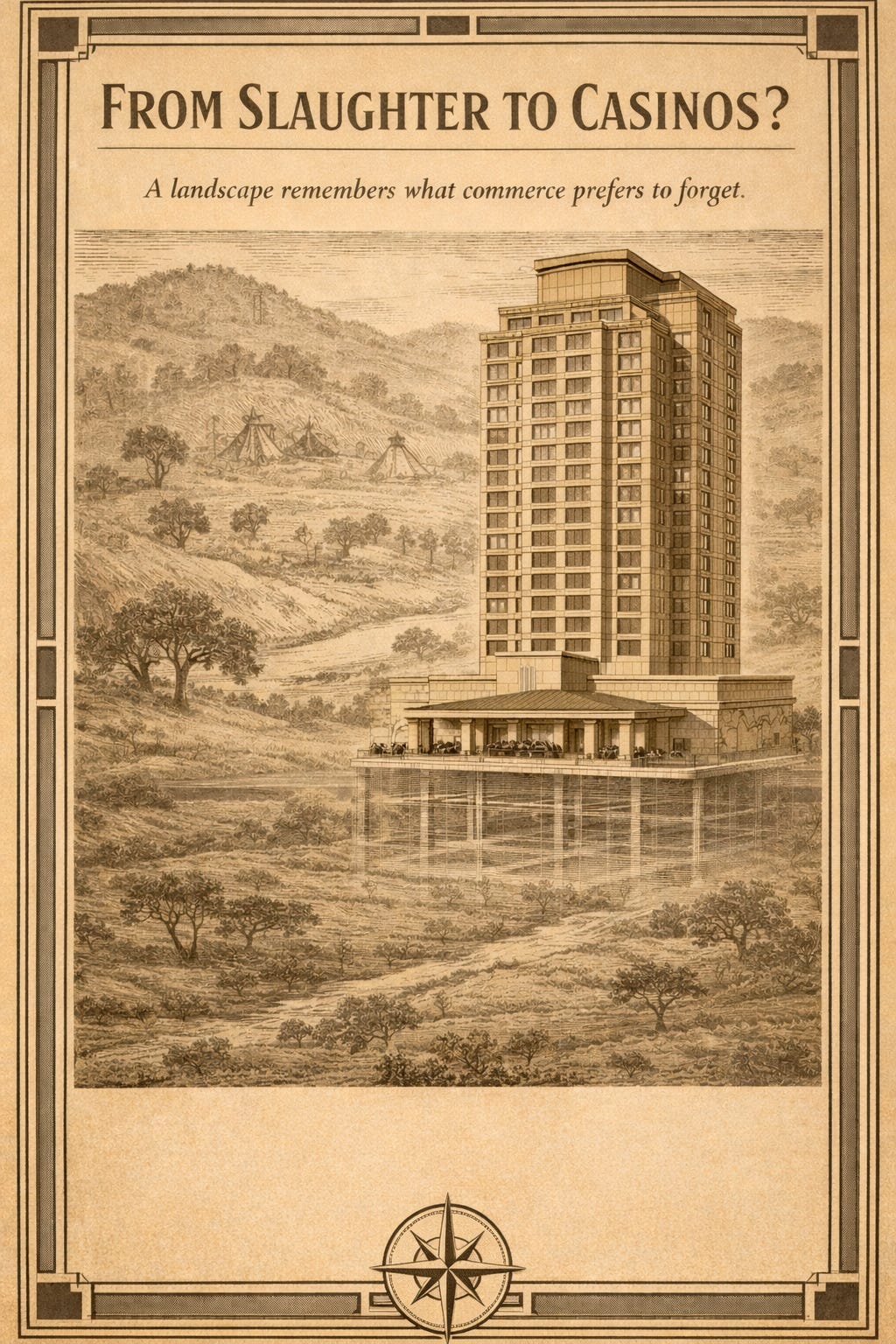
I recently visited Chicken Ranch Casino in Jamestown.
It’s a beautiful place. Slick. Polished. Fancy cocktails. Clean lighting. The kind of interior that makes you forget what the hills outside used to look like before highways and parking structures smoothed everything into accessibility.
Chicken Ranch is owned by the Chicken Ranch Rancheria of Me-Wuk Indians of California. Jackson Rancheria, just up the road, is owned by the Jackson Band of Miwuk Indians. These are federally recognized tribal governments, operating on land held in trust.
Every time I go into one of these casinos in Gold Country, I find myself asking the same question:
Where are the Native Americans?
Not symbolically. Physically.
I see everyone else. Retirees. Tour buses. Weekend groups. Families. The gaming floor is busy, the parking lot full. Many of the dealers are friendly, efficient, professional. The workforce looks like California’s broader service economy.
But the people whose names are on the buildings.
Whose symbols are on the walls and carpets.
Whose ancestors lived on this land before gold turned the Sierra into a global extraction zone.
I don’t often see them in ways I can easily recognize.
I’ve had the same thought at Jackson Rancheria. At Black Oak. At Red Hawk. Different buildings. Same question hovering quietly over the slot machines.
Maybe they’re there and I simply don’t know who I’m looking at.
Maybe sovereignty doesn’t require visibility to outsiders.
Maybe I’m standing inside an economy that belongs to them, whether or not I can see that ownership on the floor.
Still, the contrast stays with me.
And with all this money made by the casinos, I remember once driving past a reservation not far from one of them. It was strikingly poor. Housing in rough condition. Infrastructure thin. A visible kind of hardship sitting almost in the shadow of a large, profitable gaming complex.
It made me wonder:
Why are these people suffering?
Why is any Native American community suffering when tribes are supposed to have sovereignty under U.S. treaties?
If the land is theirs.
If the casino is theirs.
If this is the long arc from dispossession to self-determination.
Then why does the prosperity feel so uneven?
I started wondering how certain tribes ended up owning land and casinos while others did not. The answer, it turns out, has less to do with luck than with paperwork and survival in two different worlds. Some Native communities managed to retain or later regain federal recognition and small parcels of land held in trust. Others were stripped of recognition during the mid-20th-century termination era or were never formally recognized at all, even though their people survived. Without federal recognition and trust land, a tribe cannot operate a casino under U.S. law. Survival on the ground didn’t always translate into survival on paper. And in this country, paper determines power.
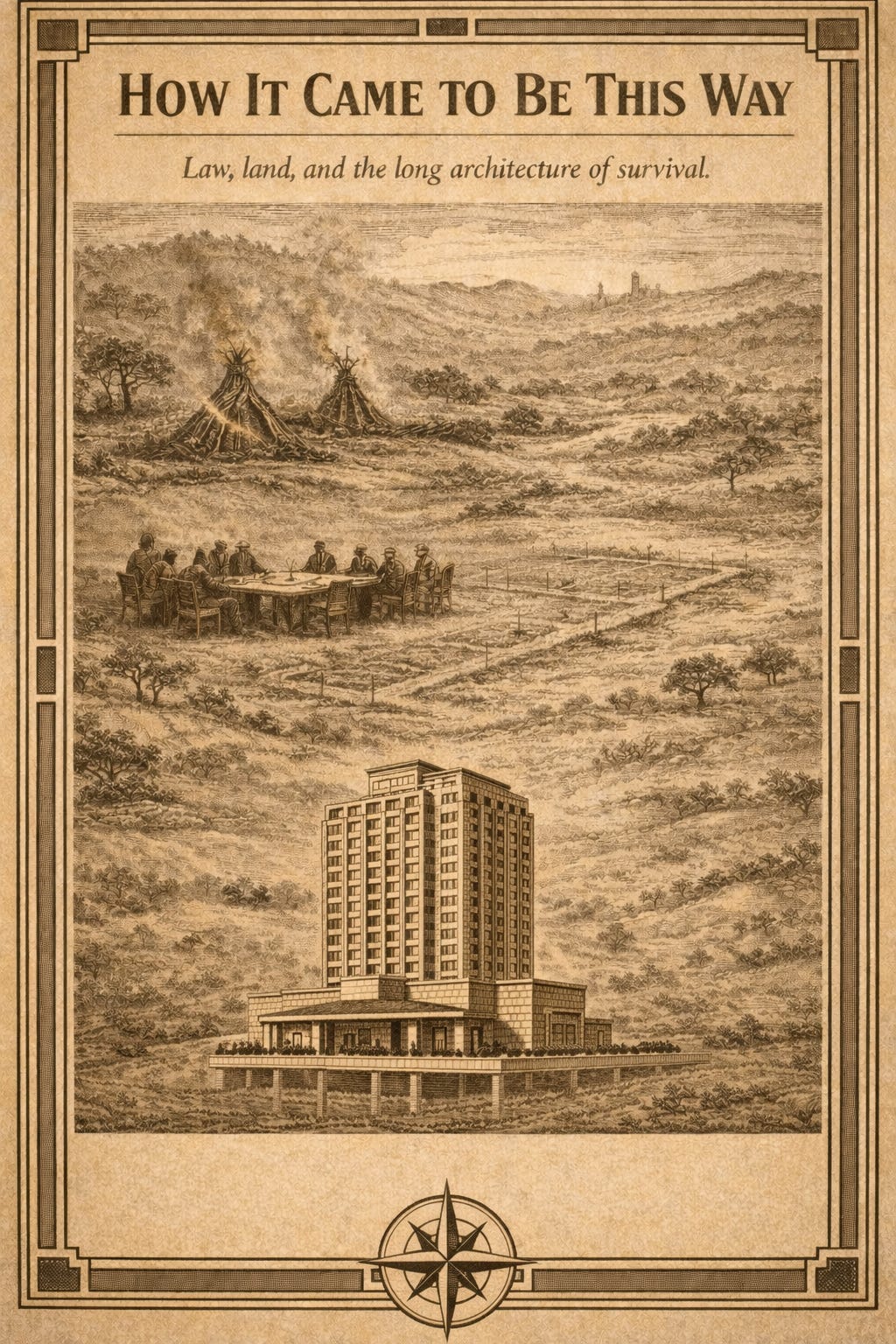
How It Came to Be This Way
After the Gold Rush, Native communities in California were devastated. Violence. Disease. Forced labor. Entire villages erased. By the late 19th century, the population had plummeted.
What remained were small reservations, often on marginal land, with limited economic opportunity.
For most of the 20th century, tribes were restricted in how they could govern or profit from their own land. Federal policy swung between forced assimilation and neglect.
Then, in 1988, Congress passed a law allowing federally recognized tribes to operate gaming facilities on tribal land under certain conditions. The idea was rooted in tribal sovereignty: tribes are recognized as self-governing nations, and gaming became one of the few reliable economic tools available to them within U.S. law.
In California, that framework expanded after voter initiatives in the late 1990s and early 2000s.
The result: tribal casinos.
Not state-owned.
Not privately owned in the usual sense.
Owned by tribes as sovereign entities.
But the reality is layered.
Many tribes partner with outside management companies.
Some take on enormous development loans.
Some share revenue directly with tribal members.
Some reinvest most of it into infrastructure, housing, healthcare, and education.
Some tribes have small memberships and very profitable casinos.
Others have larger populations and thinner margins.
Not every tribe has a casino.
Not every casino makes equal revenue.
And not every Native person belongs to a tribe that operates one.
So when I see poverty near a casino, it doesn’t automatically mean the revenue isn’t flowing. It may mean the revenue is stretched across generations of loss. Across housing shortages. Across healthcare needs. Across rebuilding what was systematically dismantled.
Sovereignty is real.
But sovereignty inside a federal framework is also constrained.
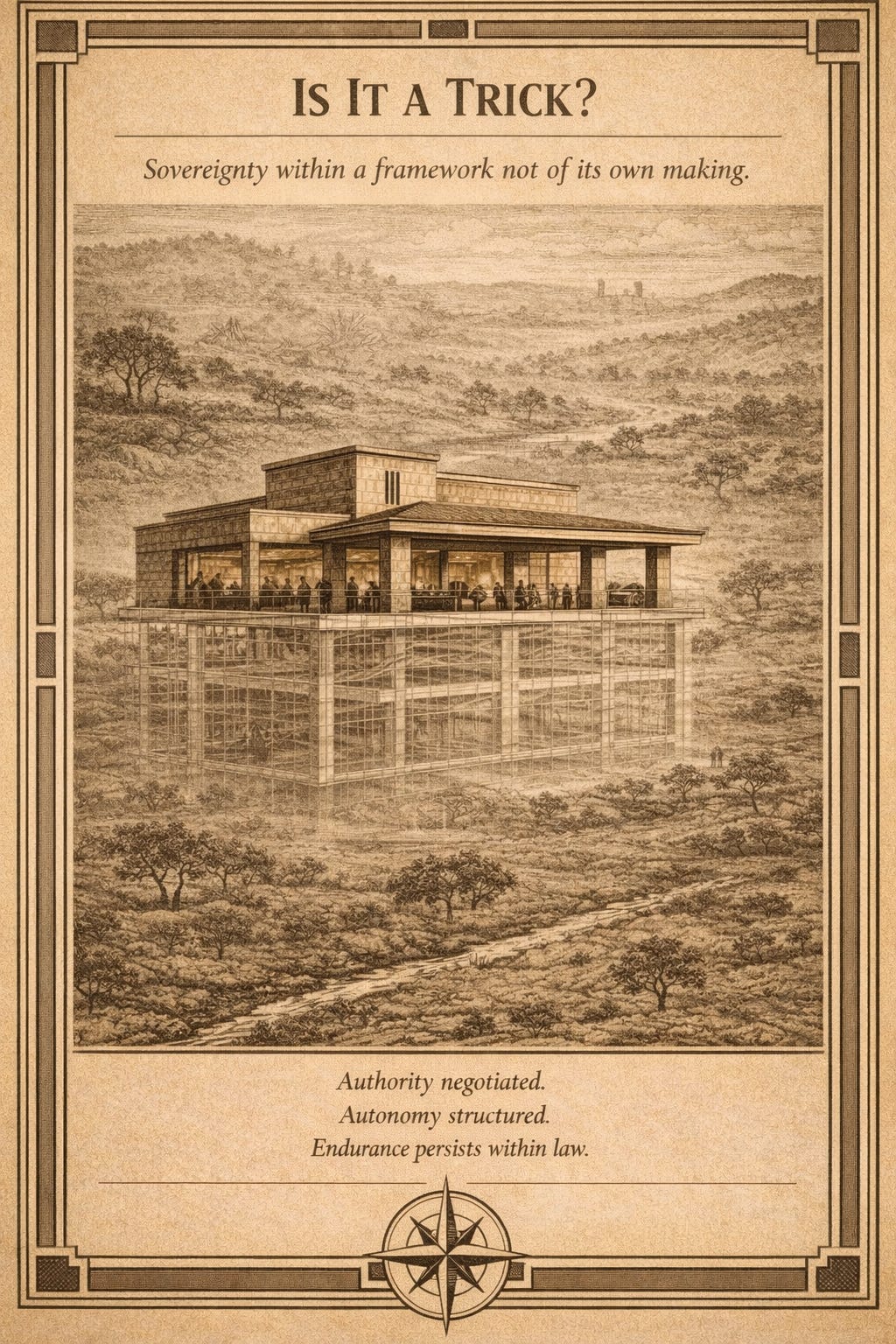
Is It a Trick?
Sometimes I wonder.
Is gaming simply another system where Native nations operate inside rules set by the same government that once sanctioned their destruction?
Casinos exist because federal law allows them.
They operate under compacts with the state.
They are heavily regulated.
This isn’t a return to pre-1848 autonomy.
It’s sovereignty negotiated inside the architecture of the United States.
So is it a trick?
Or is it one of the few tools available inside a system that was never designed to restore what was taken?
When I sit at a blackjack table in Jackson or Jamestown or Placerville, watching cards flip under bright lights, I’m aware that the wealth moving across the felt is different from the wealth that moved through these hills in 1849.
Back then, gold left.
Now, at least some of the revenue stays.
It may not erase poverty.
It may not fix 170 years of structural damage.
It may not look like restitution in the way we imagine restitution.
But it is not nothing.
And maybe the real discomfort I feel walking through these casinos isn’t that Native people aren’t visible to me.
Maybe it’s that I’m witnessing a complicated form of survival.
The Gold Rush created enormous wealth for people who arrived from somewhere else.
These casinos may be one of the few structures in Gold Country where some of that wealth has begun, however imperfectly, to circle back.
It doesn’t undo anything.
But it does make the present more complicated than the tourist brochures suggest.
And sometimes that complexity shows up as a beautiful casino on one side of the road and a struggling reservation on the other, both occupying the same history.