

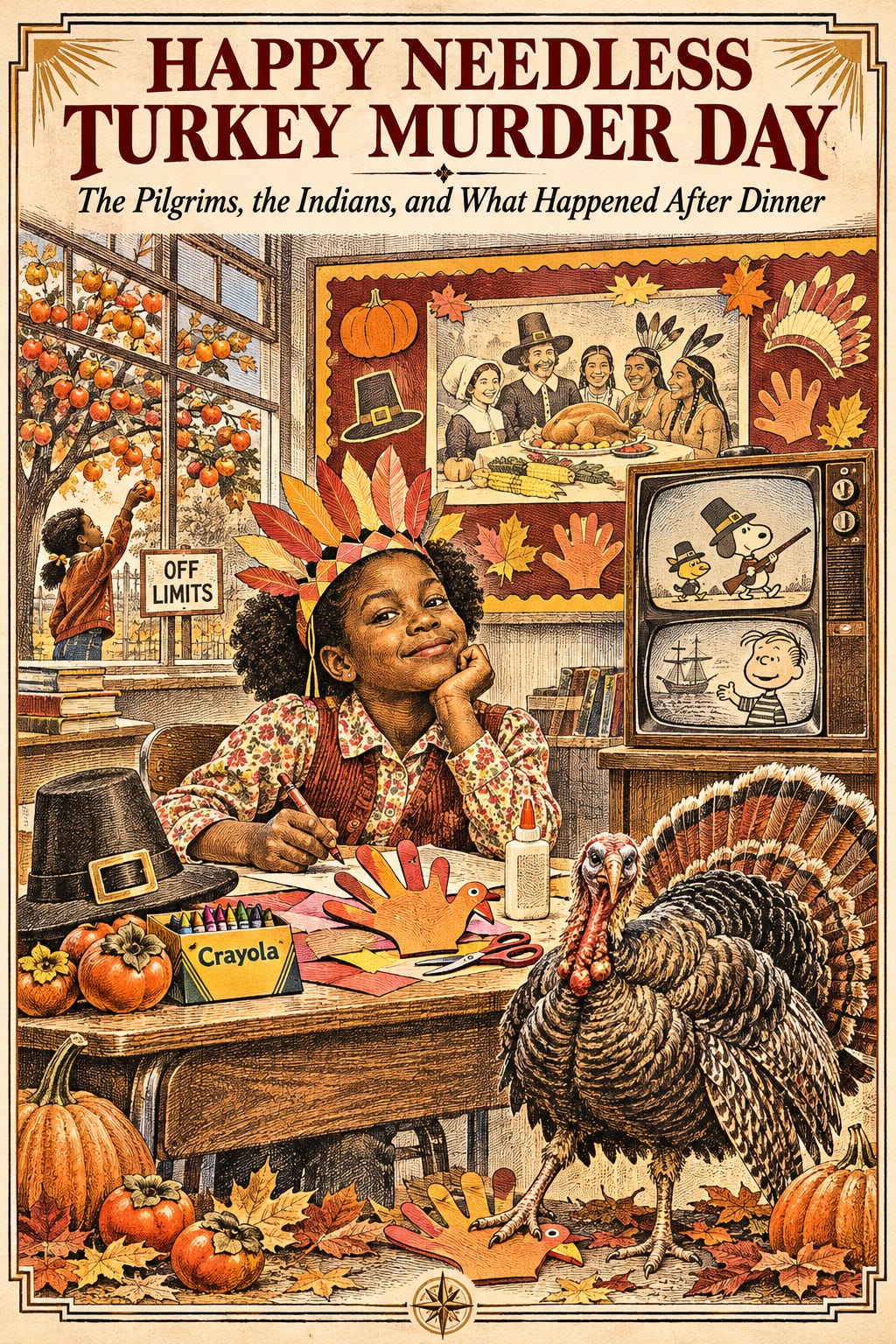
When I was a kid, I thoroughly enjoyed making those little turkeys by tracing my hand on construction paper and coloring leaves in all those glorious autumn hues. The persimmons were in season, and although that particular part of the playground was off-limits, little rebellious Kimmie would, of course, venture down there anyway.
Apparently, my difficulties with established authority began with a persimmon tree.
There were Pilgrim hats, Indian headdresses, pumpkins, and illustrations of happy little people gathered around a table, enjoying the bounty of a newly “discovered” America.
Naturally, I preferred the Indian headdresses. Even at that tender age, I found the Pilgrims’ attire rather uninspiring. The Indians, at least, had a splendid sense of color.
Everybody seemed terribly pleased about the whole affair.
My favorite cartoon of the season was, of course, A Charlie Brown Thanksgiving, which first aired in 1973.
I remember finding it absolutely hilarious watching Snoopy rummage through an old trunk, dress himself and a decidedly reluctant little Woodstock in ridiculous Pilgrim costumes, and march off toward Charlie Brown’s house with a toy musket.
Woodstock, who apparently had little enthusiasm for participating in the colonization of North America, subsequently managed to discharge the musket.
There was something particularly amusing about a beagle and a little yellow bird participating in the founding mythology of the United States of America.
Meanwhile, Linus, the resident intellectual of the Peanuts gang, furnished us with the requisite historical account of the first Thanksgiving.
Between the public school system and Charles M. Schulz, my Thanksgiving education was fairly comprehensive.
Or so I thought.
I loved all that stuff.
And yet, somewhere deep in my little Black girl gut, I suspected there was something not quite right about this whole Thanksgiving business.
One question kept nagging at me:
What about the Indians?
As I got older and became a little more aware of things, say, around the fourth grade, I started thinking more seriously about the Indians. This was about the time we started learning about slavery, and in my little mind, I was thinking:
“What the heck happened to the Indians, really?”
These new Americans were beginning to look a bit sketchy.
History, as it was presented to us, was remarkably collapsed. Between Columbus’s arrival in 1492 and the Declaration of Independence in 1776 lay nearly three centuries of human activity. Yet somehow, we managed to get through the better part of it with a few illustrations, three ships, some Pilgrims, a turkey, and a rather impressive collection of white gentlemen in powdered wigs.
That is a considerable amount of history to accommodate between recess and arithmetic.
Surely, something else had happened.
As a little girl descended from formerly enslaved people, I began to have serious doubts about all this happy Indian and Pilgrim business. I rather suspected that somebody had been up to no good.
These Europeans always seemed to be up to something.
The Indians Were You
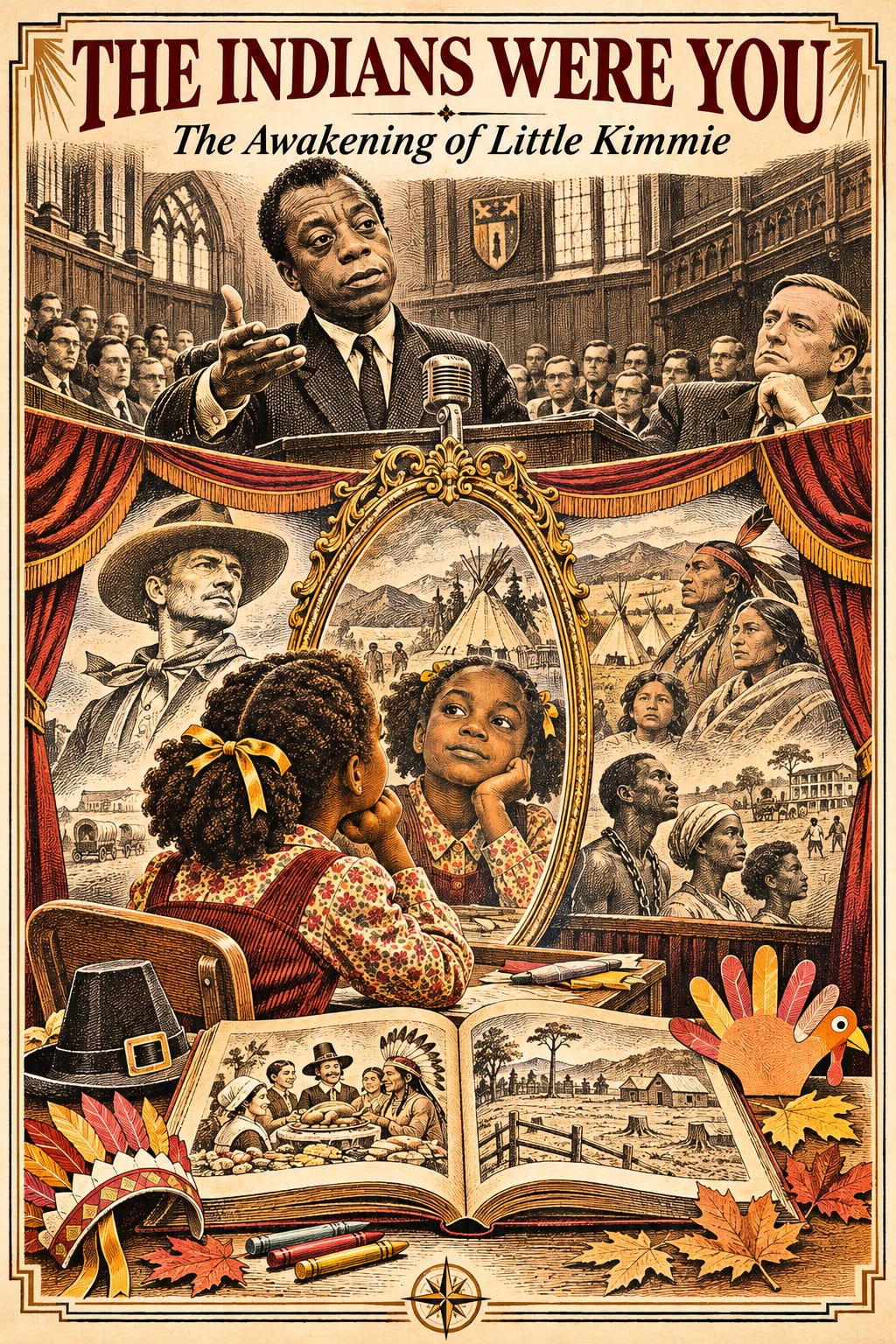
One of my favorite James Baldwin moments was during his celebrated debate with William F. Buckley Jr. at the Cambridge Union on February 18, 1965.
The proposition under debate was: Has the American Dream Been Achieved at the Expense of the American Negro?
Baldwin spoke of the peculiar awakening of a Black child in America.
“It comes as a great shock to discover that Gary Cooper killing off the Indians, when you were rooting for Gary Cooper, that the Indians were you.”
Well, that’s precisely how I felt.
There I was, happily making my little construction-paper turkeys, laughing at Snoopy in his Pilgrim hat, and cheering for the protagonists of a historical narrative without fully understanding what had become of the other people in the story.
I was being taught to celebrate the arrival of the Europeans without being told what their arrival ultimately meant for the people who were already here.
And somewhere between learning about the Pilgrims and learning about slavery, it occurred to me that my sympathies might have been rather badly misplaced.
It wasn’t that my ancestors and the Indigenous peoples of America had experienced precisely the same history. They hadn’t. But I was beginning to recognize a disturbing similarity in the way their histories were being told, abbreviated, or omitted altogether.
I was beginning to wonder who had written the history book.
More importantly, I was beginning to wonder who had been left out of it.
The peculiar thing about American history, as I was discovering, was that everybody seemed to have been discovered except the people doing the discovering. They apparently knew exactly who they were.
I suppose my rather insatiable need to know what actually happened started way back then.
So, in the interest of historical curiosity, I decided to investigate the turkey.
Before There Were Pilgrims
The first thing we ought to establish is that the Europeans did not introduce gratitude to the American continent.
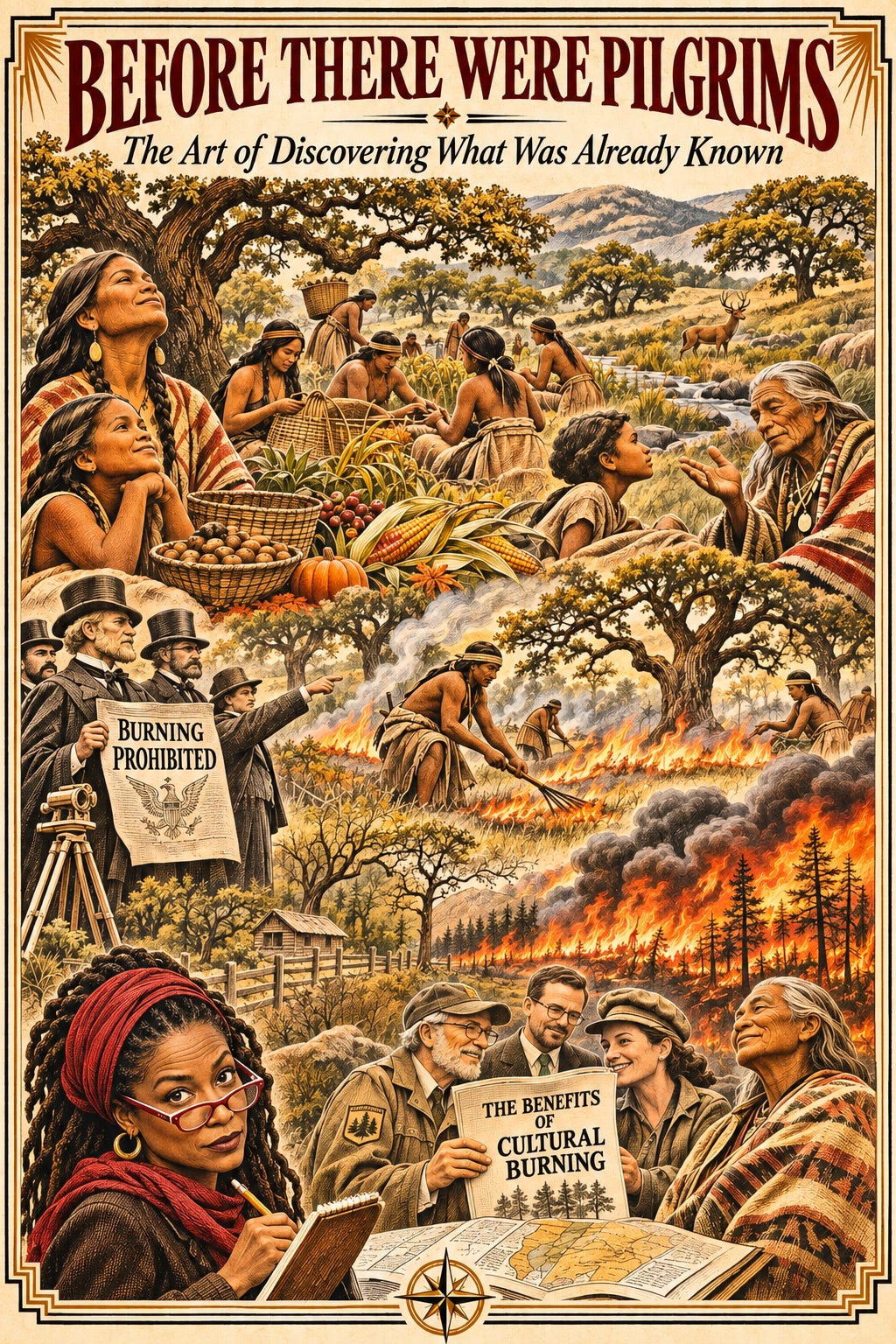
Indigenous peoples had been practicing ceremonies of thanksgiving for generations upon generations before a European ever set foot upon these shores. They celebrated successful harvests, seasonal changes, the abundance of the earth, and the relationships that sustained their communities.
They also understood a thing or two about managing the land. For centuries, Indigenous peoples practiced cultural burning, deliberately setting carefully managed fires to maintain healthy ecosystems and reduce the risk of catastrophic wildfires.
Naturally, European settlers and subsequent American authorities decided they knew better and eventually suppressed many of these practices.
Centuries later, having watched considerable portions of the landscape go up in flames, we began to “discover” the wisdom of the very practices we had prohibited.
It seems we have a peculiar national talent for discovering things that other people already knew.
Imagine that. People were perfectly capable of being grateful and managing their environment without European instruction.
In 1619, English settlers arriving at Berkeley Hundred in Virginia were instructed to commemorate their arrival annually as a day of thanksgiving.
Incidentally, that was also the year the first documented captive Africans arrived in English Virginia, having been forcibly transported across the Atlantic.
Same year. Same colony. Two decidedly different arrivals.
One wonders how the Africans felt about the proposed festivities.
The Pilgrims, it would appear, were somewhat late to the Thanksgiving business, although they would eventually receive nearly all the publicity.
A Most Conveniently Vacant Village
In 1620, the Mayflower arrived carrying 102 passengers.
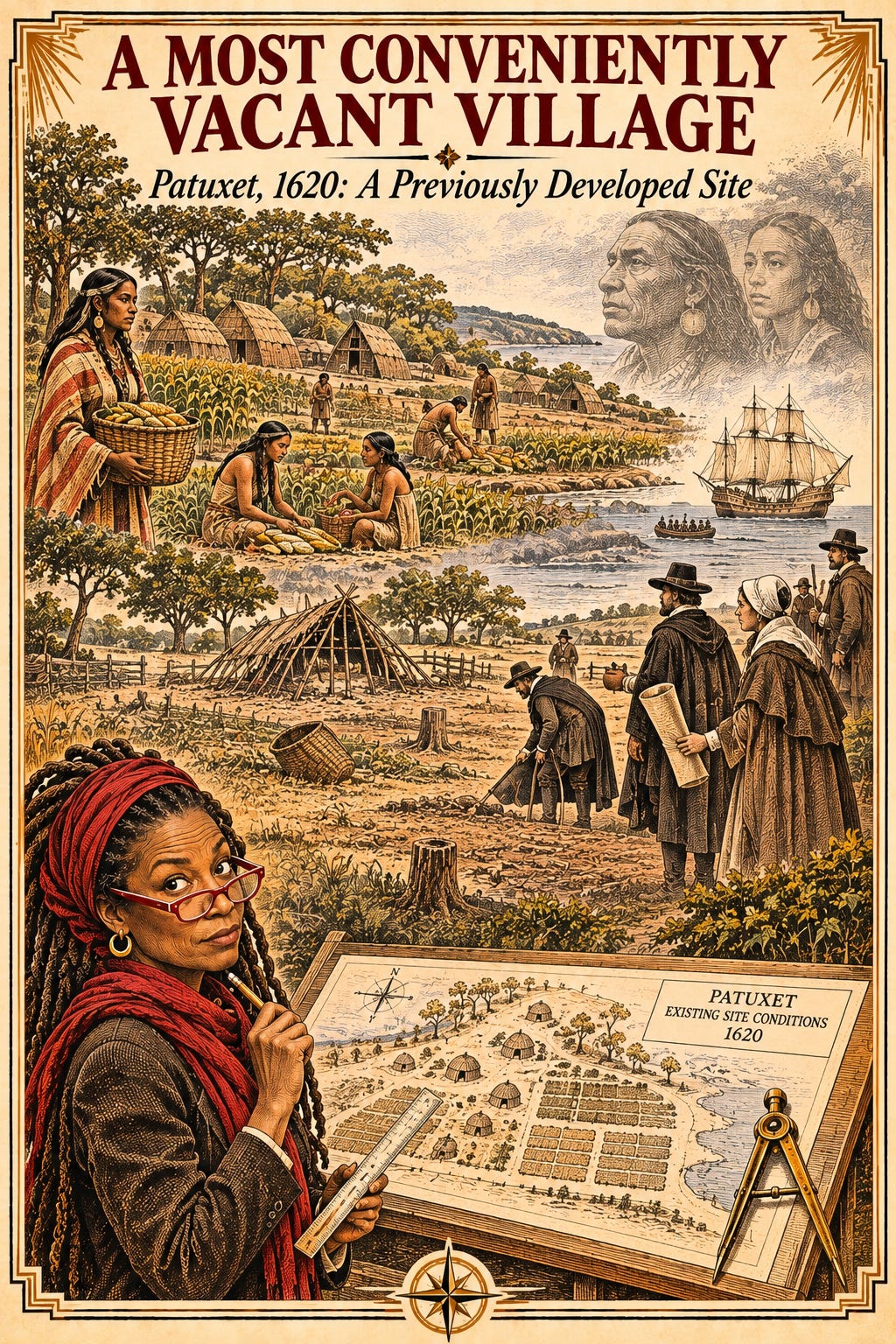
The English settlers eventually established Plymouth Colony on the site of an Indigenous village called Patuxet.
Why was the village available?
Well, there’s a rather important bit of information that rarely made it onto our construction-paper Thanksgiving decorations.
Between 1616 and 1619, an epidemic had devastated Indigenous communities along the New England coast. The precise disease remains a matter of historical debate, but its consequences were catastrophic.
Patuxet had been virtually depopulated.
The Pilgrims arrived to find land that had already been cleared and cultivated by people who were no longer there to occupy it.
As an architectural designer, I find this little detail particularly interesting. The celebrated wilderness into which these intrepid Europeans ventured contained the remnants of an established human settlement, complete with agricultural infrastructure.
The site, as we say in the profession, had already been developed.
It was not uninhabited because nobody had ever lived there. It was uninhabited because something terrible had happened to the people who did.
Even with this considerable advantage, nearly half the Mayflower passengers died during their first winter.
The survivors would receive assistance from the very people whose homeland they had entered.
It seems the New World was considerably less new to the people who knew how to live in it.
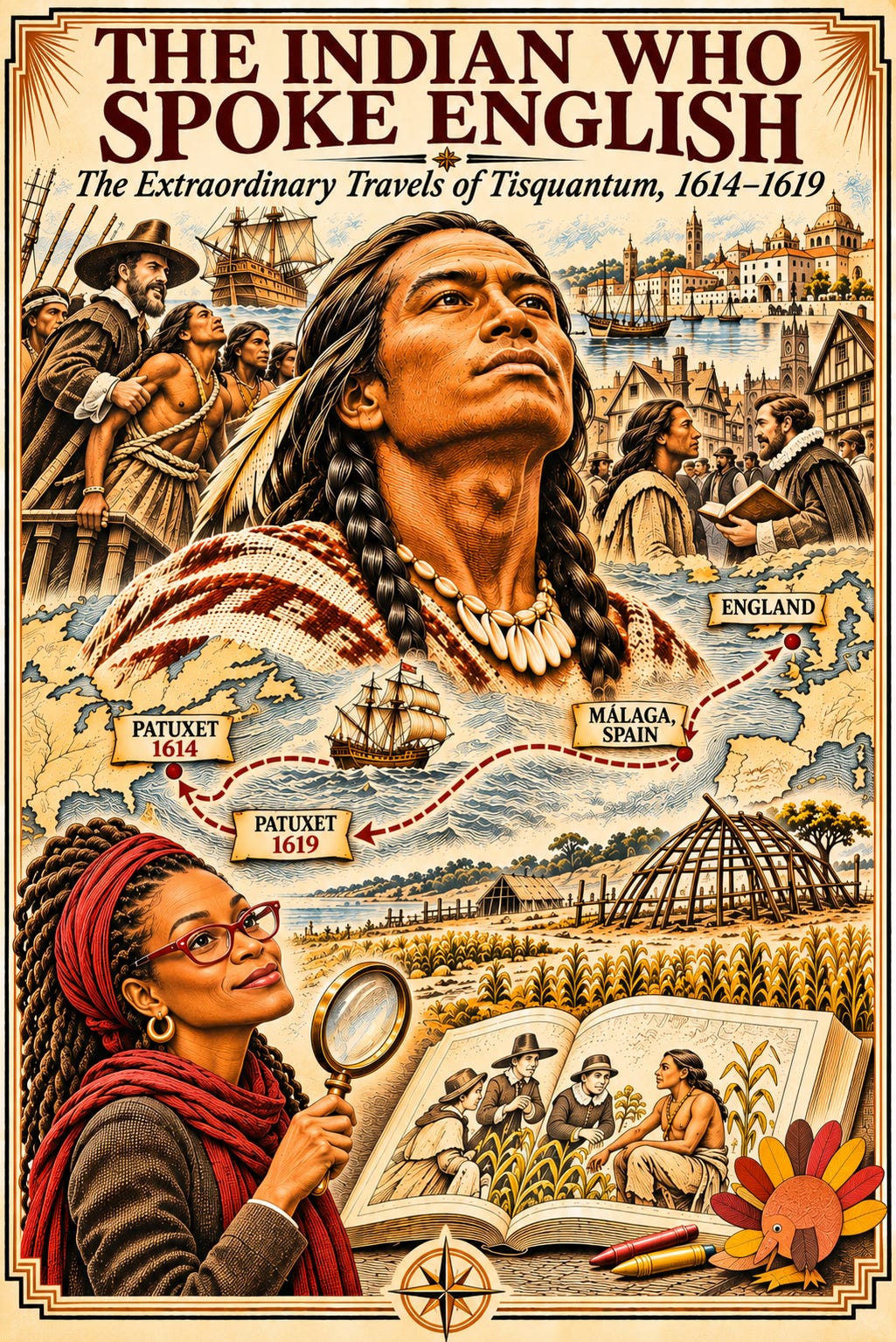
The Indian Who Spoke English
One of the more extraordinary characters in this story was a man named Tisquantum, better known to American schoolchildren as Squanto.
I remember learning that Squanto helped the Pilgrims plant corn.
What I don’t remember learning was why Squanto spoke English.
This was a rather remarkable linguistic accomplishment for a gentleman supposedly encountering the English for the first time.
In 1614, an English captain named Thomas Hunt kidnapped Tisquantum and other Indigenous men and transported them to Spain, intending to sell them into slavery.
Tisquantum eventually made his way to England and, in 1619, returned to his homeland.
There, he discovered that his community had been devastated by disease.
Imagine surviving kidnapping, forced transportation across an ocean, years of exile, and finally returning home, only to discover that virtually everyone you had known was gone.
This was the man who subsequently helped the Pilgrims survive.
And somehow, the principal accomplishment attributed to this extraordinary human being in my elementary-school education was his ability to explain the proper placement of a fish beneath an ear of corn.
I believe the gentleman deserved considerably more space in the curriculum.
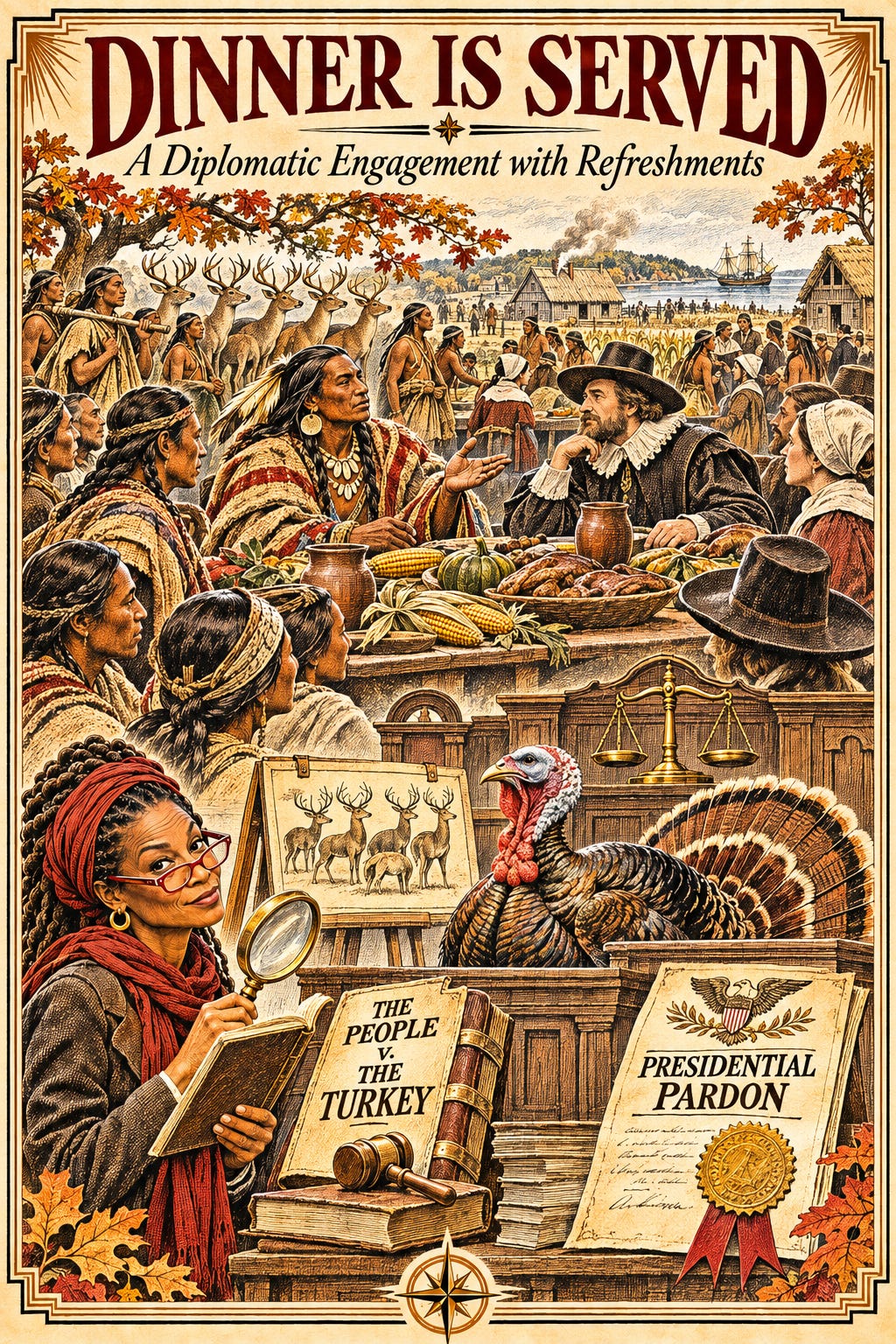
Dinner Is Served
In the autumn of 1621, approximately fifty surviving English colonists and ninety Wampanoag men, including their leader Ousamequin, commonly known as Massasoit, participated in a three-day harvest gathering.
There was food. There was hunting. There was an alliance between two peoples whose interests, at that particular moment in history, intersected.
The Wampanoag were not simply a collection of friendly woodland inhabitants waiting to assist the Europeans. They were a politically organized people navigating an increasingly precarious regional situation.
An alliance with the English offered potential strategic advantages.
What we have, then, is something resembling an extended diplomatic engagement with refreshments.
The gathering was real.
The uncomplicated story we subsequently constructed around it was something else altogether.
Incidentally, we don’t even know for certain whether turkey was served. The surviving account mentions wild fowl and records that the Wampanoag brought five deer.
Five deer!
And yet, some four hundred years later, it is the turkey that continues to pay for the occasion.
The bird, it seems, may have been convicted in absentia. Under the circumstances, an annual presidential pardon seems the least we can do to remedy four centuries of judicial injustice.
Thank you, Mr. President.
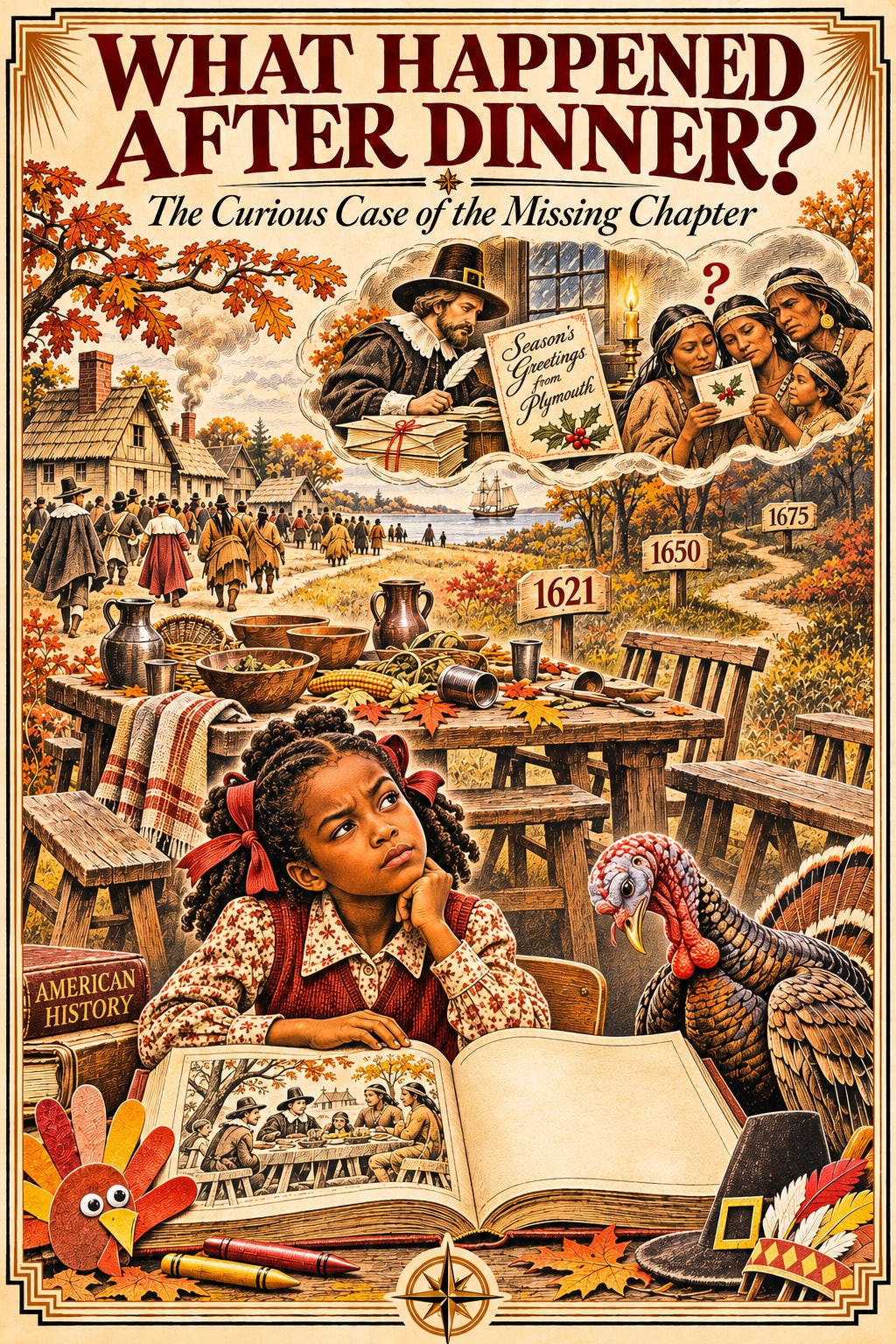
What Happened After Dinner?
This was the part that troubled me as a little girl.
What happened to all those Indians after everybody finished eating?
Did they simply disappear?
Did they go home?
Did the Pilgrims send them Christmas cards?
My elementary-school history book seemed to dismiss the Indians immediately following dessert. By the time we got to George Washington, the powdered wigs had taken over the entire production.
The alliance between Plymouth and the Wampanoag endured for several decades. But as European settlements expanded, so did European demands for land, resources, and political authority.
In 1675, war erupted between English colonists and Indigenous peoples in southern New England.
The conflict became known as King Philip’s War, named after Metacom, the son of the very Wampanoag leader who had established the alliance with the Pilgrims.
Indigenous communities were devastated. People were killed, displaced, and sold into slavery.
Within little more than half a century of that celebrated dinner, the descendants of the people who had helped the English survive were fighting to preserve their own existence.
The historical sequel was considerably less suitable for construction paper.
Now, why didn’t anybody mention that when I was making my little turkey?
And suddenly, those little muskets in the cartoon didn’t seem quite so funny.
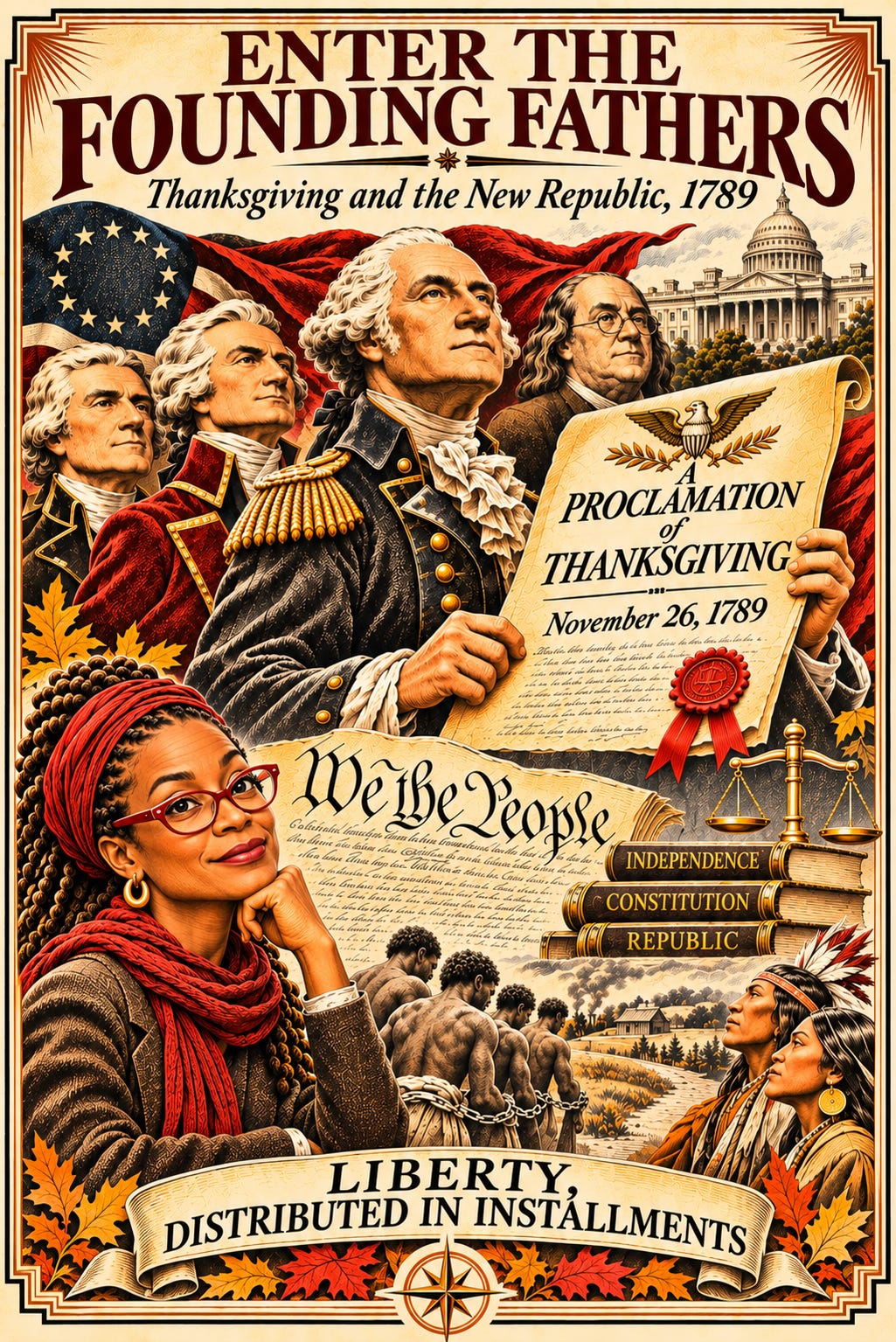
Enter the Founding Fathers
In 1789, President George Washington proclaimed November 26 a national day of thanksgiving.
Interestingly enough, his proclamation was not principally concerned with the Pilgrims.
It was concerned with the establishment of the new nation, its independence, its Constitution, and its system of government.
Thanksgiving had acquired a new purpose.
It was an exercise in civic gratitude.
The republic was understandably pleased with itself. It had successfully rid itself of a king, produced a Constitution, and embarked upon the rather ambitious experiment of governing itself.
Of course, the new republic was still engaged in slavery and the displacement of Indigenous peoples, which raises the rather inconvenient question of precisely who was being invited to give thanks for what.
Liberty, it appears, was being distributed in installments.
Nevertheless, Thanksgiving had not yet become a permanent annual national holiday.
For that, we would need a magazine editor and a civil war.
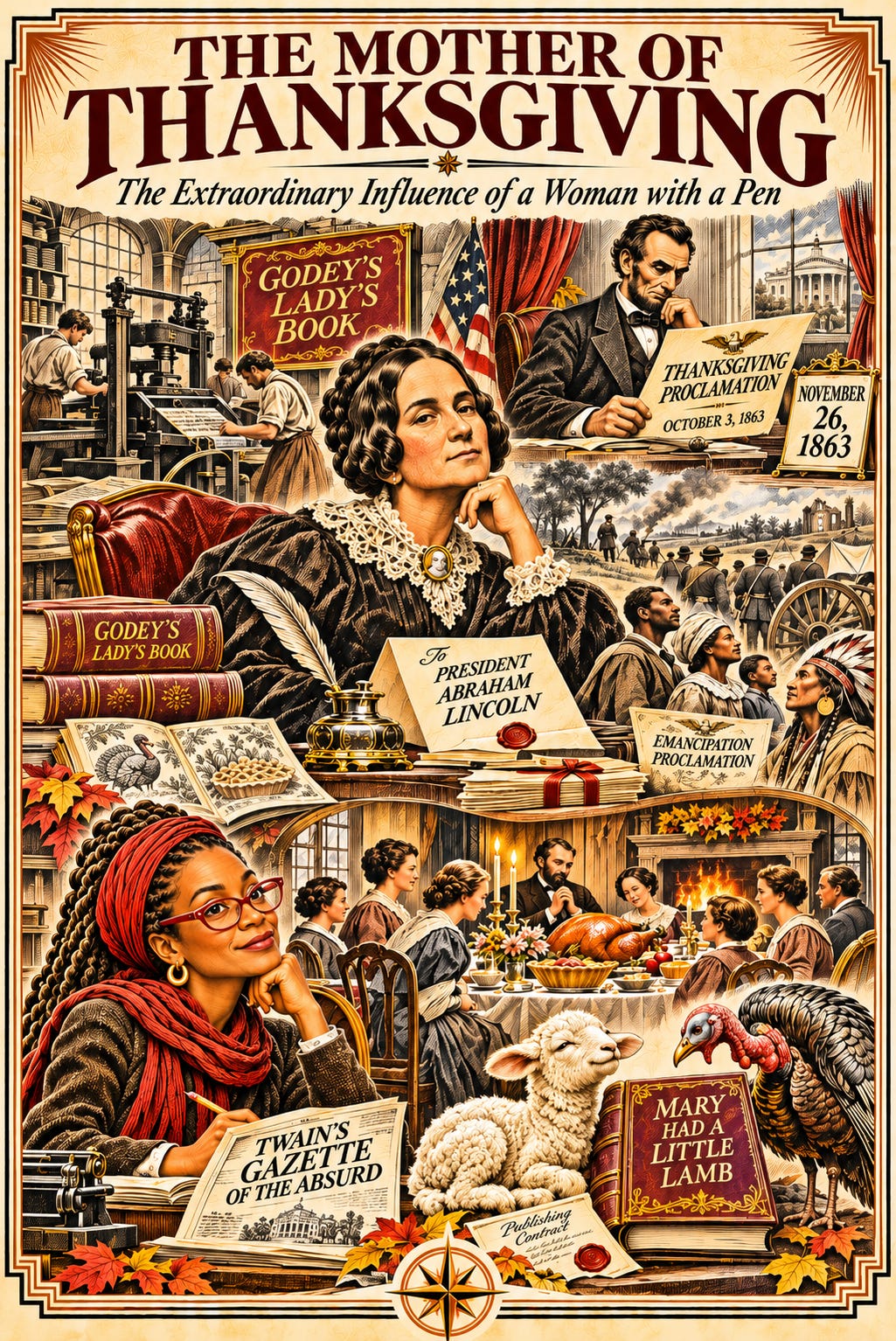
The Mother of Thanksgiving
Sarah Josepha Hale, the influential nineteenth-century editor of Godey’s Lady’s Book, spent years advocating for a national Thanksgiving holiday.
She promoted the domestic traditions we now associate with the occasion: family gatherings, elaborate dinners, roast turkey, and pies.
Incidentally, she also wrote Mary Had a Little Lamb.
One wonders how the lamb managed to escape the national dinner table. Perhaps it had better literary representation.
Hale petitioned successive presidents for years, demonstrating the considerable influence a determined woman with a publishing platform could exert upon the affairs of a nation.
As a woman with a publishing platform of my own, I find this development rather encouraging.
In 1863, in the midst of the American Civil War, President Abraham Lincoln issued a proclamation establishing the last Thursday of November as a national day of thanksgiving.
The nation was tearing itself apart.
Lincoln envisioned an occasion for gratitude, compassion, and national healing.
And so, the annual national Thanksgiving tradition that we recognize today was established not in the seventeenth century at Plymouth, but in the nineteenth century, during one of the most devastating periods in American history.
There is something rather poignant about a nation being asked to count its blessings at the very moment it was struggling to determine what those blessings ought to mean and to whom they ought to belong.
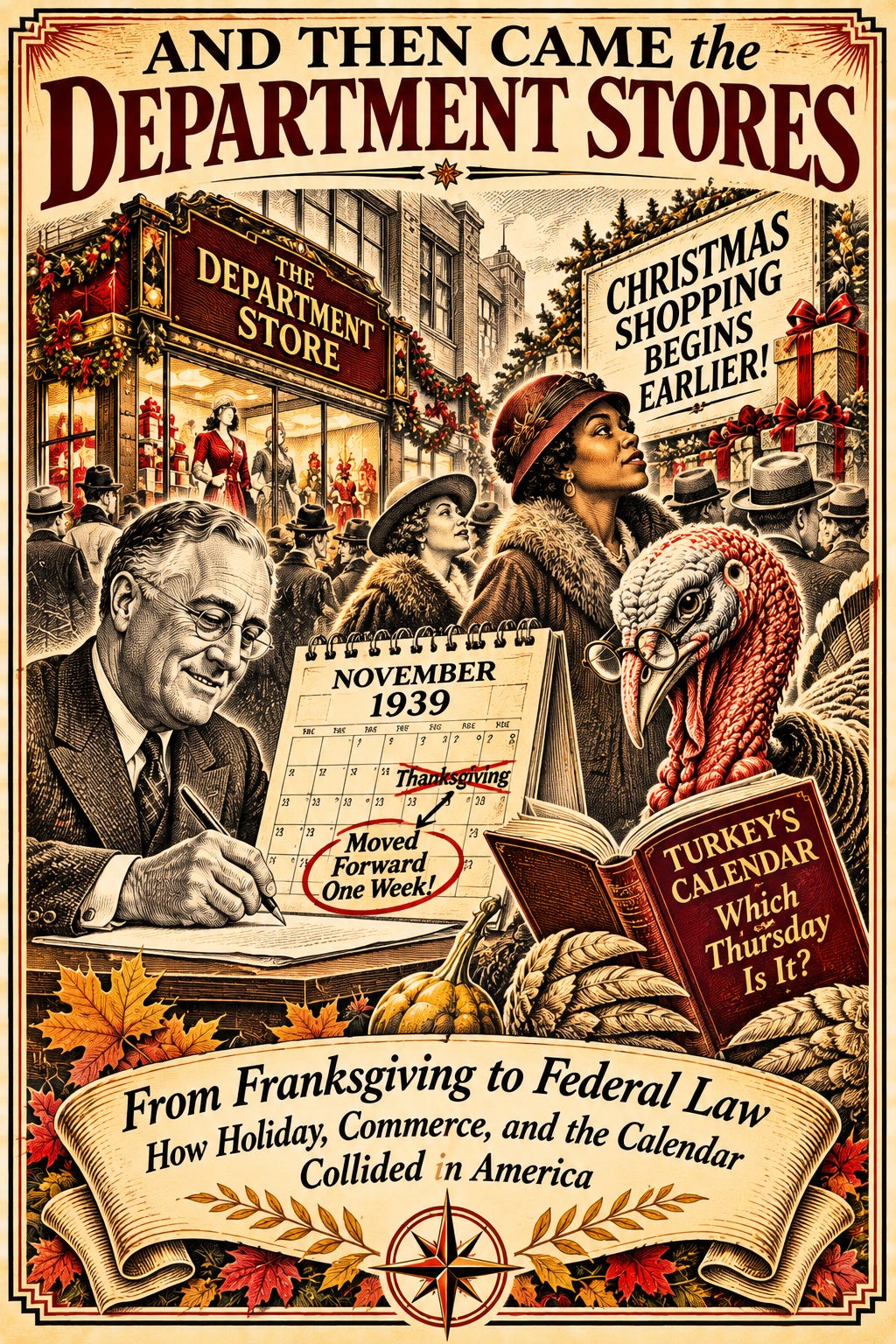
And Then Came the Department Stores
No American historical investigation would be complete without the eventual appearance of the retail establishment.
In 1939, American retailers became concerned that Thanksgiving fell too late in November, thereby shortening the Christmas shopping season.
Apparently, the national expression of gratitude was interfering with projected fourth-quarter revenues.
President Franklin D. Roosevelt moved the holiday forward by a week.
Some states complied. Others did not. Americans found themselves celebrating Thanksgiving on different days, and critics took to calling Roosevelt’s version of the holiday Franksgiving.
For a brief period in American history, even the turkey had to consult the calendar before determining which Thursday constituted its final day on earth.
Congress finally intervened in 1941, establishing Thanksgiving as the fourth Thursday in November.
Thus, a holiday associated with gratitude for what we already possessed was rescheduled to provide us with additional time to purchase things we did not yet possess.
We would spend Thursday giving thanks for everything we had and Friday standing in line to acquire everything we had apparently forgotten to be thankful for.
How very American.
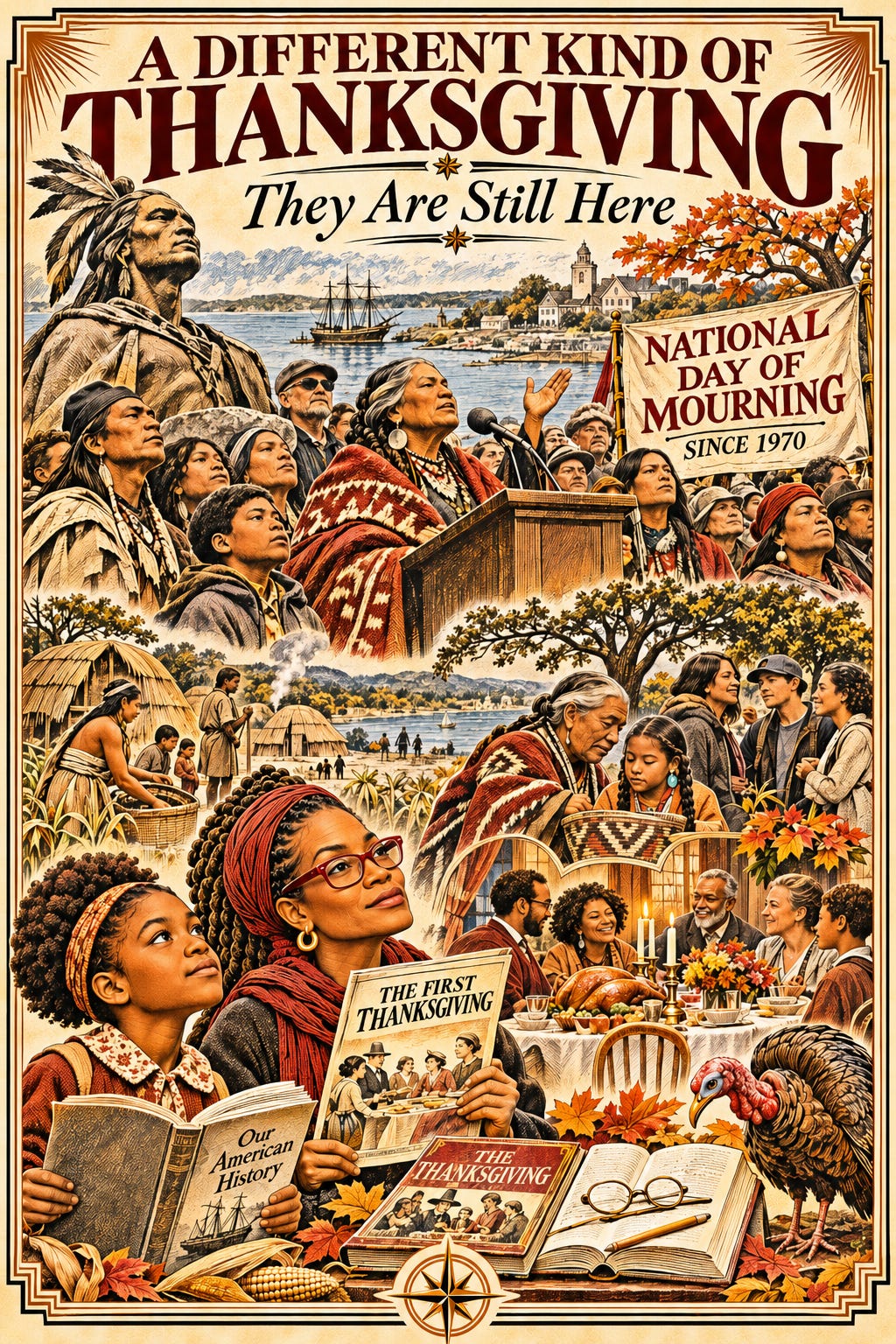
A Different Kind of Thanksgiving
Since 1970, Indigenous people and their supporters have gathered in Plymouth on Thanksgiving Day to observe the National Day of Mourning.
For them, the occasion provides an opportunity to remember the consequences of colonization, honor their ancestors, and acknowledge the continued existence of Indigenous peoples.
They did not disappear after dinner.
They are still here.
I don’t believe that acknowledging this history requires us to abandon the practice of thanksgiving. Gratitude is a perfectly lovely human inclination.
But I do think we ought to distinguish between the practice of gratitude and the mythology of American innocence.
We can enjoy the holiday without subscribing to the historical brochure.
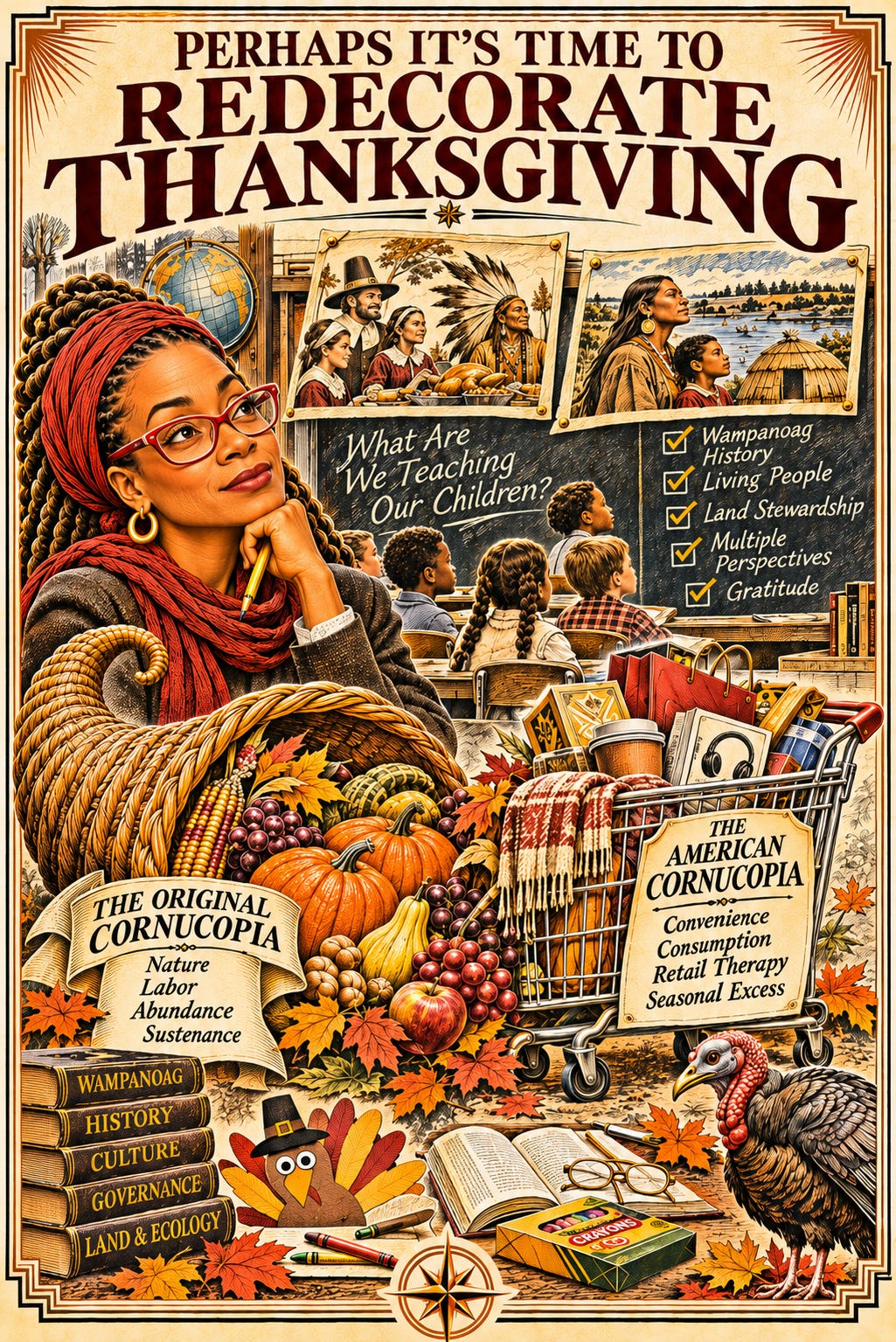
Perhaps It’s Time to Redecorate Thanksgiving
Needless to say, after all this research, I found myself having a bit of difficulty saying “Happy Thanksgiving” to people.
I’ve since determined that it is perfectly acceptable to say it in the context of genuine gratitude. I’ve had to perform a little renovation work on my psyche to arrive at this conclusion, but I believe I’m getting there.
Which brings me around to wondering what first graders are being taught in school these days.
What images are being impressed upon those little developing minds? Are they still making construction-paper Pilgrim hats and Indian headdresses? Are there still muskets, turkeys, and happy little Indians sitting around a table with their European guests?
Has the curriculum evolved since little Kimmie was sitting at her desk with a box of Crayolas, or have we merely upgraded the quality of the construction paper?
I would be curious to know.
Are children learning about the Wampanoag as a living people with their own history, culture, political institutions, and traditions? Are they learning about Indigenous stewardship of the earth? Are they being introduced to the idea that people can experience the very same historical event in profoundly different ways?
Surely, we can teach a six-year-old about gratitude without requiring the child to endorse a particular interpretation of seventeenth-century colonial history.
And then there is the imagery of Thanksgiving itself.
I’ve always loved the cornucopia. There is something aesthetically beautiful about that ancient symbol of abundance, with its fruits, vegetables, grains, and flowers spilling forth from a woven vessel.
But lately, I’ve begun to look at the cornucopia somewhat differently.
The original symbolism was lovely: the generosity of nature, the fruits of human labor, and the abundance that sustains life.
Somewhere along the way, however, the American cornucopia seems to have acquired a shopping cart.
When I wander through the stores during the holiday season, I see an abundance of merchandise, decorations, advertisements, and things I am apparently supposed to purchase in order to demonstrate that I am grateful for the things I already possess.
What I’m not necessarily seeing is gratitude.
I’m not seeing an appreciation for the people who enrich our lives, the earth that sustains us, the farmers who grow our food, or the extraordinary privilege of simply being alive.
Perhaps we ought to reconsider some of our imagery.
Imagine a Thanksgiving in which children drew pictures of the people they loved, the gardens that fed them, the trees that sheltered them, and the animals with whom they shared the earth.
Imagine teaching children that abundance is not necessarily measured by how much one can accumulate, but by how beautifully one can live with what one has.
The cornucopia need not disappear. Perhaps we simply need to reconsider what we put into it.
I suppose some of this is for me and my generation to sort out for ourselves. We inherited a particular version of American history, along with its accompanying illustrations, traditions, and assumptions. It is our responsibility to examine what we inherited and determine what is worth passing along.
I hope the younger generations are being given a more comprehensive understanding of our history and are figuring out how to build upon it.
We cannot change what happened. Nor should we erase it. But we are under no obligation to perpetually reenact it, romanticize it, or decorate our dining rooms with it.
History ought to inform our evolution, not prevent it.
Perhaps, in time, our consumer culture will begin to shift away from superficiality and perpetual acquisition toward something more meaningful.
Perhaps we will rediscover the pleasure of making things, growing things, repairing things, sharing things, and occasionally doing absolutely nothing that contributes to the gross domestic product.
Perhaps we will come to understand that having enough is not a failure of ambition.
At some point, enough ought to be enough.
It is rather interesting to watch humanity attempt to evolve. We are a peculiar species, forever discovering things, forgetting them, and then congratulating ourselves upon discovering them again.
But I remain hopeful.
As Bob Dylan reminded us:
“The times they are a-changin’.”
Let us hope we are, too.
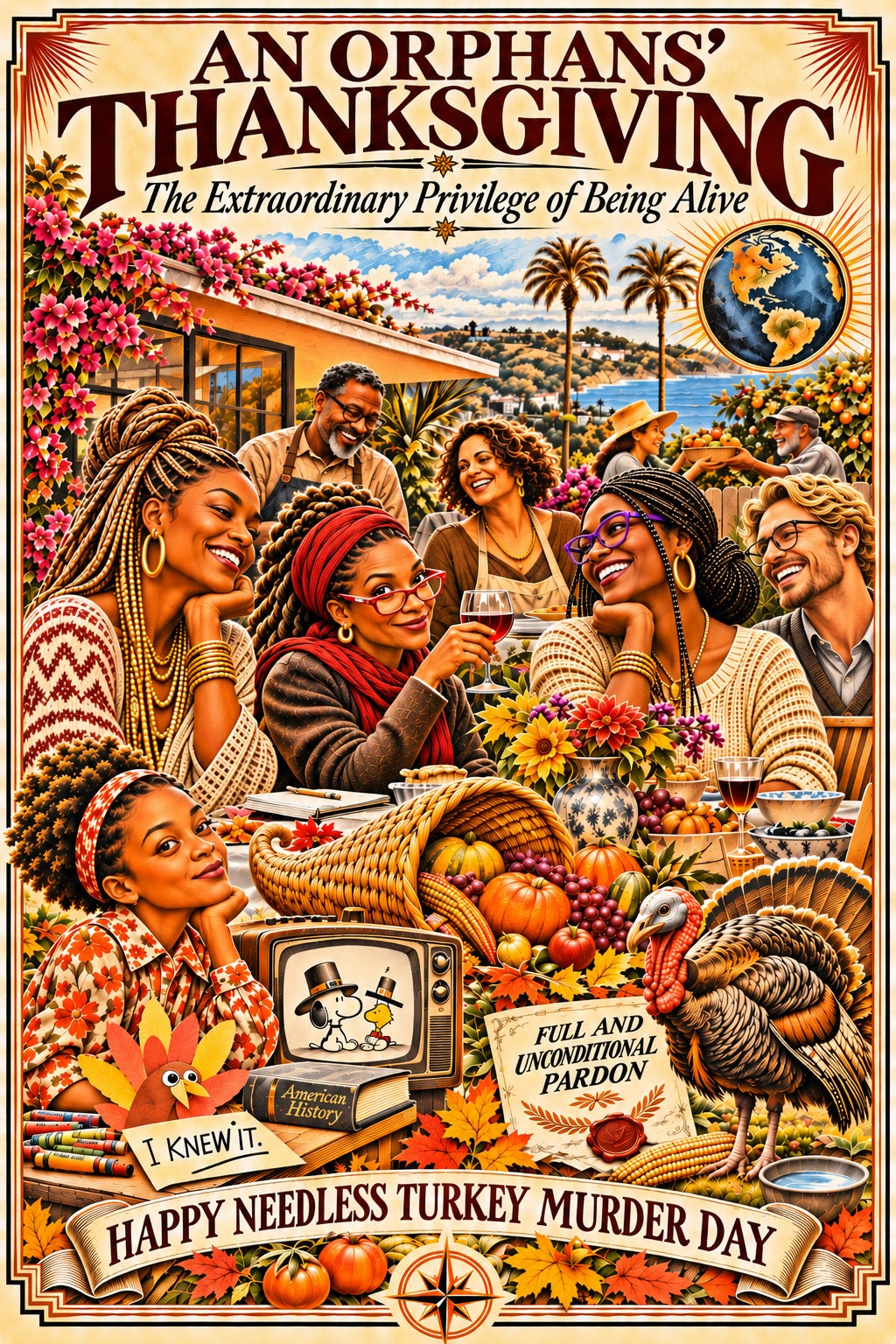
An Orphans’ Thanksgiving
This year, I am spending Thanksgiving in Southern California with dear friends. We are preparing what we affectionately call our Orphans’ Thanksgiving.
There are no Pilgrims, no historical reenactments, and no grand declarations of national righteousness.
Nobody has discovered anybody else’s backyard, and there are no immediate plans to annex the neighbor’s property.
There are simply people who love one another, preparing a lovely meal, enjoying each other’s company, and appreciating the extraordinary privilege of being alive on this beautiful little planet.
Perhaps that is what Thanksgiving ought to be.
Gratitude for the earth that sustains us. Gratitude for the people who nourish us. Gratitude for the opportunity to learn, to create, to love, and to exist.
Gratitude for having enough, without feeling perpetually obliged to acquire more.
And perhaps a little consideration for the turkey, who, as far as I can ascertain, had absolutely nothing to do with the colonization of North America.
The poor creature neither discovered a continent, negotiated a treaty, displaced a civilization, nor lobbied Congress for an extended Christmas shopping season.
Nevertheless, it is the turkey that annually finds itself held accountable for the entire affair.
As for that suspicious little fourth-grade girl with the construction paper and the crayons, watching Snoopy and Woodstock on the television?
Well.
I knew it.
Happy Needless Turkey Murder Day.
Luv,
KT
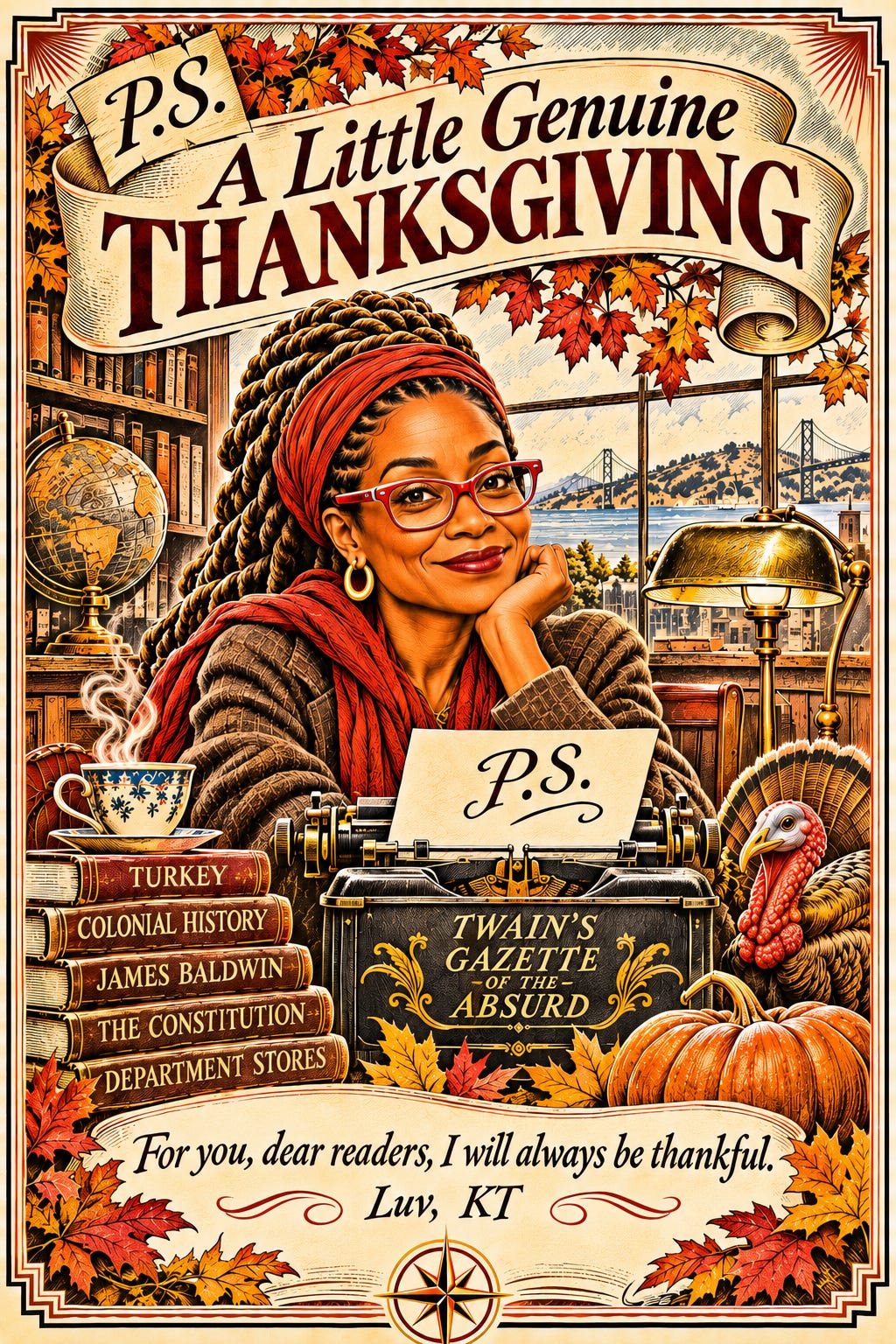
P.S. A Little Genuine Thanksgiving
One thing I am truly thankful for is all of you who support my work and accompany me on these little journeys of discovery.
Thank you for indulging my curiosity, entertaining my peculiar questions, and allowing me to share the things I discover along the way.
One never quite knows where these little investigations will lead. I started out investigating a turkey and somehow ended up with colonial history, James Baldwin, constitutional government, and the American department store.
Such is life here at Twain’s Gazette of the Absurd.
There is something rather wonderful about having people with whom to share one’s intellectual adventures.
Thank you for reading, for encouraging me, and for supporting my work. It means more to me than you might imagine.
For you, dear readers, I will always be thankful.
❤️ KT
Beautiful essay and thought provoking as always. Bravo!