

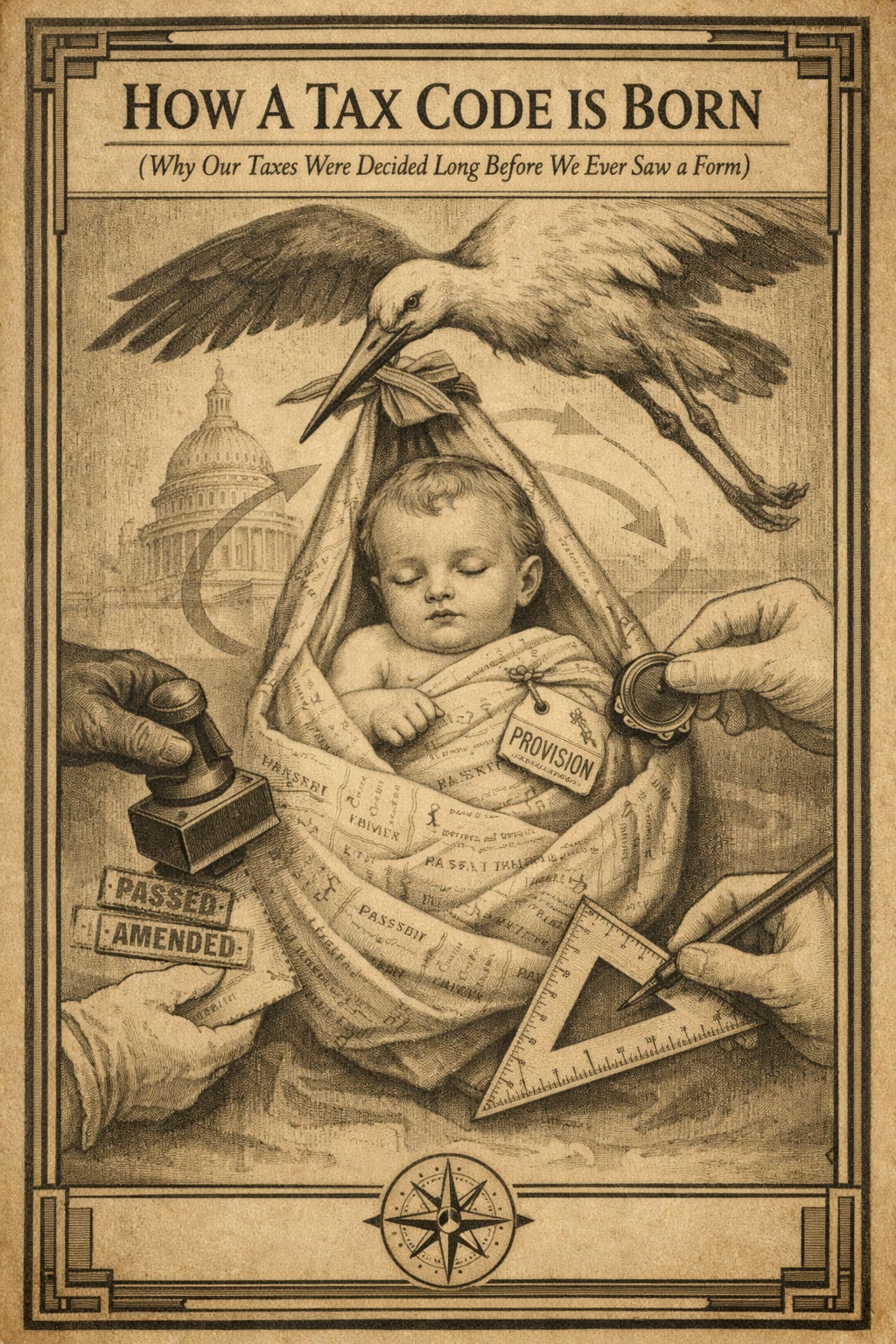
We talk about the tax code as if it descended from the heavens.
Dense. Ancient. Unchangeable.
It didn’t.
The tax code is made, deliberately, by people, inside specific rooms, following incentives that are rarely discussed in public.
So let’s demystify it.
Not as civics trivia, but as power.
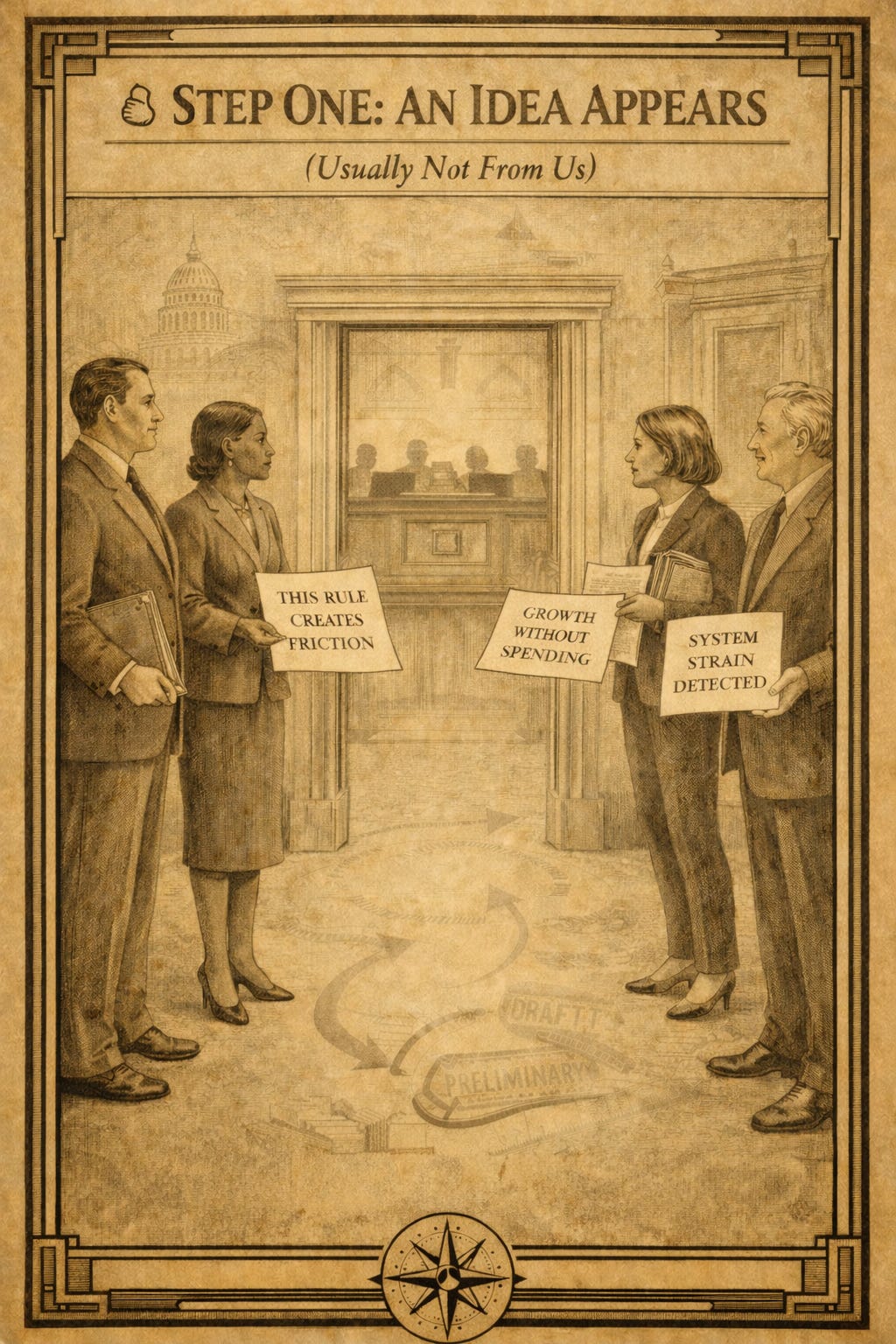
🍼 Step One: An Idea Appears (Usually Not From Us)
A tax provision almost never starts with:
“Regular people need this.”
It usually starts with:
a policy concern (“investment is slowing”)
an industry problem (“this rule creates friction”)
a political goal (“we need growth without spending”)
or a crisis (“something is about to break”)
Ideas arrive from:
industry groups
trade associations
economists
lobbyists
Treasury staff
committee staff
By the time the public hears about it, the idea has already been shaped.
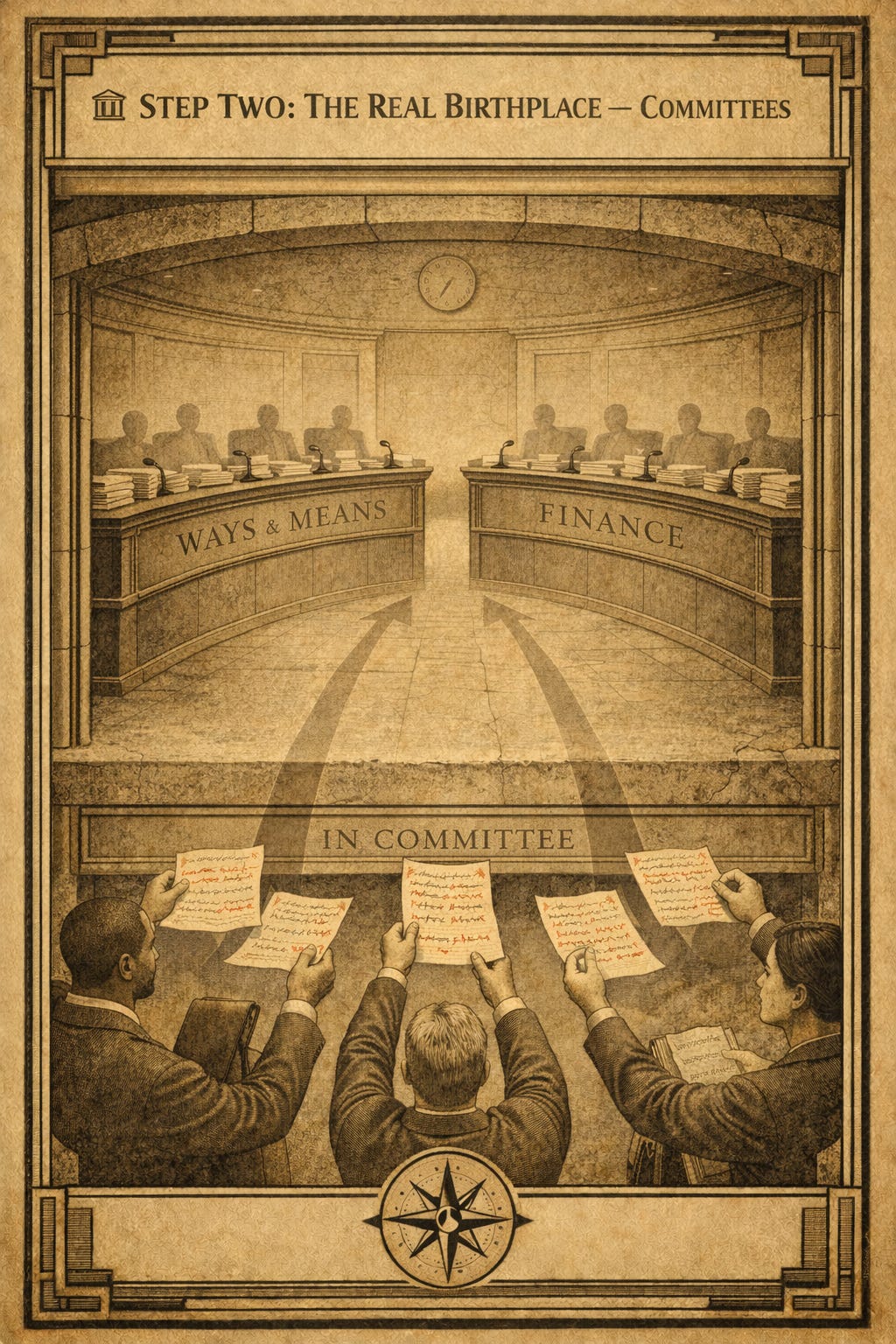
🏛️ Step Two: The Real Birthplace — Committees
In the House, tax law begins in the House Ways and Means Committee.
In the Senate, it runs through the Senate Finance Committee.
These committees:
decide what counts as income
decide what gets taxed and what doesn’t
decide which behaviors are rewarded
decide which costs are “personal responsibility”
Most members of Congress never write tax law.
They vote on it after it’s already shaped.
🧠 Step Three: Staff Write the Code (Not the Members)
Members give direction.
Staff do the drafting.
Committee staff:
translate goals into statutory language
negotiate definitions
reconcile conflicts
manage deadlines
decide what is “feasible”
This is where power concentrates.
If something isn’t written clearly, it isn’t accidental.
If something is left ambiguous, it’s usually intentional.
Ambiguity creates flexibility — and opportunity.
📚 Step Four: “Experts” Shape Reality
Hearings are public.
But witness lists are curated.
Experts tend to be:
economists
tax attorneys
accountants
industry representatives
former officials
What they say enters “the record.”
Once something is in the record, it becomes:
defensible
repeatable
harder to undo
Facts don’t just exist in policy.
They are introduced.
💼 Step Five: Lobbyists Arrive Early — and Stay Late
Lobbyists don’t just argue for tax cuts.
They:
suggest language
flag consequences
offer “technical corrections”
monitor provisions across years
ensure temporary rules don’t disappear
They work the process, not the headline.
The public sees the vote.
Lobbyists work the footnotes.
🧾 Step Six: The Bill Moves — But the Shape Is Set
By the time a tax bill reaches:
the House floor
the Senate floor
the evening news
Most decisions are locked.
Votes become symbolic.
Amendments are narrow.
Debate is compressed.
The code is already born.
What remains is formal recognition.
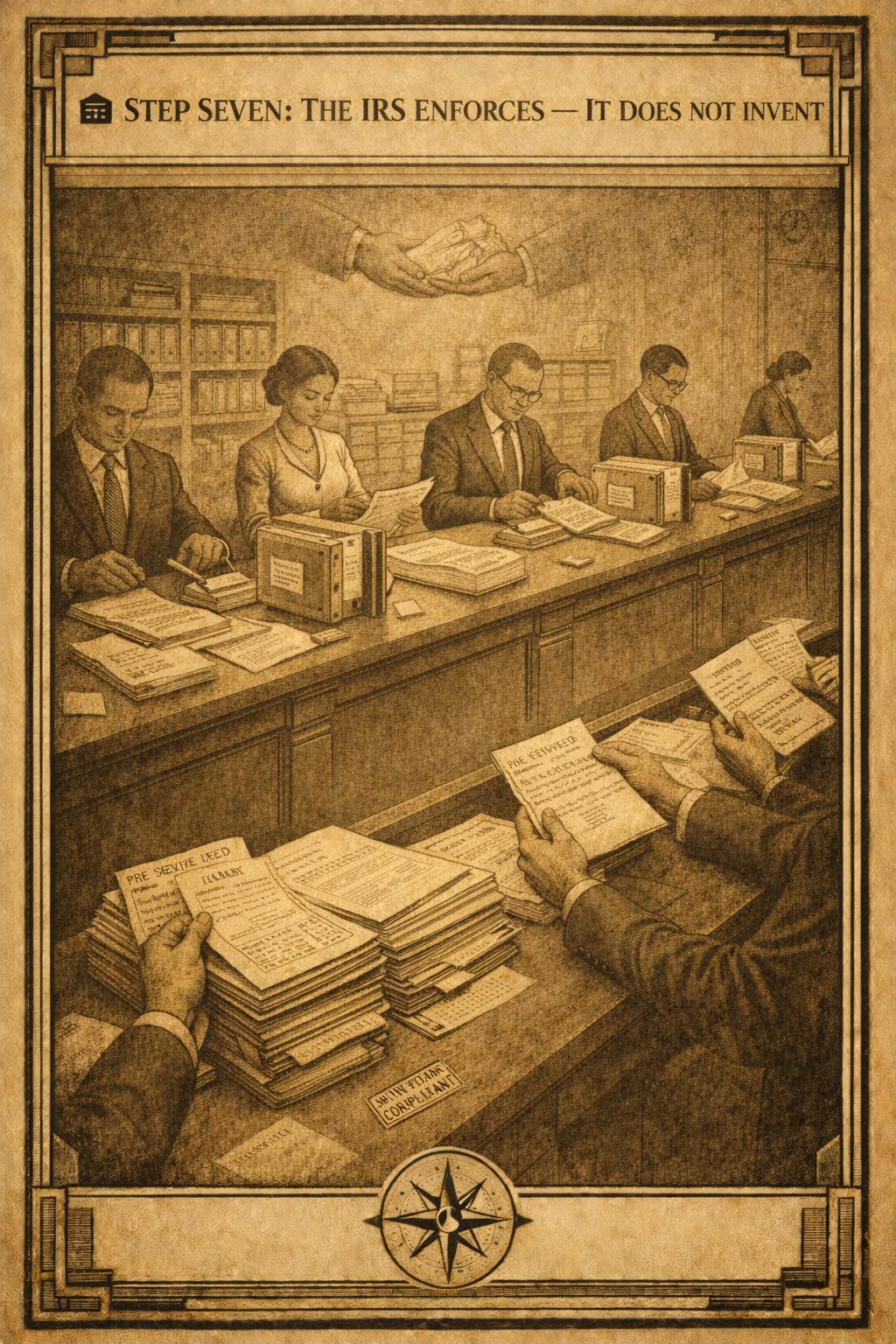
🏢 Step Seven: The IRS Enforces, It Does Not Invent
Here’s the part people get wrong.
The Internal Revenue Service does not write tax law.
It:
interprets
enforces
audits
collects
If the law is complicated, the IRS didn’t choose that.
If the law has loopholes, the IRS didn’t design them.
The IRS is the midwife, not the parent.
🔁 Step Eight: The Code Learns Who Uses It Most
This is the quietest step — and the most important.
The tax code evolves based on:
who interacts with it constantly
who has professional help
who can wait
who can structure income
Over time, the code becomes more responsive to its frequent users.
Not because of evil intent.
Because systems adapt to pressure.
🧭 The Quiet Truth
A tax code is not born neutral.
It is shaped by:
access
expertise
continuity
patience
We encounter it once a year.
Others live inside it year-round.
🧭 In Plain Terms
The tax code isn’t written for us against us.
It’s written without us, by people who never leave the room, for problems we’re not invited to define.
By the time we see it, it’s already grown up.
🧾 Final Line
Taxes don’t start with what’s fair.
They start with who’s present.
And fairness, if it arrives at all, comes later — as an amendment.