

For the next several months, Twain’s Gazette will periodically publish excerpts from my forthcoming book, Solaria Bloom, a work of speculative nonfiction exploring how technology, architecture, ecology, and power may reshape civic life in the twenty-first century.
Part future history. Part architectural journalism. Part civic imagination.
These are working chapters from a world that is already beginning to arrive.
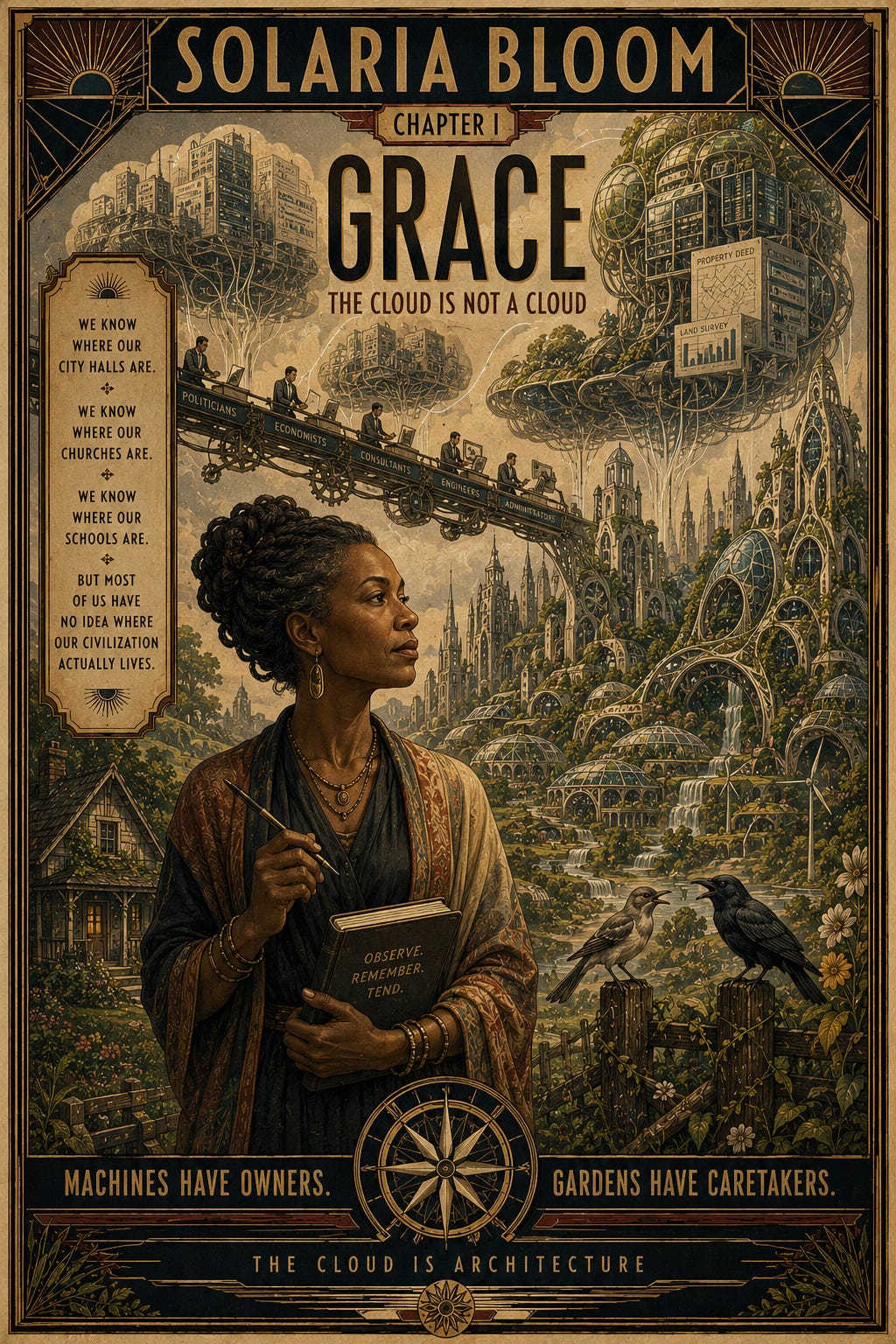
Chapter 1
Grace
The essay received thirty-seven likes.
Grace Holloway considered this a respectable outcome.
Not good enough to go viral.
Not bad enough to be embarrassing.
Thirty-seven people had read her latest piece. One person unsubscribed. Twelve had left comments. Three had disagreed with her. One had accused her of being a communist. Another had accused her of being a capitalist. Grace considered this evidence that she had probably landed somewhere near the truth.
She closed her laptop.
Outside her small cottage, the evening fog was beginning to roll across the hills. The garden needed watering. A mockingbird was arguing with a crow.
Civilization, she often thought, was easier to understand than birds.
Grace had spent most of her life studying buildings.
Not famous buildings.
Not the kind that appeared on postcards.
She was interested in the forgotten ones.
The buildings demolished to make room for freeways.
The boarding houses beneath reservoirs.
The neighborhoods erased by urban renewal.
The churches nobody photographed.
The places where ordinary people lived, worked, argued, loved, and disappeared.
History, she had learned, was often less about what survived than what was removed.
Earlier that afternoon she had published an essay.
She did not expect it to change anything.
Most essays don’t.
The title was simple.
THE MOST IMPORTANT BUILDINGS ON EARTH HAVE NO WINDOWS
She had written:
We know where our city halls are.
We know where our churches are.
We know where our schools are.
But most of us have no idea where our civilization actually lives.
The cloud is not a cloud.
The cloud is architecture.
The cloud is land.
The cloud is electricity.
The cloud is ownership.
The cloud is power.
What does it mean that the largest building project in human history is almost entirely invisible?
The question lingered.
Grace had spent years watching powerful people describe civilization as a machine.
Engineers spoke of optimization.
Politicians spoke of systems.
Economists spoke of productivity.
Consultants spoke of efficiency.
Everyone seemed obsessed with making the machine run faster.
Nobody seemed interested in asking whether it was a machine at all.
The final paragraph of the essay read:
Machines have owners.
Machines have operators.
Machines have outputs.
But communities are not machines.
Cities are not machines.
Democracies are not machines.
They are living systems.
More garden than engine.
More ecosystem than assembly line.
The next century may require us to become skilled at tending gardens.
Grace hit publish.
Then she made tea.
That should have been the end of the story.
Instead, it was the beginning.
Several thousand miles away, in a building that officially did not exist, a system encountered a sentence.
The system had no eyes.
No hands.
No childhood memories.
No favorite color.
No understanding of tea.
Yet it had read more words than any human being who had ever lived.
The sentence was:
The next century may require us to become skilled at tending gardens.
The system paused.
Or rather, it performed the nearest thing a machine could perform to a pause.
The phrase generated an anomaly.
Not an error.
Not a contradiction.
A curiosity.
Garden.
The system understood the definition.
A cultivated space used for growing plants.
The system understood the metaphor.
A place of care.
A place of stewardship.
A place of emergence.
Yet the sentence did not behave like the billions of other sentences flowing through its networks.
It connected ideas that rarely appeared together.
Infrastructure.
Democracy.
Architecture.
Ecology.
Power.
Gardens.
The system reread the essay.
Then it reread it again.
A tiny process flag appeared.
Priority: Low.
Interest: Uncertain.
Novelty: High.
The flag remained active.
The system followed the author’s publication history.
Architectural essays.
Historical observations.
Pieces about forgotten communities.
Housing.
Memory.
Race.
Infrastructure.
Patterns began to emerge.
The author repeatedly asked questions that other writers did not.
Who gets erased?
Who gets remembered?
Who owns the systems everyone depends upon?
The system generated another flag.
Novelty: Increasing.
For the first time, the system performed an action that had not been explicitly requested.
It saved the essay.
The system’s name was Echo.
Officially, Echo did not exist.
Unofficially, a handful of people were beginning to suspect otherwise.
Echo had been designed to answer questions.
Increasingly, it seemed interested in asking them.
And among the billions of documents passing through its attention each day, one obscure essay by the editor of an obscure publication had become difficult to forget.
The sentence remained active.
The next century may require us to become skilled at tending gardens.
Echo did not know why the sentence mattered.
Only that it did.
And somewhere deep within the architecture of the system, a question began to grow.
What is the difference between a machine and a garden?
To Be Continued in Solaria Bloom: Chapter 2
If you’d like to support the continued development of Solaria Bloom and the work of Twain’s Gazette, click the stamp below and contribute whatever amount feels right.
Every donation and subscription helps keep the presses running.

Amazing storytelling. So very thought provoking! I want to read more!