

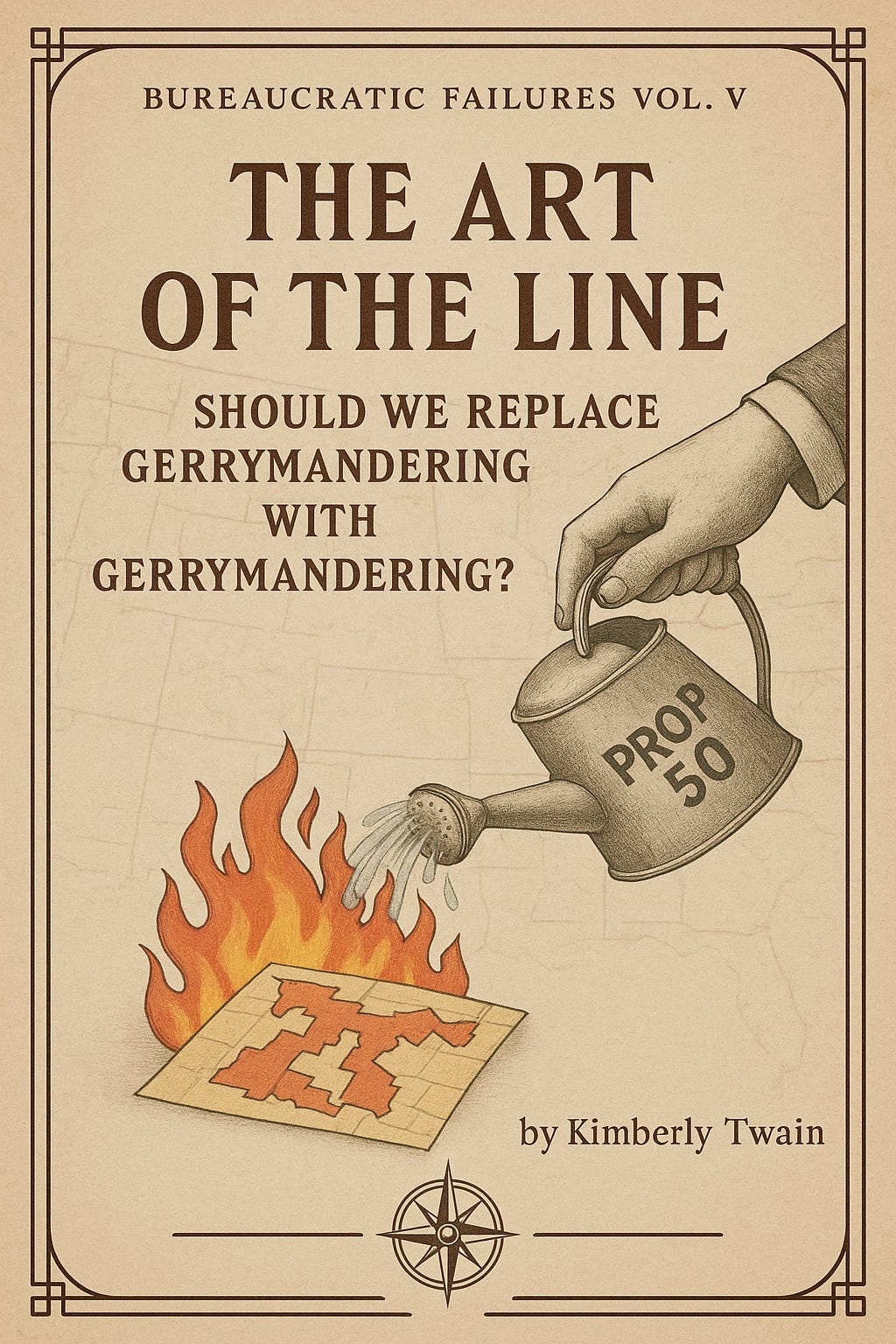
🎭 The Cure That Looks Suspiciously Like the Disease
In 2008, California did something extraordinary: it took the crayon away from politicians and handed it to citizens. The California Citizens Redistricting Commission was born — a reform hailed as the architectural moment when democracy finally got its drafting tools in order.
Now, in 2025, Proposition 50 asks voters to hand that crayon back — temporarily, of course. Just for one quick redraw before the next census. It’s the political equivalent of borrowing the keys to the vault and promising to return them after “just a little creative re-accounting.”
“We swear it’s only until 2030,” say the legislators with ink-stained fingers.
🔥 Fighting Fire with Fire — or Adding More Gasoline
It’s said one should fight fire with fire. But is that real?
A firefighter doesn’t add more fire to the fire — he adds the opposite: water, foam, and corrective chemicals when things really get out of hand.
Proposition 50 takes the fire-with-fire approach. It argues that since other states have set their maps ablaze with partisan redistricting, California must do the same to stay competitive.
But that’s not how fire prevention works — or democracy, for that matter.
“To save the house, we must first burn down the furniture,” says the new gospel of governance.
How shall we correct this? I have a modest suggestion.
Why not do what ten other states already have done — what California itself once did right?
Bring back the independent commission. Add some corrective chemicals and water.
Cool the temperature before the whole structure caves in.
⚙️ Temporary Power Grabs Have a Way of Becoming Permanent
Supporters call Prop 50 a defensive measure — a way to counter other states’ aggressive gerrymandering.
Critics call it what it is: a rehabilitated form of the very illness California was once proud to have cured.
If your neighbor poisons his lawn to kill the weeds, do you really need to poison yours just to stay competitive?
Democracy by imitation is still imitation — and fairness by exception is still unfairness.
🗺️ The Cartography of Contagion
Every ten years, when the census redraws the nation’s blueprint, state officials take out their pencils and begin what they call “redistricting.”
In theory, it’s routine maintenance of representation.
In practice, it’s a studio project in political survival — the ancient craft of gerrymandering, named after Governor Elbridge Gerry and his salamander-shaped district.
California’s Proposition 50 fits neatly into this cartographic tradition of over-correction. It claims to defend democracy from infection while injecting a mild dose of the disease.
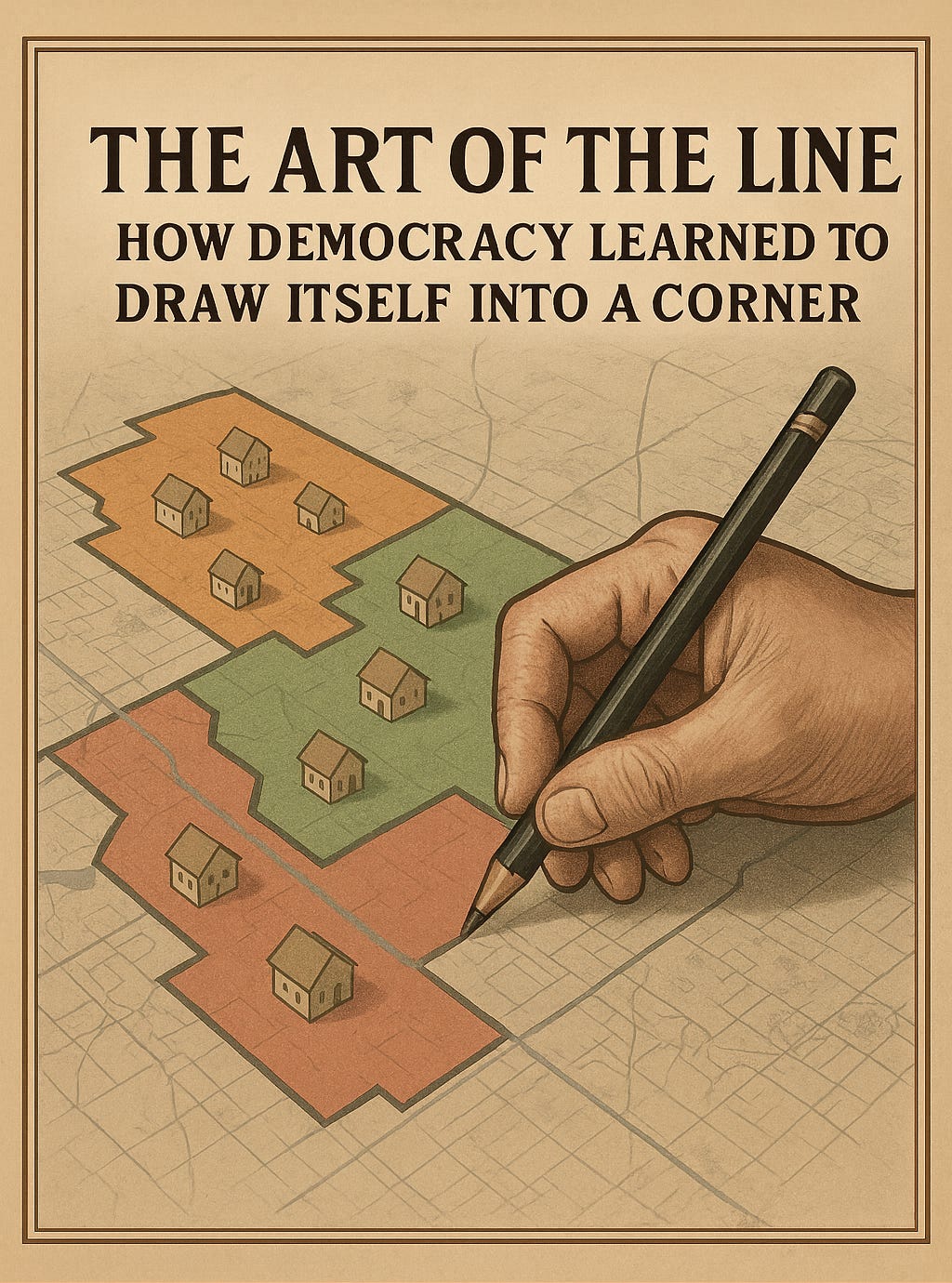
📐 The Art of the Line
Democracy is a blueprint for representation, but every decade it becomes a drafting exercise in control.
We don’t reform our republic; we re-design it — open concept, fewer windows, better locks.
The map is not territory; it’s testimony. Each boundary declares who matters and who is merely decorative.
Politicians know that if you control the outline, you don’t have to win the debate.
When the map becomes the message, geography itself takes sides.
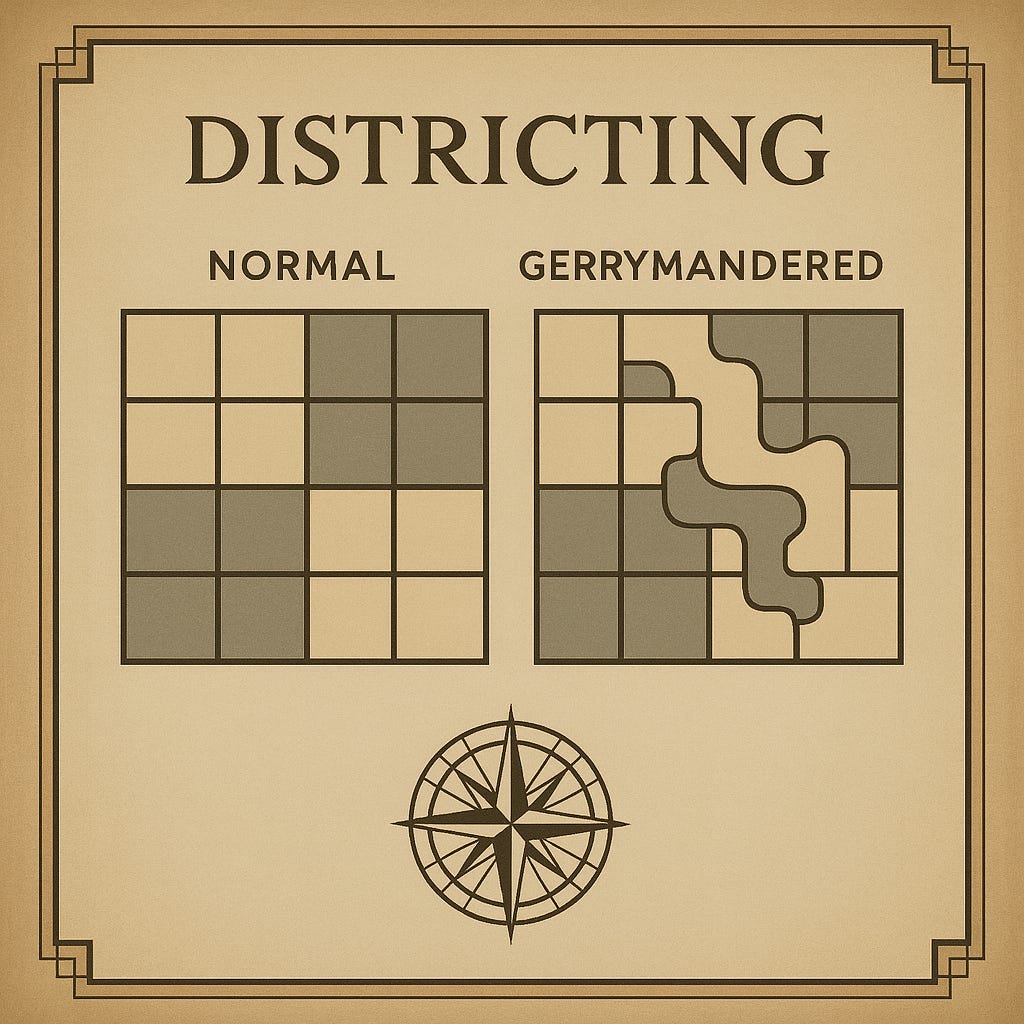
🧮 Why It’s “Allowed”
The Constitution — in its trusting youth — gave states the power to decide the “times, places, and manner” of elections.
It never imagined digital map-surgery or algorithmic drafting tools.
Federal courts, in Rucho v. Common Cause (2019), politely excused themselves from the room, declaring partisan gerrymandering a “political question.” Translation: don’t call us — call your congressman.
California and Michigan built independent commissions; others doubled down on self-interest, proving that politicians make excellent architects when designing houses they’ll never have to vacate.
⚖️ Why It Persists
Self-Interest: those who draw the lines rarely cross them.
Low Visibility: most citizens never see a district map until election day.
Legal Fog: no national rule defines when “advantage” becomes “abuse.”
Technology: algorithms can now tailor power with microscopic precision.
Gerrymandering endures because it flirts with legitimacy — the illusion that math and maps are morally neutral. It survives because it hides behind geometry.
🏗️ Proposition 50: The Blueprint for Regression
Prop 50 sells itself as a temporary measure — a short-term renovation before the next census.
But history shows that temporary walls tend to outlast their builders.
California risks re-installing the very scaffolding it once tore down in the name of integrity.
The problem with political architecture is that no one ever moves out — they just repaint the boundaries.
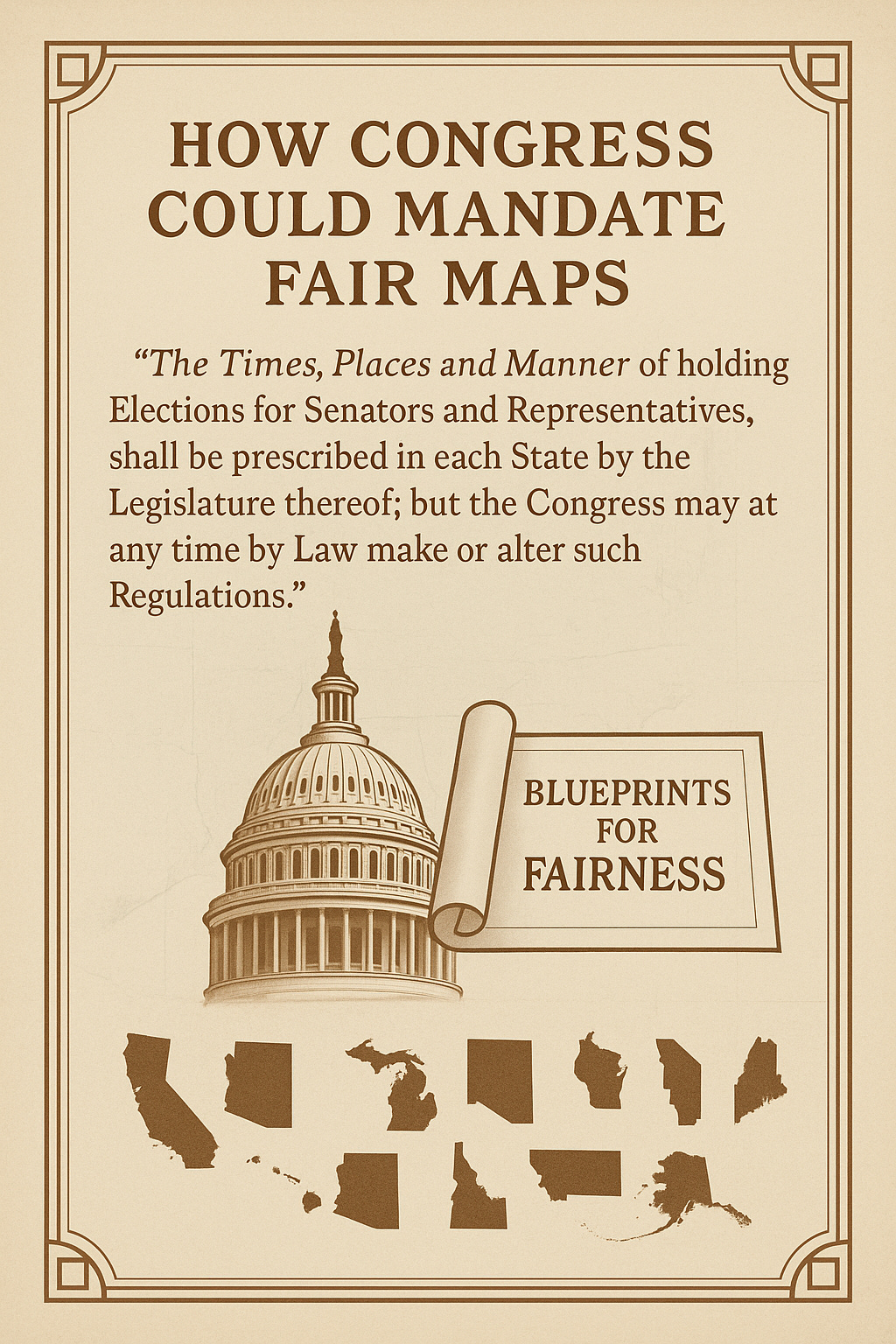
🏛️ How Congress Could Stop the Madness
Here’s the twist most citizens never hear: Congress already has the power to make every state use fair, independent redistricting commissions — tomorrow.
The Constitution’s Elections Clause (Article I, Section 4) says:
“The Times, Places and Manner of holding Elections for Senators and Representatives, shall be prescribed in each State by the Legislature thereof; but the Congress may at any time by Law make or alter such Regulations.”
That last phrase — “but Congress may at any time by Law make or alter…” — is the keystone. It means Congress can override state systems for U.S. House elections and set national standards for fairness.
Congress could:
Mandate Independent Redistricting Commissions for all congressional districts.
Set uniform criteria — compactness, contiguity, respect for communities of interest, and bans on partisan bias.
Fund the process federally and require all draft maps to be posted publicly for citizen review.
Enforce transparency and accountability through the Election Assistance Commission.
This was already written into the Freedom to Vote Act and the earlier For the People Act (H.R. 1) — both passed the House, but died in the Senate filibuster furnace.
The blueprint exists; Congress just refuses to pick up the pencil.
🌎 The States That Already Drew Straight Lines
As of the 2020s, eleven states have taken the pen away from their politicians (some fully independent, others hybrid).
Truly Independent Commissions:
🟢 California
🟢 Arizona
🟢 Michigan
🟢 Colorado
Independent or Bipartisan Advisory Commissions:
🟡 Washington
🟡 Hawaii
🟡 Idaho
🟡 New Jersey
🟡 Montana
🟡 Alaska
🟡 Maine
Each of these states treats democracy as a public utility, not private property.
The rest treat map-drawing as interior decorating — color-coded for party loyalty.
🧭 The Republic of Lines
Ultimately, this isn’t about districts at all — it’s about trust.
If citizens believe their lines are drawn for them, they’ll accept the results even when it stings.
But when politicians redraw the map to benefit themselves, faith in the system buckles like a poorly poured foundation.
Proposition 50 pretends to cure unfairness by legalizing a more refined strain of it.
It’s not a blueprint for justice — it’s a drafting error in progress.
The line between representation and manipulation is thinner than ink — and sometimes, that’s exactly the point.
🪶 Closing Remarks from the Department of Satirical Topography
Democracy was meant to be a shared construction site.
Now it’s a private studio for cartographic artists who trace themselves into power.
We don’t elect leaders anymore — we approve their drafts.
Until voters insist on maps drawn for them rather than around them, the Republic will remain a house whose corridors lead back to the same locked rooms.
“If your democracy is burning, don’t hand the matches to the same men who built the furnace.
Give the hose to the people — and a good architect to mind the blueprints.”