


🌞 I. Morning at the Republic’s Saloon (Where the Story Begins)
Picture a simple saloon at the edge of the Republic — a place where carpenters, barmaids, tycoons, tourists, retired cowboys, aspiring politicians, and their lawyers take turns complaining about how hard life is.
Into this humble establishment walks our first hero:
🪚 The Carpenter.
A man of:
union wages,
union shoulders,
union knees,
and a dream of retiring before Social Security raises the full benefit age to “after 93.”
He earns $85,000 a year — a respectable living for a man who shapes wood, repairs staircases, and still believes that a pension is a promise, not a rumor.
He works hard.
He files his taxes.
He pays $11,000 to the federal government — the customary cover charge for existing.
He shrugs.
“That’s the price of civilization,” he says.
Oh, dear reader.
If only it were that simple.
No sooner has our Carpenter taken his seat than a breeze of air-conditioning and private-jet fuel announces the arrival of our second hero (or villain, depending on your tax bracket):
🎩 The Billionaire.
A man who has not seen a hammer since it appeared in a magazine spread titled Tools as Décor: Rustic Masculinity for the Modern Penthouse.
He possesses:
$5,000,000,000 in wealth
$400,000,000 in annual stock growth
A $50M personal line of credit secured against said stock
And a tax plan so refined, monks in medieval Spain would have illuminated it by candlelight
He pays taxes too.
Specifically:
$3.7 million.
On $410 million of economic gain.
An effective tax rate of 0.9% — which is what happens when the tax code tears off its glasses, squints at the billionaire, and says:
“Sorry, sir, I can’t see your wealth. Is it… unrealized?”
Yes, the Billionaire is a ghost.
A vapor.
A shimmering financial apparition whose wealth grows untaxed because no one has declared it “real.”
Not even the IRS.
The Carpenter pays.
The Billionaire prays.
And the bartender keeps pouring.
🔨 II. The Absurdity of “Unrealized Wealth” (A Fable Told by One Who Has Seen Too Much)
Let’s pause here for a brief architectural metaphor, since this is, after all, a Kimberly Twain joint:
A house increases in value every year because the neighborhood improves.
You don’t sell it — you just own it.
But the value is real.
You could borrow against it.
You could leverage it.
You could rent it out.
You could build a small empire with it.
The appreciation isn’t imaginary.
It’s simply untaxed until you sell.
Now imagine your house grows $400 million in value every year.
That’s a billionaire.
Now imagine that:
You borrow millions against it,
You live like Midas,
You avoid taxes because loans are not “income,”
You die,
And the “step-up basis” erases all lifetime gains from tax memory.
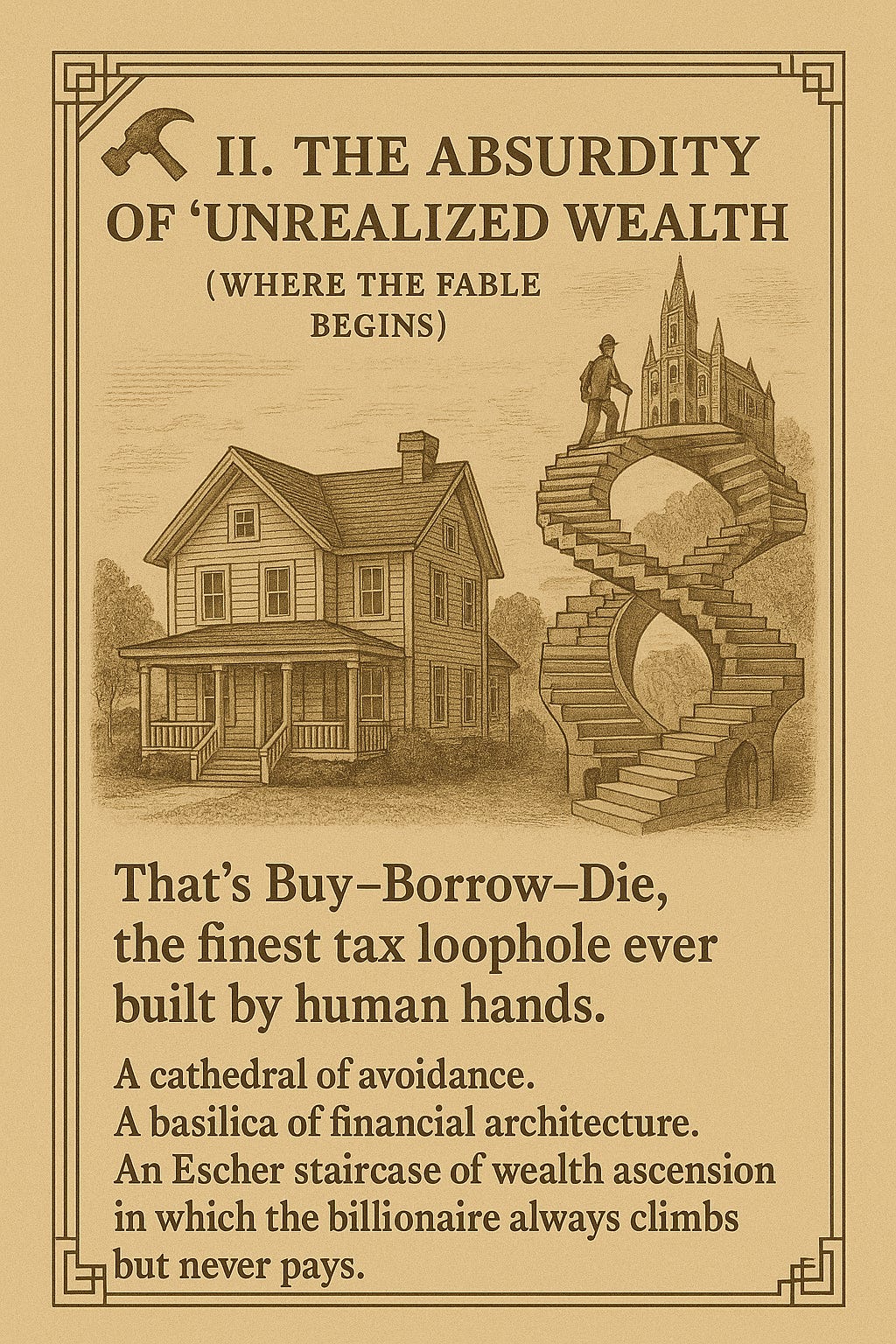
That’s Buy–Borrow–Die, the finest tax loophole ever built by human hands.
A cathedral of avoidance.
A basilica of financial architecture.
An Escher staircase of wealth ascension in which the billionaire always climbs but never pays.
And the carpenter?
He pays up front.
Every paycheck.
Every year.
No step-up.
No loopholes.
Just receipts.
🧱 III. Enter the Economic Gains Tax: A Blueprint for a Functional Republic
Now—enter EGT, the hero of this story and the villain of billionaire cocktail parties.
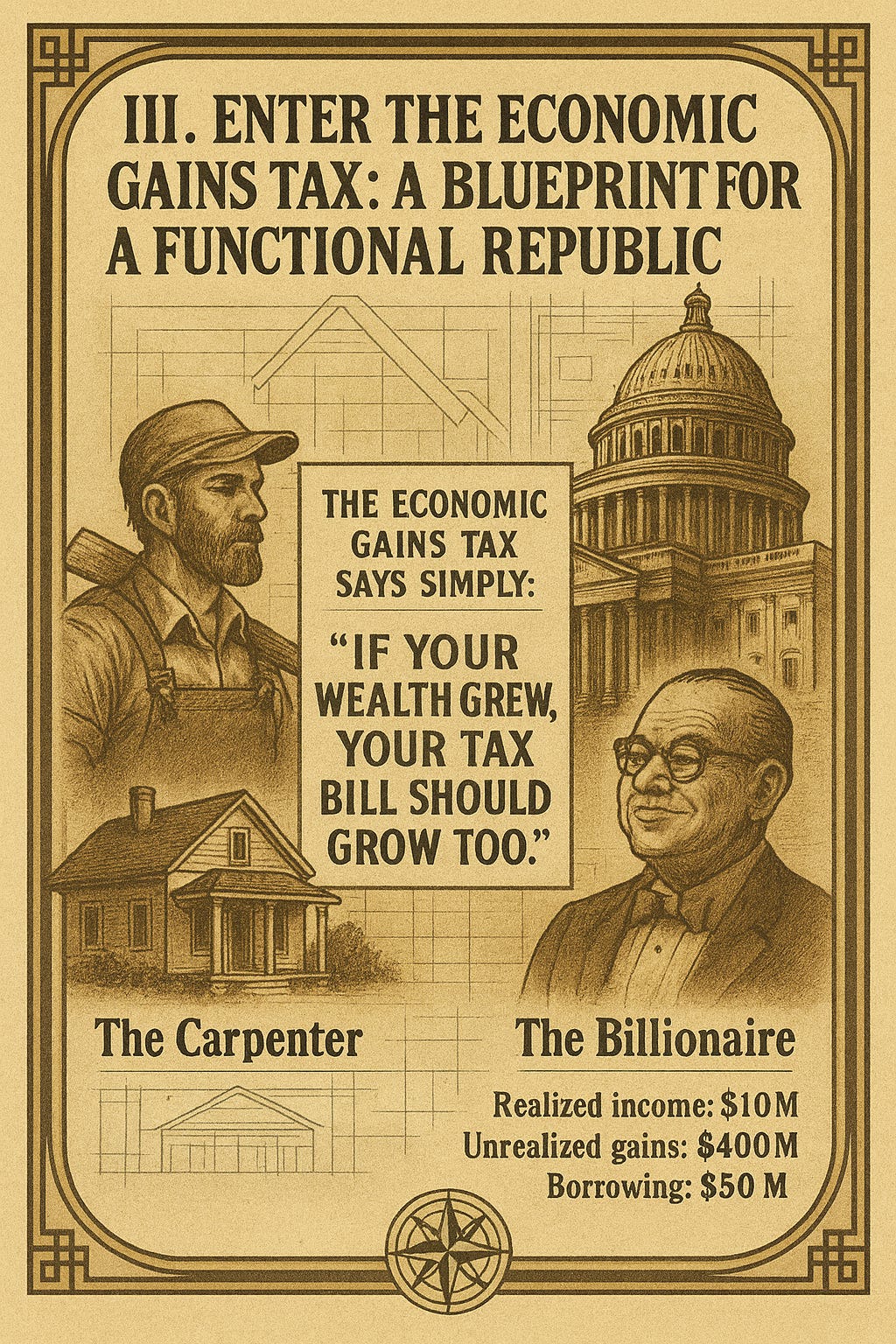
The Economic Gains Tax says simply:
“If your wealth grew, your tax bill should grow too.”
Not everything.
Not everyone.
Just the largest fortunes.
Under EGT:
The Carpenter
Income: $85,000
Tax: ~$11,000
No new burden
No wealth tax
No annual valuation
No forced asset sales
No stress
In fact: nothing changes.
He remains the bedrock taxpayer of the Republic — but no longer the only one.
The Billionaire
Realized income: $10M
Unrealized gains: $400M
Borrowing: $50M
EGT minimum tax (25%): $102,500,000
Less credits for taxes already paid: $3.7M
EGT Total: ~ $103,000,000
Still only 2% of his $5 billion fortune.
He will survive.
He will likely purchase a new yacht to celebrate surviving.
He may even name it The Unrealized.
But for the first time in modern history, the Republic will collect a tax Bill for a tax Bill-ionaire.
🪙 IV. The Republic’s Parable: Who Pays for Civilization?
Civilization runs on something, and for most of American history, that something has been the middle class:
payroll taxes
sales taxes
property taxes
excise taxes
income taxes
But not wealth taxes.
Not stock appreciation taxes.
Not unrealized gains.
Not billionaire borrowing schemes.
EGT restores a simple balance:
Carpenter = pays on his labor.
Billionaire = pays on his wealth growth.
Not wealth.
Not assets.
Just growth.
The system becomes structurally balanced, finally tax-code-literate about modern capitalism.
No more ghosts.
No more illusions.
No more shimmering stock portfolios that grow in the shadows.

🌙 V. Closing Reflections: A Republic Worth the Tab
At the end of the night, the bartender sets down two bills:
For the Carpenter:
Sandwich
One beer
$11,000 tax
For the Billionaire:
Annual wealth growth: $400M
Personal spending loan: $50M
$103M EGT tax
Still leaves richer than yesterday
The bartender glances from one to the other, wipes the counter, and says:
“Gentlemen, one of you is keeping the lights on.
The other is just visiting.”
And somewhere in the golden distance, Mark Twain raises a glass:
“The tax code is a vast structure.
The question is simply this —
who built it,
and who gets to live in it rent-free?”
Tap the postage-size image below. Each one opens a small portal to the Whiskey Treasury, where supporters decide what the author drinks (and whether she returns to the saloon as patron or employee).
