

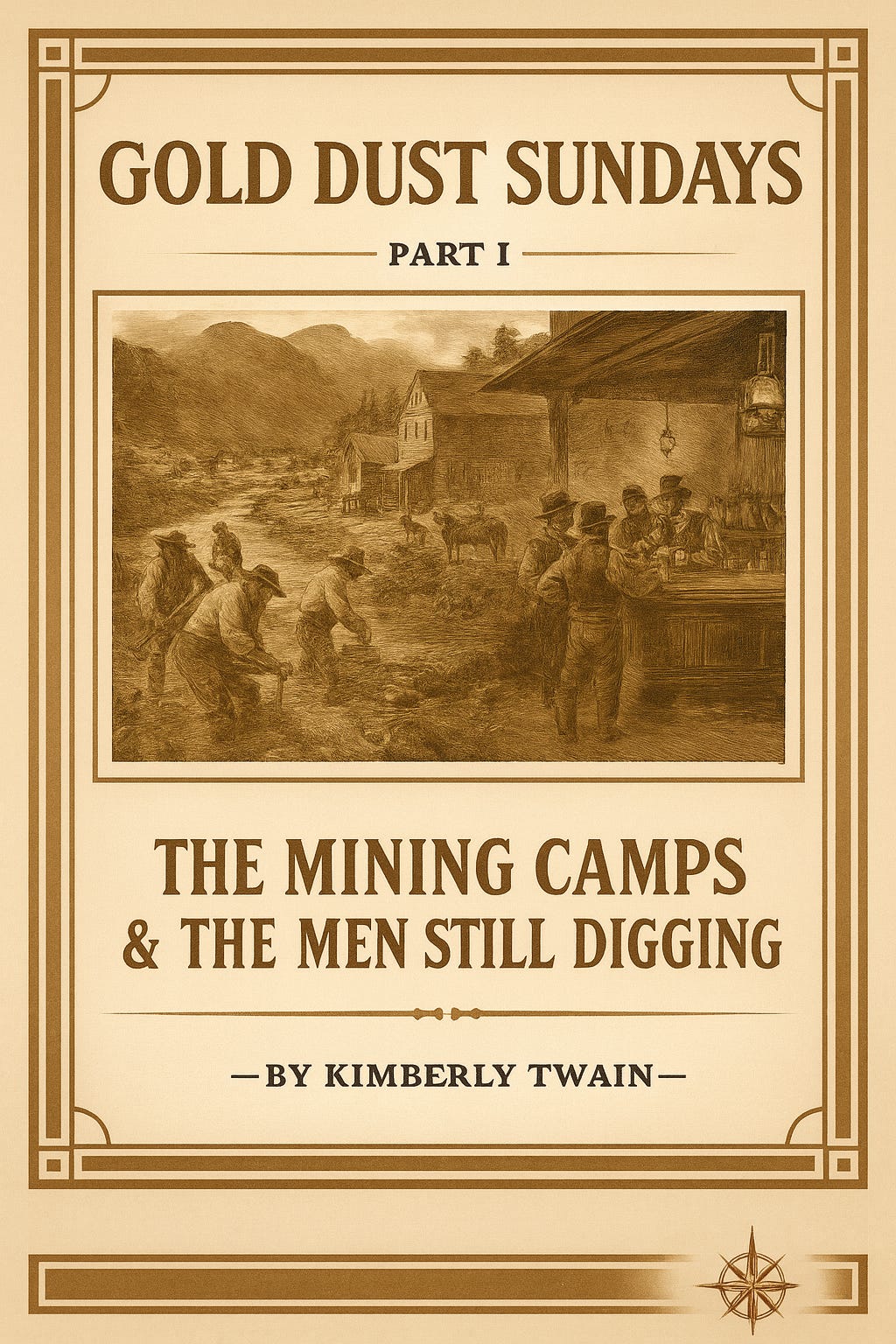
There’s a moment—right as you step off Placerville’s Main Street and into the Cary House lobby—when time folds in on itself like a badly hemmed curtain. The carpet is too new, the lighting too LED, but the bones of the building remain stubbornly 1850. Gold dust once drifted across this floor. Miners tramped in with mud up to their shins. Madame-run brothels occupied the upper rooms in rotating shifts. Mark Twain himself slept here, woke here, and almost certainly eavesdropped here, because eavesdropping was his cardio.
Like most Gold Rush institutions, the Cary House doubled as everything at once: hotel, saloon, political theater, gossip depot, courthouse-in-a-pinch, and a place where a man might gamble away an entire year’s wages before breakfast. The walls still carry that vibration. You don’t need a museum plaque to know—just lean against the wainscotting, and history will hum like a tuning fork.
But beneath the romance, another story lingers:
these buildings were the beating hearts of California’s early vice economy.
Women worked upstairs for survival. Immigrants built the streets but rarely owned the businesses. Black travelers were both essential to the camps and marginalized in the records. Indigenous Californians, whose land was torn open to produce all this gold, were nearly erased by the very prosperity they enabled.
Architecture is never neutral.
It holds what a culture wants to remember—and what it prefers to bury.
And the Cary House remembers everything.
I stood in the doorway last week, coffee in hand, noticing the faint ghost of the bar that used to run along the far wall. A bartender here once bragged he could pour whiskey faster than a priest could absolve sin. He wasn’t wrong. This was a place where stories fermented, where lies and truths traded costumes, and where California first practiced being California: restless, seductive, speculative, and dangerously confident.
One can almost hear Twain raising a glass in the corner, grinning at the spectacle.
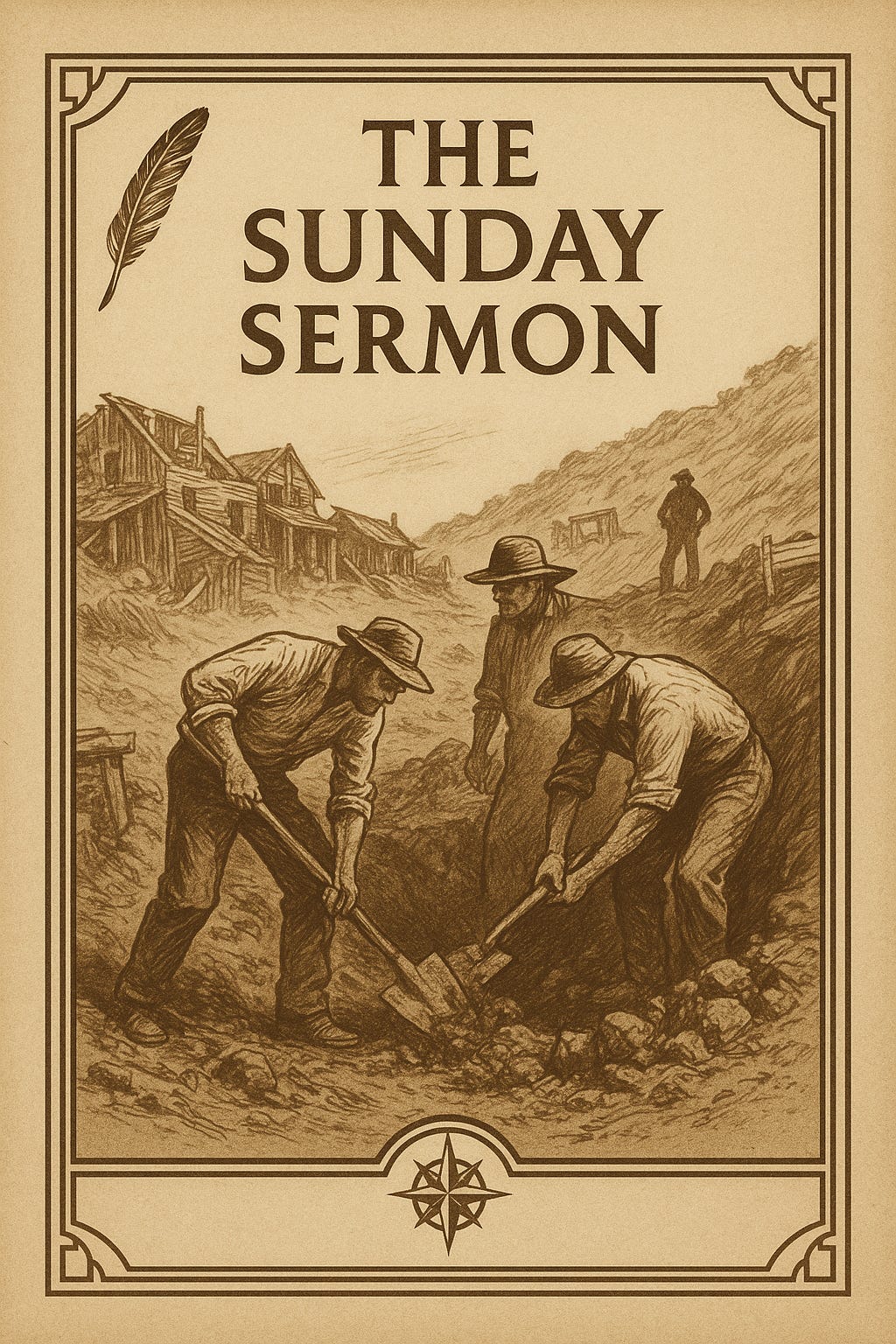
🪶 THE SUNDAY SERMON
⛏️ On the Mining Camps & the Men Still Digging
My fellow citizens,
When you walk through the ruins of a Gold Rush mining camp, you learn one basic truth:
America has always been a country where a small group of men dig holes and everyone else deals with the fallout.
The camps were simple operations:
a few lucky strikes, a lot of broken backs, and a handful of men who figured out it was far more profitable to control the land, the water, the tools, the stores, and the laws than it ever was to swing a pickaxe.
Sound familiar?
Because our modern mining camps are built not in the Sierra foothills, but in Fortune 50 boardrooms, Wall Street offices, data centers, private islands, and the unregulated backfilling pits of Congress.
And the excavations?
They’re bigger than ever.
Today’s billionaires no longer dig for gold.
They dig for tax breaks.
For deregulation.
For subsidies labeled “innovation.”
For loopholes carved large enough to drive a Gulfstream through.
They strike ore every time a politician claims that “wealth will trickle down,” as if prosperity were a leaking canteen and not a locked vault with armed guards and offshore coordinates.
In the old camps, miners complained about claim-jumpers.
Today, the nation complains about claim-keepers — the men who stake out the economy itself and insist every ounce belongs to them.
And just like in 1850,
the laborers, the cooks, the washerwomen, the clerks, the surveyors, the immigrants, the freedmen,
they do the work while someone else walks off with the motherlode.
The structures haven’t changed; only the machinery has.
Back then, the rich dug into mountains.
Now they dig into the Treasury.
Back then, they washed gold in riverbeds.
Now they wash profits in accounting software.
Back then, they owned the water rights.
Now they own the senators.
And the camps?
They still believe in one sacred rule:
If you can’t mine the earth, mine the people.
Which brings me to the moral of today’s sermon:
A republic is not lost in a single collapse.
It erodes one shovelful at a time—
as wealth is extracted upward,
as public goods are hollowed out,
as the mining camp becomes the model instead of the warning.
We cannot rebuild democracy while the nation’s wealth is being tunneled out from under us.
We cannot repair the stage when the carpenters can’t afford lumber.
We cannot call this the land of opportunity when opportunity has been fenced off and guarded like a private claim.
So take a lesson from the old camps:
When a few men take all the gold,
the town dies.
When the gold is shared,
the town becomes California.

Bless the laborers.
Bless the forgotten diggers.
And bless the day the Republic finally stops subsidizing the excavations of the already wealthy.
Pass the whiskey.
And mind your footing—
there’s a sinkhole where the public treasury used to be.
— Kimberly Twain
A generous round that keeps the presses warm, the compass rose polished, and the author safely away from bar shifts.

Bravo
Well said. A powerful story,
very timely. We need a new a progressive era