A Twain’s Gazette of the Absurd Essay
By Kimberly Twain

🌀 I. Are We There Yet?
The government shutdown reminded me of a classic Simpsons episode:
The family is on a long road trip, and Bart keeps asking, “Are we there yet?”
Each time, Homer answers, “Just a little farther.”
Over and over and over again.
And nothing actually moves.
American governance under Trump has felt exactly like that:
a stalled station wagon of democracy, lurching forward on charisma fumes,
reassured by a man who insists the destination is always “just a little farther,”
even as the wheels come off.
The truth is simple:
the cult of personality can only go so far before it starts to catch up with you.
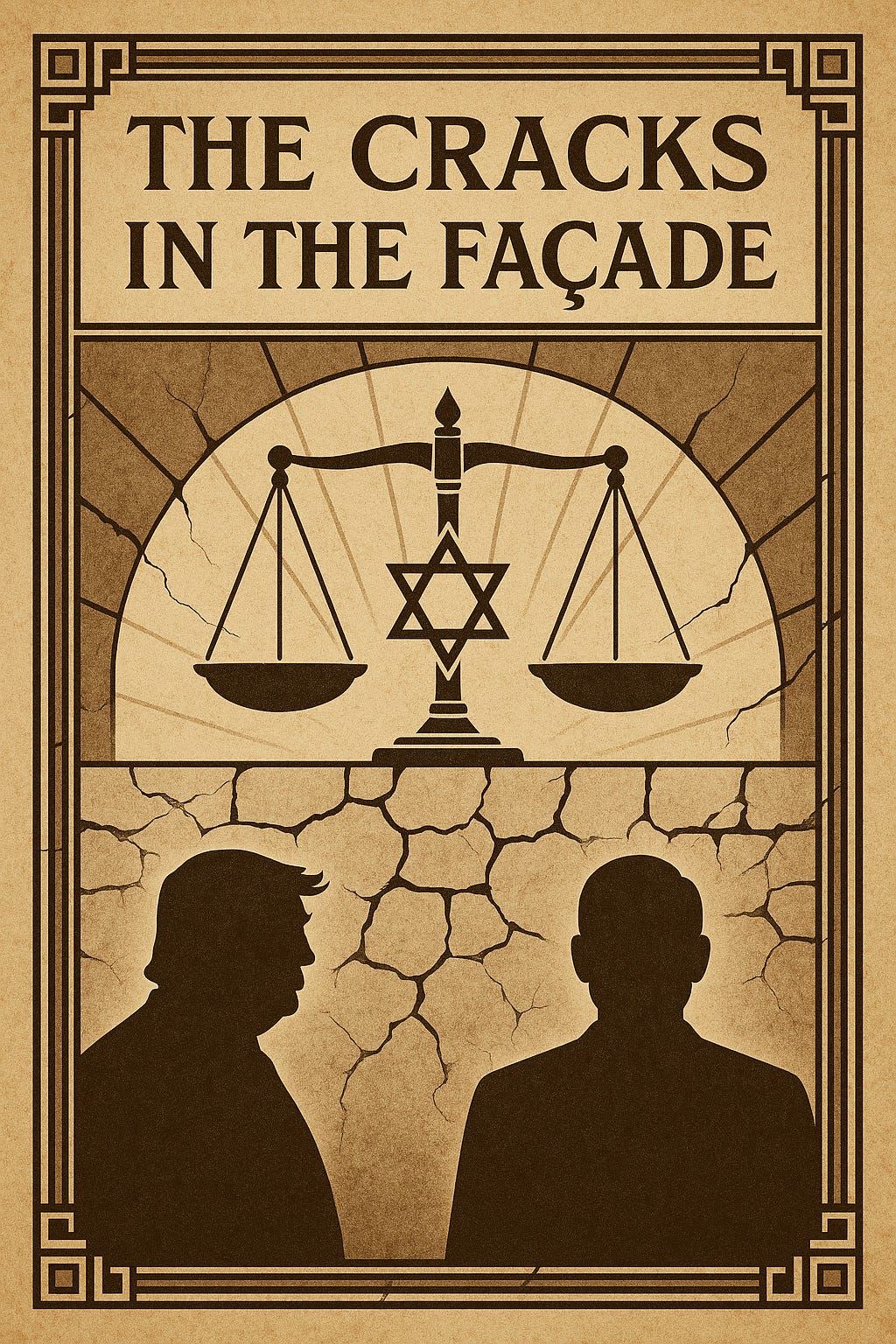
🎭 II. The Cracks in the Façade
For a moment—one brief, audacious moment—I wondered if Trump had actually pulled it off.
Then I listened to the Israeli leadership speak about the ceasefire.
It was all Israel-this, Israel-that, how much Trump adored Israel,
how Israel was the moral compass, the sacred vessel, the chosen child,
the geopolitical Jesus of the moment.
What I didn’t hear was any mention of what peace might mean for Palestinians—
the other branch of the family tree.
Half-brothers.
The ones written out of the script.
I even had second thoughts listening to the Trump Show at the Knesset.
It had all the spectacle of a Broadway opening,
except something felt off-key.
As if Israel, in its theatrical zeal,
had forgotten to take its morning dose of Act-Right Juice.
I thought:
This isn’t going to last.
Drama never does.
And then the deeper irony revealed itself.
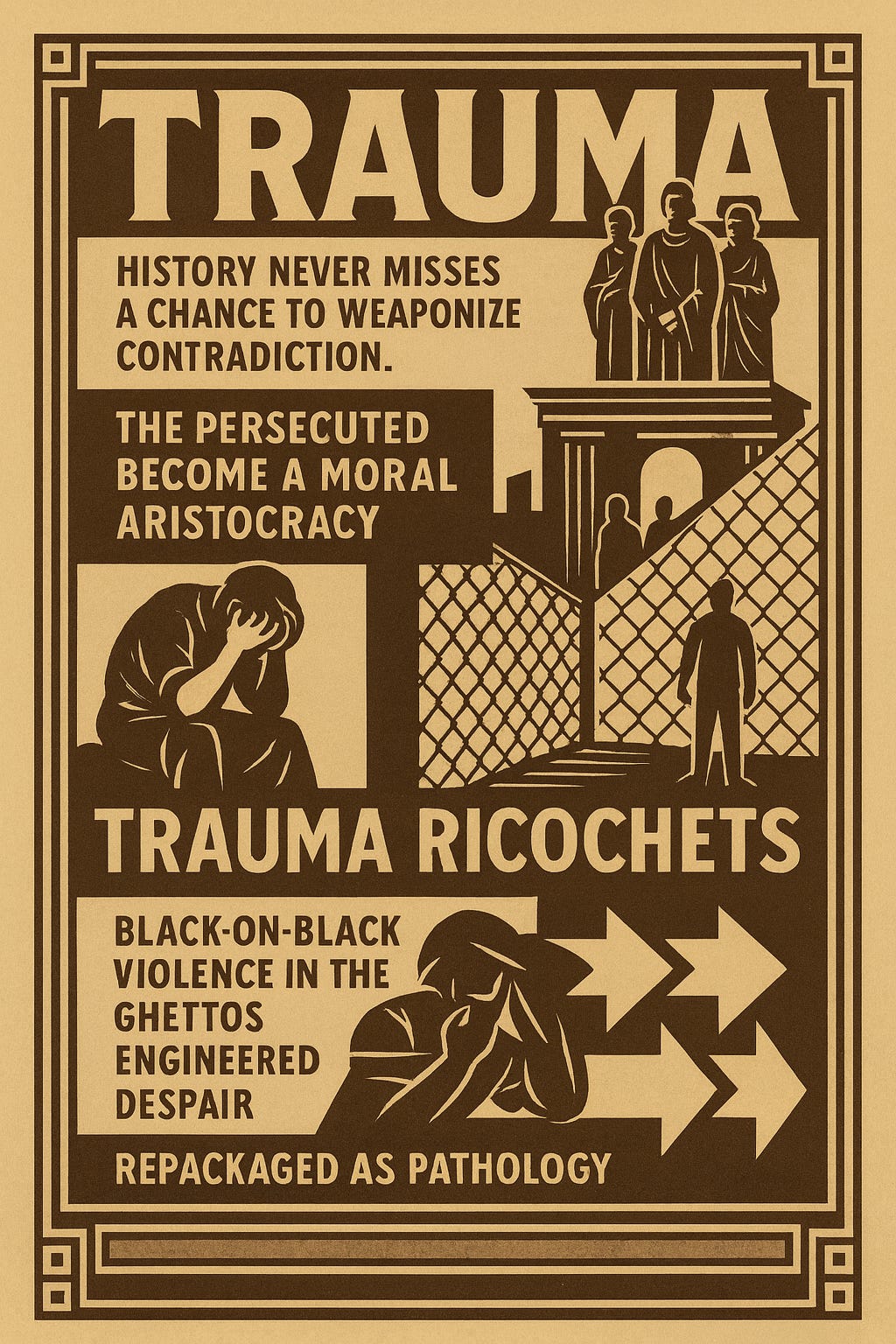
History never misses a chance to weaponize contradiction.
The persecuted often reinvent themselves as the only legitimate victims,
hoarding suffering like it’s a precious metal and guarding it from anyone else
who might dare claim a shared wound.
Overnight, communities once treated as “outsiders” elevate themselves into a kind of
moral aristocracy, perched above the very people who carry the same ancient scars.
We’ve seen this trick before in America.
Black-on-Black violence in the ghettos—violence born from redlined cages,
exclusion zones, and a century of state-sanctioned trauma—gets repackaged
as cultural pathology instead of the predictable outcome of engineered despair.
Trauma doesn’t disappear; it ricochets.
Sometimes inward.
Sometimes sideways.
But always somewhere.
And Gaza becomes the Semite-on-Semite edition of the same story.
Same ancestor. Same bloodline. Same inheritance feud with a thousand-year paper trail.
But centuries of persecution and displacement twist the branches of the family tree
into weapons—aimed at one another.
Yet no one dares call it what it is.
Because naming it truthfully would shatter the mythology,
the one that casts one side as the eternal martyr
and the other as the eternally suspect.
Because pain is political currency—
and only certain people ever get approved for an account.

🔥 III. America’s 15 Minutes of Everything
One thing about Americans: we love a show.
We love a personality.
We love a ringmaster who can keep us guessing.
But we are also fickle.
Everyone gets their fifteen minutes—not just of fame but of attention, outrage, devotion, and disbelief.
Then we move on to the next shiny object.
Even Trump moves on.
You haven’t heard him brag about “stopping the wars” in nearly six weeks.
He’s busy doing other things now.
Except, of course, when someone crosses him—
then he sends Pam Bondi after them like an overly caffeinated legal Chihuahua.
It’s all spectacle, all the time.
But spectacle doesn’t last forever.
As Yeats wrote in The Second Coming:
“Things fall apart; the center cannot hold.”
And what is a cult of personality if not a trembling center in search of a foundation?
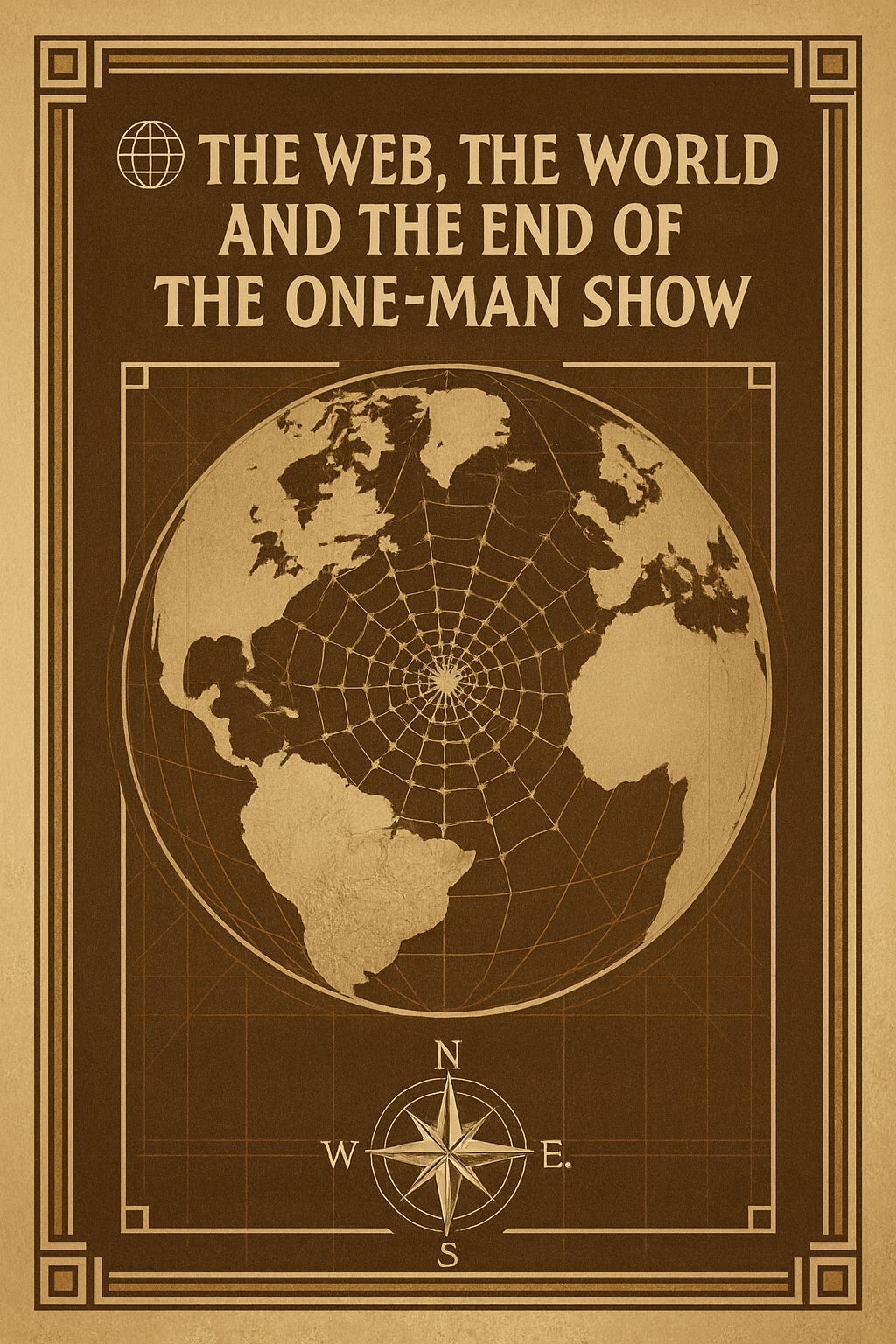
🌐 IV. The Web, the World, and the End of the One-Man Show
We are not a 20th-century nation anymore.
We are a planetary organism wired together with a digital bloodstream.
We are not connected by borders or walls or lines on paper.
We are connected by a World Wide Web—
a shimmering spider’s lattice that wraps the entire globe,
linking the Amazon rainforest to suburban St. Louis,
Gaza to Google headquarters,
the Knesset livestream to your grandmother’s iPhone.
This web thinks faster than governments can react.
Faster than politicians can perform.
Faster than any one man can charm, fool, distract, or dominate.
It is, in effect, a hyper-powered collective brain—
and once the public catches up to it?
Look out.
People will be mad as hell,
and they will not take it anymore.
AI will not overthrow the system.
We will.
And that—that—is what powerful people truly fear.
🧭 Twainian Compass Rose
Direction still exists, even when leadership doesn’t.