

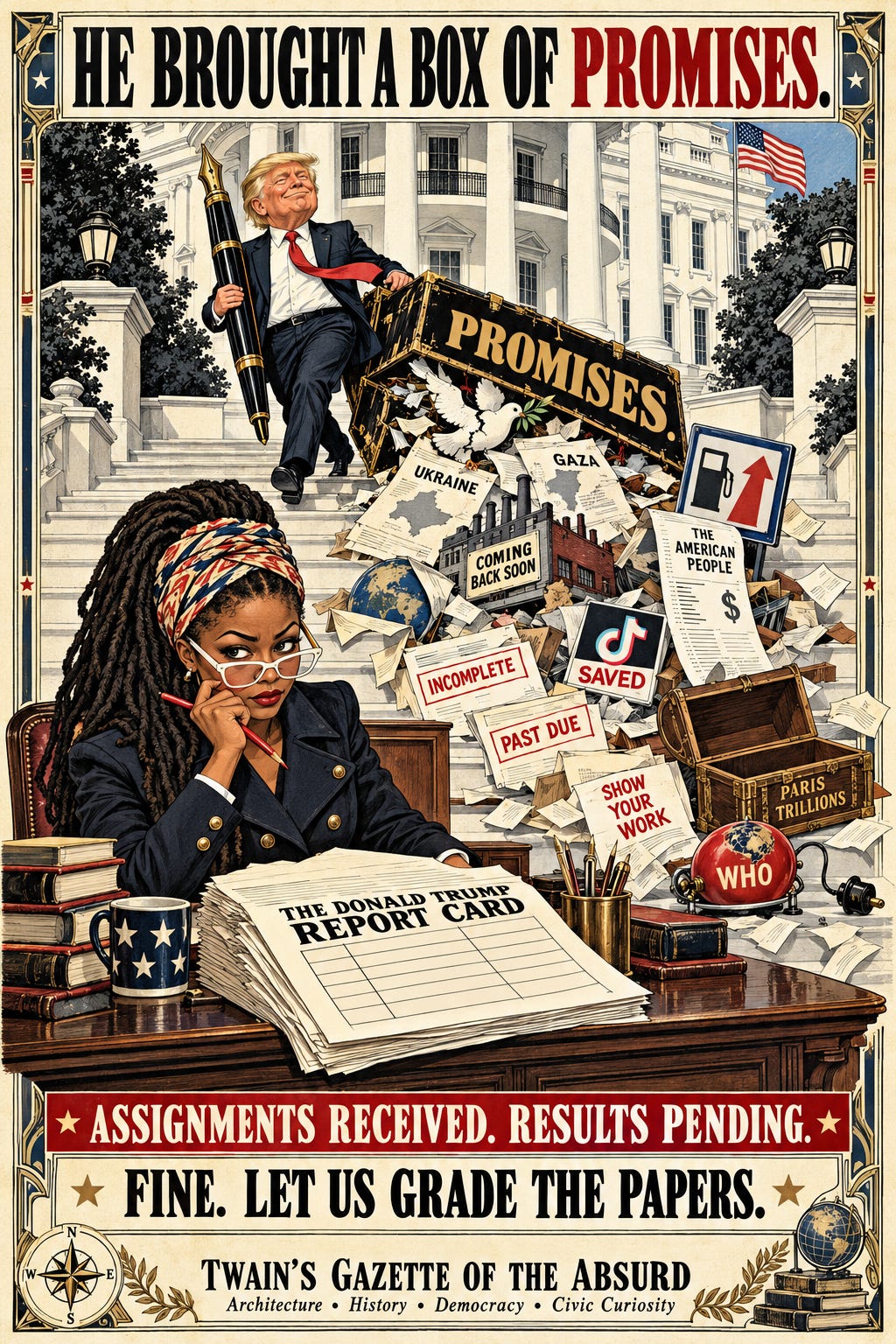
Donald Trump returned to the White House carrying a black pen and a large box of promises.
He would end the wars.
He would bring back the factories.
He would lower prices.
He would make foreign countries pay tariffs.
He would save TikTok.
He would save trillions by withdrawing from the Paris Agreement.
He would withdraw from the World Health Organization because America was apparently spending entirely too much money learning where the next plague was coming from.
Fine.
The man has now had time to turn in his assignments.
Let us grade the papers.
The standard is not whether Trump did something. Trump is always doing something. The question is whether anything he did improved the lives of the American people.
Where is the peace?
Where are the factories?
Where are the savings?
And where, exactly, is our money?
TikTok: B+
Let us begin with the good news.
Trump saved TikTok.
The platform remains available in the United States under a new American-based entity controlled primarily by investors including Oracle, Silver Lake and MGX. American user data is stored under Oracle’s supervision, and the new company has a mostly American board.
ByteDance, TikTok’s Chinese parent company, still owns 19.9% and licenses the recommendation algorithm to the American operation. China has therefore not departed the building. It has merely been moved to a smaller office near the service entrance.
Still, the app survived.
Millions of Americans may continue dancing, selling vitamins, explaining the Roman Empire and diagnosing strangers with narcissistic personality disorder.
Report-card comment: Assignment completed with a few suspicious Chinese footnotes.
Grade: B+
Tariff revenue: B−
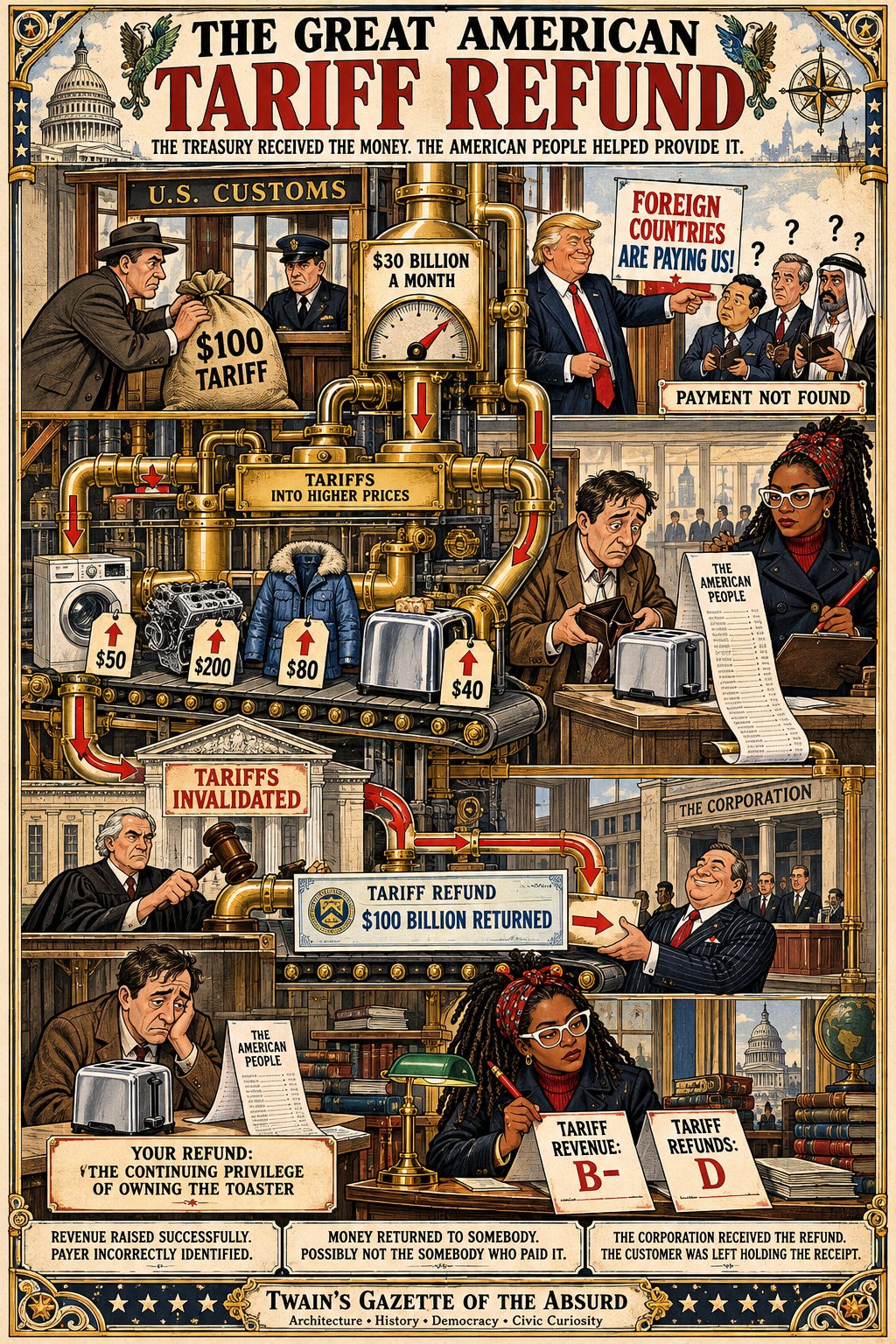
Trump said tariffs would bring money into the federal Treasury.
They did.
During 2025, tariffs were generating approximately $30 billion a month in gross customs revenue. Then the Supreme Court ruled that Trump lacked the authority to impose much of his worldwide tariff program, and the government began returning the money.
By August 2026, approximately $100 billion had been refunded.
Even after the refunds, the government collected substantially more tariff revenue than it had before.
So Trump was correct about the revenue.
He was considerably less forthcoming about where it came from.
Foreign governments did not gather in a ballroom, remove their wallets and write checks to the United States.
American importers paid the tariffs at the border. Those companies then absorbed the cost, reduced investment, pressured their suppliers or passed the expense to American customers.
The Treasury received the money.
The American people helped provide it.
This is ordinarily called a tax. But “foreign countries are paying us” looks much better on a campaign sign.
Report-card comment: Revenue raised successfully. Payer incorrectly identified.
Grade: B− for collecting the money. D for explaining whose money it was.
Tariff refunds: D
After the courts invalidated many of the tariffs, the government returned the money to the importer of record—the company legally responsible for paying Customs.
The customer who had already purchased the tariff-inflated washing machine, automobile part, winter coat or toaster generally received nothing.
Imagine the arrangement.
The importer pays a $100 tariff.
The retailer raises the price.
The customer buys the product at the higher price.
The court declares the tariff unlawful.
The importer receives the refund.
The customer receives the continuing privilege of owning the toaster.
Companies may use their refunds to lower prices, repay debt, preserve jobs or restore inventory. They may also use the money to replenish profits. They are not required to locate the customer and return the portion of the tariff already buried in the purchase price.
The public helped finance the tariff.
The corporation received the refund.
The customer was left holding the receipt.
Report-card comment: Money successfully returned to somebody. Possibly not the somebody who ultimately paid it.
Grade: D
Protecting American industry: C+
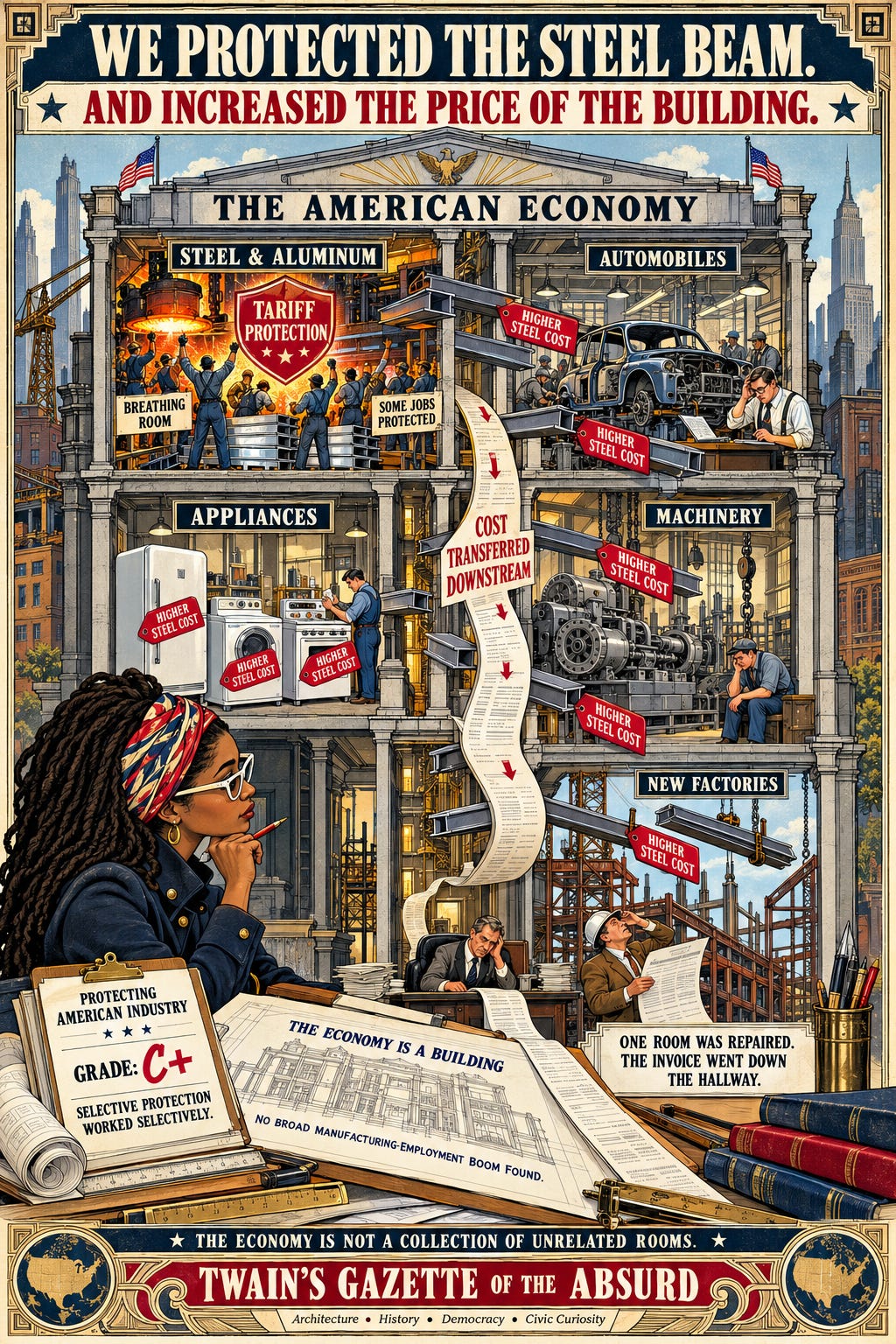
Tariffs did protect certain American industries.
Steel and aluminum producers benefited when imported metals became more expensive. Companies competing directly with foreign products gained breathing room. Some factories increased production. Some jobs may have been protected.
But the economy is a building, not a collection of unrelated rooms.
If you raise the price of steel to protect the steel mill, the automobile manufacturer pays more for steel.
So does the appliance company.
So does the machinery company.
So does the contractor erecting the next American factory.
We protected the steel beam and increased the price of the building.
Federal Reserve researchers found some evidence of higher production in heavily protected industries, but no clear evidence of a broad manufacturing-employment boom.
Report-card comment: One room was repaired by sending the invoice down the hallway.
Grade: C+
Bringing the factories home: D+
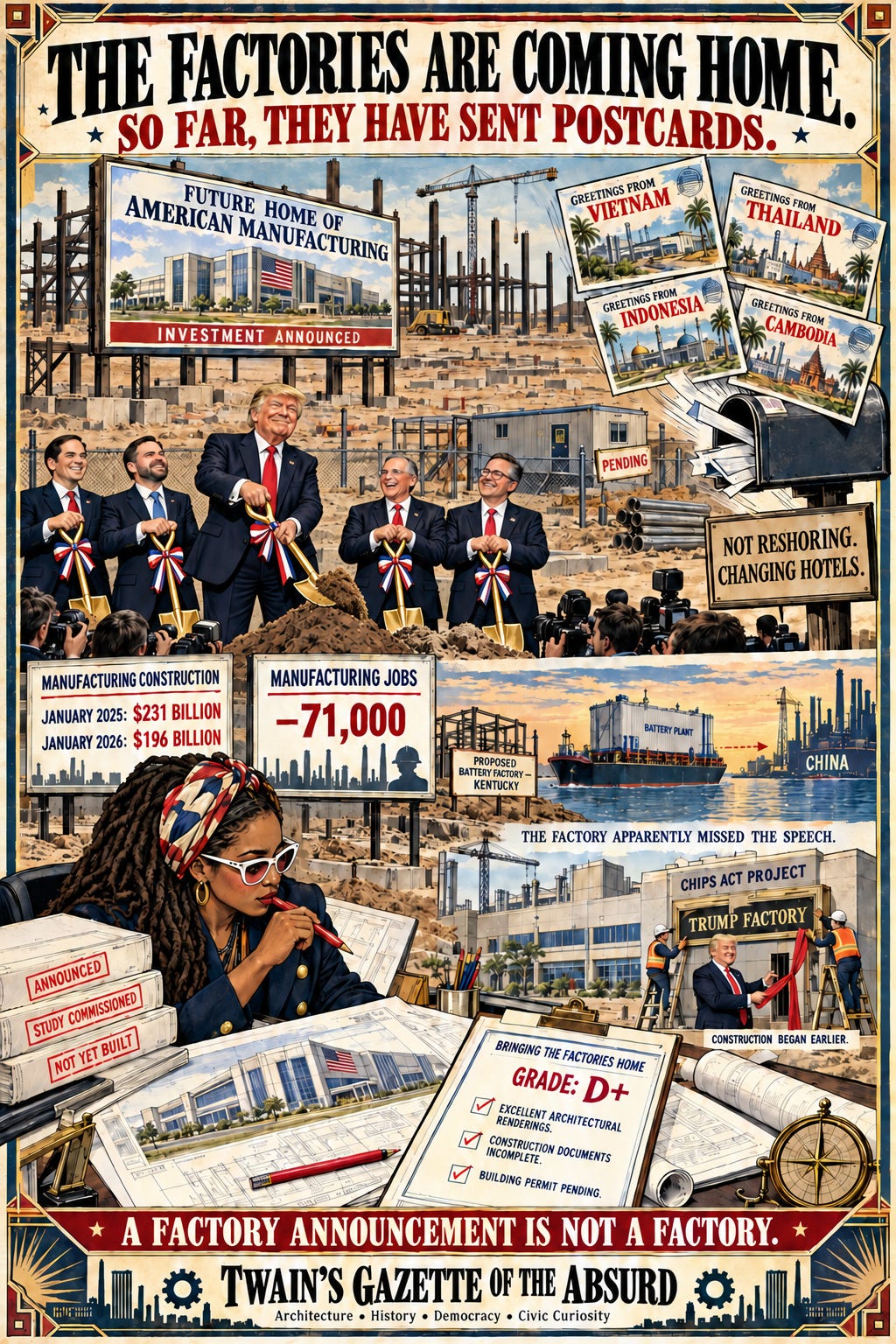
Trump promised that tariffs would bring American factories home.
So far, the factories have sent postcards.
Executives have announced investments. Foreign governments have promised investment funds. Companies have commissioned studies. Politicians have posed with ceremonial shovels on empty lots.
But manufacturing-construction spending declined from approximately $231 billion in January 2025 to $196 billion in January 2026. Manufacturing employment fell by roughly 71,000 jobs between April 2025 and March 2026.
Some companies moved production out of China.
Unfortunately, much of it moved to Vietnam, Thailand, Indonesia or Cambodia.
That is not reshoring. That is changing hotels.
Some factories now opening in America were initiated under the Biden-era CHIPS Act and related incentives. Trump may continue those projects, modify them or stand in front of them holding a pair of golden scissors. But he cannot honestly claim that every factory constructed during his presidency was conceived by his tariffs.
One American battery startup even abandoned a proposed Kentucky factory and opened its first plant in China because China had the supply chain, engineers and lower costs it needed.
The factory apparently missed the speech.
Report-card comment: Excellent architectural renderings. Construction documents incomplete. Building permit pending.
Grade: D+
Trade-negotiating leverage: B
Here Trump has a point.
The American consumer market is enormously valuable. When Trump threatens to make access to it painfully expensive, governments answer the telephone.
South Korea negotiated a 15% tariff instead of the threatened 25% and promised additional American investment and energy purchases.
Japan negotiated tariff relief alongside proposed investment and greater access for American goods.
China agreed to purchase American aircraft and agricultural products during a temporary truce.
Trump successfully brought governments to the table.
Of course, he occasionally accomplishes this by setting the table on fire and accepting congratulations when everyone agrees to use smaller candles.
Some investment promises remain vague. Some are spread over many years. Some consist of loans, purchases and guarantees rather than bags of foreign cash arriving at the Treasury. Some projects might have happened anyway.
And sometimes Trump threatens an enormous tariff, negotiates it down to a merely large tariff and declares that America has won.
That is leverage.
Whether it is durable economic policy is another question.
Report-card comment: Extremely effective at scheduling meetings. Results of meetings still being translated.
Grade: B for leverage. C− for completed work.
Cost of living: D
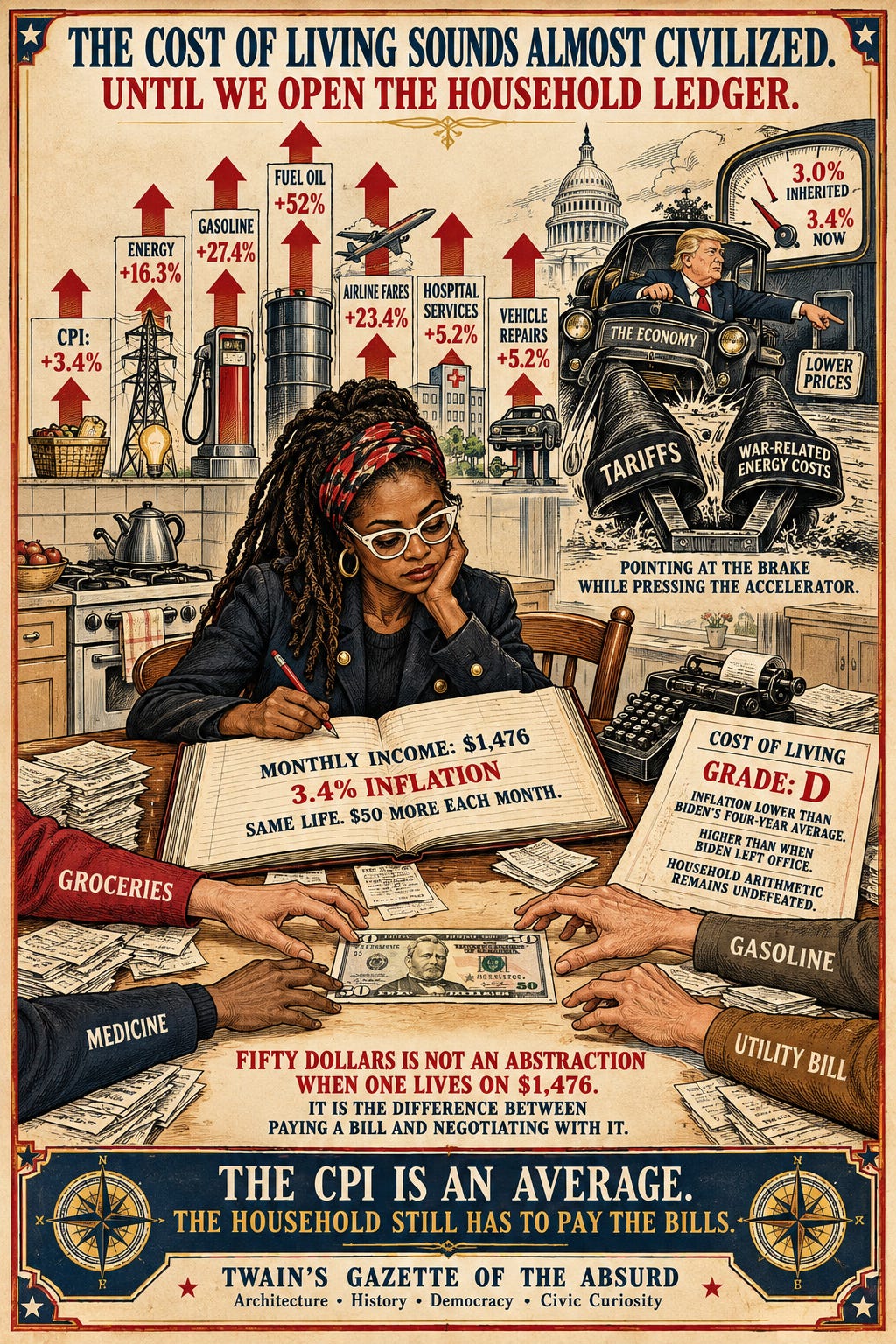
The Consumer Price Index rose 3.4% over the year ending in August 2026.
That sounds almost civilized until we open the household ledger.
Energy was up 16.3%.
Gasoline was up 27.4%.
Fuel oil was up 52%.
Airline fares were up 23.4%.
Hospital services and vehicle repairs were each up approximately 5.2%.
Trump inherited an inflation rate of 3.0%. It is now 3.4%.
That remains well below the worst inflation of the Biden years, but it is not the decline Trump promised. Tariffs and war-related energy costs are now pressing on the accelerator while the administration points proudly at the brake pedal.
For a person receiving $1,476 a month, 3.4% inflation requires approximately $50 more each month simply to purchase what the same income bought one year earlier.
Fifty dollars is not an abstraction when one lives on $1,476.
It is groceries.
It is medicine.
It is gasoline.
It is the difference between paying a bill and negotiating with it.
Report-card comment: Inflation lower than Biden’s four-year average, but higher than when Biden left office. Household arithmetic remains undefeated.
Grade: D
Gasoline: F
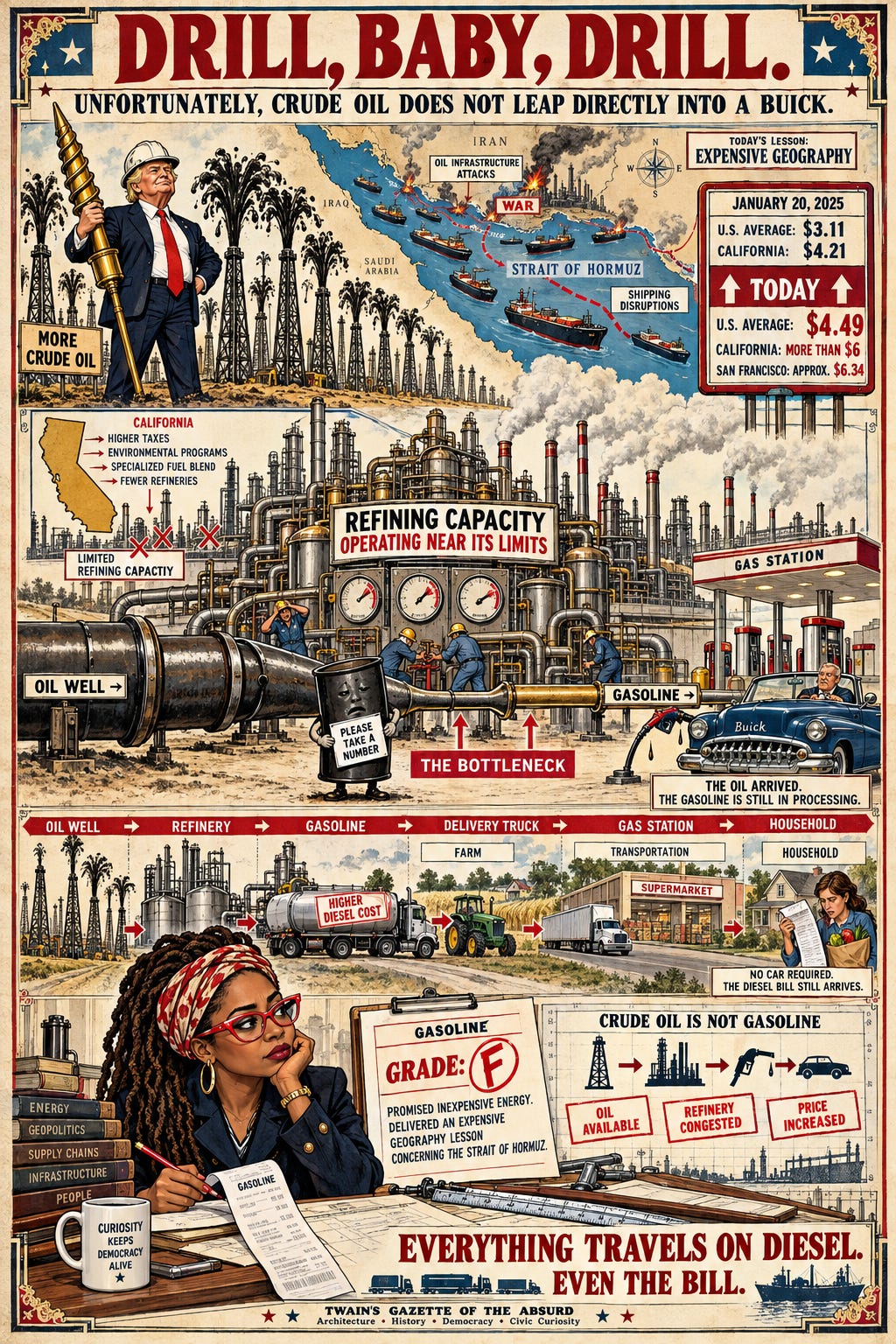
When Trump began his second term on January 20, 2025, regular gasoline averaged approximately $3.11 nationally and $4.21 in California.
Today it is approximately $4.49 nationally, more than $6 in California and roughly $6.34 in San Francisco.
Trump does not control every penny at the pump.
California has higher taxes, environmental programs, a specialized fuel blend and a refinery system held together with fewer and fewer refineries.
But the national increase is closely connected to the U.S.–Iran war, disruptions in the Strait of Hormuz, attacks on oil infrastructure and a worldwide shortage of refining capacity.
Trump’s answer has been “Drill, baby, drill.”
Unfortunately, crude oil does not leap from the ground directly into a Buick.
It must first be refined.
American refineries are already operating near their limits, and California keeps losing refining capacity. More crude oil does not immediately solve the shortage of facilities capable of turning it into gasoline and diesel.
Meanwhile, diesel costs travel everywhere.
They travel to the farm.
They travel to the supermarket.
They travel inside every truck carrying every object we buy.
Even people who do not own cars pay for diesel.
Report-card comment: Promised inexpensive energy. Delivered an expensive geography lesson concerning the Strait of Hormuz.
Grade: F
Ukraine: F
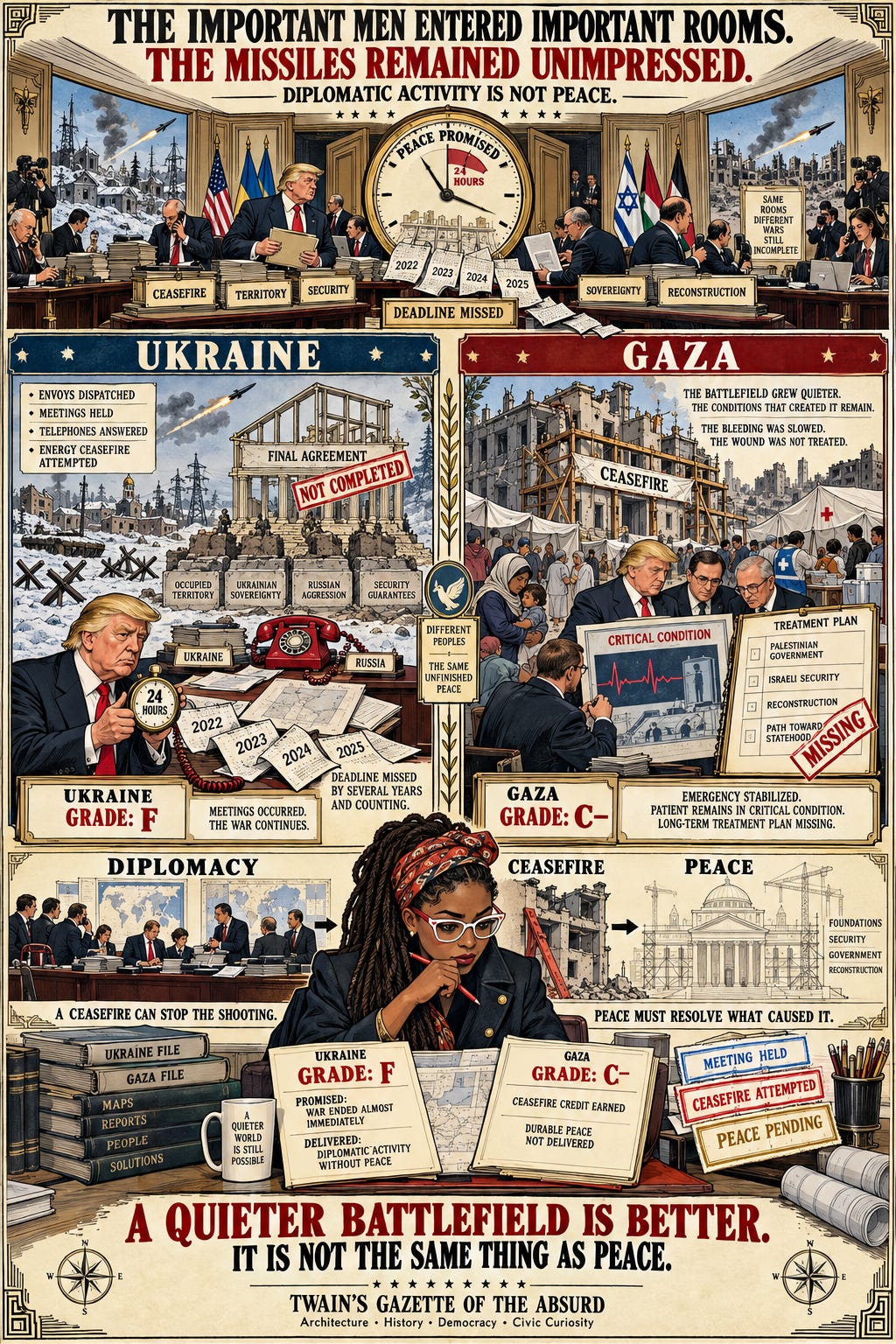
Trump said he could end the Russia–Ukraine war almost immediately.
Twenty-four hours was mentioned.
The war continues.
Trump has spoken with both sides. He has dispatched envoys. He has attempted ceasefires around energy infrastructure. Meetings have occurred. Telephones have rung. Important men have entered important rooms carrying important folders.
The missiles remain unimpressed.
No final agreement has resolved occupied territory, Ukrainian sovereignty, Russian aggression or future security guarantees.
Diplomatic activity is not peace.
It is what governments do while peace has not yet arrived.
Report-card comment: Deadline missed by several years and counting.
Grade: F
Gaza: C−
Trump deserves some credit for helping obtain a ceasefire that reduced the worst phase of open warfare.
But a ceasefire is not peace.
Palestinians continue to die.
Large portions of Gaza remain uninhabitable.
Families live in tents and bomb-damaged buildings.
Reconstruction is stalled.
No durable political agreement has established Palestinian government, Israeli security or a path toward statehood.
Trump helped quiet the battlefield without resolving the conditions that created it.
He stopped some of the bleeding.
He has not treated the wound.
Report-card comment: Emergency stabilized. Patient remains in critical condition. Long-term treatment plan missing.
Grade: C−
The Paris Agreement: F
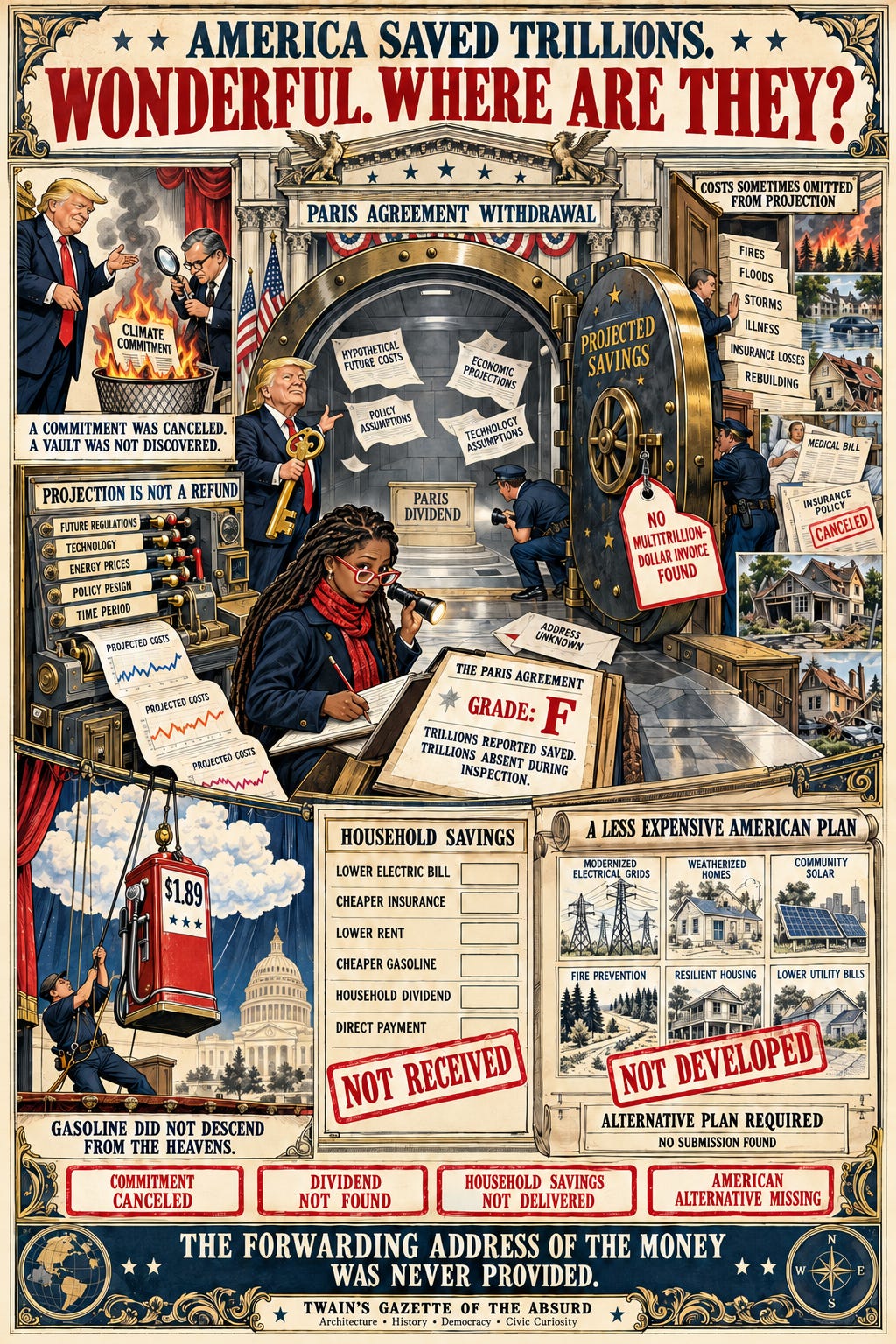
Trump says withdrawing from the Paris Agreement saved America trillions of dollars.
Wonderful.
Where are they?
The Paris Agreement did not send America a multitrillion-dollar invoice. The claimed savings are projections of economic costs that might have resulted from hypothetical future climate regulations.
Those projections change depending upon which policies are assumed, how technology develops and whether anyone bothers to count the cost of fires, floods, storms, illness, insurance losses and rebuilding.
Trump canceled a commitment.
He did not discover a vault.
Nor did Americans receive a Paris dividend.
Electric bills did not fall.
Insurance did not become cheaper.
Rent did not decline.
Gasoline did not descend from the heavens at $1.89 a gallon.
A serious alternative might have rejected the international framework while creating a less expensive American plan: modernized electrical grids, weatherized homes, community solar, fire prevention, resilient housing and lower utility bills.
Instead, we withdrew, announced that we had saved trillions and neglected to provide the forwarding address of the money.
Report-card comment: Trillions reported saved. Trillions absent during inspection.
Grade: F
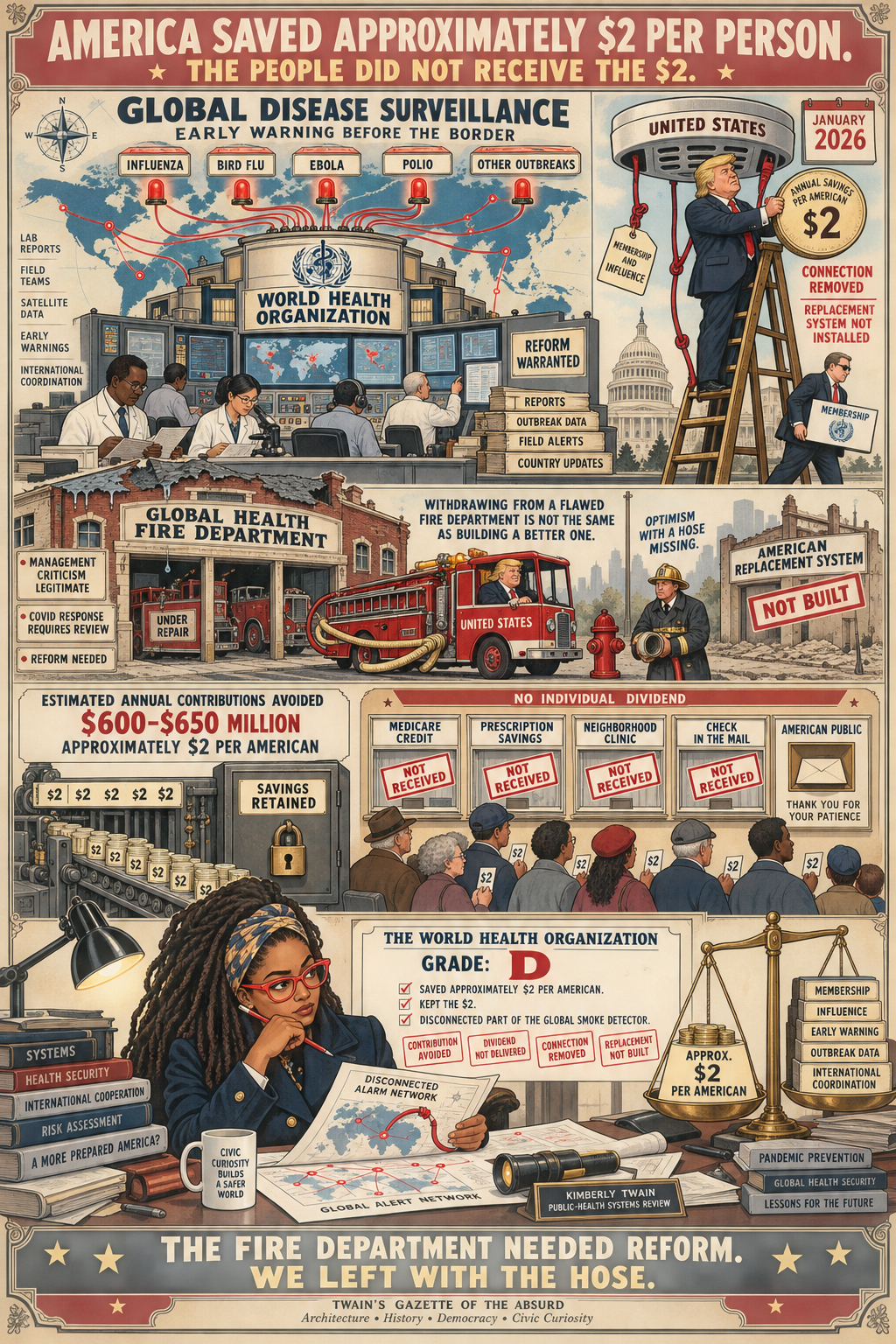
The World Health Organization: D
The United States formally withdrew from the World Health Organization in January 2026.
Based on previous contributions, the federal government may avoid spending approximately $600 million to $650 million annually.
That works out to roughly $2 per American each year.
Americans did not receive the $2.
It did not appear as a Medicare credit.
It did not lower prescription prices.
It did not fund a neighborhood clinic.
It did not arrive in the mail with a note thanking us for our patience.
In exchange, the United States surrendered membership and influence within an international system that monitors influenza, bird flu, Ebola, polio and other diseases before they reach American borders.
Criticism of the WHO’s management and COVID response is entirely legitimate. Reform was warranted.
But withdrawing from a flawed fire department without building another fire department is not reform.
It is optimism with a hose missing.
Report-card comment: Saved approximately $2 per American, kept the $2 and disconnected part of the global smoke detector.
Grade: D
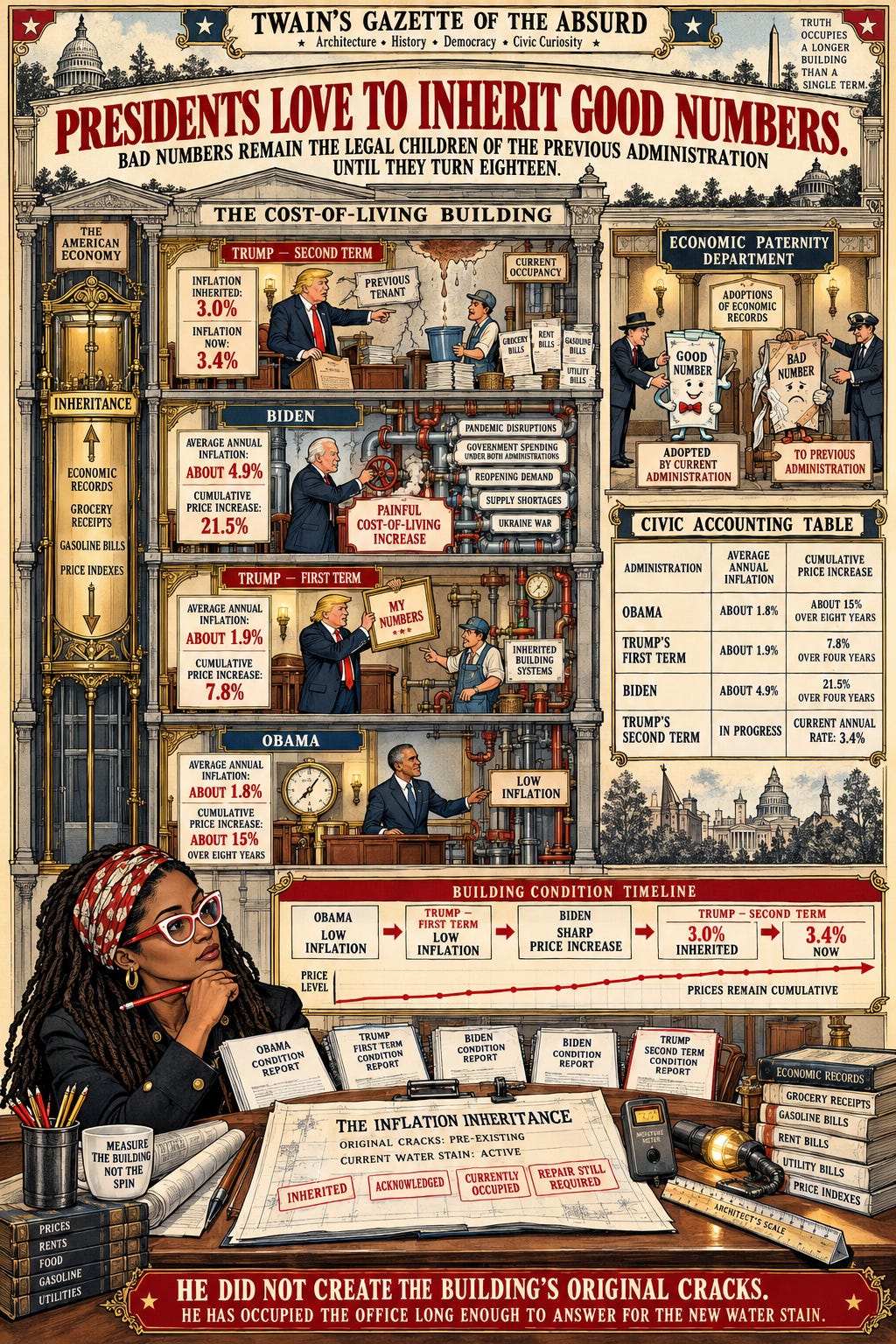
The inflation inheritance
Presidents love to inherit good numbers and adopt them immediately.
Bad numbers, on the other hand, remain the legal children of the previous administration until they turn eighteen.
Here is the actual record:
Administration
Average annual inflation
Cumulative price increase
Obama
About 1.8%
About 15% over eight years
Trump’s first term
About 1.9%
7.8% over four years
Biden
About 4.9%
21.5% over four years
Trump’s second term
In progress
Current annual rate: 3.4%
Inflation was low under Obama and during Trump’s first term.
It rose dramatically under Biden because of pandemic disruptions, enormous government spending under both administrations, reopening demand, supply shortages and the Ukraine war.
Biden unquestionably presided over a painful increase in the cost of living.
Trump inherited an inflation rate of 3.0%.
It is now 3.4%.
He did not create the building’s original cracks. But he has been occupying the office long enough to stop blaming the previous tenant for the new water stain.
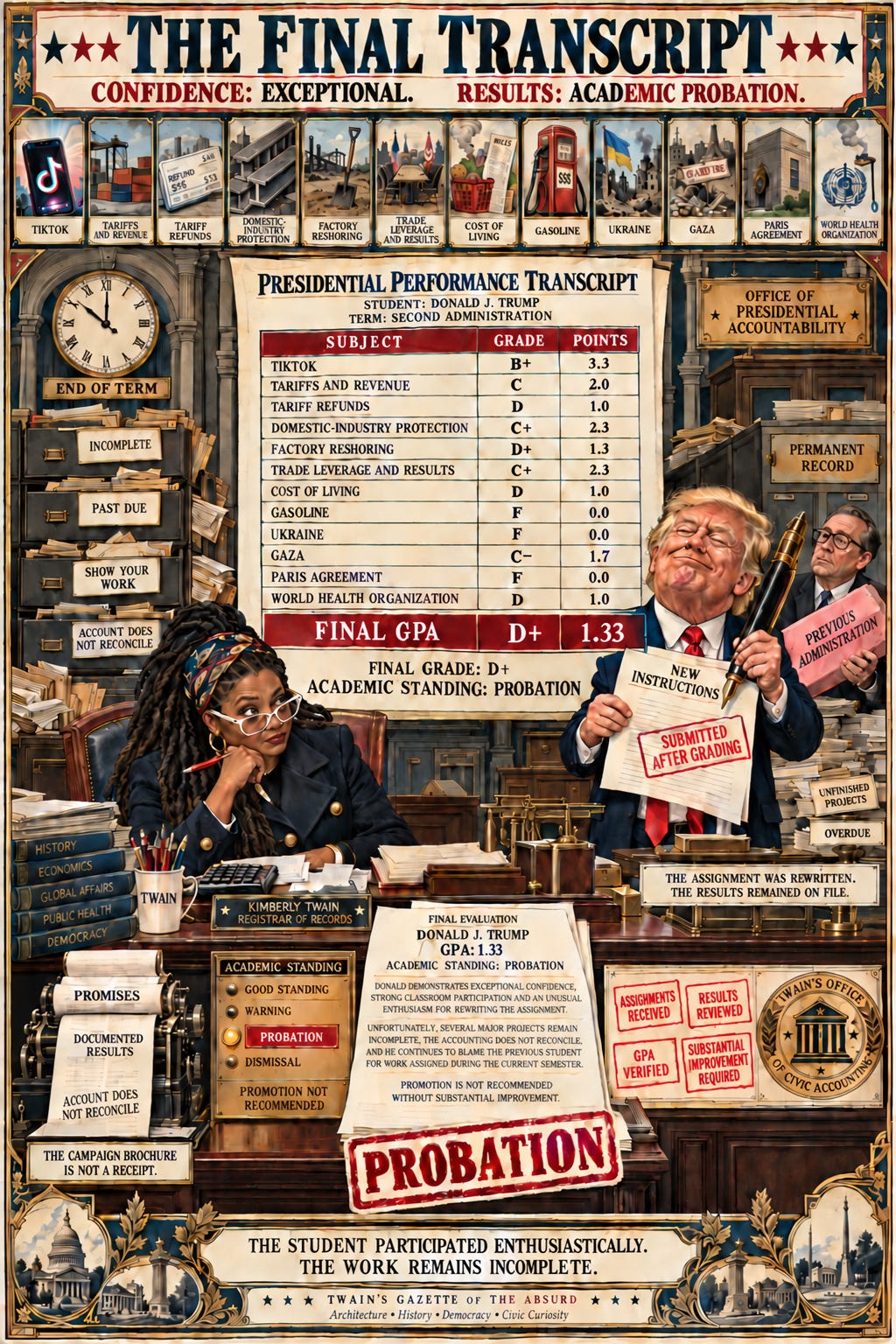
The final transcript
Using a standard four-point grading scale, Trump’s report card produces the following transcript:
Subject
Grade
Points
TikTok
B+
3.3
Tariffs and revenue
C
2.0
Tariff refunds
D
1.0
Domestic-industry protection
C+
2.3
Factory reshoring
D+
1.3
Trade leverage and results
C+
2.3
Cost of living
D
1.0
Gasoline
F
0.0
Ukraine
F
0.0
Gaza
C−
1.7
Paris Agreement
F
0.0
World Health Organization
D
1.0
Final GPA
D+
1.33
Final grade: D+
Academic standing: Probation
Trump’s clearest success is TikTok.
His tariffs raised federal revenue and created genuine negotiating leverage. They selectively protected certain industries and forced companies to reconsider their supply chains.
But the larger promises remain unfulfilled.
The factories have not returned in sufficient numbers.
Manufacturing employment has not boomed.
The wars have not ended.
Gasoline has not become cheaper.
The Paris trillions are still missing.
The WHO savings did not appear in anyone’s healthcare account.
Tariff revenue was not distributed as a public dividend.
Tariff refunds went to importers rather than necessarily reaching the consumers who absorbed the higher prices.
Donald Trump has been remarkably successful at moving money, obligations, risks and headlines around the board.
What he has not demonstrated is that the American people ended up with more.
So here is the final comment on the report card:
Donald J. Trump
GPA: 1.33
Academic Standing: Probation
Donald demonstrates exceptional confidence, strong classroom participation and an unusual enthusiasm for rewriting the assignment. Unfortunately, several major projects remain incomplete, the accounting does not reconcile, and he continues to blame the previous student for work assigned during the current semester. Promotion is not recommended without substantial improvement.
Donald Trump promised to make foreign countries pay.
So far, the American people have been picking up a surprising amount of the check.
And there we have it.
The speech received an A.
The work did not.
Luv,
KT
A devastating report. Fail
Time to leave the class