

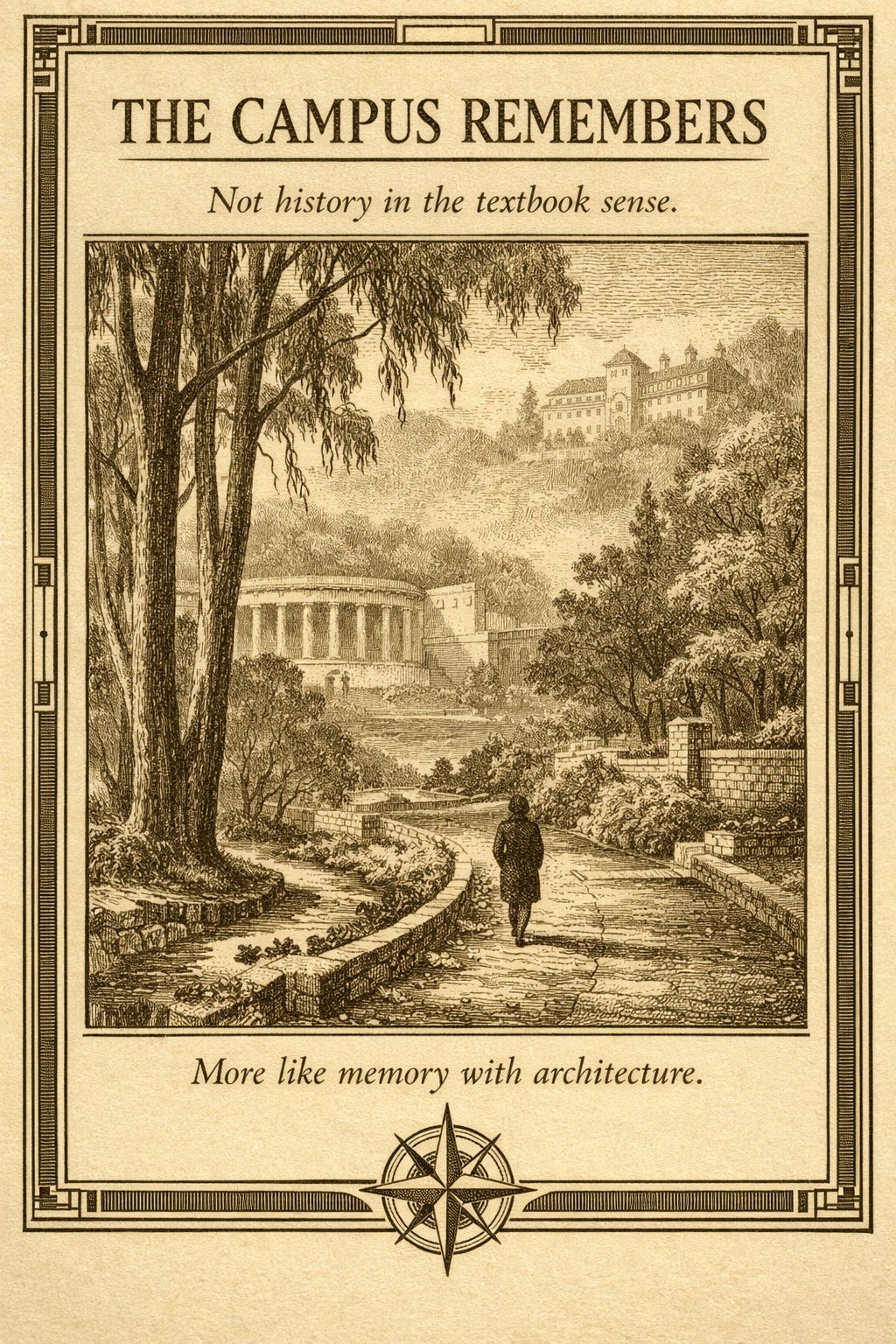
On certain afternoons in Berkeley, if the fog behaves and the eucalyptus hold their perfume like seasoned actors, you can walk past the Greek Theatre and feel that the campus is quietly remembering things.
Not history in the textbook sense.
More like memory with architecture.
There is the Greek Theatre, funded by Phoebe Apperson Hearst, still open to the sky and whatever guitar happens to wander onto the stage. Above it sits Bowles Hall, a stone fortress gifted to the university in 1929 by a woman who apparently believed that students should live inside something that looked morally serious. Down the slope today, fencing creeps along sidewalks, roads close without apology, and cranes hover like long-necked birds waiting for instructions.
It is one hillside.
But it contains several species of wealth.
I walk this stretch often, and lately I have begun to suspect that the buildings are engaged in a quiet argument about what money is supposed to do once it becomes too large for its owner’s pockets.
🏛️🧱 The civic builder
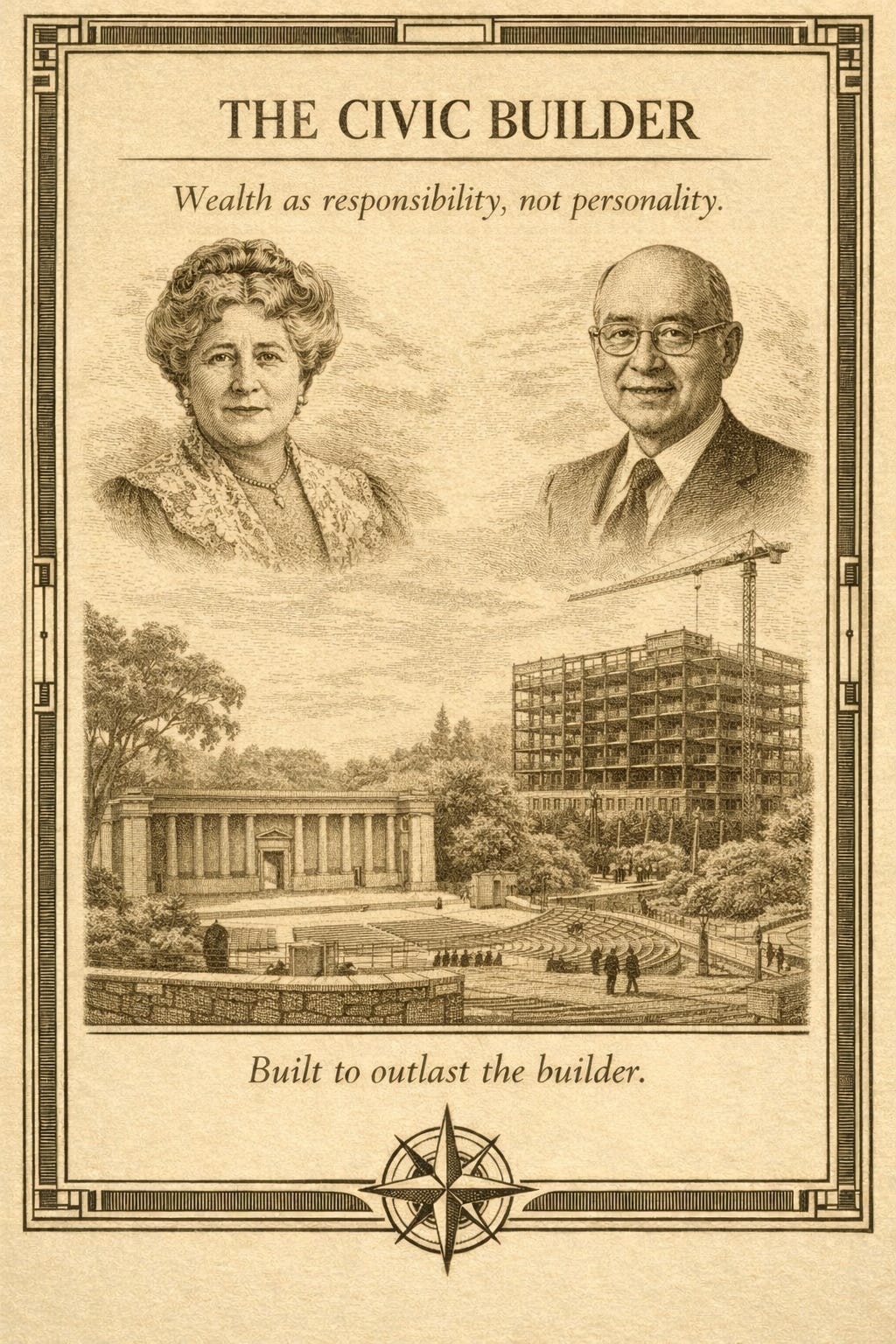
Phoebe Hearst belonged to that robust class of donors who treated wealth as a responsibility rather than a personality. She did not fund institutions so they would repeat her opinions. She funded them so they would exist.
She built libraries, schools, university buildings, and a theater open to the public air. Once completed, these structures went about their business without consulting her. A century later, thousands of people sit in the Greek Theatre each year without the faintest curiosity about what Mrs. Hearst would have thought of the program.
That is the peculiar virtue of civic-minded philanthropy:
it creates something strong enough to forget you.
Bowles Hall, sitting uphill like a medieval conscience, reflects a similar instinct. It was built as a gift to the university, not as a personal megaphone. Students live there now with only a passing awareness of who paid for the stone. The building has successfully escaped its donor.
In our own time, the global supply-chain magnate Victor Fung has funded universities and research initiatives with a comparable sensibility. His philanthropy tends toward educational infrastructure and knowledge exchange rather than personal spotlight. He builds frameworks and then, admirably, refrains from hovering over them like a stage manager with opinions.
These donors appear to share a radical thought:
Perhaps the point of giving is not to remain visible afterward.

🎙️📰 The narrative age
Our present era, however, has developed a fondness for donors who prefer not to exit the stage.
Some of today’s wealthiest figures operate not only as philanthropists but as proprietors of the channels through which public life is narrated. Jeff Bezos owns a newspaper. Rupert Murdoch owns enough of them to start a small weather system. Both have given money to various causes. Yet their most consequential acts of generosity sit comfortably alongside ownership of platforms that shape what the public knows and how it knows it.
There is a difference between endowing a library and owning the printing press inside it.
One invites voices.
The other curates them.
This is not a tidy morality play. Earlier philanthropists were not saints, and modern billionaires are not required to wear villain capes. But the architecture of influence has shifted. Wealth that once sought legitimacy by building shared civic space now often seeks it by shaping the story of that space.
One builds the amphitheater.
The other owns the microphone and the lighting grid.
🌩️💰 The psychological weather of great wealth
Extreme wealth produces a certain atmospheric condition around the person who possesses it. Doors open. Disagreement thins out. People nod. Over time, it becomes possible to conclude that one’s judgment is not merely strong but historically necessary.
Earlier generations of donors operated within a social expectation that visible contributions to public life mattered. If you had made a fortune, you were expected to leave behind a library, a school, a park, or at the very least a respectable fountain. Wealth required architecture.
Today’s fortunes are more mobile and less attached to place. They drift across global markets and digital networks. And when wealth is not anchored to a particular city, the urge to build something that belongs entirely to that city can weaken. The urge to influence how the city understands itself can grow stronger.
The result is a new philanthropic posture:
generous, certainly — but seated comfortably near the controls.
🚶🏾♀️⛰️ A walk uphill
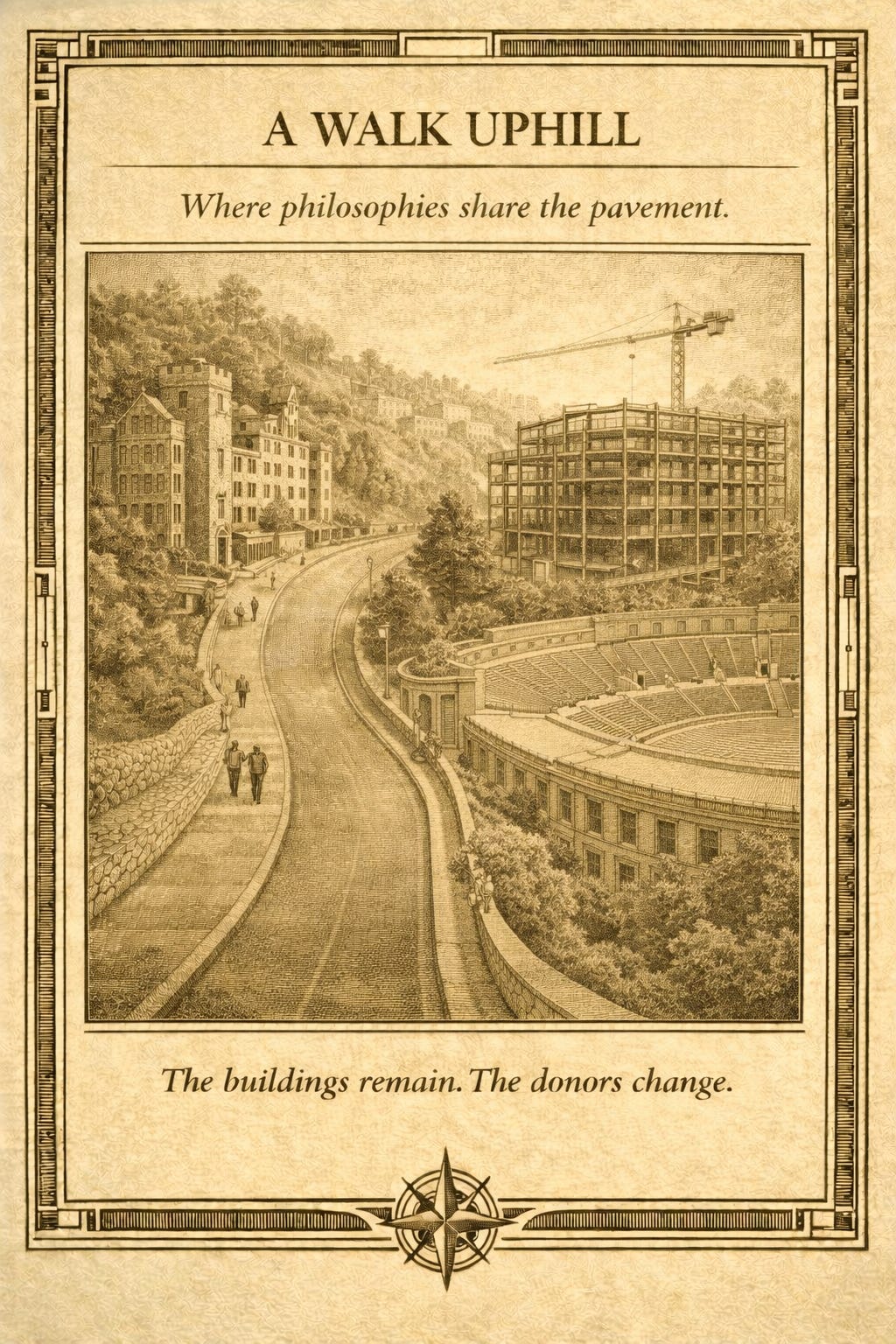
Walk up Gayley Road now and you can feel these philosophies sharing a narrow stretch of pavement. Bowles Hall continues to loom with medieval composure. The Greek Theatre continues to host concerts without consulting any donor’s editorial preferences. Across the street, new construction advances in phases funded by modern campaigns, global capital, and institutional borrowing.
Universities have always relied on private wealth. That is not new. What has changed is the donor’s relationship to visibility.
Does the donor build something and step back?
Or build something and remain in the control room?
The earlier model leaned toward disappearance. The newer one sometimes leans toward permanent presence. Both will continue. But the balance between them will shape the cultural life of our institutions.
📜🏛️ A modest civic request
The Berkeley hillside offers a quiet demonstration of what happens when philanthropy ages well. The Greek Theatre still belongs to everyone. Bowles Hall houses students who may never know who funded its stone. This is not a failure of memory. It is a triumph of public life.
To build something that eventually forgets you is a rare civic grace.
As cranes rise and institutions negotiate with modern wealth, one hopes for a revival of that grace. Not nostalgia. Just restraint. A willingness to fund culture without narrating it.
Build the theater.
Fund the studio.
Endow the library.
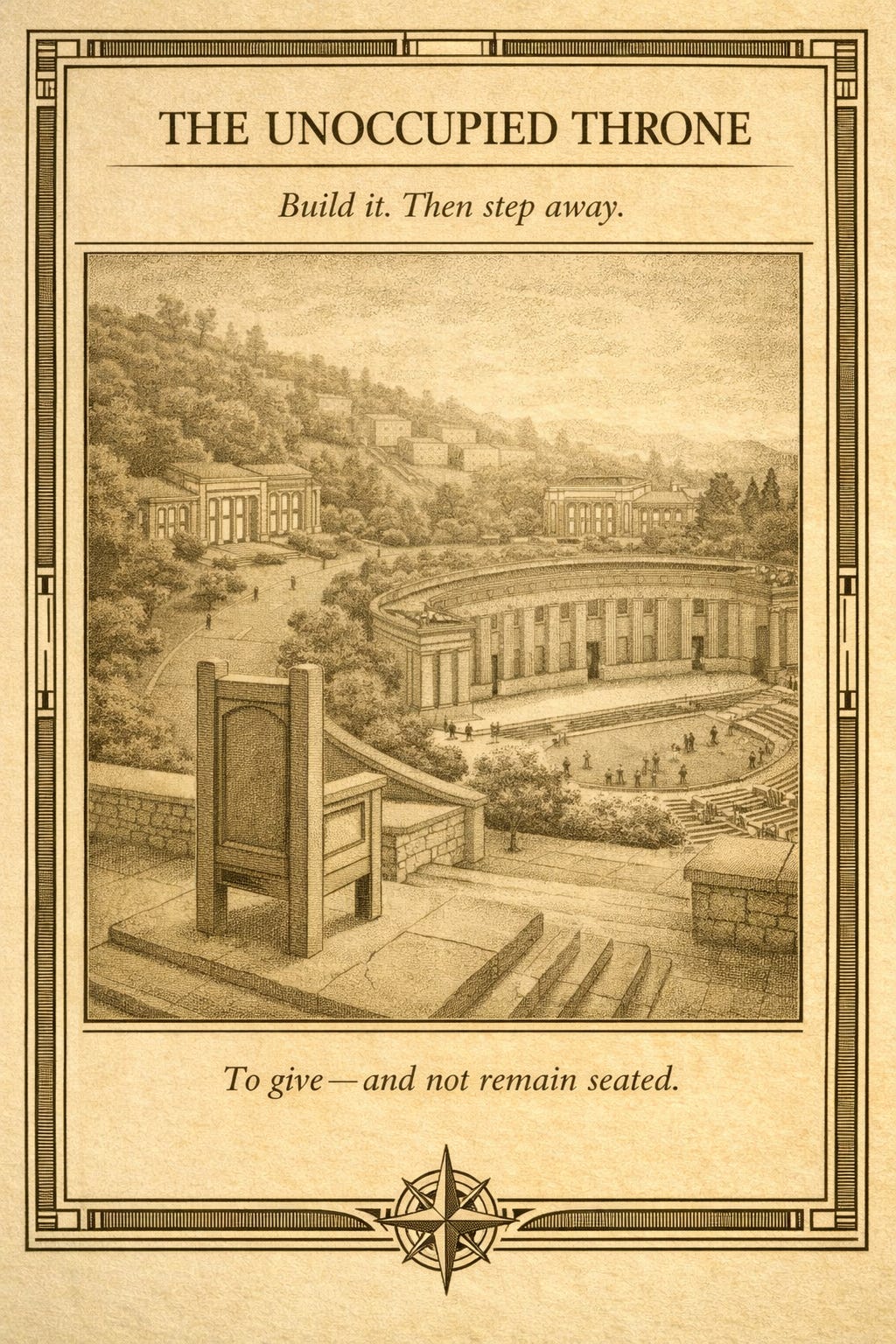
Then resist the temptation to sit on the throne you just paid for.
The hillside above the Greek Theatre still has room for benefactors.
What it needs are donors who can bear the almost unbearable act of building something and then allowing it to belong to everyone else.