

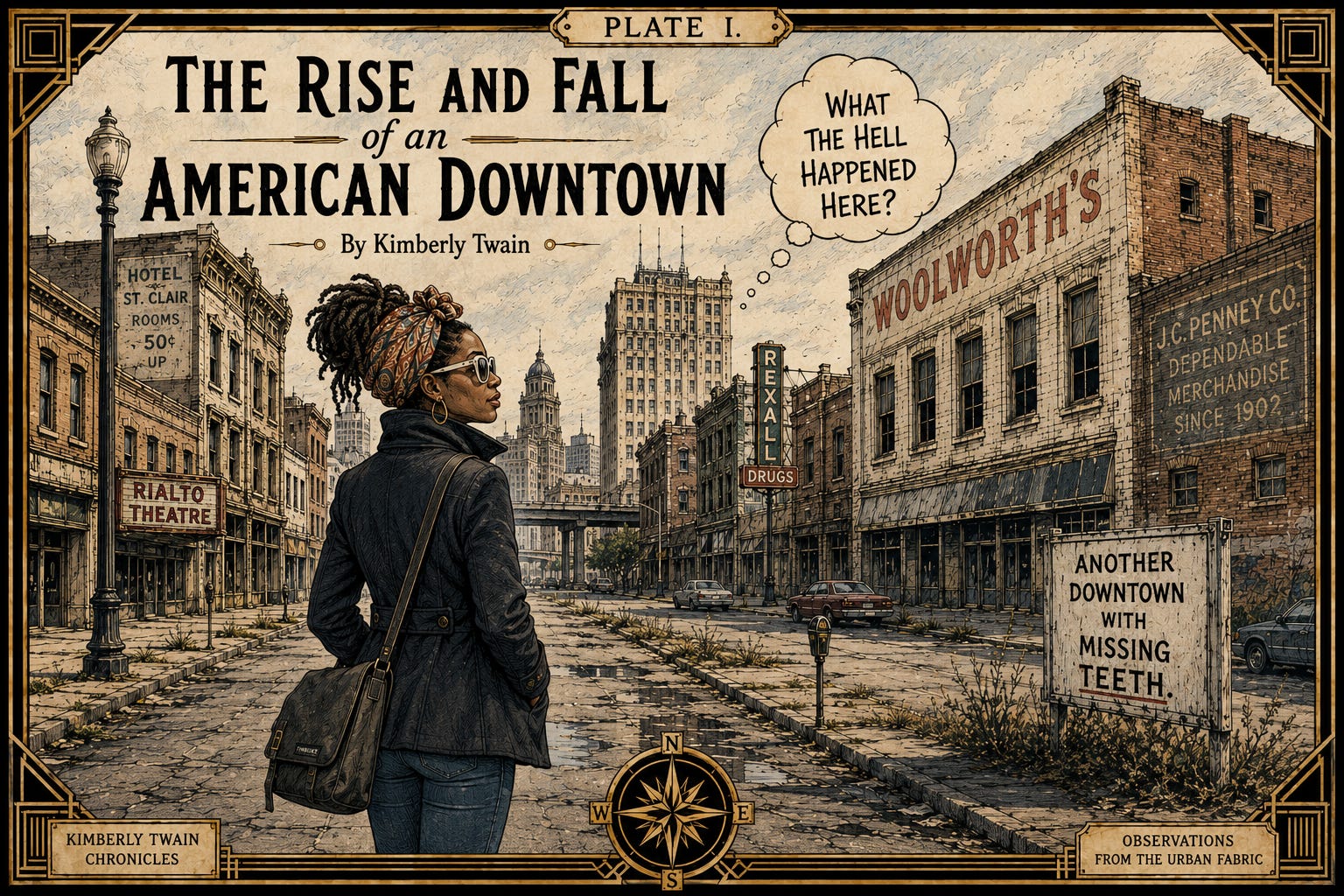
There is an old American habit of looking at a downtown after we have spent fifty years dismantling it and asking:
What the hell happened here?
We do this with considerable innocence.
We stand in front of an empty department store, surrounded by parking lots where buildings used to be, beside a freeway that demolished half the neighborhood, and wonder how the place got this way.
It’s a mystery.
Call somebody.
Architects are considerably less innocent.
Once you’ve gone to architecture school, something unfortunate happens to your eyesight. You never quite see the world normally again.
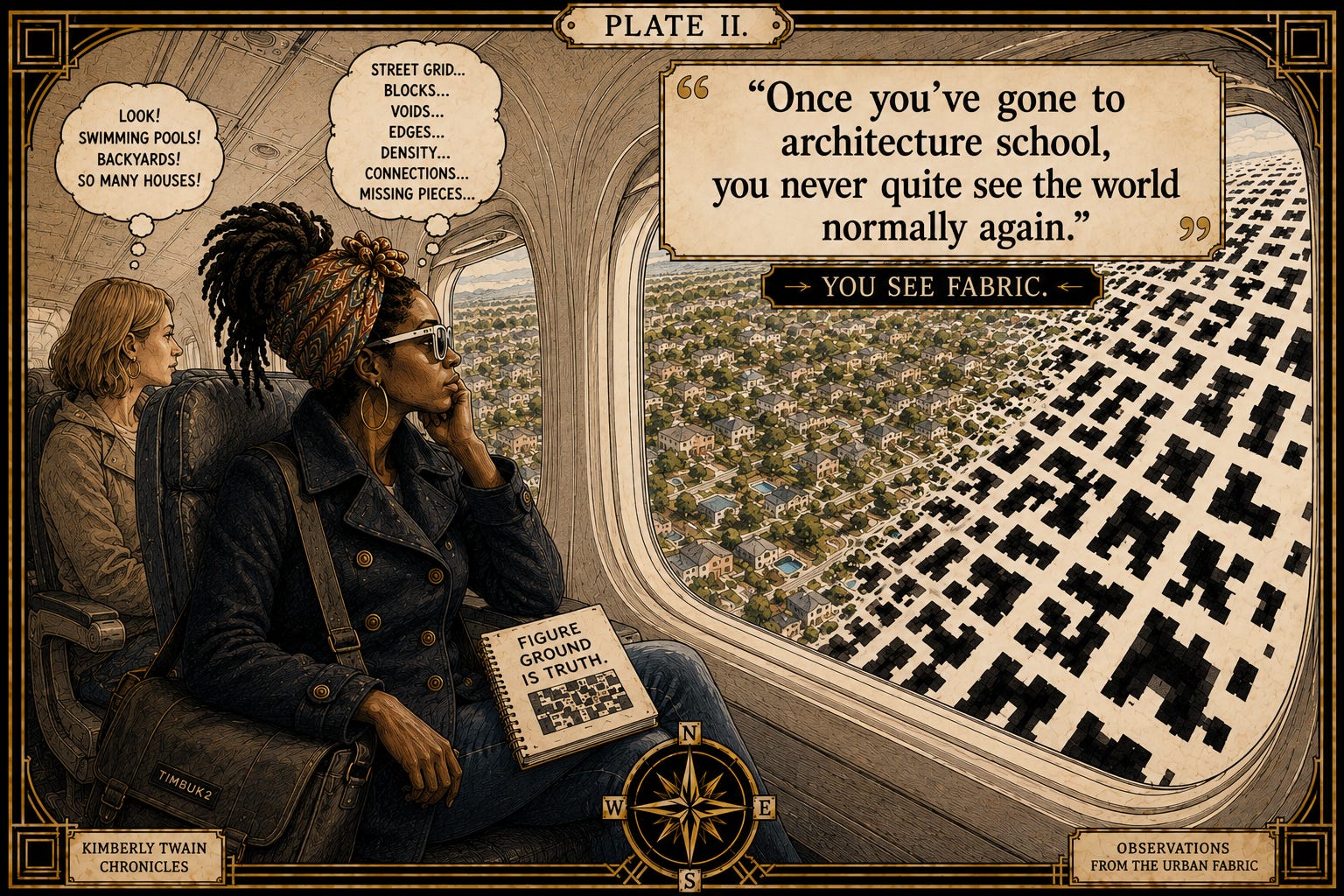
You fly over a city in an airplane and everybody else sees houses.
You see fabric.
Your companion is looking out the window saying, “Look at the swimming pools!”
You’re thinking, Interesting. The nineteenth-century street grid terminates right there.
This is what architecture school does to a person.
You walk through Rome, Berlin, Detroit, Oakland or Stockton and somewhere in the back of your mind you are drawing.
Blocks.
Voids.
Edges.
Streets.
Density.
Interruptions.
Missing pieces.
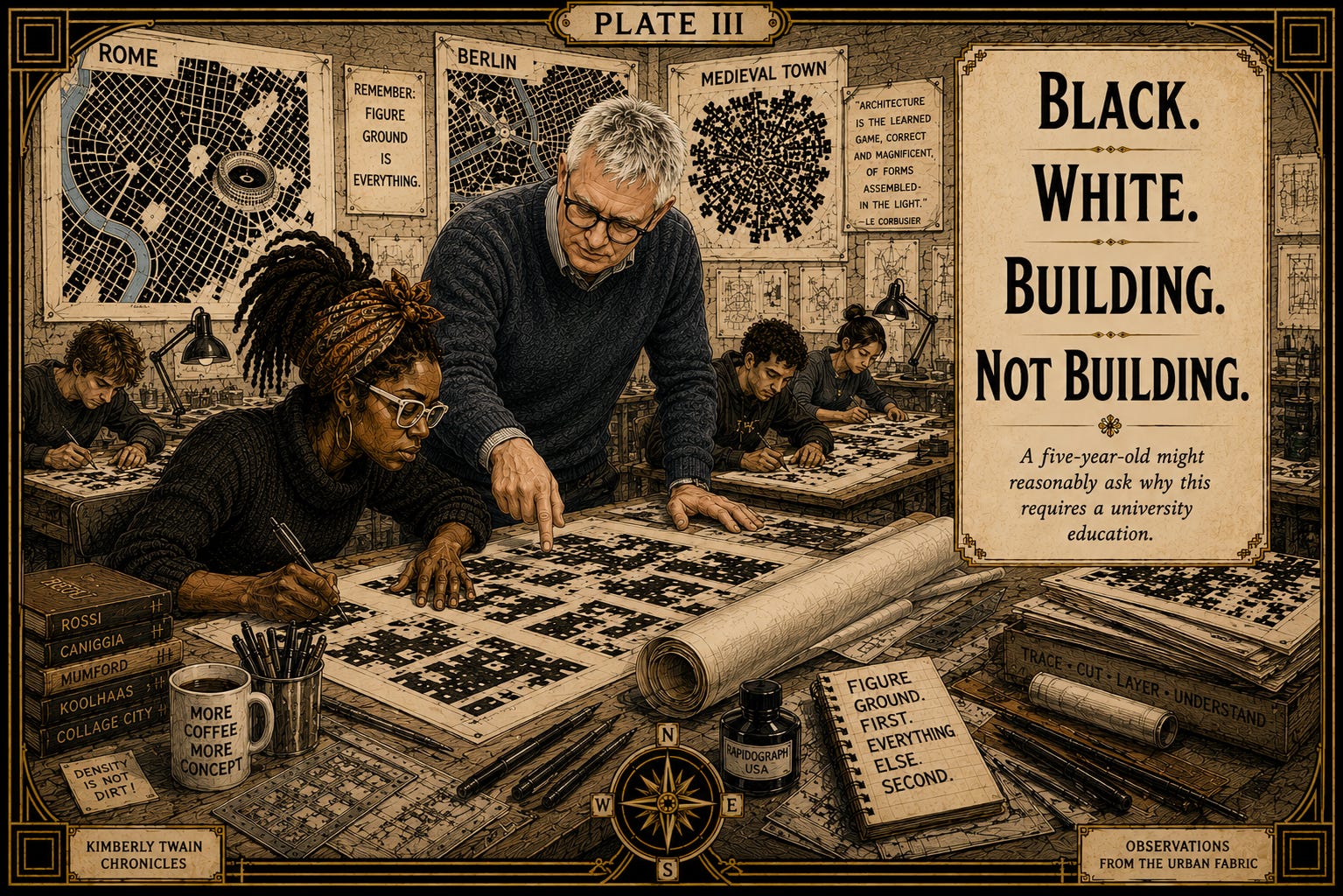
My professor, mentor and friend John G. Ellis loved figure-ground drawings. In our first architecture studios, he taught us their importance.
We drew them constantly.
For the uninitiated, a figure-ground drawing is one of architecture’s great tricks because it looks almost insultingly simple.
Buildings are black.
Everything that isn’t a building is white.
That’s about it.
Black.
White.
Building.
Not building.
A five-year-old might reasonably ask why this requires a university education.
But there may be no drawing more revealing about a city.
We drew medieval towns. Rome. Berlin. European cities whose names and street patterns I have long since forgotten.
At first, they meant very little to me.
Fine.
Rome has buildings.
I had suspected as much.
Then we began drawing American cities.
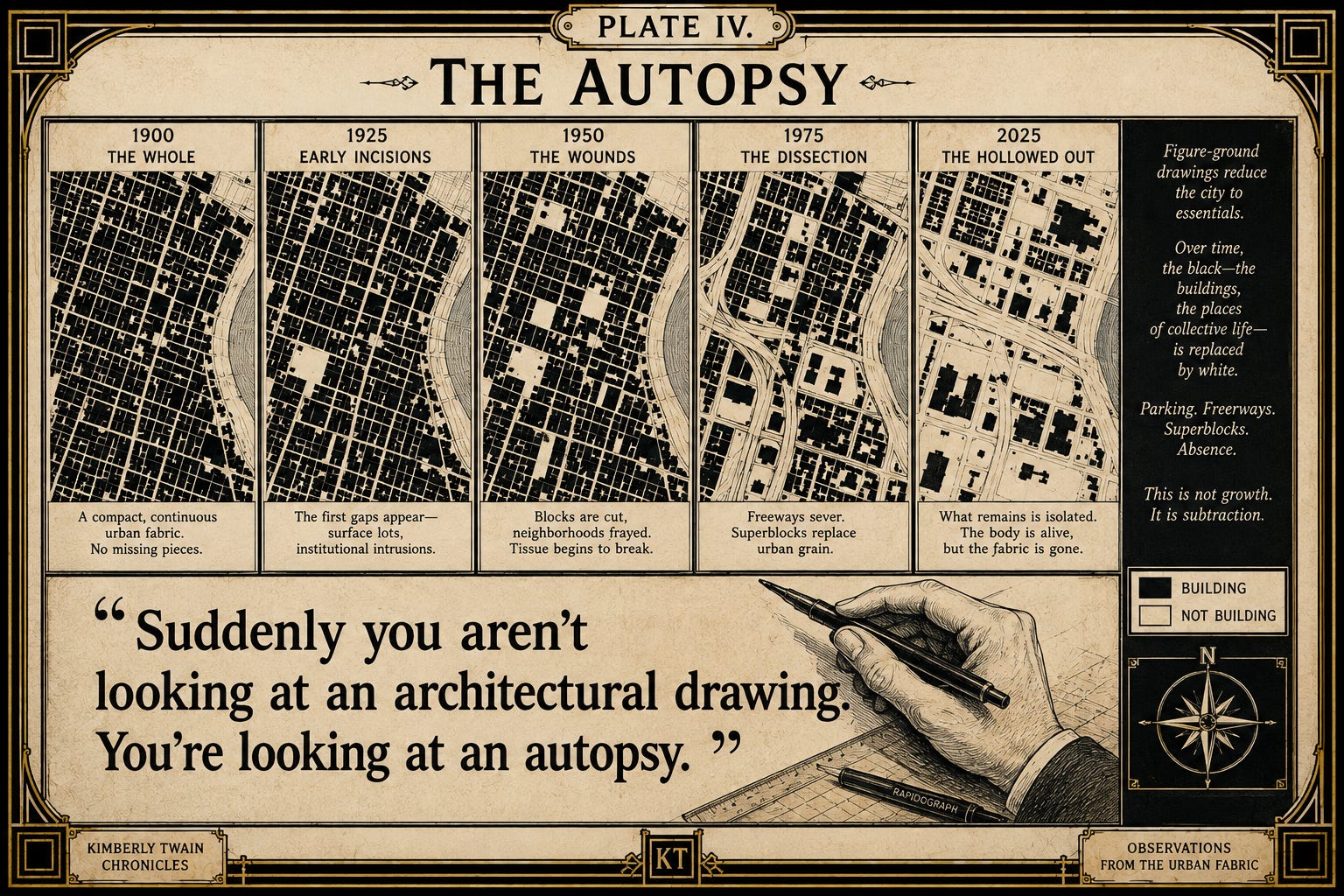
More importantly, we drew them over time.
Draw the same downtown in 1900.
Then 1920.
Today.
Now something happens.
Suddenly you aren’t looking at an architectural drawing.
You’re looking at an autopsy.
The black begins disappearing.
A building goes.
Then another.
A street gets wider.
A freeway arrives.
Parking lots appear.
Whole blocks lose their edges.
The dense black fabric begins developing white holes.
Then larger holes.
Then enormous ones.
The city begins losing teeth.
And once architecture school teaches you to see those missing teeth, you’re ruined.
You see them everywhere.
Detroit.
Cleveland.
Buffalo.
Oakland.
Vallejo.
Stockton.
After enough years of this, I don’t even need the drawing anymore.
I make figure grounds in my head
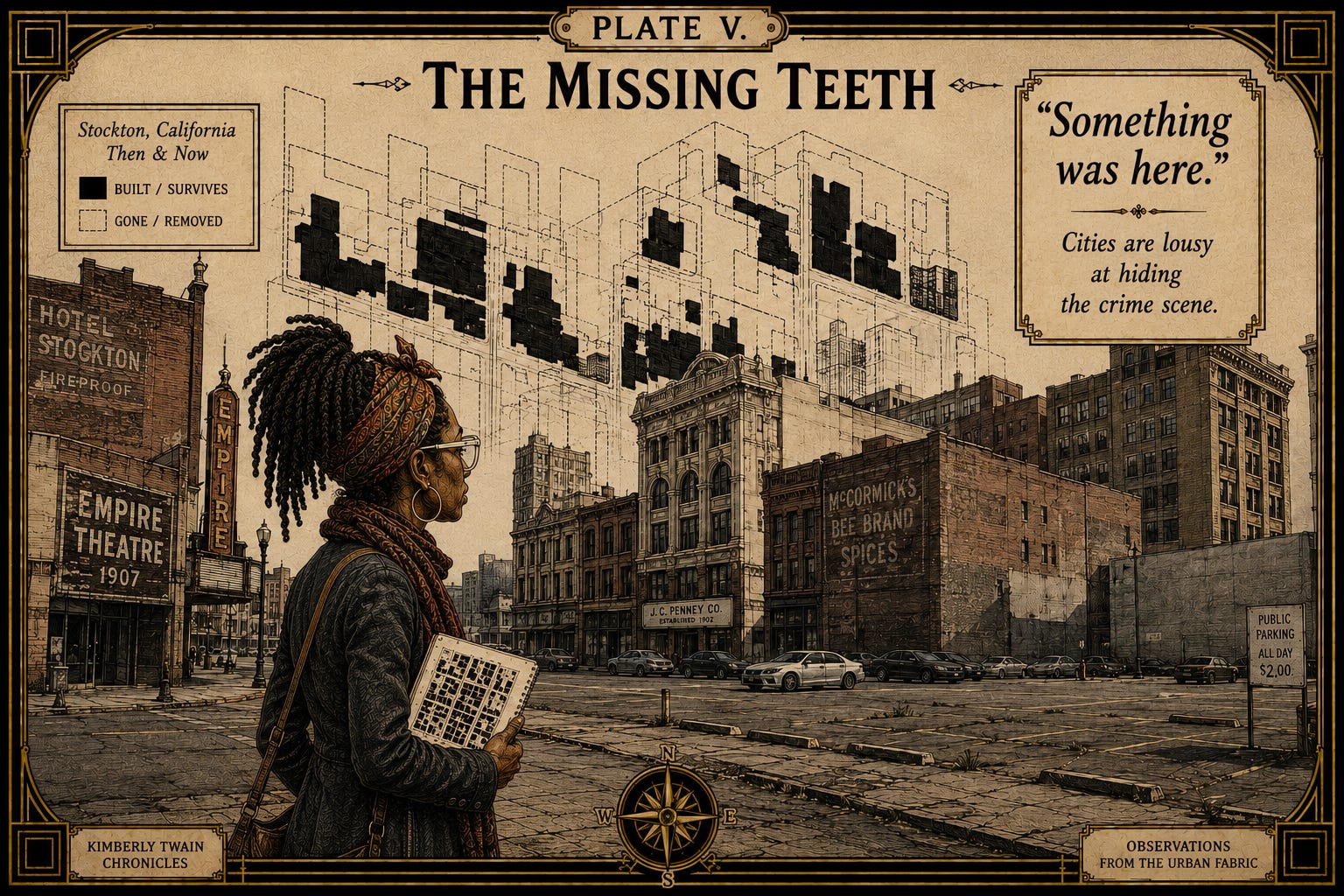
.
I walk down a street and think:
Something was here.
A parking lot occupying half a block tells you something.
A beautiful commercial building standing alone tells you something.
A blank brick wall facing an empty parcel tells you that nobody who designed that wall expected you to be looking at it.
That wall had a neighbor.
Where did the neighbor go?
Now we’re investigating.
The buildings survive.
They stand there waiting for the civilization that built them to come back.
That was when I wanted to go home and pull my copy of Jane Jacobs’s The Death and Life of Great American Cities off the shelf again.
Because Jacobs understood something astonishingly simple.
Cities require people.
Not cars.
Not development plans.
Not decorative banners attached to lampposts.
People.
And not merely consumers.
People with somewhere to be.
That distinction may explain more about the death of the American downtown than almost anything else.
Architecture leaves evidence.
Cities are lousy at hiding the crime scene.
And the last time I experienced this strongly was walking through downtown Stockton.
There it was again.
The pattern.
The missing teeth.
The surviving buildings standing around like witnesses who had been waiting fifty years for somebody to ask them what happened.
And then I saw the Woolworth’s.
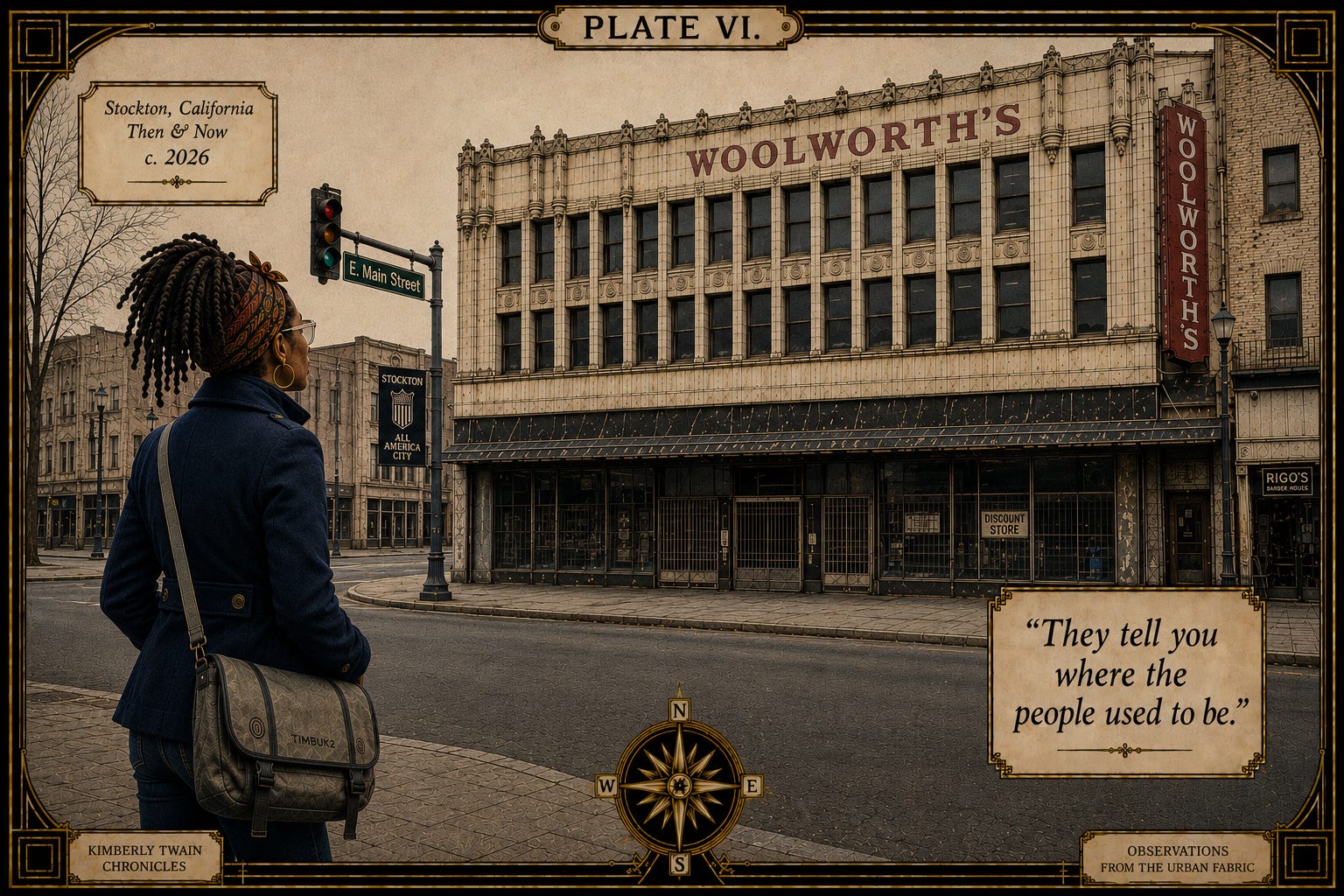
The Woolworth’s
Nothing tells the story of an old American downtown quite like a Woolworth’s.
Maybe a Rexall drugstore.
Find either one and you have found an archaeological layer of American civilization.
Somewhere nearby there was probably a bank.
A theater.
A hotel.
A jeweler.
A shoe store.
A barber.
A lunch counter.
A newspaper stand.
Probably a Sears or JCPenney.
And naturally a bar, because civilization requires a little propping up.
There it stood in Stockton.
The Woolworth’s.
Beautiful.
Empty.
Its original architecture was still recognizable, and high on the building the old lettering remained, faded by years of Central Valley sun.
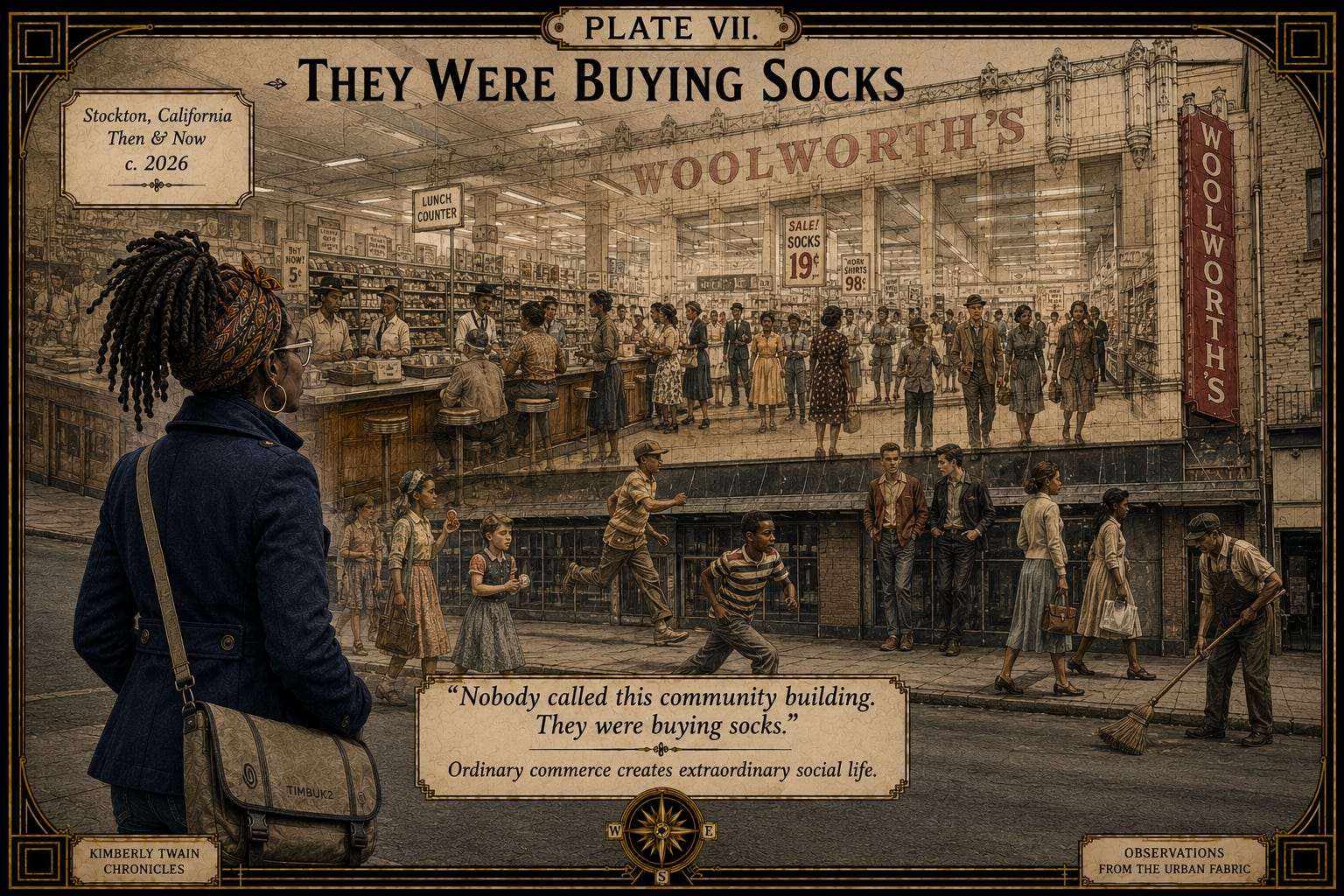
WOOLWORTH’S.
I stopped.
That’s what triggered this essay.
Because I wasn’t looking at an abandoned store anymore.
I was looking at evidence.
Suddenly I could make the old figure ground in my head.
I could see the storefronts continuing down the block.
I could see people on the sidewalks.
I could see the city that belonged to that Woolworth’s.
Somebody once unlocked those doors every morning.
Somebody swept the sidewalk.
Somebody arranged merchandise in the windows.
Someone worked the register.
Someone sat behind the lunch counter.
Children came in clutching coins.
Teenagers wandered the aisles.
Women bought household goods.
Workers stopped in during lunch.
People bumped into neighbors.
People bumped into strangers.
People probably bumped into people they were trying to avoid.
That’s a city too.
Nobody called any of this “community building.”
They were buying socks.
And perhaps that is one of the great things we’ve forgotten about cities.
Ordinary commerce creates extraordinary social life.
Woolworth’s didn’t have a Director of Community Engagement.
It didn’t hire consultants to develop an activation strategy.
It opened the doors.
People came in.
The people created the community.
Now the customers are gone.
The lettering remains.
The architecture remains.
And that may be more haunting than demolition.
Demolish a building and eventually people forget it existed.
Leave it standing empty and it becomes an accusation.
Look what used to happen here.
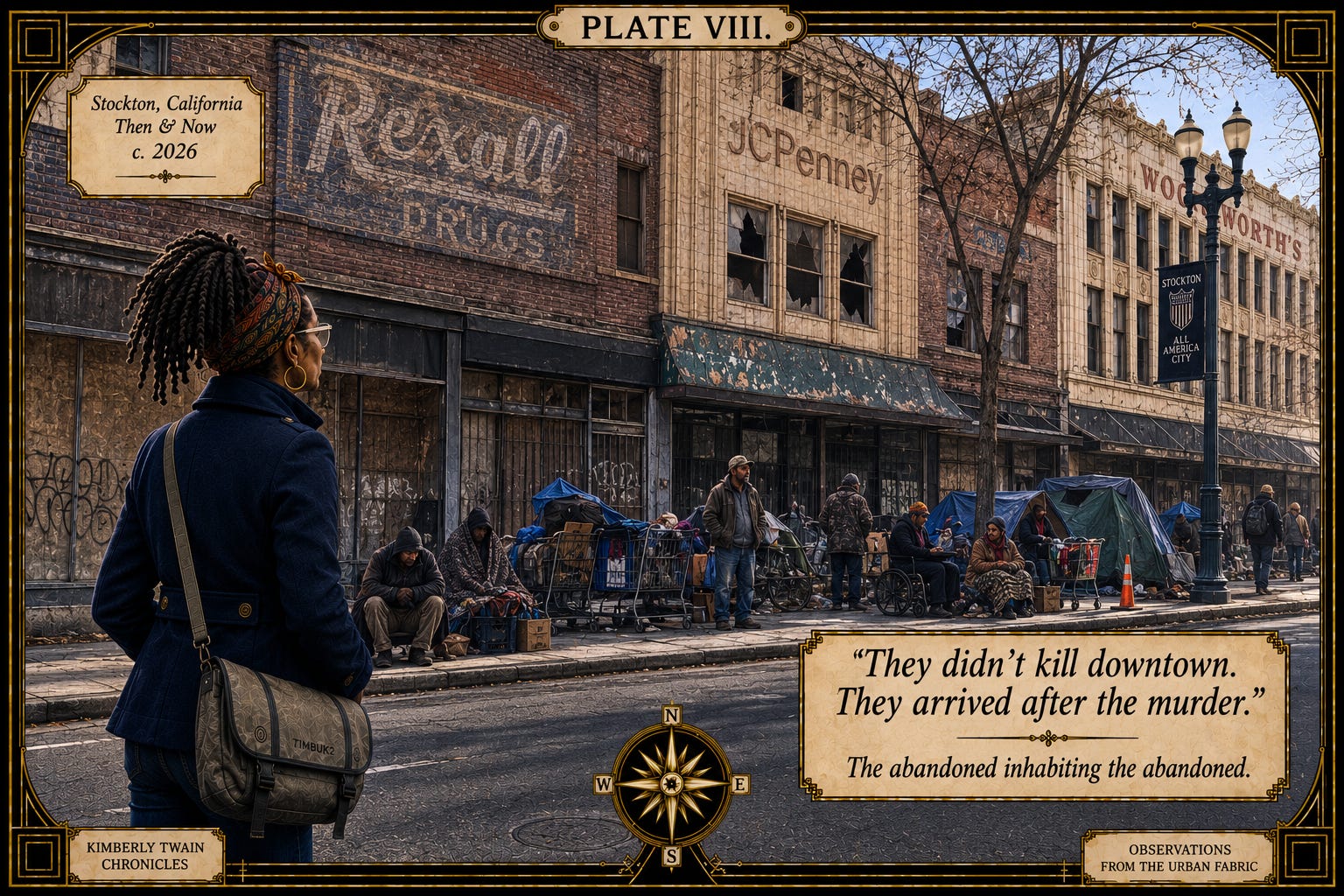
The Abandoned Inhabiting the Abandoned
And then the metaphor of urban decay becomes uncomfortable because the decay isn’t confined to buildings.
When ordinary city life leaves, the vacuum doesn’t remain empty.
The merchants leave.
The office workers leave.
The shoppers leave.
The families leave.
The lights go out.
And into the spaces abandoned by prosperous society come many of the people prosperous society has also abandoned.
People addicted to drugs.
People suffering from mental illness because they had to fight in a war.
People sleeping in doorways.
People carrying everything they own.
People living amid garbage and human waste.
There is something obscene about a society wealthy enough to construct enormous buildings and apparently too bewildered to provide a toilet for the human being sleeping beside one.
All the things we don’t particularly want to look at collect in the places we’ve decided not to look at.
Addiction.
Poverty.
Mental illness.
Violence.
Prostitution.
Desperation.
The death and decay become more than metaphor.
It begins to resemble a kind of bacterial growth in the wounds of the city, except the “bacteria” are people.
And that is precisely the horror.
The people are decaying alongside the buildings.
But they didn’t kill downtown.
They arrived after the murder.
We removed the jobs.
We removed the stores.
We removed the customers.
We demolished buildings.
We punched holes through neighborhoods.
We moved commerce to shopping centers.
We moved families to subdivisions.
We moved public life elsewhere.
Then the people for whom society could find no place arrived in the places for which society could find no use.
The abandoned inhabiting the abandoned.
And then we drove past, rolled up the windows and said:
See? That’s why nobody goes downtown.
There is a magnificent bit of American logic for you.
First, Somebody Had to Build the Damn Thing
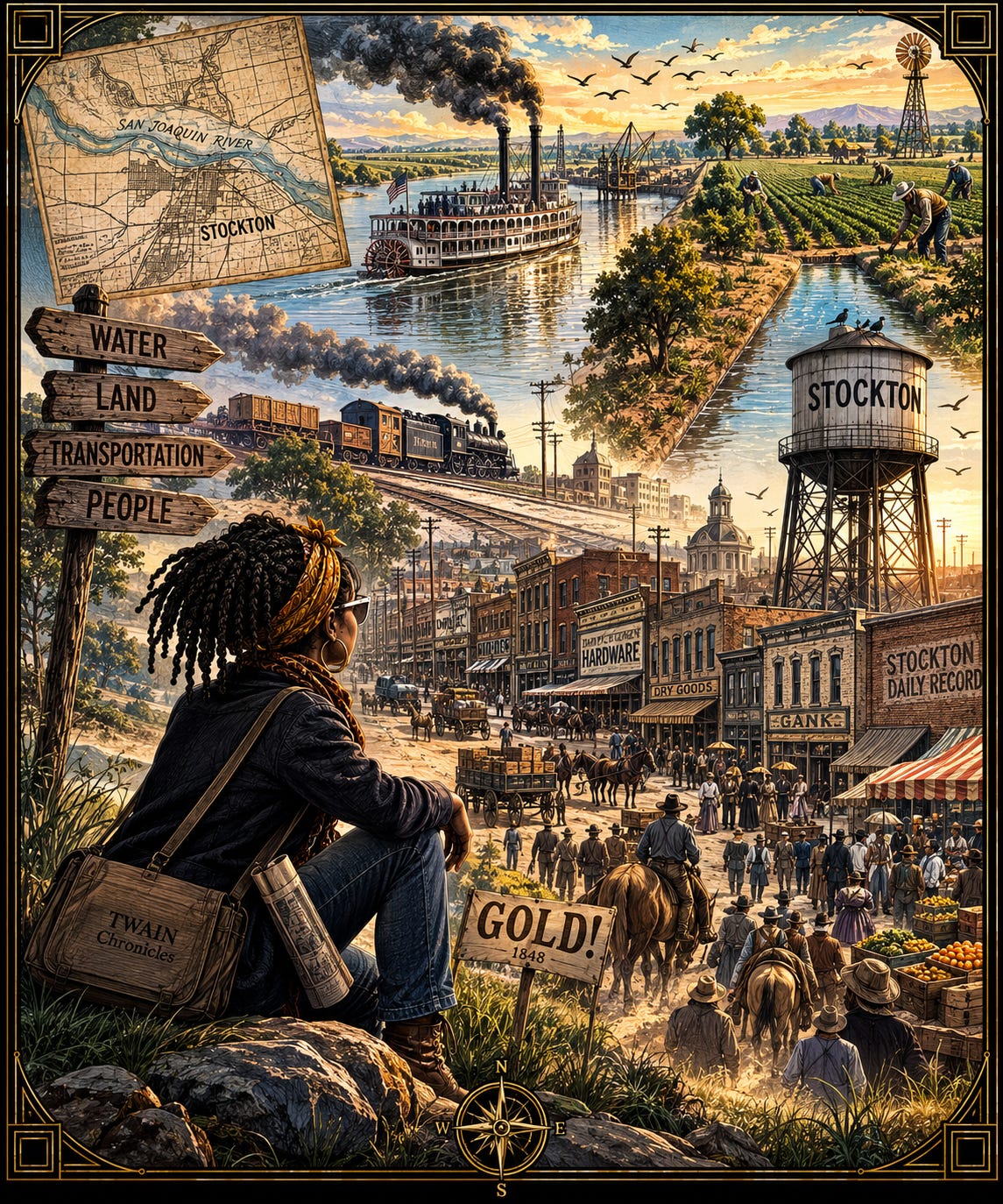
Of course, before we could abandon Stockton, somebody had to build it.
And cities don’t usually appear because someone looks across an empty field and announces:
“This would be a terrific location for a Cheesecake Factory.”
Cities appear because geography gives people a reason to gather.
Stockton had an excellent reason.
Water.
Land.
Transportation.
Then somebody found gold.
Thousands of people suddenly needed picks, shovels, lumber, horses, boots, food, whiskey, lodging, banking and several services respectable historical societies generally summarize as “entertainment.”
Stockton became one of the great supply points of the Gold Rush.
And when the Gold Rush faded, Stockton did something important.
It found another reason to exist.
Agriculture.
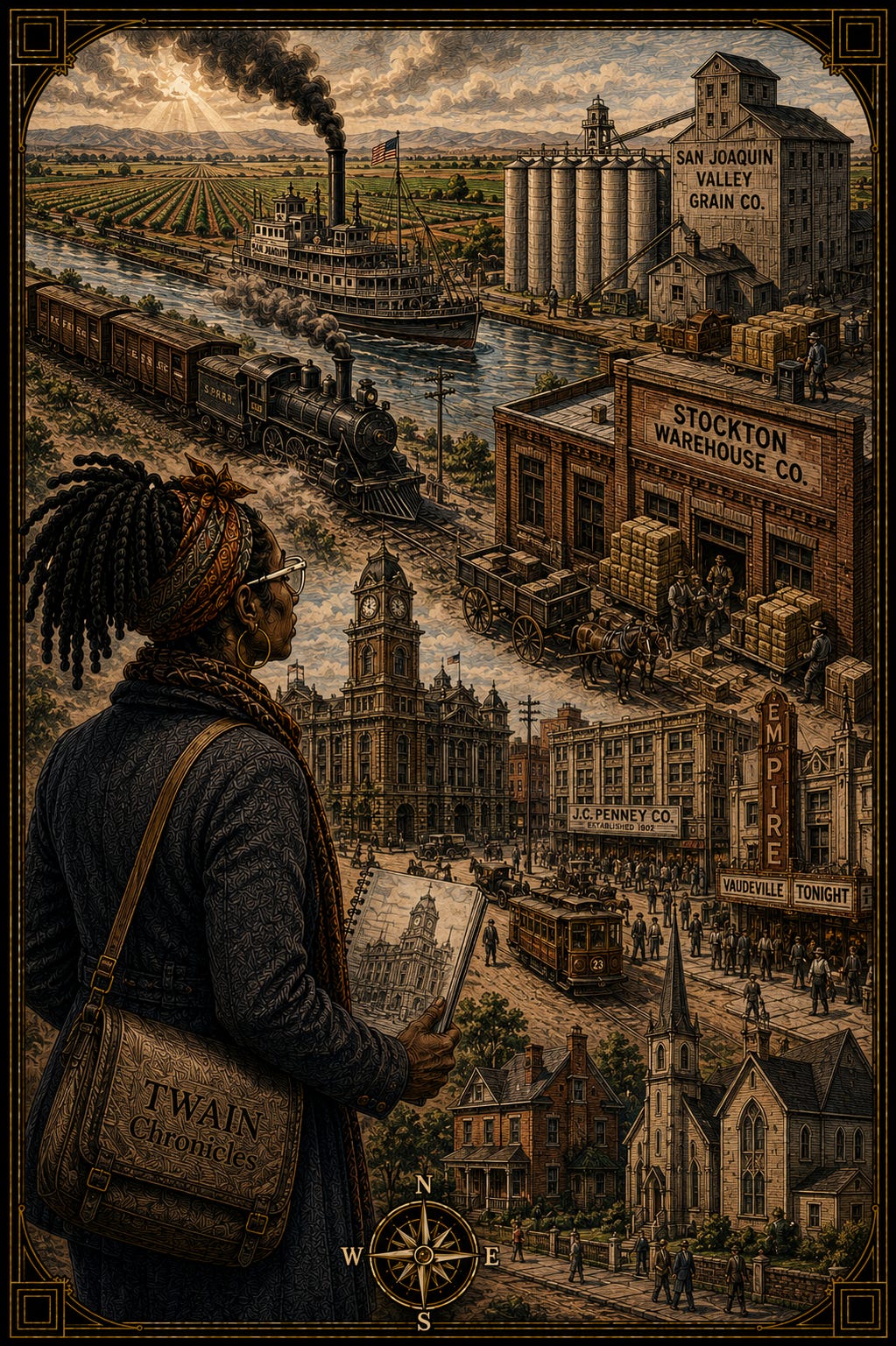
The San Joaquin Valley produced crops.
Crops required processing.
Grain required storage.
Machinery required repair.
Goods required transportation.
Stockton had water.
Stockton had railroads.
Stockton had warehouses.
Stockton had workers.
In other words:
Stockton had something we occasionally forget is useful when building a city.
An economy.
And economies make architecture.
Warehouses appeared.
Banks appeared.
Hotels appeared.
Department stores appeared.
Theaters appeared.
Restaurants, saloons, offices, churches, schools and houses filled the spaces between them.
Nobody had to hire a consultant to “activate the downtown.”
The downtown was activated because people had things to do there.
They Called It Town
This is the part we sometimes misunderstand when looking at photographs of old downtowns.
We get sentimental about the architecture.
Look at the cornice!
Look at the brickwork!
Look at those wonderful windows!
Yes.
The cornices were lovely.
The cornices weren’t the secret.
Proximity was.
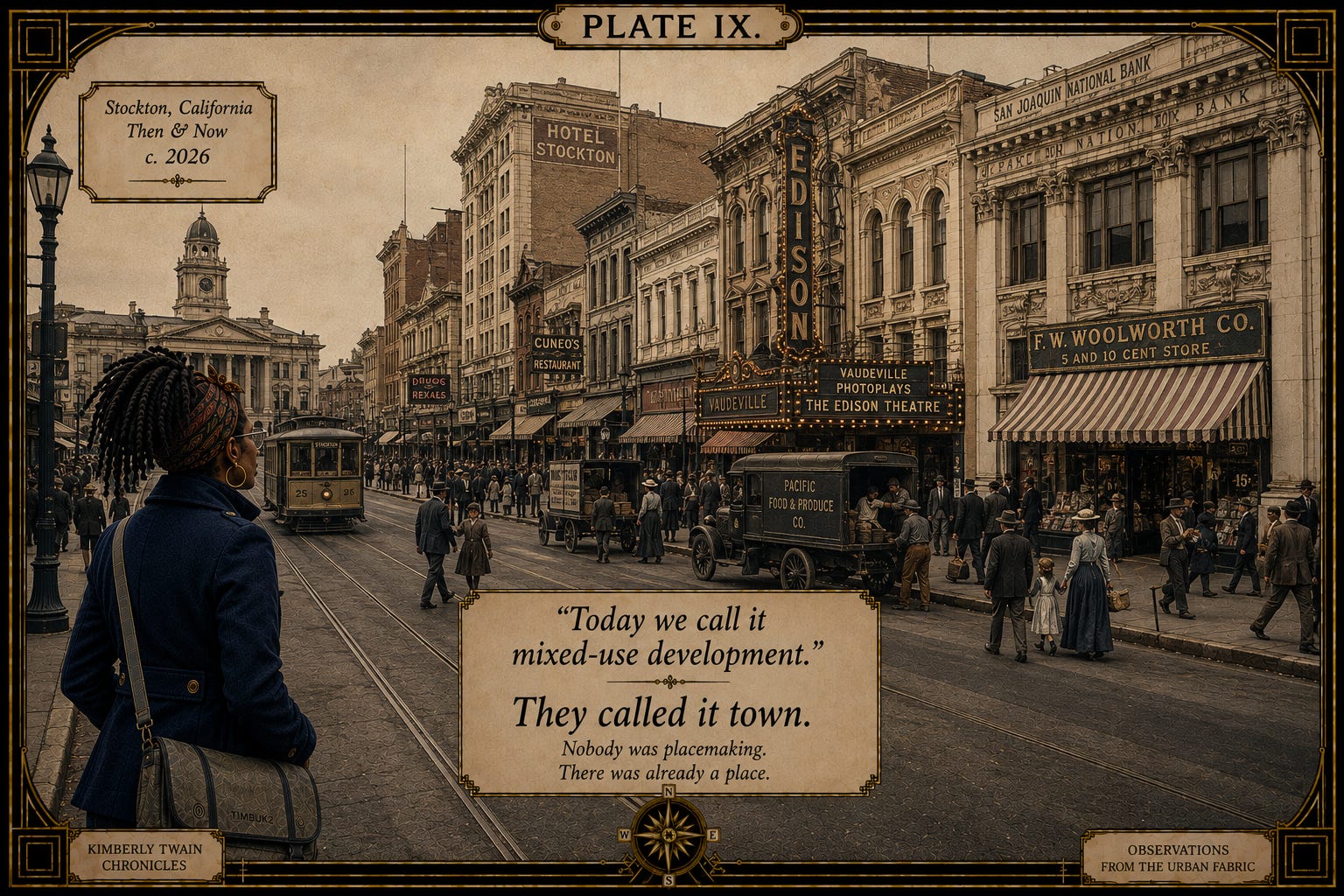
You could go to the bank, see your attorney, buy shoes, mail a letter, eat lunch, visit the courthouse, pick up the newspaper, purchase a birthday present, have a drink, see a movie and meet the person who would eventually ruin your life without moving your automobile six times.
Today we call this mixed-use development.
They called it town.
The butcher needed the banker.
The banker needed the lawyer.
The lawyer needed the courthouse.
The courthouse employees needed lunch.
The restaurant needed customers.
The customers needed shops.
The shops needed pedestrians.
And everybody apparently needed a bar.
Nobody was “placemaking.”
There was already a place.
Then We Invented Something Better
Unfortunately, Americans are extremely susceptible to better ideas.
Enter the automobile.
The automobile was wonderful.
It gave people freedom.
You could live farther from work.
You could visit places beyond the streetcar line.
You could buy groceries without balancing a cabbage on your lap.
There was just one tiny problem.
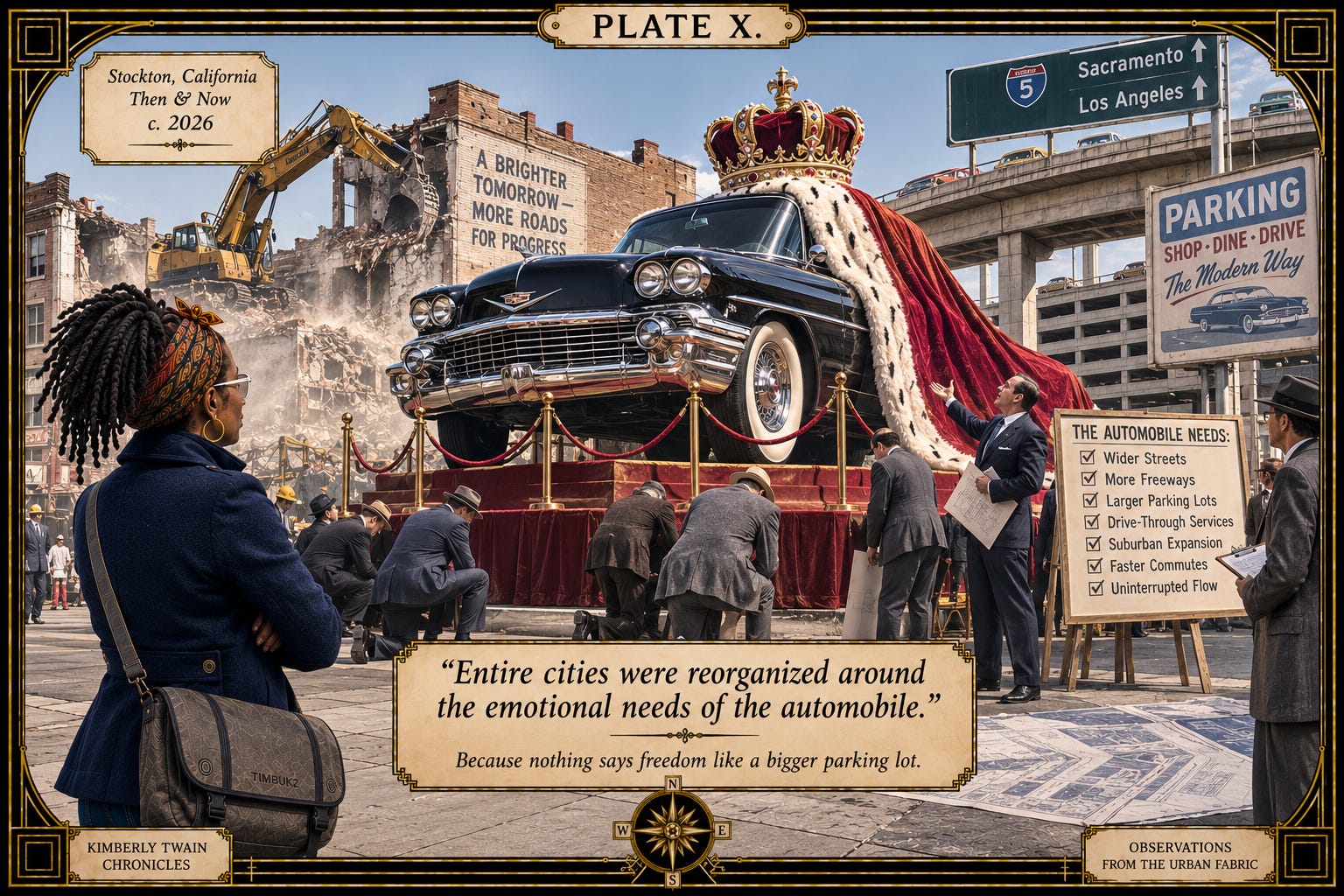
Cars require an astonishing amount of room.
They need roads while moving.
Parking spaces while resting.
Garages while sleeping.
Gas stations when hungry.
Freeways when ambitious.
And gradually Americans decided that the automobile was such an important member of the family that entire cities should be reorganized around its emotional needs.
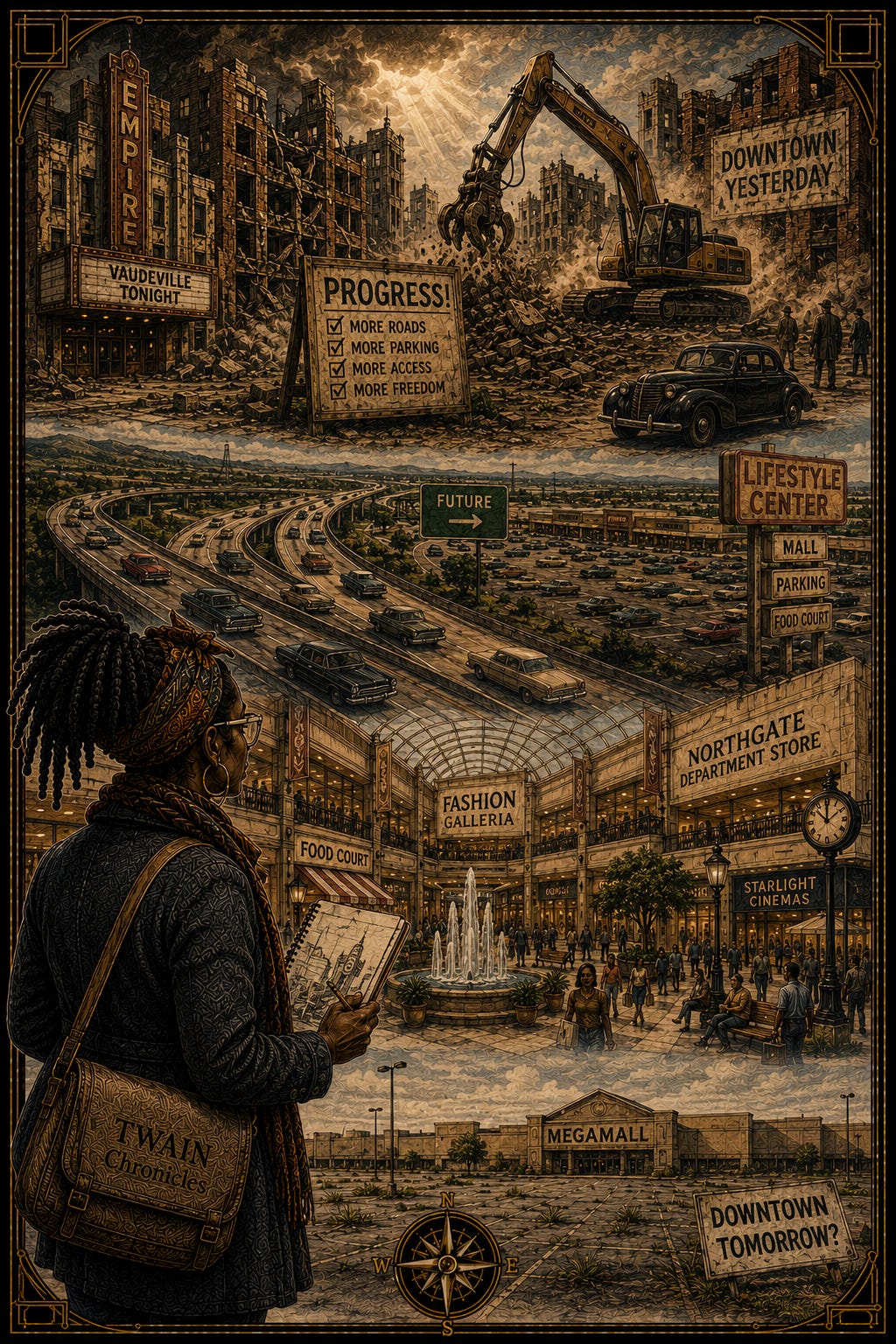
Buildings came down.
Parking lots appeared.
Roads widened.
Freeways sliced through neighborhoods.
Businesses migrated toward interchanges.
The city began spreading.
Then we invented the shopping mall.
And the shopping mall performed one of the most extraordinary tricks in architectural history.
It recreated downtown.
Inside.
There were shops.
Restaurants.
Department stores.
Movie theaters.
Benches.
Fountains.
Sidewalks.
Decorative streetlights.
Sometimes even fake trees.
The only thing missing was the city.
We took urban life, put a roof over it, air-conditioned it, surrounded it with several thousand parking spaces and handed the whole thing to a corporation.
Naturally, we loved it.
There was air-conditioning.
The Incredible Disappearing Downtown
And downtown began losing the argument.
A store moved.
Then another.
An office moved.
Families moved farther out.
Employers followed.
The person who once went downtown three times a week now went once.
Then once a month.
Then never.
One storefront emptied.
Fewer customers came.
The neighboring store suffered.
It closed.
Now there were two empty storefronts.
More people said downtown was dangerous and depressing.
Still fewer people came.
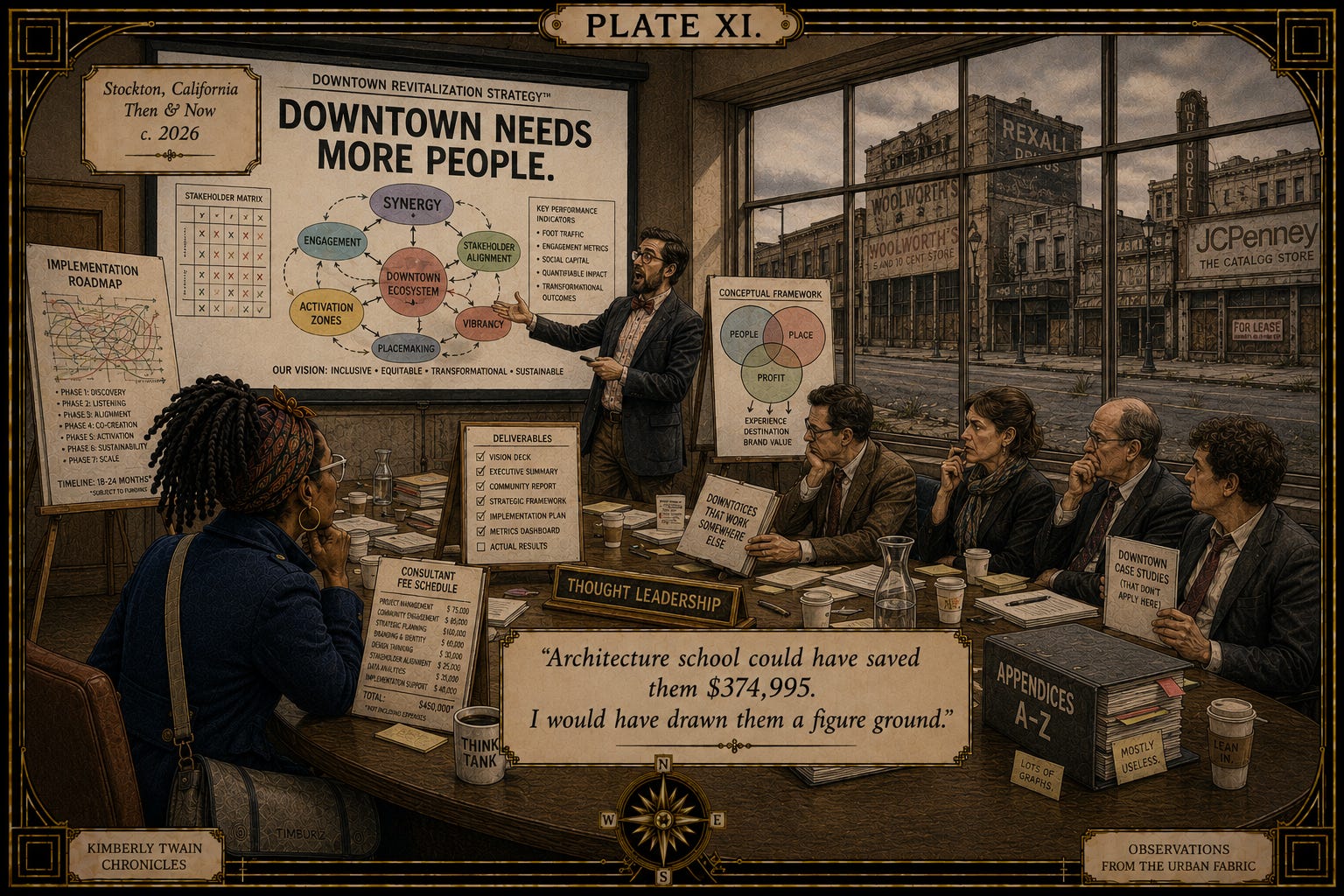
Eventually someone at City Hall said:
“We need to understand why people aren’t coming downtown.”
So they commissioned a study.
The study cost $375,000.
Six months later, the consultants returned with PowerPoint slides, colored arrows, stakeholder input and the astonishing conclusion:
Downtown needs more people.
Architecture school could have saved them $374,995.
I would have drawn them a figure ground.
Then Stockton Became Affordable
This is rarely a sentence that ends happily in California.
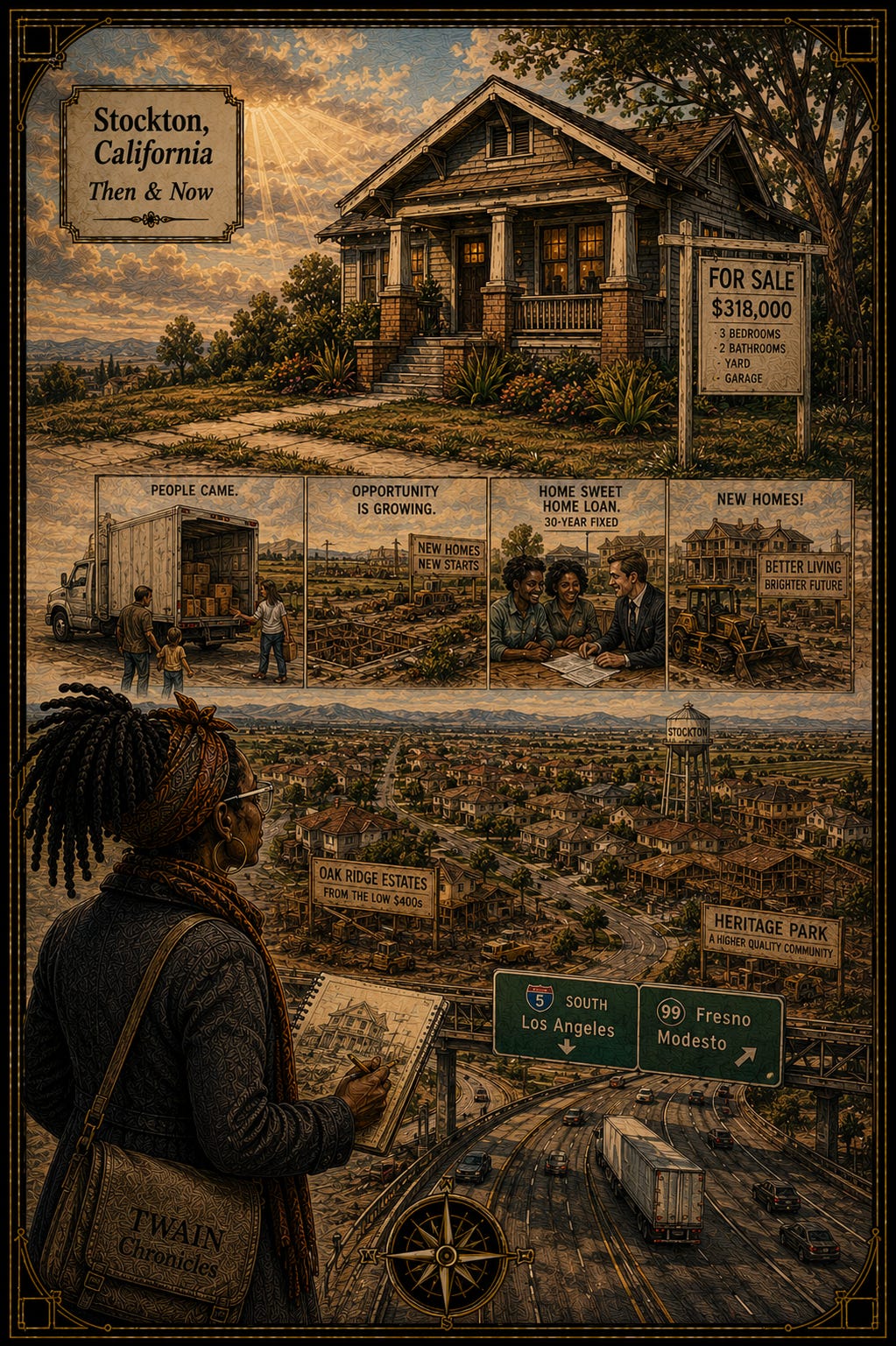
As housing closer to the Bay Area became increasingly expensive, Stockton offered something almost mythical.
A house.
An actual house.
With bedrooms.
A yard.
Possibly two bathrooms.
And a price that did not require the purchaser to be a venture capitalist, orthopedic surgeon or successful narcotics trafficker.
People came.
Developers noticed.
Developers are very observant when people have mortgages.
Subdivision after subdivision spread across former agricultural land.
But these new neighborhoods weren’t necessarily connected to downtown Stockton.
They didn’t need to be.
They were connected to the freeway.
Stockton became part of a peculiar California arrangement in which you could own a house in one city and spend several hours each day desperately attempting to be somewhere else.
Then came the housing bubble.
Money became easy.
Prices rose.
Construction accelerated.
Everybody became wealthier because everybody’s house became more expensive.
There was one slight difficulty.
Nobody had actually become wealthier.
When the housing market collapsed, Stockton was hammered.
Foreclosures spread.
Property values plunged.
Municipal revenues suffered.
In 2012, Stockton filed for bankruptcy.
A city that had once prospered by supplying people chasing California gold had managed, a century and a half later, to get caught in another California gold rush.
This time the gold was real estate.
The ending was remarkably similar.
Somebody was left holding the shovel.
What Exactly Are We Saving?
And yet I resist saying Stockton is dead.
Dead cities don’t annoy you.
Stockton annoys me precisely because it isn’t dead.
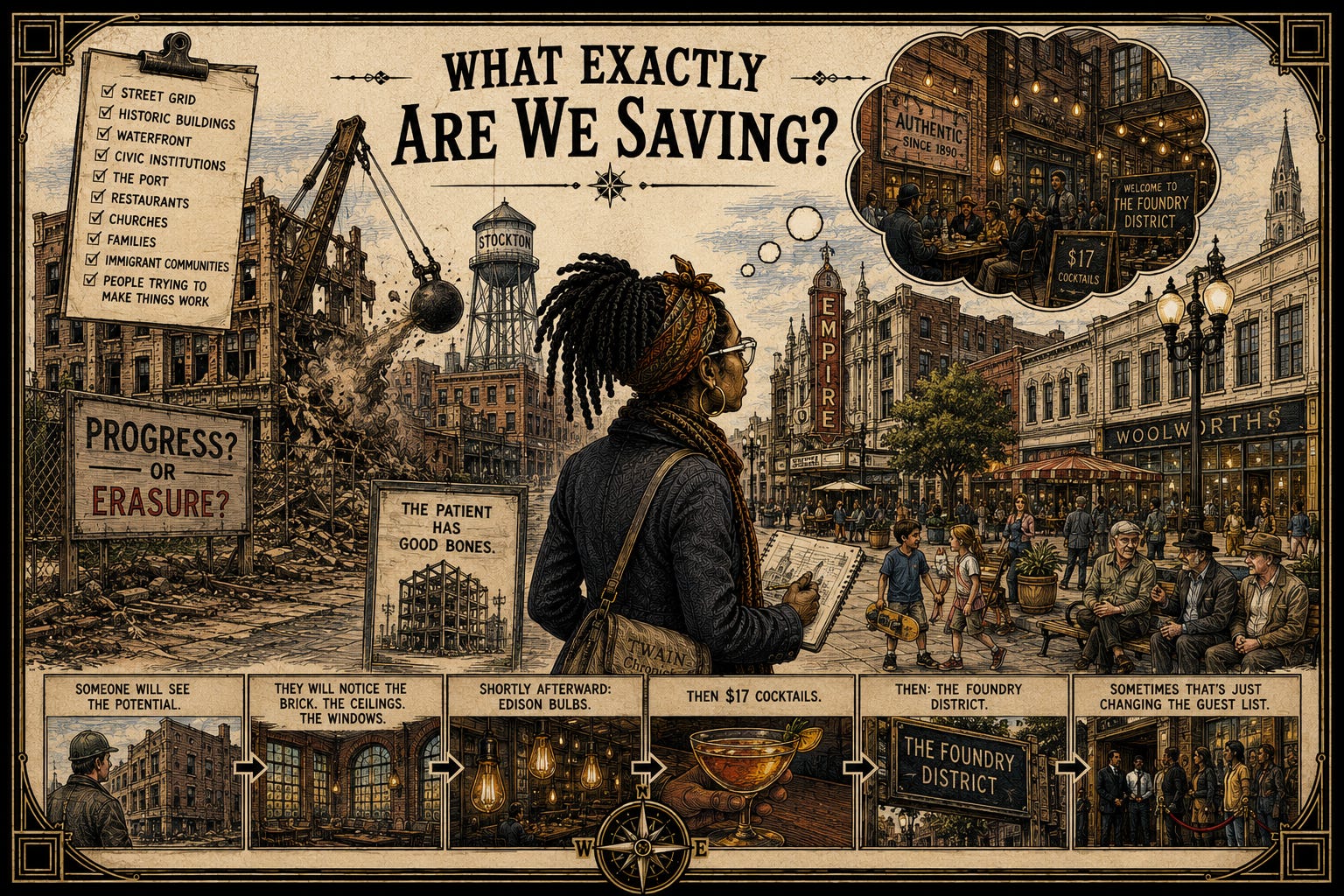
The street grid remains.
Historic buildings remain.
The waterfront remains.
Civic institutions remain.
The port remains.
Restaurants remain.
Churches remain.
Families remain.
Immigrant communities remain.
People are still trying to make things work.
Architecturally, the patient still has good bones.
And this is where redevelopment can become almost as dangerous as decline.
Because someone will eventually discover these old buildings.
They will notice the brick.
The high ceilings.
The enormous windows.
Someone will use the word authentic.
Shortly afterward there will be Edison bulbs.
Then $17 cocktails.
Then somebody will rename three blocks The Foundry District, even though nobody in Stockton has ever called it that.
That isn’t necessarily revival.
Sometimes that’s just changing the guest list.
Stockton does not need to become somebody else’s idea of a successful city.
It needs to become a functioning Stockton again.
Please Do Not Build Another Lifestyle Center
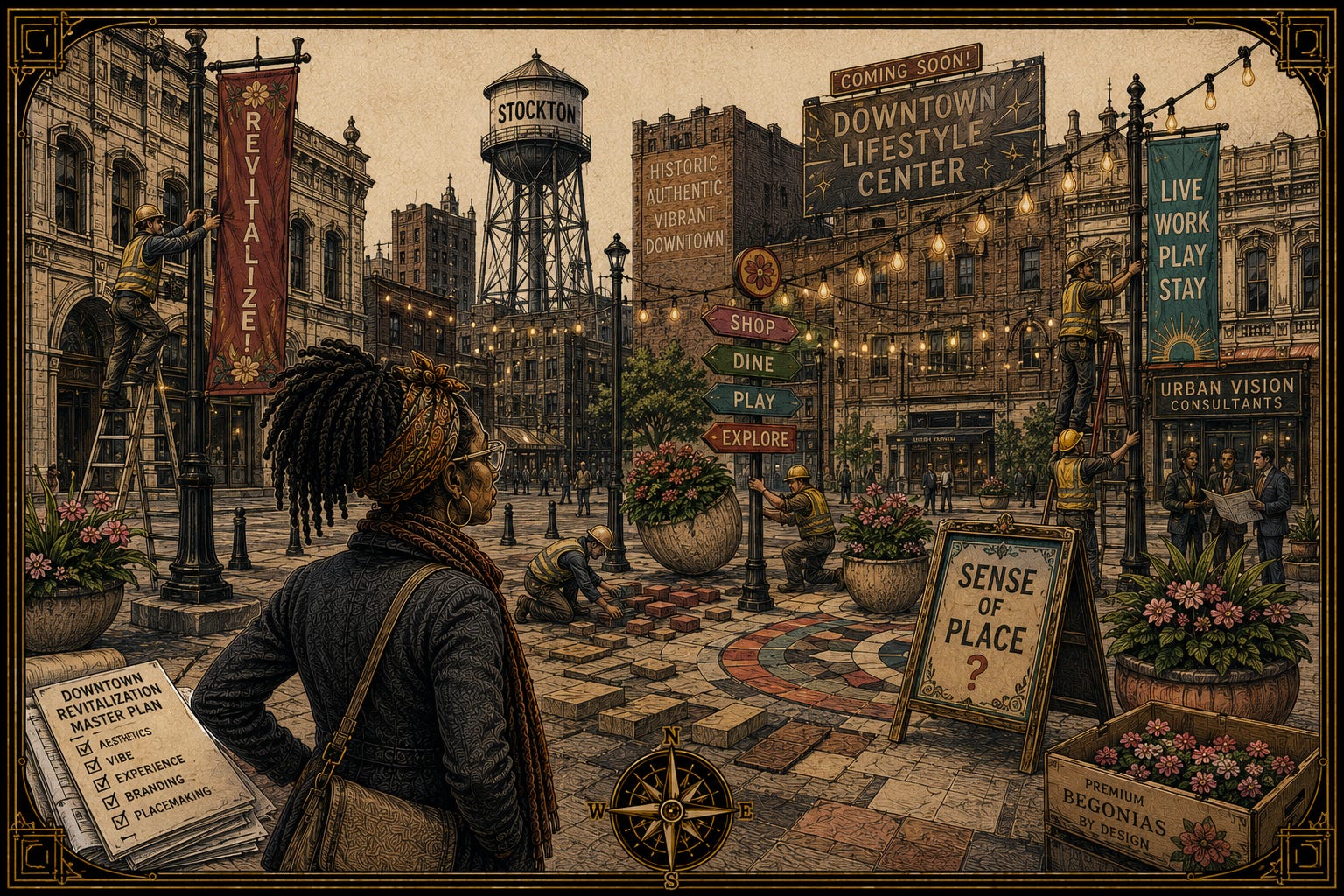
Whenever an American city decides to revive downtown, someone orders enormous planters.
I don’t know why.
Apparently begonias are the first responders of urban planning.
Then come decorative paving stones.
Banners.
String lights.
Wayfinding signs.
A consultant announces that downtown lacks a “sense of place.”
Downtown Stockton already has a sense of place.
It is Stockton.
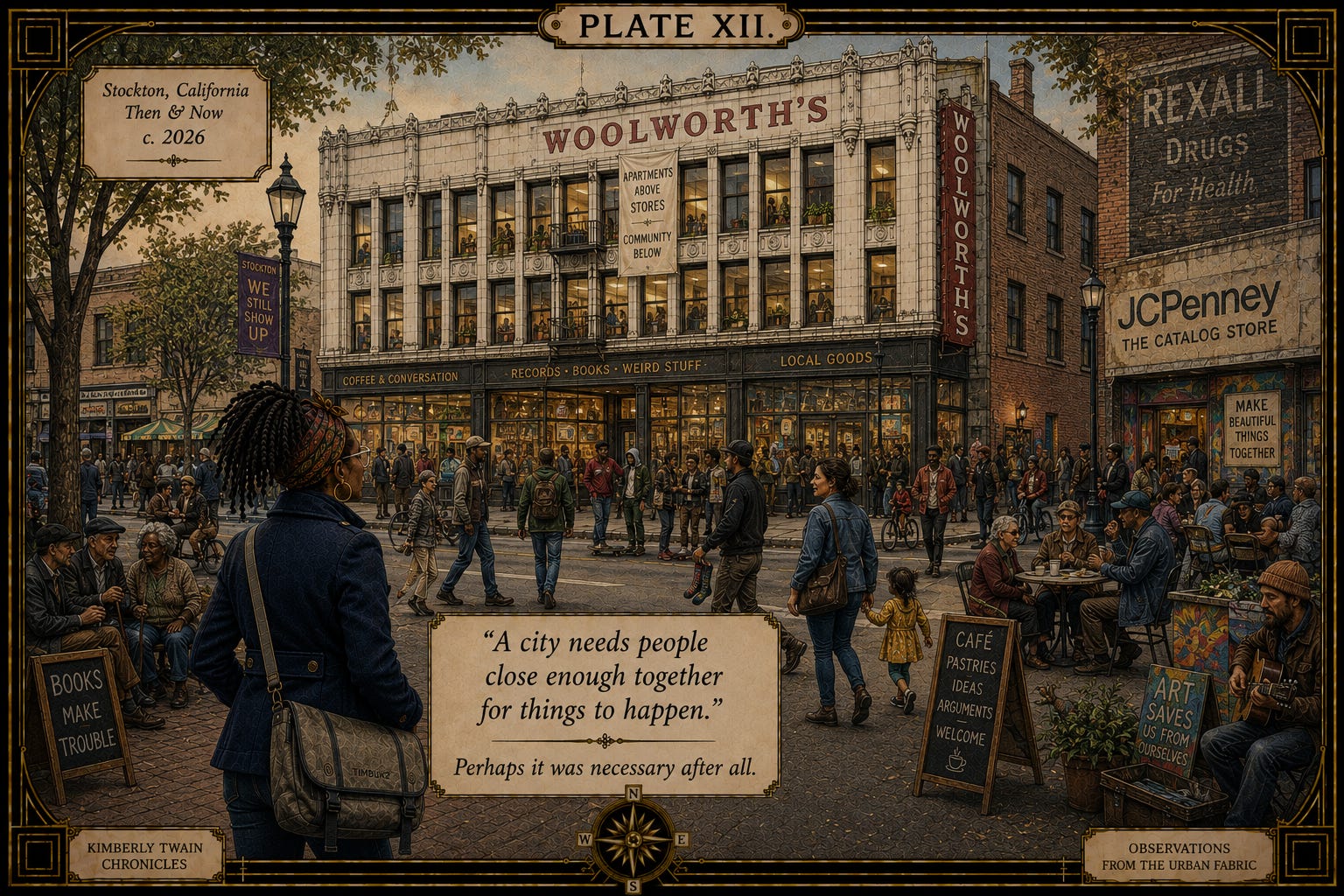
You cannot manufacture authenticity by hanging banners that say AUTHENTIC.
The problem is not that Stockton needs better flowerpots.
The problem is that downtown needs enough people living, working, studying, eating, shopping, arguing, flirting, drinking coffee, playing music and generally carrying on that it becomes indispensable again.
Housing over storefronts.
Independent businesses.
Affordable apartments.
Students.
Libraries.
Restaurants.
Artists.
Parks.
Transit.
Old buildings put back to work.
Let somebody open a weird bookstore.
Let children exist.
Let teenagers loiter somewhere without immediately being treated as a security problem.
Let old people sit down without having to purchase a $7 latte for the privilege.
And for God’s sake, stop believing that every empty parcel needs another parking lot.
If everyone can park directly in front of every destination, you haven’t built a city.
You’ve built a drive-through.
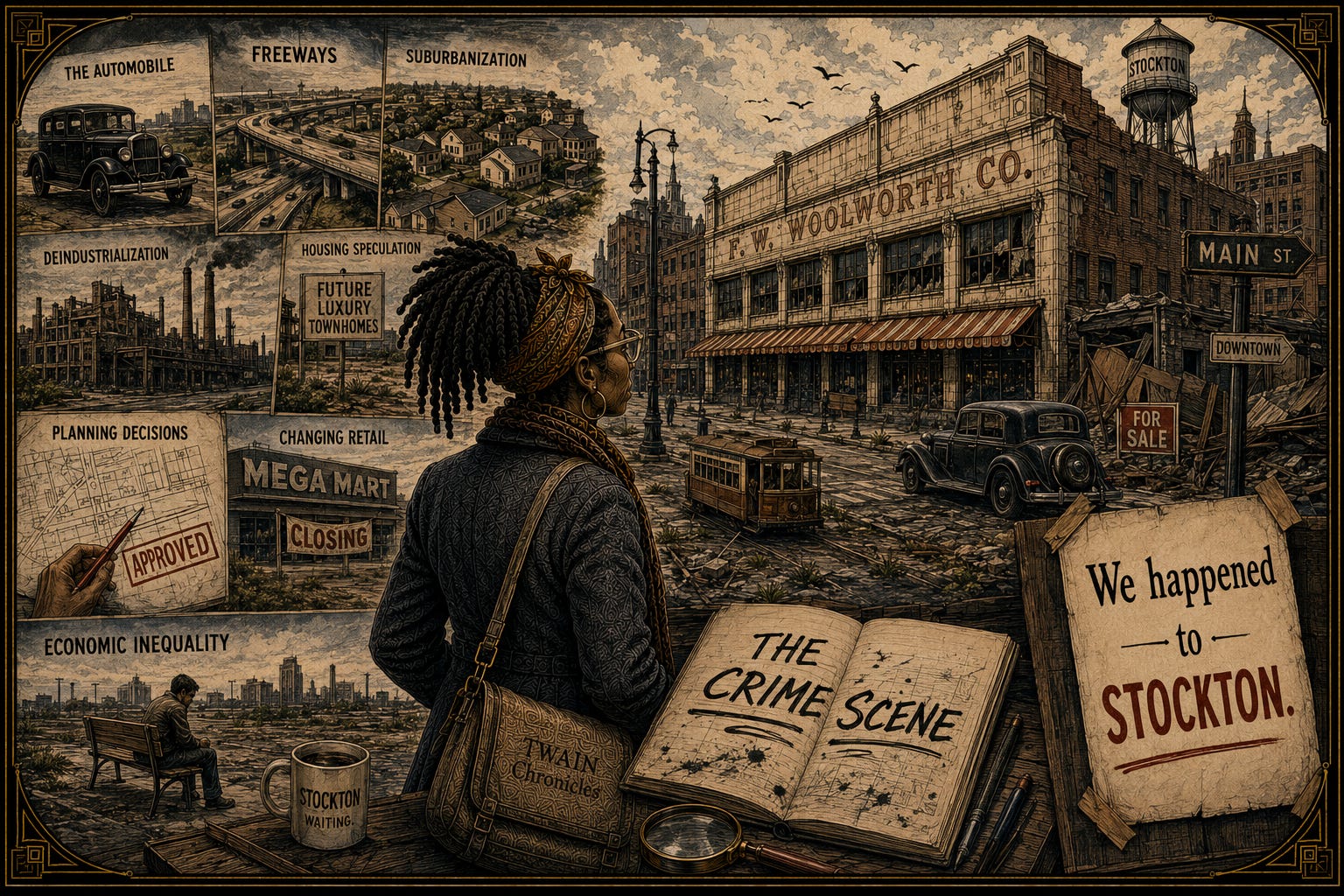
The Crime Scene
So.
What happened to Stockton?
The automobile?
Certainly.
Freeways?
Absolutely.
Suburbanization?
Yes.
Deindustrialization?
That too.
Housing speculation?
Good Lord, yes.
Planning decisions?
Naturally.
Changing retail?
Of course.
Economic inequality?
Pull up a chair.
But perhaps the most interesting answer is:
We happened to Stockton.
Not because some villain sat in a room in 1957 stroking a cat and plotting the destruction of downtown.
That’s what makes the story interesting.
Most of the decisions were perfectly reasonable.
People wanted houses.
People wanted cars.
People wanted parking.
Merchants wanted customers.
Developers wanted land.
Cities wanted tax revenue.
Shoppers wanted convenience.
Nobody voted to kill downtown.
We merely voted, purchased, financed, zoned, paved and drove our way toward a thousand individually sensible decisions that produced one enormous collective absurdity.
Then we stood in the middle of it and asked:
What the hell happened here?
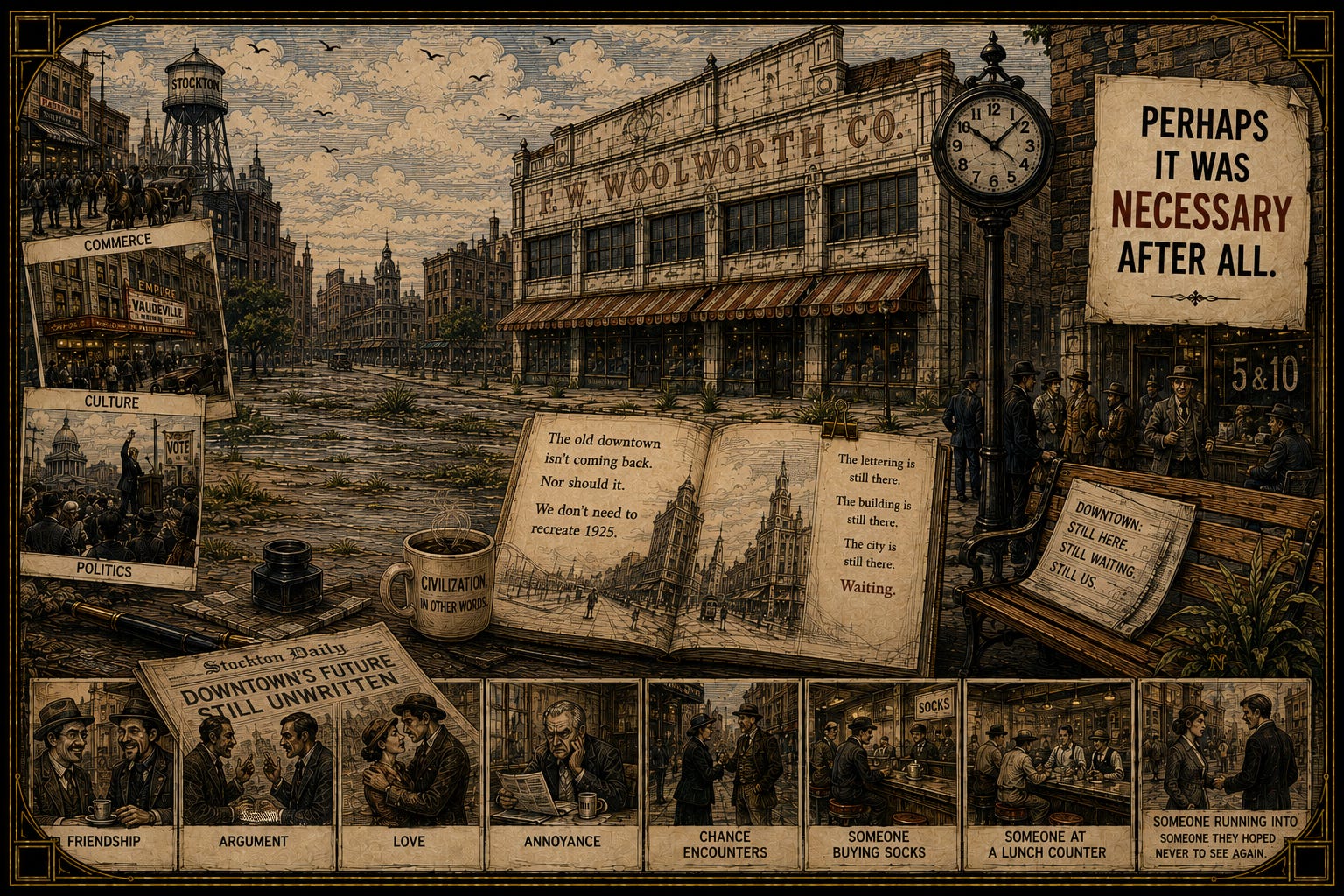
Which brings me back to the Woolworth’s.
The lettering is still there.
The building is still there.
The city is still there.
Waiting.
The old downtown isn’t coming back.
Nor should it.
We don’t need to recreate 1925.
We need to remember what 1925 understood.
A city needs people close enough together for things to happen.
Commerce.
Culture.
Politics.
Friendship.
Argument.
Love.
Annoyance.
Chance encounters.
Someone buying socks.
Someone sitting at a lunch counter.
Someone running into someone they hoped never to see again.
Civilization, in other words.
Stockton spent decades participating in America’s great experiment to determine whether we could construct a world in which downtown was no longer necessary.
We succeeded remarkably well.
And now, standing in front of that empty Woolworth’s, looking at the faded letters above the street, I find myself wondering whether we have discovered something rather inconvenient.
Perhaps it was necessary after all.
Love this!
Talk soon — we’re working on a plan for downtown Stockton!…:)
Bravo Kimberly
Nice to see me looking over your shoulder !