

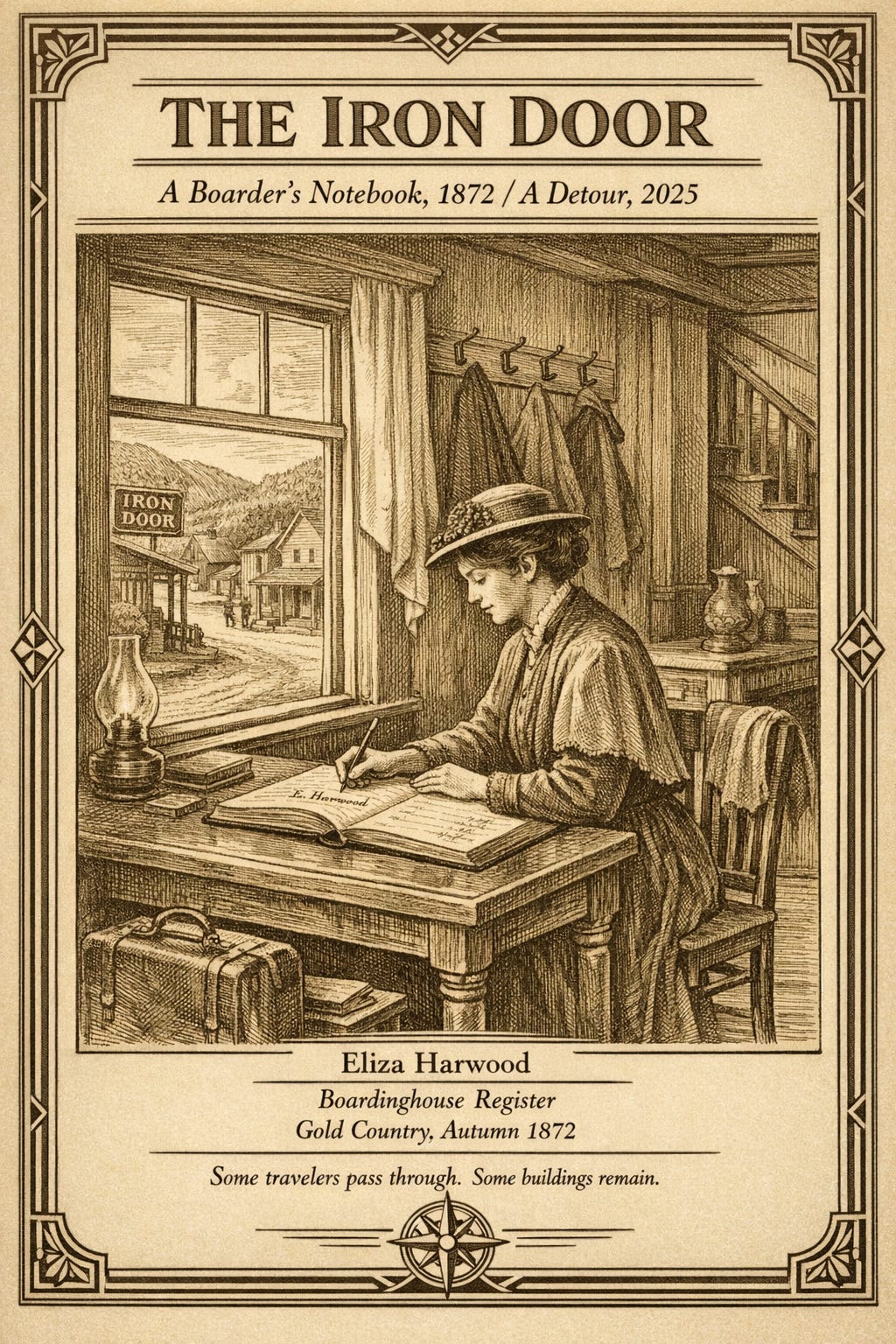
I. Eliza, 1872
In the autumn of 1872, Eliza Harwood signed the boarding ledger in Groveland with a firm, unadorned hand.
E. Harwood. Sacramento.
She traveled alone through Gold Country with the steady composure of someone who had already considered the risks and found them negotiable. One valise. One notebook. A habit of observing before speaking.
She had heard of the saloon with the iron door and went, as curious people do, toward whatever had managed to remain.
Inside, the room held lamplight the way a teacup holds heat. The boards were worn to a polite smoothness. Conversation paused long enough to register her presence and then resumed in a slightly more careful key.
She ordered whiskey.
Not from thirst. From practicality.
The iron door sat in the back wall, dark and embedded, a slab from some former mine safe dragged into town when the mine itself failed. Too heavy to waste. Too honest to disguise. In a place devoted to motion, it had chosen stillness.
Above the room hung a plow suspended from chains. No one seemed troubled by this. It hovered as if waiting for a field to materialize between the tables. Nearby, a long double-handled crosscut saw rested in the rafters. It swayed faintly when the front door opened, not enough to alarm, just enough to recommend thoughtful seating.
Eliza chose her chair with care.
From her notebook that evening:
The tools remain when the work is done.
A plow in the air. A saw above the bar. A door that once guarded gold now guards a room.
Objects possess more patience than people.
Miners spoke of claims with theological intensity. A gambler leaned into optimism. Someone laughed too loudly at something that was not entirely funny. Eliza wrote in the spaces between sound.
These towns arrive quickly and depart without ceremony.
The buildings attempt endurance.
The iron door will likely outlast us all.
She did not romanticize the place. She had seen camps dissolve into weeds and memory. But she felt a measured affection for the room. It was trying. Trying to hold itself together long enough to be called established.
When she stepped back into the Sierra night, the air smelled of pine and worked earth. The saloon glowed behind her like a coal that had decided not to cool.
She wrote one last line before sleeping:
The Iron Door promises no fortune.
It promises duration.
By morning she would continue on.
The door would remain.
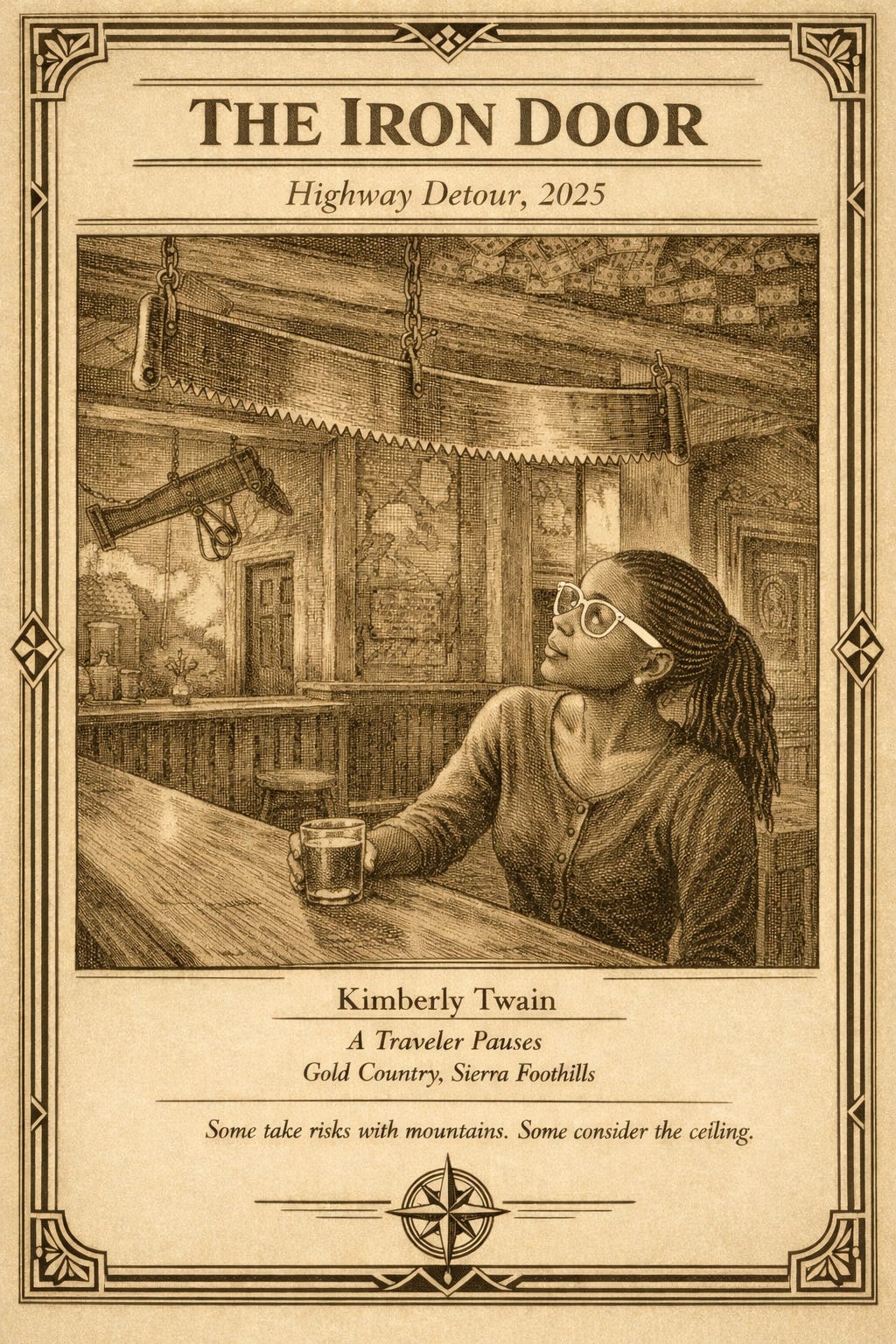
II. Kimberly Twain, 2025
On my way back from Yosemite, I spotted the old saloon and executed a respectful U-turn. I love anything old, especially a dive bar that has survived several economic systems and at least one moral panic.
I used to live near The Little Shamrock, which claims to be the second oldest bar in San Francisco and still keeps a clock stopped at 5:12 a.m., the exact minute the 1906 earthquake said good morning. I also spent time at The Saloon, circa 1861, which insists it is the oldest bar in the city. California, perhaps. Depends who’s holding the tiara.
Then I walked into the Iron Door Saloon, which now claims to be the oldest bar in California.
These places compete like pageant contestants in boots. Oldest. Most continuous. Most historically hydrated.
Inside, the ceiling is layered with dollar bills in various stages of decomposition. Some are barely holding together. If they ever took them down, they could probably finance a respectable structural retrofit. I’ve heard of bars discovering thousands of dollars up there once gravity finally intervened. Not to even mention all the gold dust that remains in the floorboards.
Then I noticed the plow.
Suspended from the ceiling by chains that, from my vantage point, might as well have been threads. It hung there like agricultural watchman passing the time. Beneath it, patrons drank without visible concern, which is the kind of optimism that built the West.
And then there was the double handled saw.
Hanging directly above the bar.
Swinging.
Gently.
Suggestively.
I ordered a Jack and Coke and took a seat directly under it, because apparently I, too, enjoy historical immersion. For a moment I sat there contemplating my life choices while the saw performed a subtle pendulum act above my head.
I thought:
These miners took chances.
Why can’t I.
So I raised my drink in solidarity with 19th-century risk tolerance and sat there at the peril of my life for a full minute or two.
Then I moved two seats down.
Courage has limits.
So does my insurance coverage.
Murals stretch across the walls, painted by a local artist in exchange for drinks, which remains one of the more transparent economic systems in California. Heck, I even use it myself. Faded bills cling to the ceiling. The floorboards hold whatever gold has sifted into them over the last century and a half. Down the road sits the Mark Twain cabin site, because in California Twain is legally required to have passed through everywhere.
I imagined Eliza up at the boardinghouse in 1872, writing by lamplight after walking down from her rented room. A traveler passing through. A writer collecting atmospheres. Someone who noticed that buildings sometimes outlast the intentions that built them.
Two travelers.
One room.
A century and a half apart.
The titles may be debated. Oldest bar in California. Oldest continuous. Oldest surviving with intact ceiling hazards.
But some buildings are less interested in titles than in staying.
The Iron Door simply remains.
Cool. Steady. Entirely unconcerned with overhead hazards.
And still receiving visitors who wander in from the present and find themselves briefly seated inside the past.
The gold is gone.
The titles are disputed.
The saw still swings.
The plow still hovers.
The Iron Door no longer guards treasure.
It guards continuity and memory.