

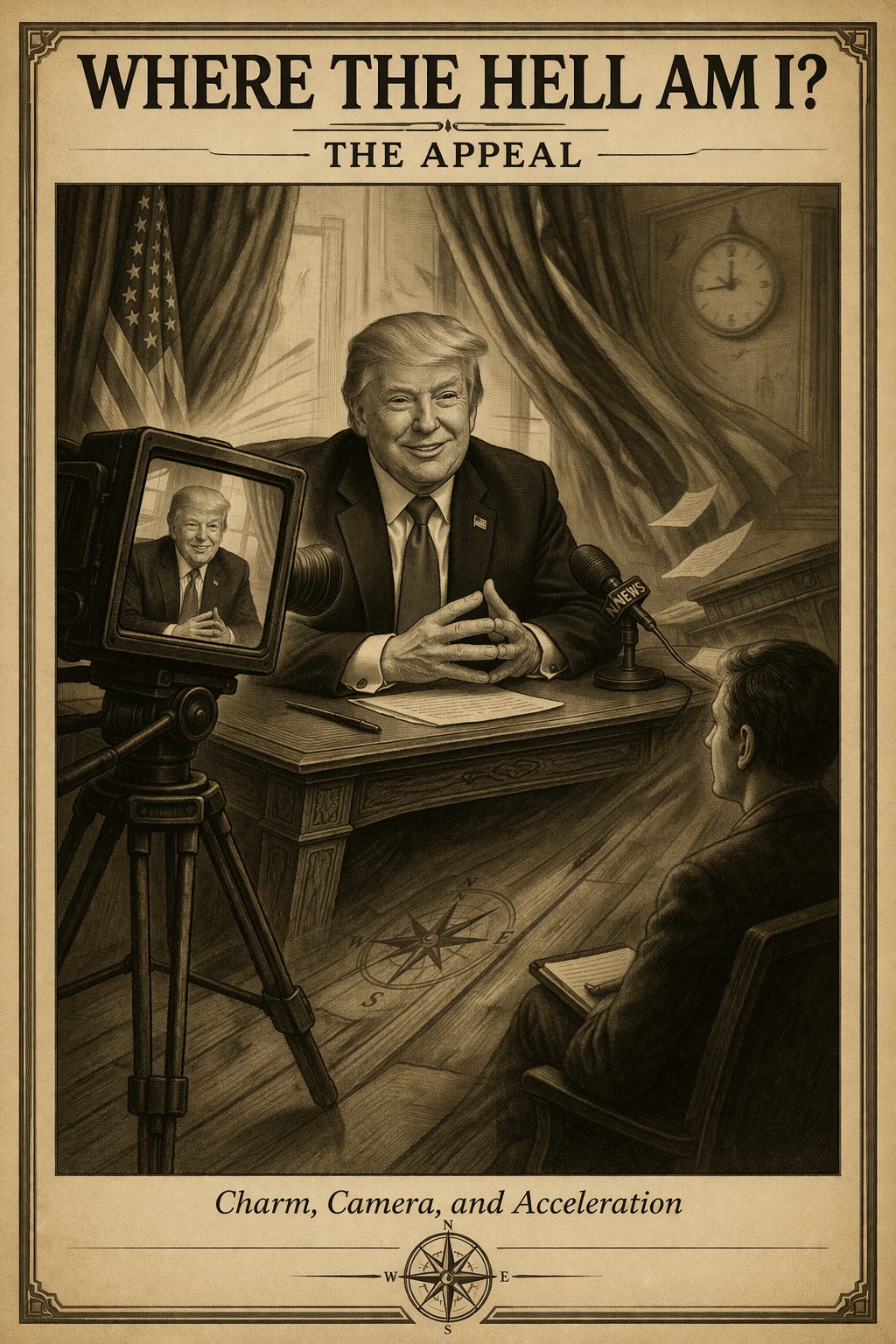
I’m not sorry to say it: I understand the appeal.
Donald Trump smiles like a man who has already decided the room belongs to him. On camera, he is effortless. Warm, even. A kind of grand, familiar American archetype, the friendly, egotistical tycoon who seems as though he might clap you on the shoulder, ask your opinion, and then proceed to ignore it entirely.
From a distance, he is not alarming.
He is magnetic.
And that may be the most important fact about him.
But governing is not a camera test.
And Trump does not so much govern as accelerate.
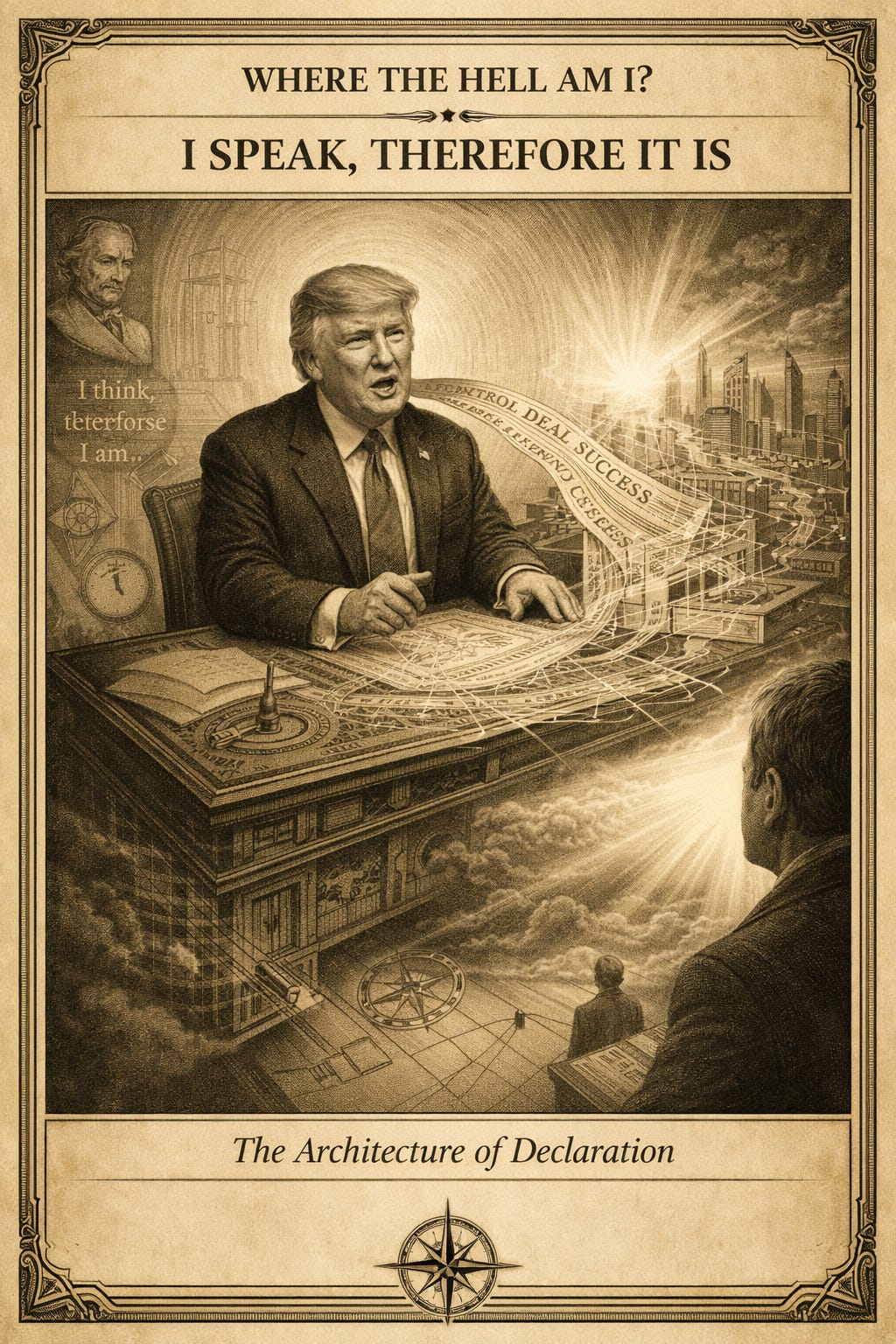
He moves with the logic of impulse. One declaration arrives before the last has had time to prove itself true, false, or something in between. He speaks not like a man describing reality, but like a man attempting to author it in real time.
René Descartes gave us:
I think, therefore I am.
Trump appears to have revised it for the age of television:
I speak, therefore it is.
Or perhaps something even older is at work.
In Genesis, God says, Let there be light.
And light obeys.
And the strange thing, the unnerving thing, is that he often appears to believe himself.
Not in the careful way of a politician shaping a message, but in the immediate, total way of someone for whom saying and believing collapse into the same act.
It is not lying in the traditional sense.
It is something closer to wishcasting.
Policy by proclamation.
Akin to making a wish and expecting it to come true, like a child whose imagination has not yet learned the limits of the world.
The Secret, rewritten as statecraft.
So we are left with a peculiar civic task.
In an ordinary administration, the question is whether a policy will work.
In this one, the more basic question comes first:
What is actually happening?
Because somewhere between the announcement and the aftermath, between the televised certainty and the unresolved reality,
we are being asked to live inside a sentence that has not yet been finished.
🧭 Let’s Pause
The harder part is this:
Looking at what is not being fully analyzed.
Not even in the places that pride themselves on seriousness. Not even in The Guardian. Not even in that timeless, supposedly intellectual magazine of and for the people, The Atlantic.
Perhaps they cannot keep up either.
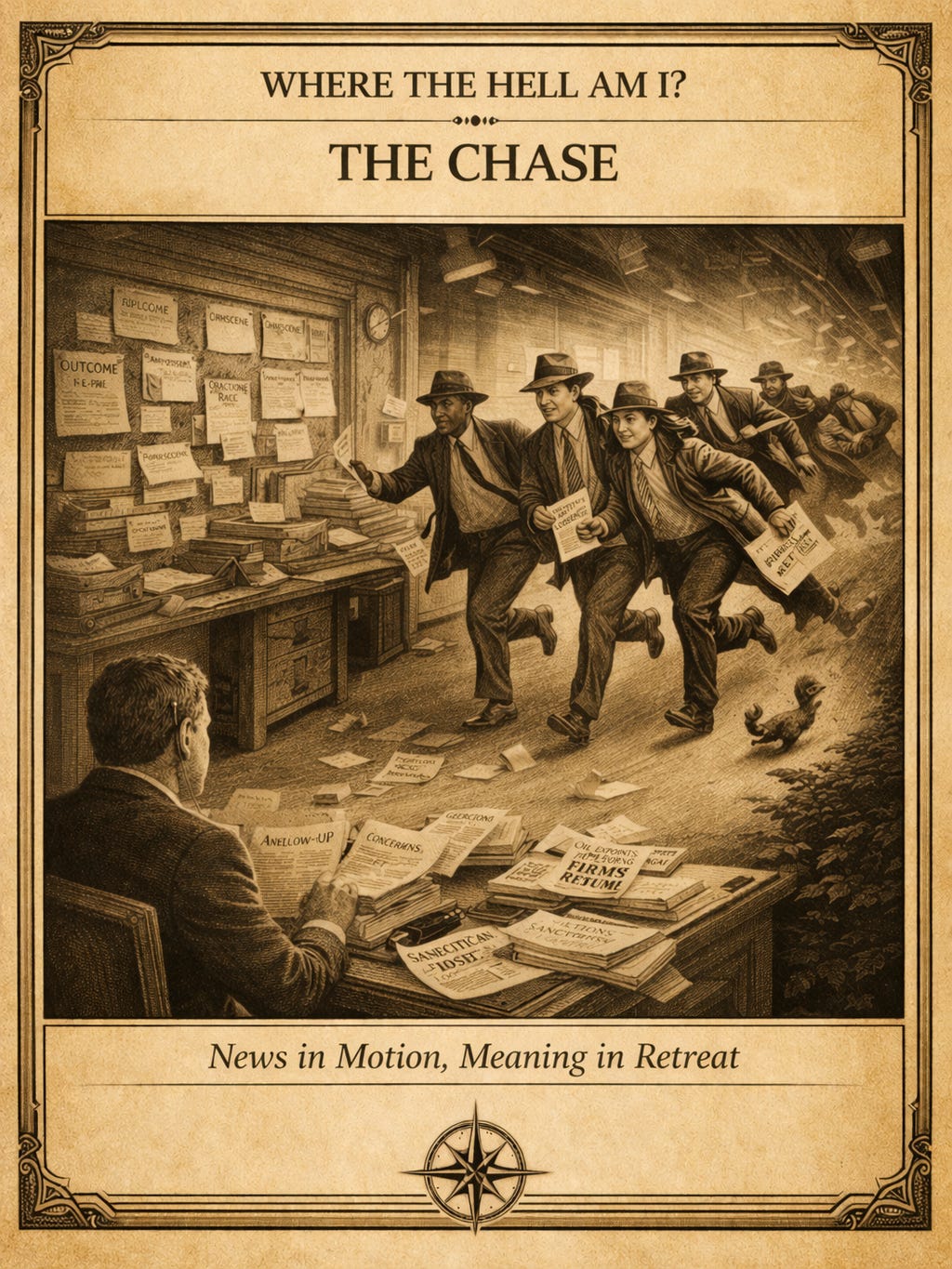
Every time he says squirrel, the press jumps to the next tree.
That is not failure.
That is news.
News captures what is happening while it is still happening.
But a presidency like this cannot be understood through motion alone.
It requires something slower.
Someone has to stop.
So let this be that pause.
Because if we do not stop to reflect,
we are not analyzing a presidency.
We are surviving its weather.
🧭 What No One Has Time to Go Back and Ask
I. Iran
The ayatollah is dead.
That sentence alone should have stopped the world.
And yet, almost immediately, it dissolved into uncertainty.
A successor is named, but not clearly seen. Authority is asserted, but not fully established.
At one point, even Trump suggested we may not know whether Iran’s leadership is intact.
So I’ll ask the simplest question:
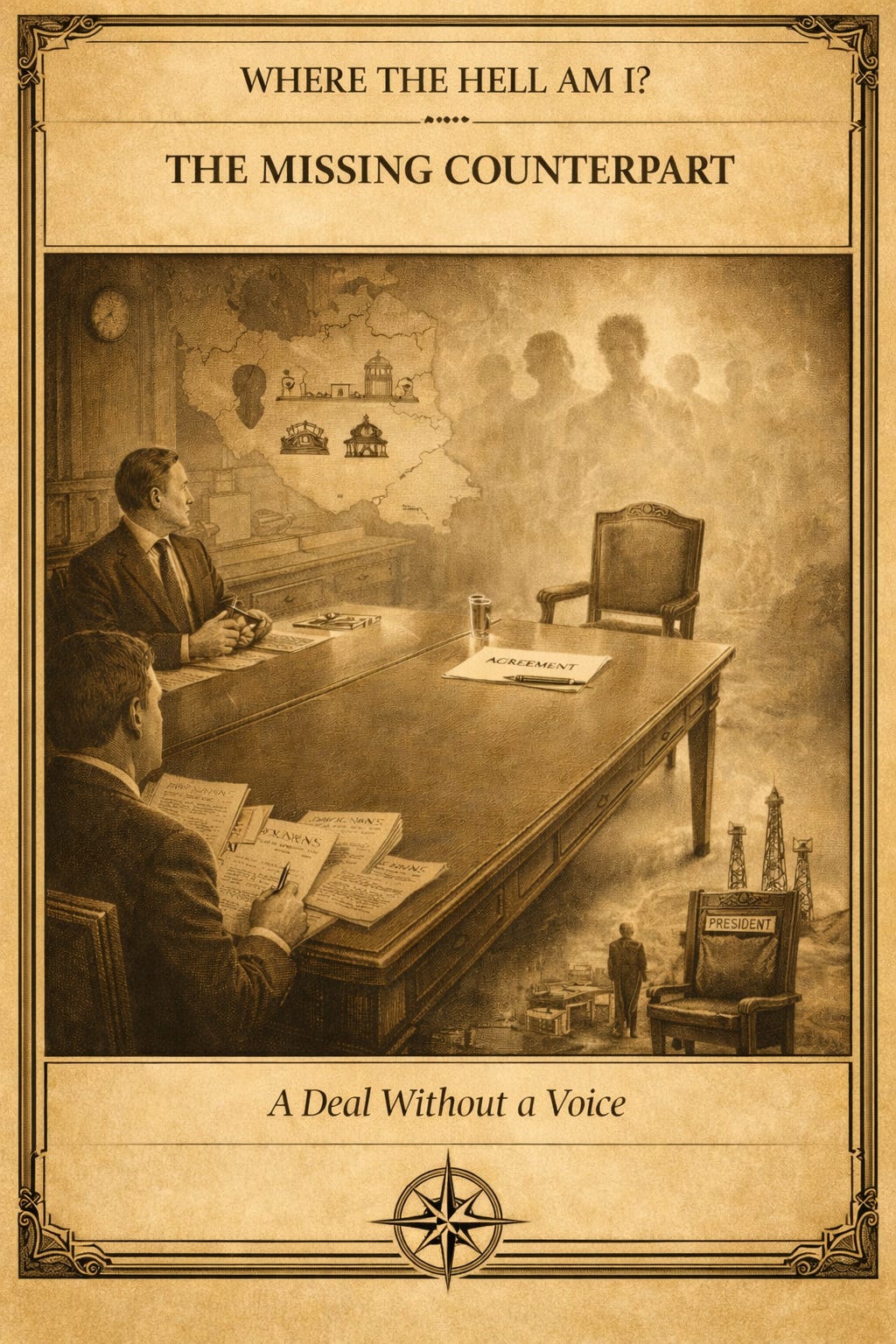
With whom are we making a deal?
Because diplomacy requires a counterpart.
And right now, the sentence feels unfinished.
II. Venezuela
Iran did not come out of nowhere.
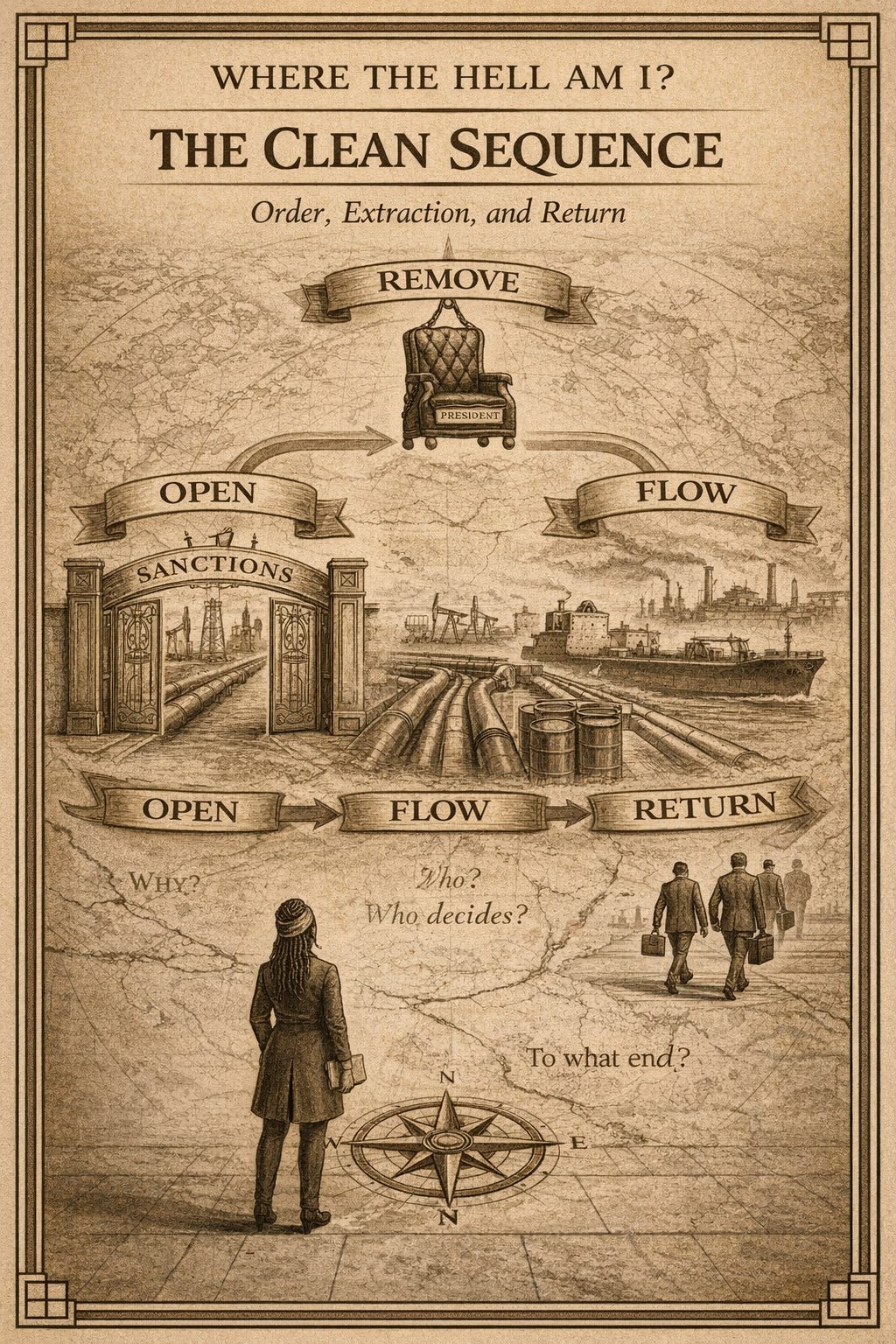
Weeks earlier, the United States removed the sitting president of Venezuela.
The justification was familiar:
Drugs.
Corruption.
Instability.
And then something else happened.
Oil began to move.
Sanctions loosened.
American companies returned.
The sequence was clean.
Remove the leader.
Reopen the resource.
Re-enter the market.
We were told this was about security.
But oil flowed faster than explanations.
So now I ask:
Was Venezuela an isolated act?
Or a precedent?
III. The Story We Are Told
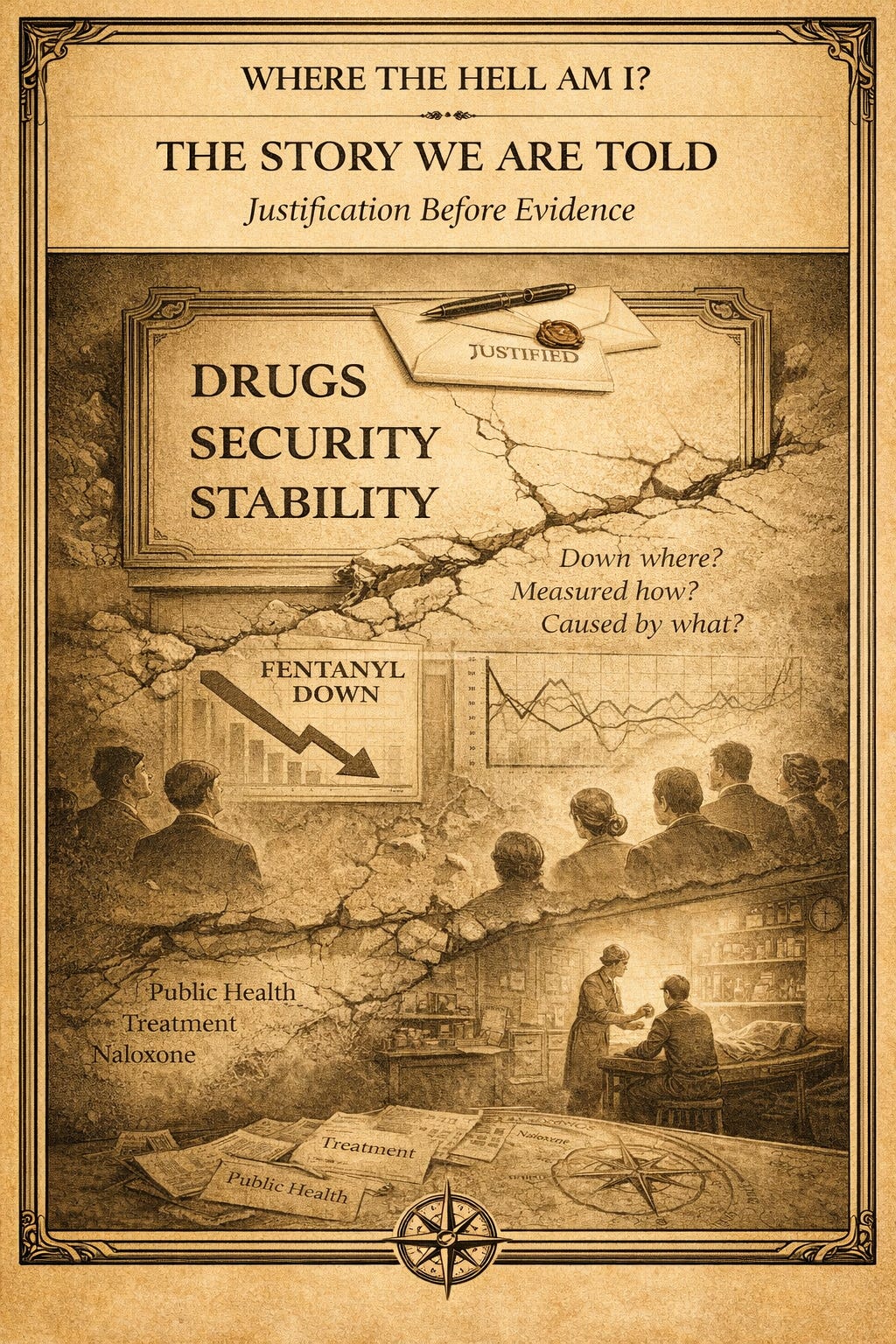
Before anything happens, it is explained.
Drugs.
Security.
Stability.
The justification arrives already sealed against opposition.
Because who argues in favor of fentanyl?
No one.
But then comes the leap.
We are told fentanyl is down.
A victory number.
But numbers require context.
Down where?
Measured how?
Caused by what?
Because reality is quieter.
Public health. Treatment. Naloxone.
Slow work.
Untelevised work.
But that is not what we see.
We see boats struck.
Routes disrupted.
It looks like control.
It feels like control.
But feeling is not causation.
IV. The Quiet Machinery
While the world watches the explosions, something else is moving.
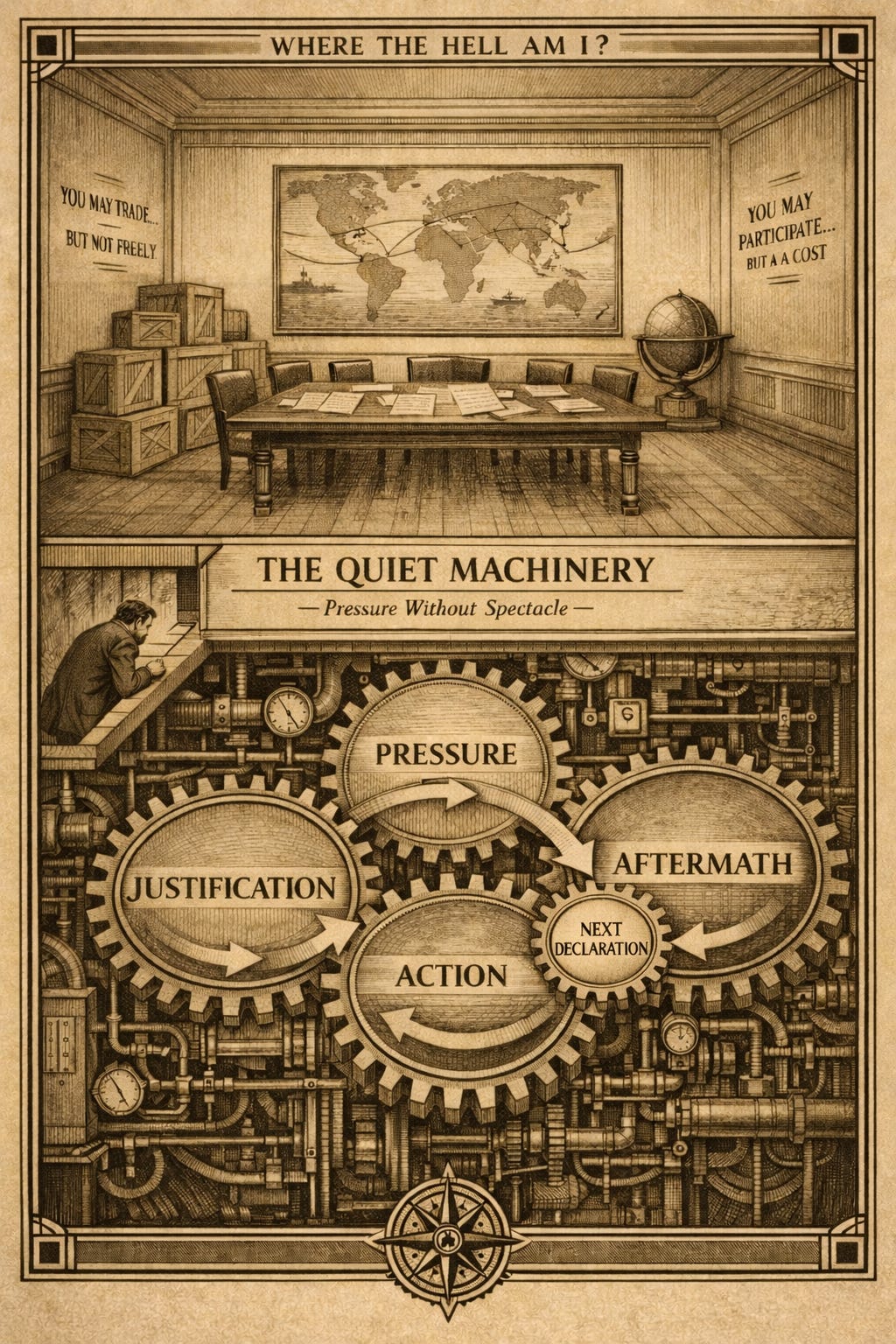
Tariffs.
No spectacle.
No breaking news.
But everything bends around them.
They are pressure.
You may trade… but not freely.
You may participate… but at a cost.
This is not spectacle.
This is structure.
And it prepares the ground for everything else.
The Pattern
Pressure.
Justification.
Action.
Aftermath.
And then,
before the aftermath can be understood,
the next declaration.
🧭 And Then It Arrives
It is easy to think all of this is happening “out there.”
But power travels.
And when it arrives,
it looks different.
It looks like this:
🧭 The Homefront
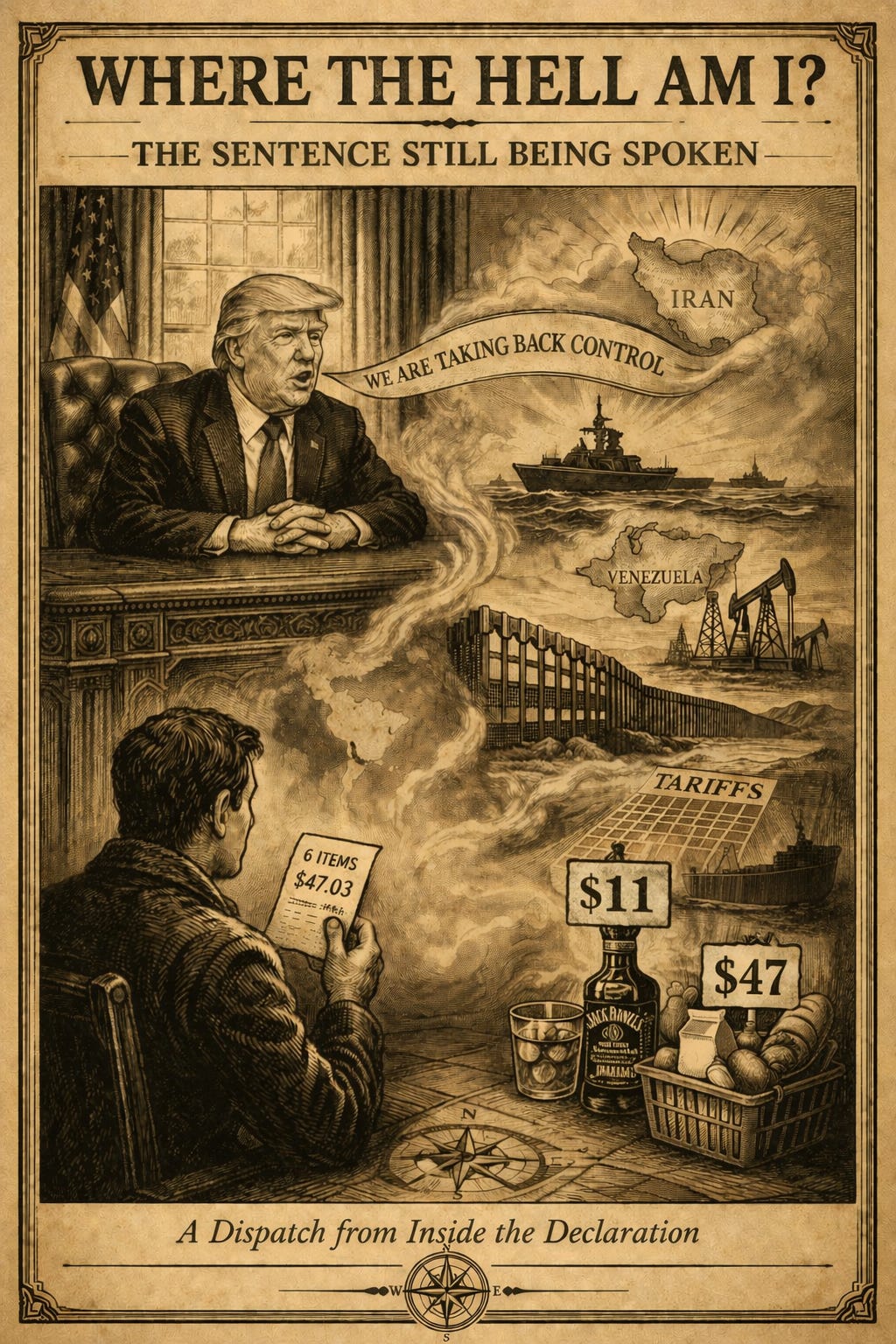
I judge the economy by the price of Jack Daniel’s.
A year ago, I could get a Jack and Coke for seven dollars.
Yesterday, I paid eleven.
In a dive bar.
I went to the grocery store and bought six items for forty-seven dollars.
No meat.
Nothing extravagant.
Just… more than it used to be.
We are told inflation is cooling.
Maybe.
But inflation is not a number.
It is a feeling.
You feel it when you hesitate.
When you calculate.
When the ordinary becomes noticeable.
The baseline has moved.
At the border, enforcement intensifies.
Systems move faster.
Less visible.
Harder to track.
And yes,
we do have a responsibility to deal with crime.
Including those who commit serious offenses in this country, whether they were born here or entered illegally.
When individuals come into the country unlawfully and then commit serious crimes, that is not abstract.
That is real.
That requires a response.
These are not imaginary problems.
And yet,
recognizing the problem is not the same as understanding the method.
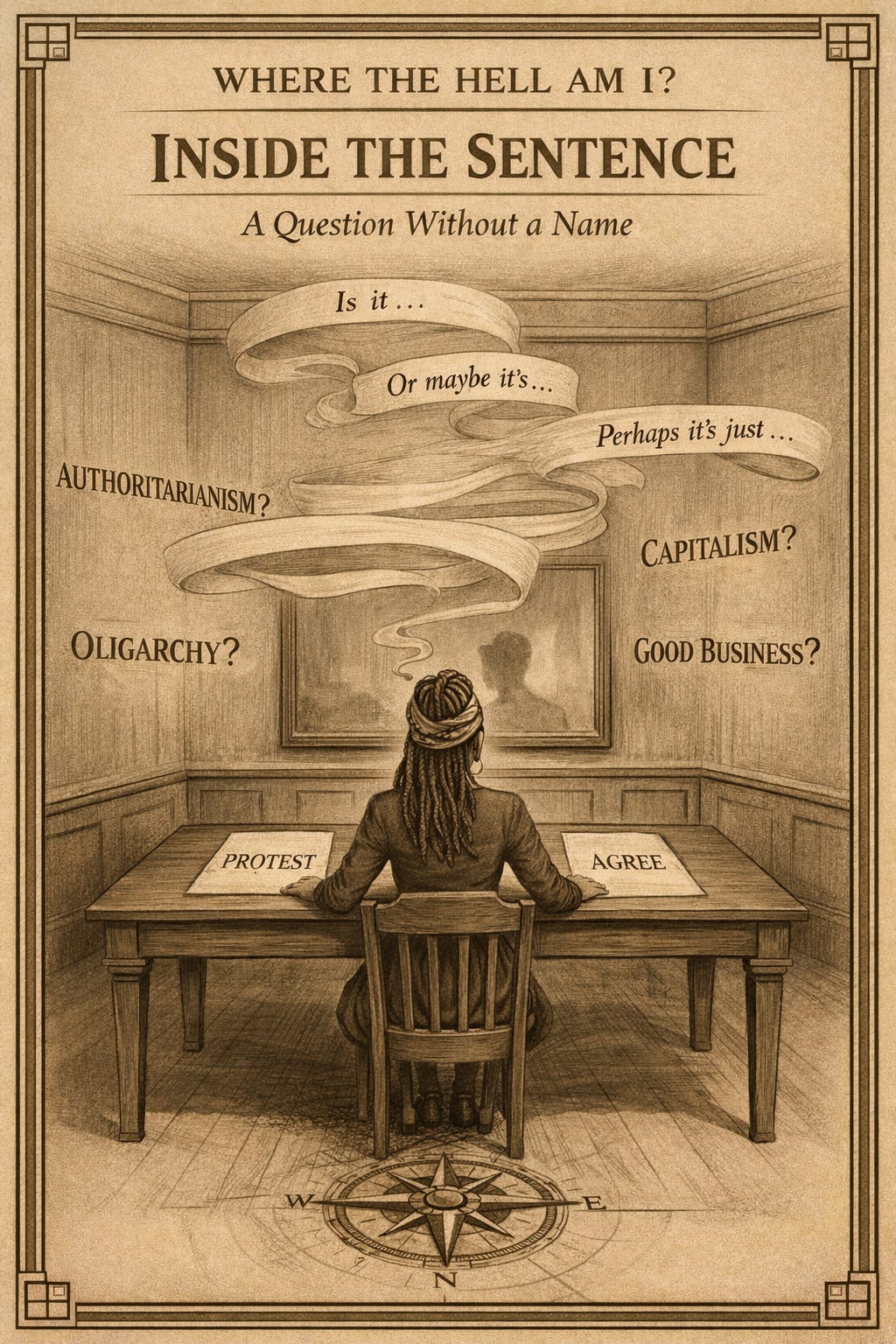
🧭 So… Where the Hell Am I?
This is where my own uncertainty begins.
Do I protest… or not protest?
Do I agree… or disagree?
Because I don’t entirely disagree.
That’s the problem.
And also the point.
So what is this?
Is it authoritarianism?
Oligarchy?
Capitalism at scale?
Or just… good business?
I’m not saying it’s right or wrong.
I’m asking something more basic.
What is it?
Because I have not seen anything quite like it in my lifetime.
Have you?
Because until we can answer that,
we are still inside the sentence
while it is being written.