

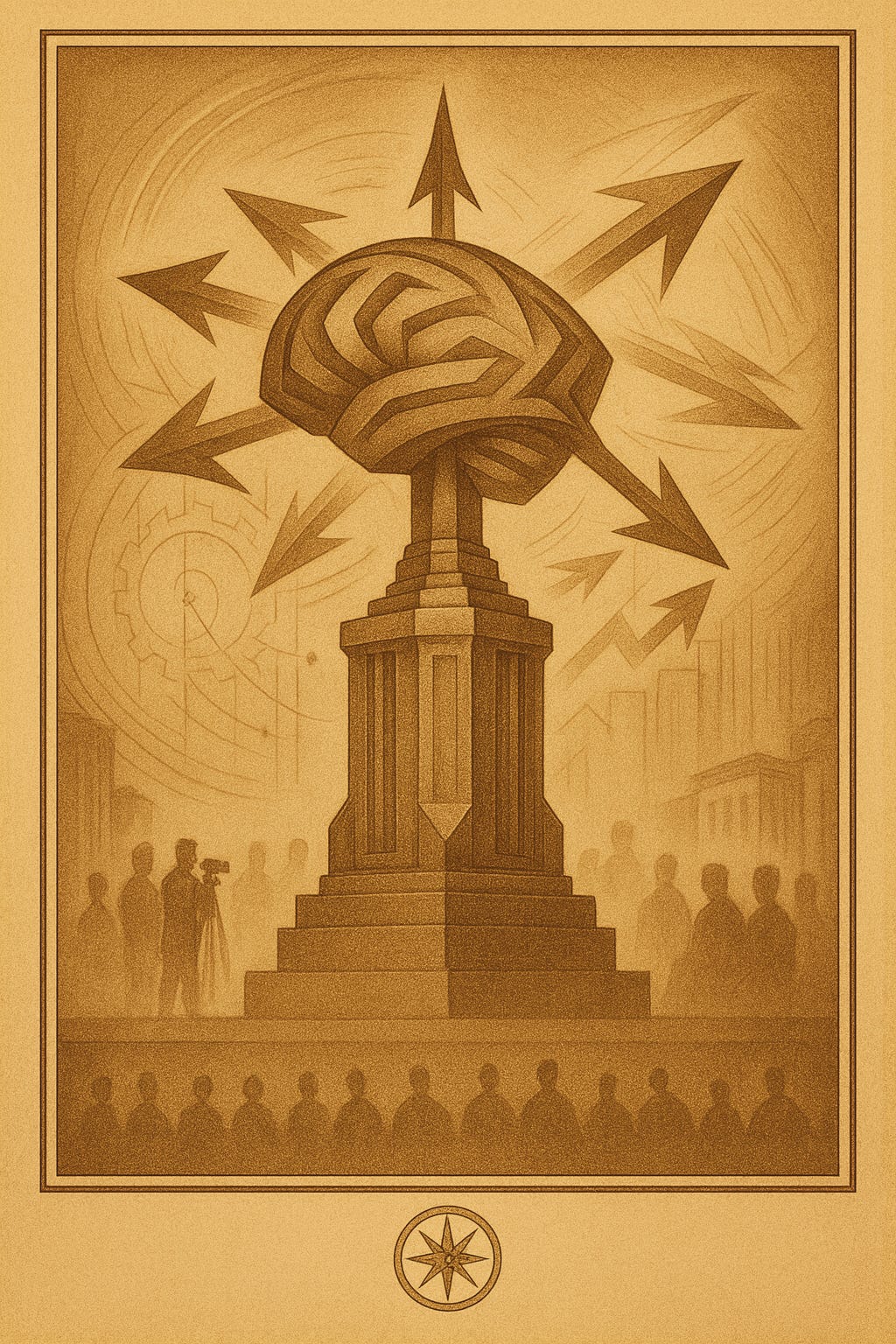
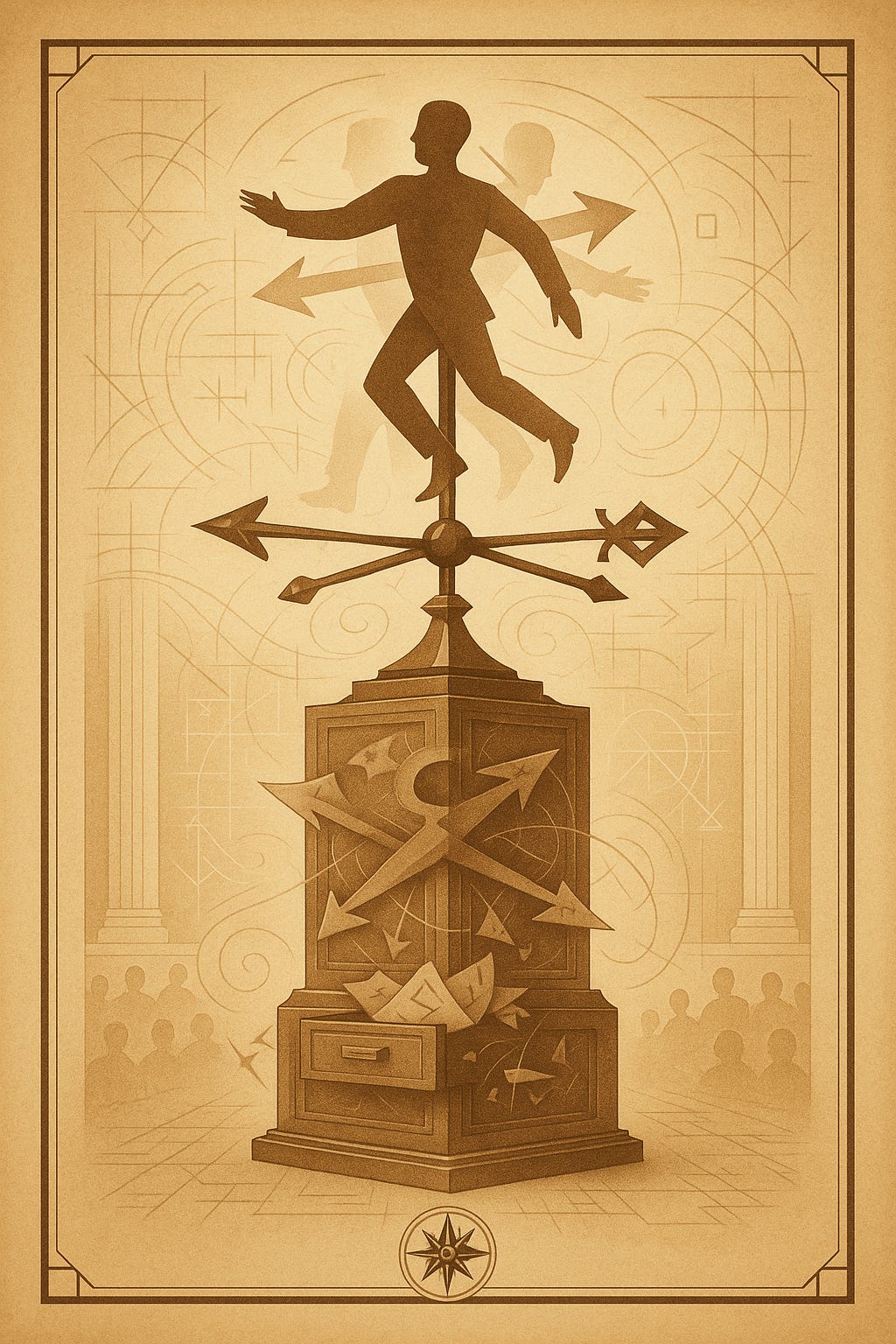
Donald Trump is a man famous for changing his mind — not slowly, not thoughtfully, but with the kinetic unpredictability of a weather vane in a tornado.
One minute he declares a cosmic truth; the next he politely disagrees with himself. His policy positions don’t evolve so much as revolve, spinning through the news cycle like a particularly excitable carousel horse.
And yet — every so often — he pivots in a positive direction.
Not effectively, not sustainably, and certainly not with the consistency of a functioning bureaucracy.
But the pivot is there.
A visible lurch toward something that looks like understanding.
Or responsibility.
Or, on rare occasions… empathy.
Here is your field guide to Trump’s notable self-corrections and conceptual somersaults: the moments when he seems to learn something, or at least respond to the realization that he might not have known it yesterday.
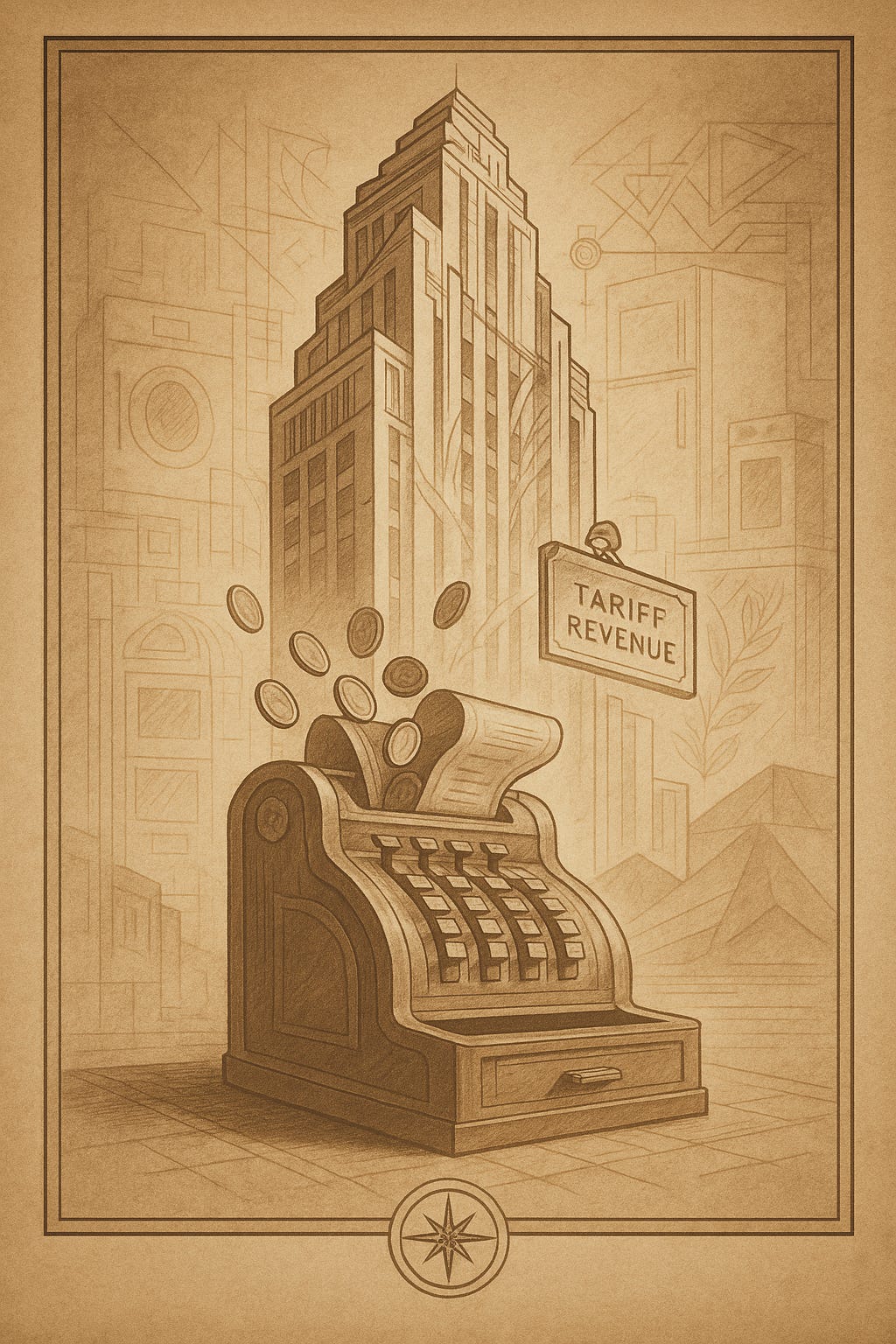
I. 💰 Tariffs: From “They’re Paying Us!” to “Wait—Are We Paying?” to “What If We Ended Income Tax?”
Trump’s early tariff messaging could have been embroidered on a pillow:
“We made millions and trillions. The money is pouring in. They’re giving us money.”
Except “they” — foreign governments — were not giving us money.
Importers pay tariffs. Retailers pay tariffs. Consumers pay tariffs.
The money “pouring in” was from Americans buying dishwashers.
For a long time, Trump appeared unaware of this. Then, somehow, perhaps through a briefing or osmosis or a late-night Fox chyron, he realized that Americans were the ones footing the bill.
And suddenly — the pivot:
If tariffs bring in all this revenue…
and if Americans are paying it anyway…
why not eliminate the income tax altogether?
A bold idea!
A mathematically incoherent idea!
A vintage Trump idea.
But incredibly, there is a bill he could piggyback on: the FairTax Act of 2025 (H.R. 25), which would replace the entire federal income-tax system with a national sales tax starting in 2027.
A decades-old fever dream of tax reformers, resurrected suddenly by Trump’s newfound love of tariff revenue. It’s not the same policy, but in his mind, it’s probably close enough to call a match.
Does this show learning?
Possibly.
Does it show caring?
Hard to say.
Does it show that Trump thinks of federal policy the way other men think of home renovation — knock it down and see what happens?
Absolutely.
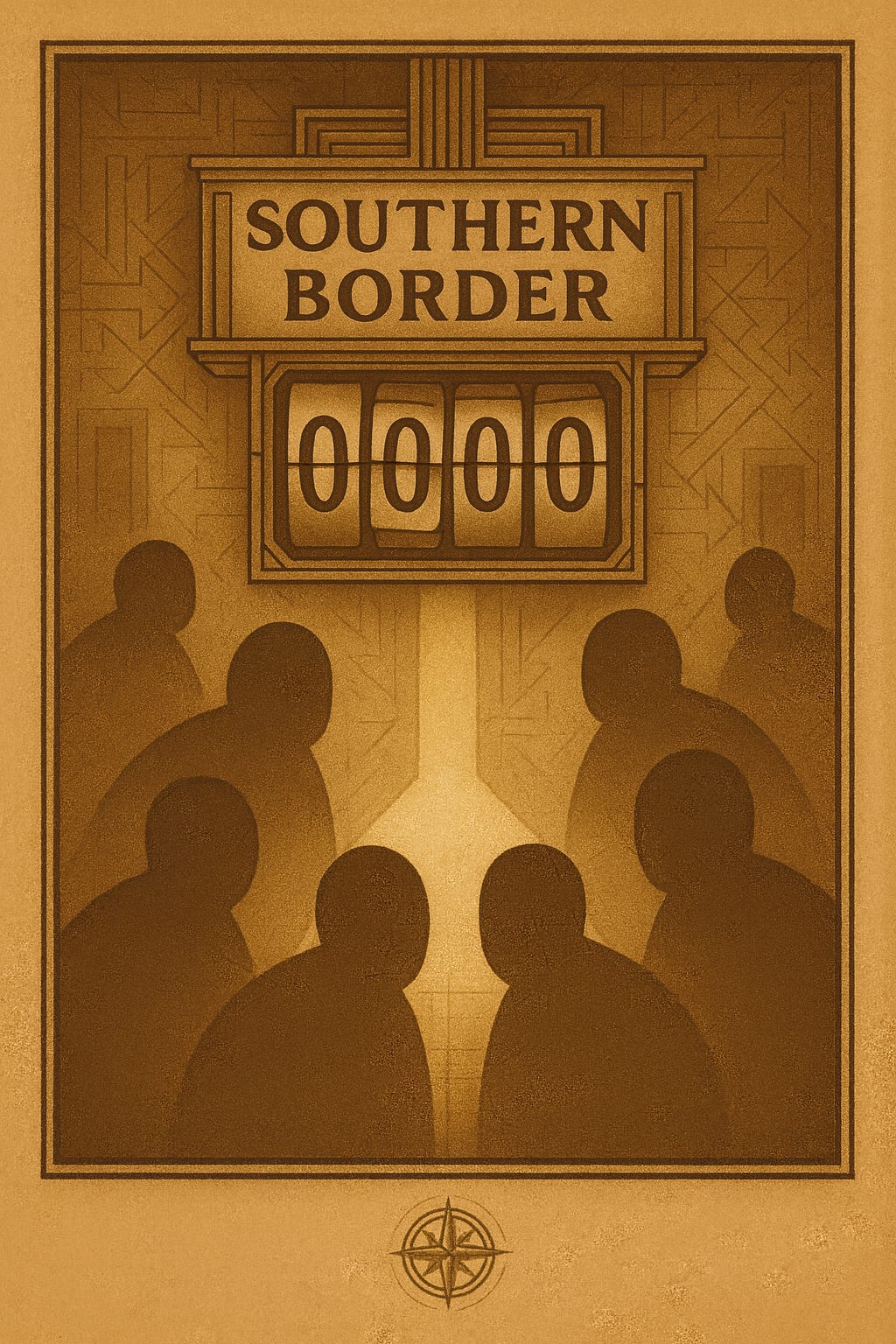
II. 🚧 Border Numbers: From “Zero Illegal Aliens Coming In” to “Zero Illegal Aliens coming in From the Southern Border”
Trump declared recently that “zero illegal aliens are coming into the United States.”
A number that is, regrettably, larger than zero.
Pressed on the math, Trump clarified:
“I meant zero from the Southern border.”
Ah! A directional correction.
A narrowing of scope.
A revision born not of data, but of necessity.
Because migrants were very much entering the U.S. through other pathways — Eastern Europeans, Asians, networks tied to trafficking and fentanyl distribution. But those weren’t the bodies Trump was politically interested in tracking.
Still: credit where it’s due.
He did adjust the statement to reflect a more specific claim when the original proved too obviously false.
Is this empathy?
No.
Is it awareness?
Occasionally.
Is the racialized subtext still doing the heavy lifting?
Indisputably.
But a pivot is a pivot, and we are documenting the phenomenon, not endorsing it.

III. 🕊️ In Israel: A Flash of Humanity in an Unlikely Setting
At the Knesset’s “Praise the Trump” ceremony — a diplomatic tribute event so effusive it made Oscar acceptance speeches look modest — Trump delivered an unexpected line.
While every other speaker focused exclusively on Israel’s needs, Trump’s remarks at the Knesset were, unexpectedly, a moment of unusual diplomatic coherence.
He did something startling: he acknowledged cooperation across the Arab and Muslim world — nations that “you wouldn’t suspect,” as he put it — and credited them for helping press Hamas to release hostages.
He framed it as a “brilliant point in time,” a golden-age hinge moment where former adversaries acted as “partners in peace.” Even more surprising, he spoke of the Middle East working together, of people who “love your country” and “love the region.”
It was one of those rare Trump moments where rhetoric briefly aligned with reality, as if the teleprompter, the political cosmos, and the man himself all exhaled at the same time. A flash of humanity — unexpected, fleeting, but undeniably present.
This was not a line anyone expected from him in that room.
It wasn’t on-brand.
It wasn’t a crowd-pleaser.
It wasn’t even strategically necessary.
And yet, he said it.
It didn’t result in meaningful policy.
It didn’t shift the situation on the ground.
It didn’t survive the next news cycle.
But it happened.
And in Trumpworld, a moment of unexpected bipartisanship — or bi-national empathy — is the moral equivalent of spotting a snow leopard: rare, brief, and immediately chased away by noise.
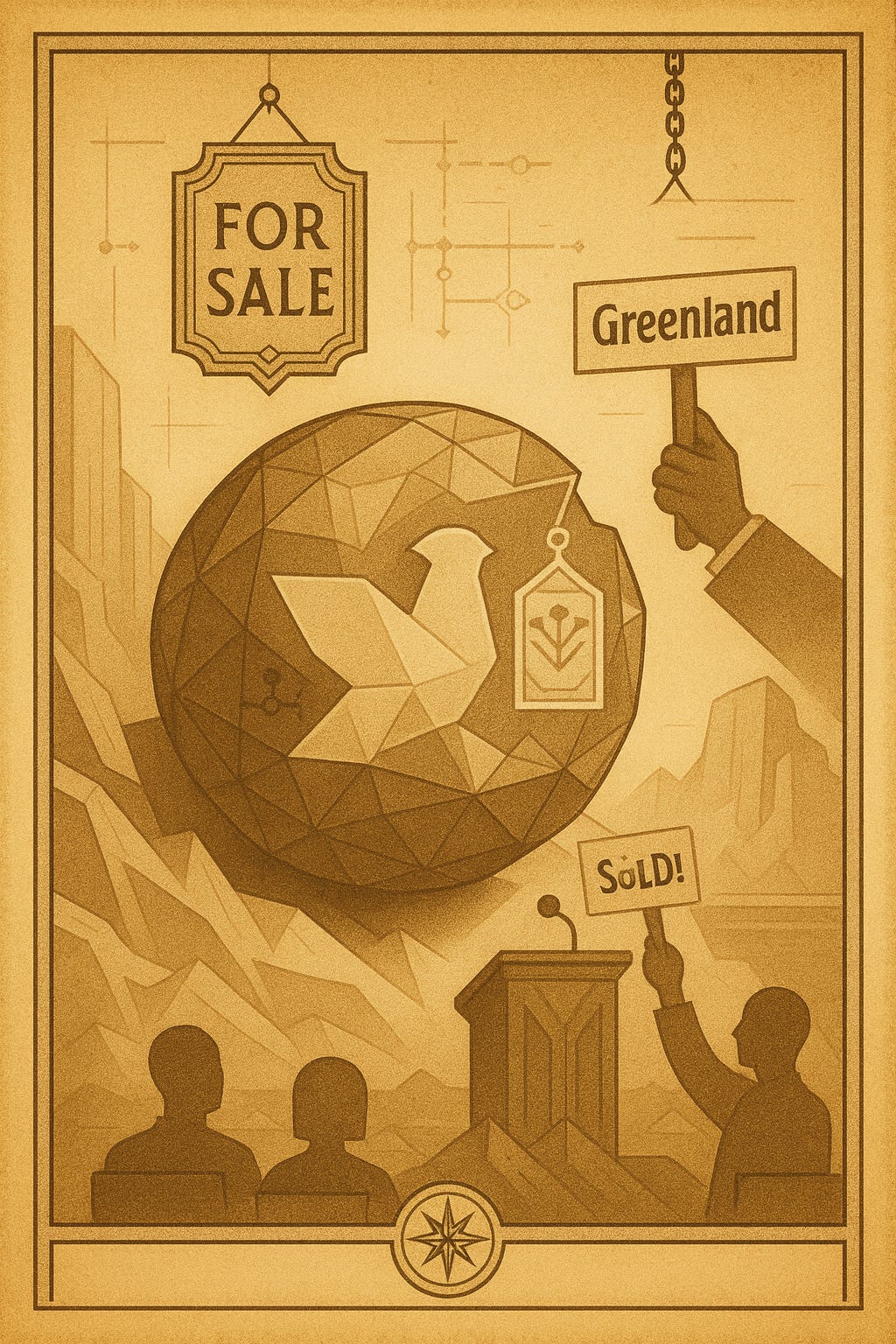
IV. 🧲 Rare Earths, China, and the Greenland Solution No One Asked For
Trump occasionally identifies a real geopolitical vulnerability, and the rare-earths crisis was one of them.
China dominates global rare-earth processing — the minerals essential for U.S. military systems, technology, and green energy. If the tariff war escalates, China could pinch the supply chain hard enough to shut down entire industries.
Trump appeared to grasp this.
For about ten minutes.
Then came the pivot — not toward industrial strategy, not toward alliances, not toward domestic mineral investment, but toward the solution he trusts most:
“Let’s buy Greenland.”
To Trump, this was logical.
Why negotiate when you can acquire?
Why diversify supply chains when you can annex a mineral jackpot with scenic coastlines?
Denmark’s prime minister called the proposal “absurd.”
Trump called her “nasty.”
And the rare-earths problem remained as unresolved as his golf-course disputes.
But again — the pattern holds:
He identifies a genuine strategic issue
He skips every realistic response
He leaps directly to a real-estate fantasy
A pivot, yes.
A solution, no.
An entertaining display of how Trump imagines statecraft?
Absolutely.

V. 🎭 The Man Who Can Be Lovely at Dinner and Lethal by Sunrise
For all this volatility, there is a parallel narrative whispered by those who know Trump personally:
He can be incredibly nice.
Bill Maher — whom Trump publicly roasts with rotisserie-level consistency — once admitted that when they met at Mar-a-Lago, Trump was perfectly warm. Funny. Gracious. A delightful dinner companion.
And that complicates everything.
It suggests that Trump is not a singular persona but a time-of-day phenomenon:
Evening Trump hosts you warmly, remembers your drink order, and smiles for the cameras.
Morning Trump rips you to shreds before breakfast and denies knowing you by lunch.
It’s the gladiator’s creed paired with the maître d’s handshake:
“It’s just business.
I’m sorry if I must destroy you in the arena.”
This duality defies conventional political analysis.
He can dote on guests beneath the chandeliers and then carpet-bomb their reputations hours later.
Is it compartmentalization?
Performance?
A lifelong habit of treating every interaction as transactional?
Whatever it is, it fits the pattern:
Trump doesn’t only pivot on policy.
He pivots on personality.
Warm in the foyer, ruthless on the battlefield.
A man for whom affection is conditional, alliances are temporary, and enemies are merely people awaiting their turn on the wheel.
And in that sense, he is consistent:
Hospitality is genuine.
Combat is inevitable.
And none of it is personal — until it very much is.
🧩 So What Do All These Pivots Mean?
Donald Trump contains multitudes —
not in the Walt Whitman sense,
but in the “miscellaneous drawer next to the kitchen sink” sense.
A tangle of impulses, half-formed ideas, corrections, improvisations, and the occasional unexpected gesture toward humanity.
Sometimes he learns.
Sometimes he clarifies.
Sometimes he surprises everyone, including himself.
Rarely does any of it translate into durable policy.
But the pivots themselves tell a story:
Trump is not static.
He is not predictable.
He is not consistently informed, but he is sporadically corrigible.
He moves through politics like a man rearranging furniture in a house that is perpetually on fire.
Does he care?
Historians may someday decide.
For now, we can only observe the spectacle:
A man evolving.
Or revolving.
Or pinwheeling.
Or, quite possibly, spinning in place —
the human weather system whose forecast changes without notice.
— Next installment: Why Rich People Hate Taxes and Death. —
One they can delay with lawyers; the other they try to outrun with kale and cryogenic freezers.
If this piece made you laugh, sigh, or mutter “Lord help us,” slip a coin to the bartender-author.
I promise to pour another round of democracy analysis, neat.
Your generosity keeps the typewriter fed and the jokes legally printable.

Couldn't agree more, this analysis of his unpredictable thought process is just brilliant and so well articualted! It's like trying to hold a precise Pilates pose while someone keeps randomly shifting the mat - impossible to find any consisent core strength!
A national sales tax would put the burden on consumers and everyday people while an income tax can be graduated to protect low income families. That is why a graduated tax is fairer.