Last week, I drove past one of the most important buildings in America.
I did not know its name.
There was no monumental sign. No tour guide. No gift shop. No schoolchildren spilling out of buses. No bronze plaque commemorating the great events that had occurred there. No flashing lights, no neon arrow proclaiming “Computers Are Us,” no stone computers perched like gargoyles along the roofline.
Apparently, civilization prefers to hide its monuments in plain sight.
The building was substantial, orderly, and carefully finished. It could have been an office building, the headquarters of an engineering firm, or some exceptionally well-housed municipal department.
It might simply have been storage.
And in a sense, it was.
It was a data center.
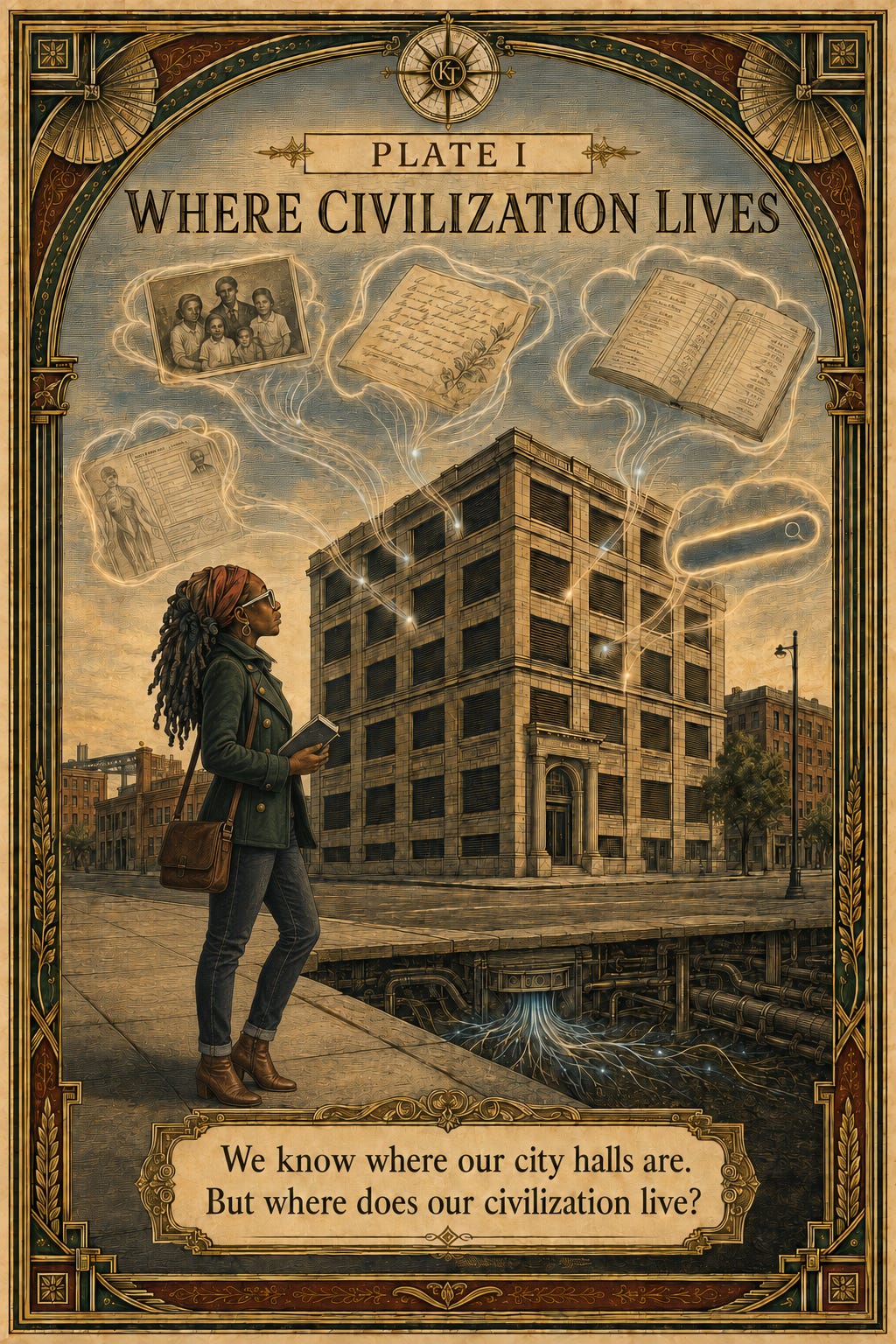
Inside that building lived pieces of our collective lives.
Photographs.
Emails.
Bank records.
Medical histories.
Family memories.
Arguments.
Love letters.
Searches made at two in the morning.
Questions we would never ask another human being—or would ask only after first clearing our browser history.
The building contained fragments of millions of people. Yet almost nobody driving past it appeared to know what it was.
We know where our city halls are.
We know where our churches are.
We know where our libraries are.
We know where our schools are.
But most of us have no idea where our civilization actually lives.
For most of human history, the buildings that contained a society’s memory and power were deliberately visible.
The cathedral stood at the center of town.
The courthouse occupied the public square.
The library announced itself with columns and grand staircases.
The bank built a marble temple to its own permanence, shortly before lending you money against yours.
Today, some of our most consequential buildings resemble ordinary warehouses, offices, and industrial buildings. They sit along familiar streets and at the edges of cities—architecturally composed, operationally discreet, and largely absent from public consciousness.
But they are not empty sheds.
They are the storehouses of modern memory. They are the factories of artificial intelligence. They are the counting houses of global commerce. They are the private libraries into which humanity has deposited its photographs, correspondence, finances, medical histories, movements, habits, desires, and fears.
We call all of this the cloud, as though our civilization had floated gently into the atmosphere.
It has not.
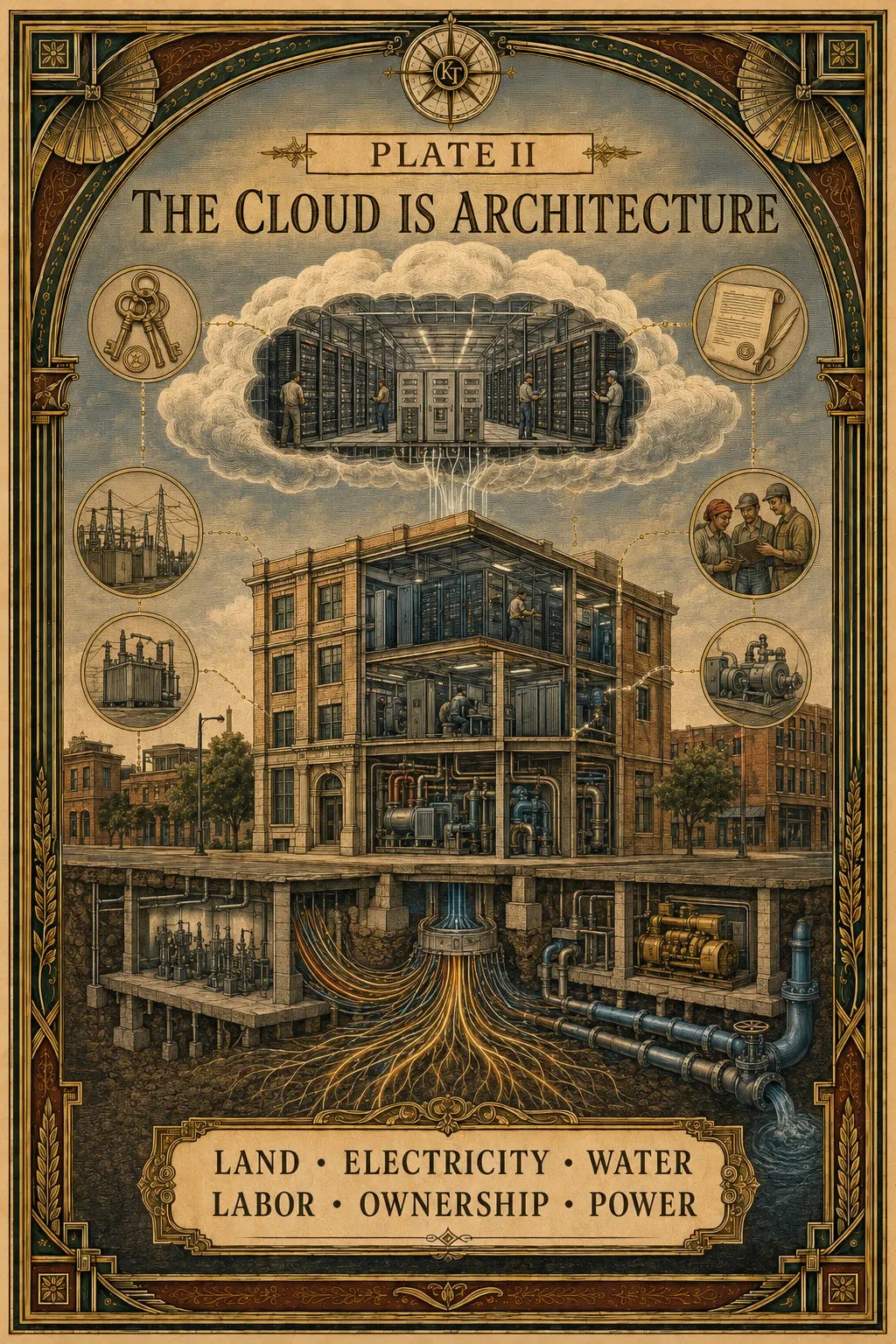
The cloud is architecture.
The cloud is land.
The cloud is electricity.
The cloud is water.
The cloud is labor.
The cloud is ownership.
The cloud is power.
The cloud, in other words, is remarkably heavy for something named after the weather.
And every part of it exists somewhere.
That realization led me to an uncomfortable question:
Who owns the roads our thoughts travel on?
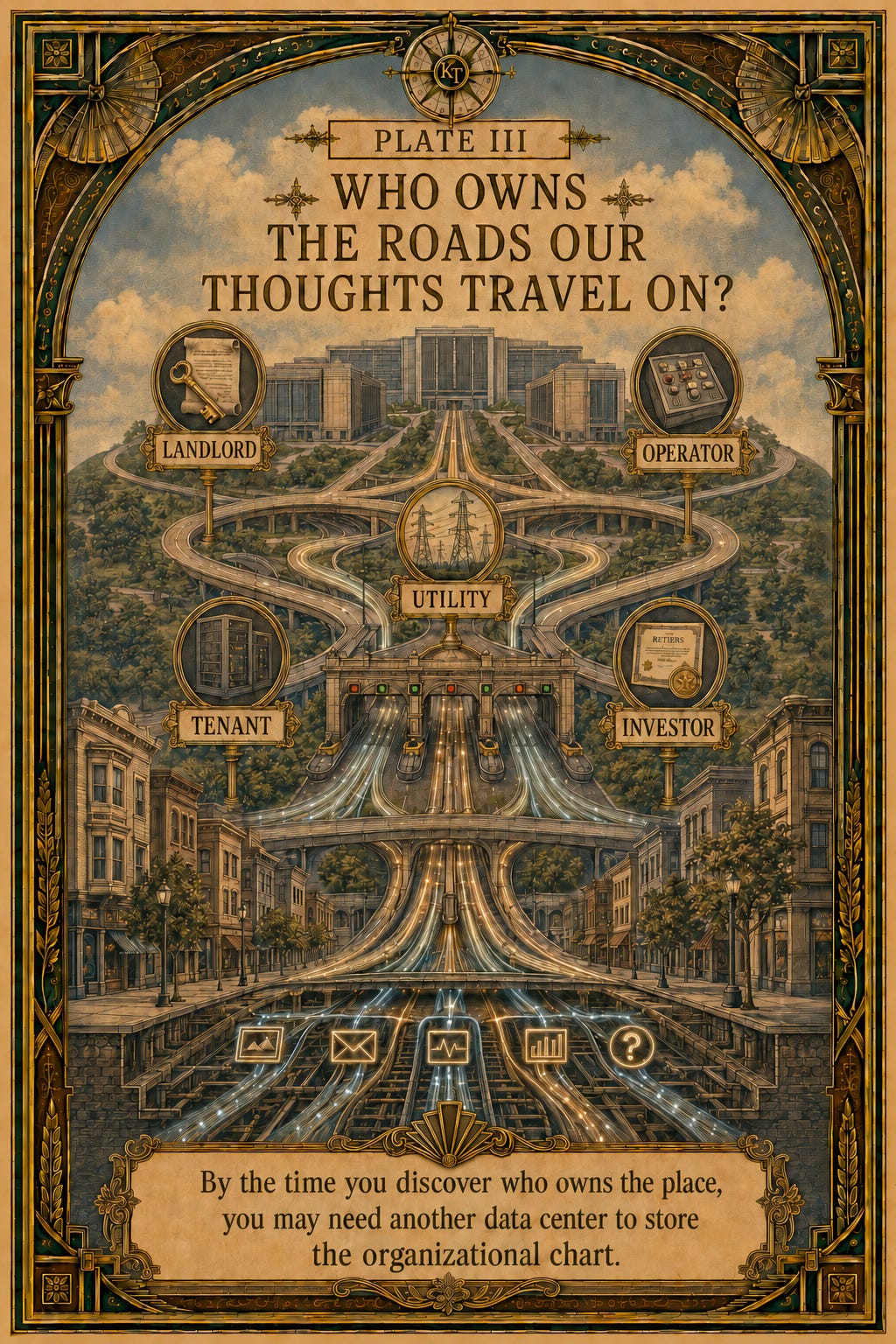
I had assumed Amazon owned Amazon’s cloud, Microsoft owned Microsoft’s, and Google owned Google’s. Broadly speaking, that is true—but it does not mean these companies own every acre of land, building, cable, generator, cooling plant, or server rack that keeps their clouds aloft.
I still didn’t know what the hell Salesforce did. It turns out Salesforce sells corporate civilization by subscription: customer records, sales leads, complaints, contracts, and all the other bureaucratic sediment of commerce. And now we know.
But even Salesforce must live somewhere. Its cloud runs largely on infrastructure supplied by other cloud companies, which, in turn, depends on physical buildings that Salesforce may neither own nor occupy.
The ownership of the cloud is layered.
One company may own the land. Another may own the building. A third may operate it. A fourth may lease a secured room inside it. A fifth may provide the electricity. A sixth may own the fiber carrying the information away.
By the time you discover who owns the place, you may need another data center just to store the organizational chart.
And somewhere at the end of this chain is a photograph of your mother.
The physical infrastructure of memory has become a form of commercial real estate.
Some data centers are owned directly by the great technology companies. Others belong to publicly traded real-estate investment trusts such as Digital Realty and Equinix. Still others are controlled by private-equity firms, infrastructure funds, insurance capital, pension money, and sovereign investors.
Blackstone acquired QTS Data Centers in a deal valued at roughly $10 billion. KKR and Global Infrastructure Partners bought CyrusOne for approximately $15 billion. Vantage Data Centers attracted billions more in investment from DigitalBridge and Silver Lake.
You didn’t know that, did you? I certainly didn’t.
These vast digital empires are being bought, sold, and assembled while the rest of us are sleeping, sipping cocktails, or lamenting the death of downtown.
Some of us may therefore own tiny pieces of these buildings through our retirement funds without knowing where the buildings are, who occupies them, or what they contain.
We may be both the product and the landlord, which is one way of achieving vertical integration.
The cloud does not merely have an owner.
It has landlords, tenants, lenders, utilities, contractors, investors, tax agreements, water rights, zoning entitlements, and electrical contracts.
It has nearly everything a city has—except citizens.
The early internet was imagined as a decentralized network: a system without a single indispensable center, capable of routing information around damaged or unavailable points.
Yet over time, something curious happened.
We rebuilt the center.
Not necessarily through conspiracy.
Not necessarily through malice.
We rebuilt it through convenience. Through efficiency. Through scale. Through habit.
The roads became highways.
The highways became toll roads.
The toll roads became kingdoms.
The kingdoms gave us free shipping.
And now an astonishing portion of human life passes through infrastructure controlled by a relatively small number of corporations and investment interests.
This is not simply an accusation against the people who built it.
The builders of the modern cloud have accomplished extraordinary things. They have created forms of communication, scientific inquiry, commerce, creativity, and access to knowledge that earlier generations could scarcely have imagined.
They have made it possible for a person to consult the collected knowledge of humanity while sitting in bed, avoiding the collected responsibilities of the morning.
The question is not whether these builders are good or evil.
The question is whether the rest of us understand what they have built, where it exists, what resources it consumes, and what we have entrusted to it.
Amazon publicly identifies American cloud regions such as Northern Virginia, Ohio, Northern California, and Oregon. But a region is not one building. It contains multiple “availability zones,” and each zone may contain one or more physically separate data centers.
A dot on the cloud map may therefore represent a constellation of buildings.
Microsoft describes a worldwide Azure infrastructure spanning hundreds of secured facilities, while generally identifying broad metropolitan regions rather than publishing a directory of street addresses.
Google is somewhat more forthcoming. It identifies major data-center locations in Virginia, Oregon, Iowa, Georgia, North Carolina, South Carolina, Ohio, Nevada, Texas, and elsewhere.
These buildings are not placed randomly.
They follow electricity.
They follow fiber-optic cables.
They follow water.
They follow affordable land.
They follow favorable tax agreements.
They follow public officials eager to announce investment.
They follow communities that may not yet understand what they are being asked to host.
Nothing in America moves faster than a public official toward a podium bearing the words economic development.
American civilization now has physical neighborhoods.
One of the largest is in Northern Virginia, around Ashburn, Sterling, Loudoun County, and Prince William County. Others have emerged around Dallas–Fort Worth, Phoenix, Chicago, central Ohio, Oregon, Iowa, Georgia, the Carolinas, New Jersey, and Silicon Valley.
Here in the Bay Area, the cloud is not floating above us. It is sitting in San Francisco, Oakland, Santa Clara, San Jose, Sunnyvale, and Palo Alto.
Consider 720 Second Street in Oakland.
It does not crouch behind a chain-link fence looking guilty.
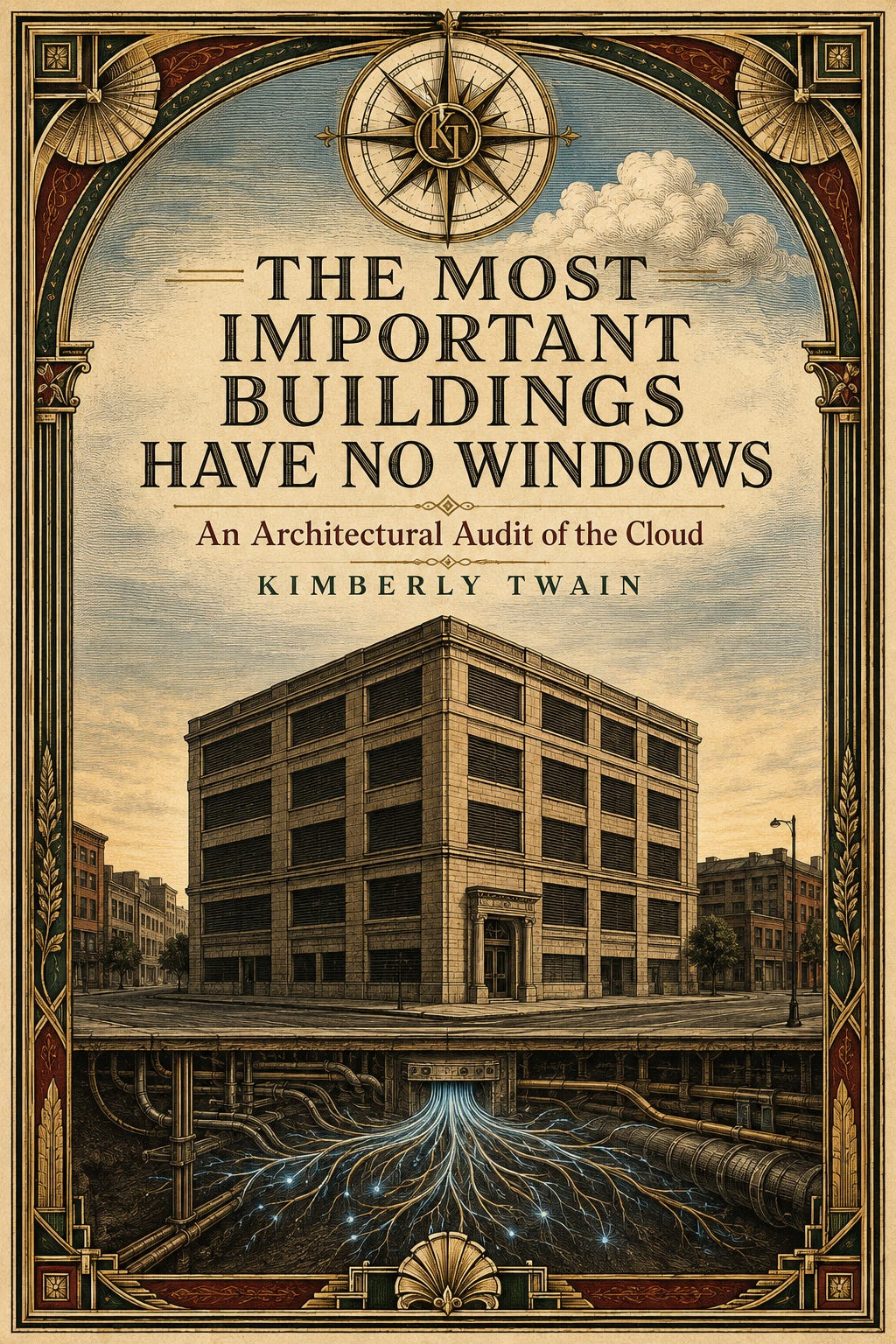
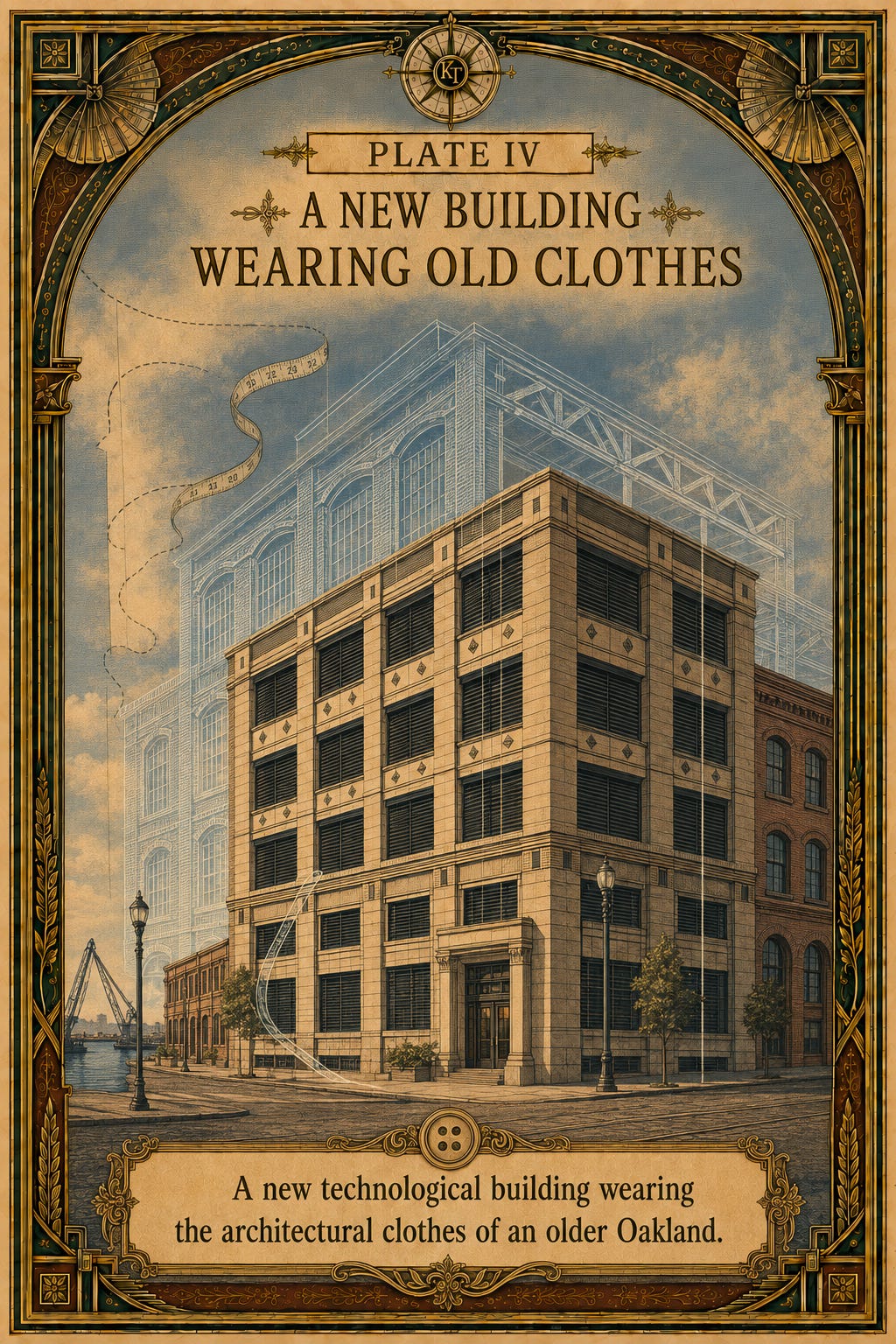
It is a substantial, well-maintained, four-story building near Jack London Square. Its warm, earth-toned exterior is carefully composed. Strong horizontal lines organize the façade. Dark recessed openings give it rhythm and depth. The entrance is formal, the lobby polished, the architecture restrained but respectable.
At first glance, I assumed it was an older industrial building that had been repurposed as a data center. It looks as though it belongs to Oakland’s historic warehouse district.
But the present building was constructed around 2001 as a data center.
Its physical resemblance to an older warehouse may have been an intentional contextual design choice. Rather than importing a futuristic glass box or erecting a blank concrete bunker, its designers appear to have borrowed the massing, proportions, and visual rhythm of the industrial buildings surrounding it.
It is a new technological building wearing the architectural clothes of an older Oakland.
It might be an office building.
It might be the headquarters of an engineering firm.
It might contain architects, accountants, attorneys, or some exceptionally well-housed municipal department.
It might simply be storage.
And in a sense, it is.
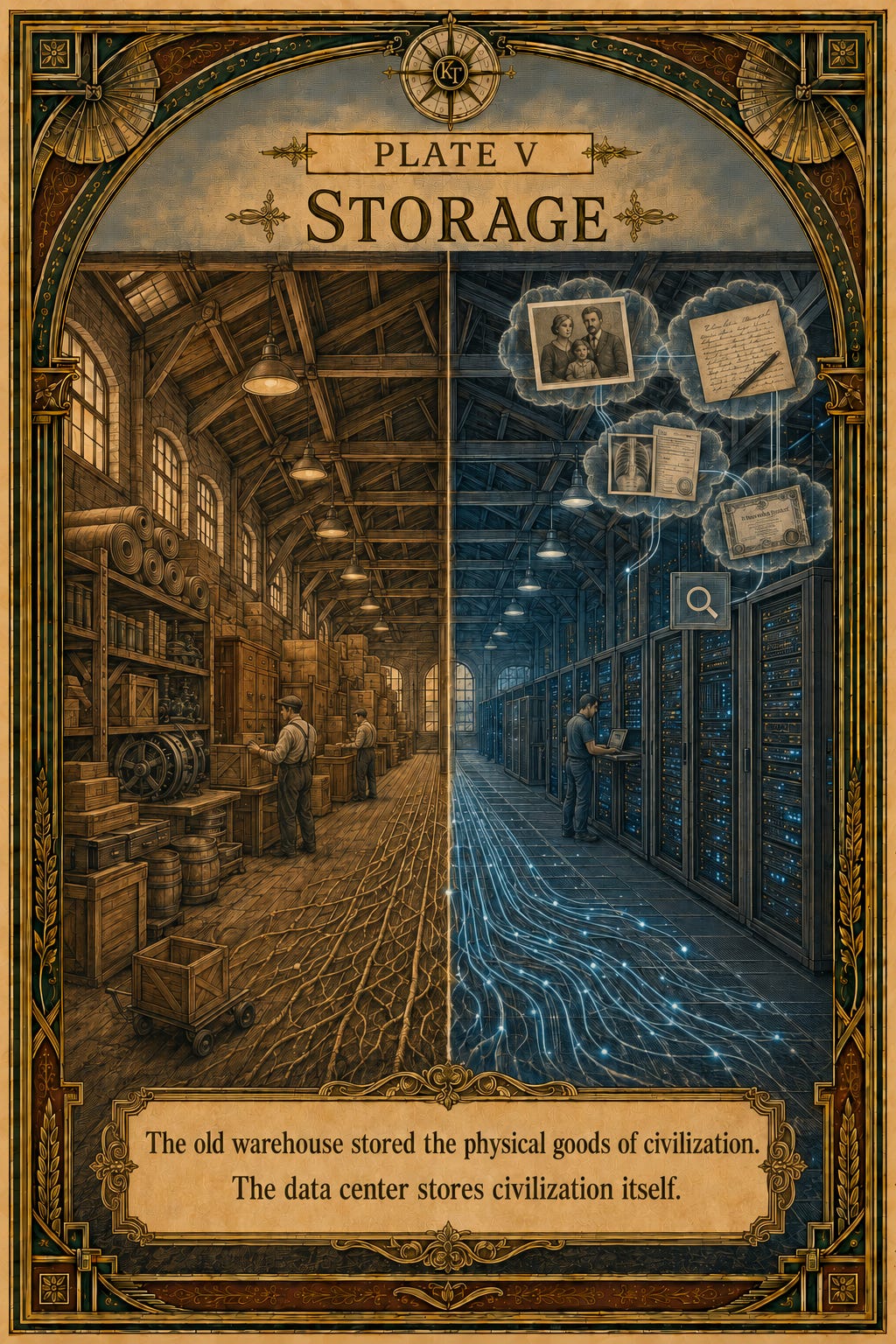
It is storage not in the old physical sense—crates, furniture, machinery, and merchandise—but in the data sense.
Behind its composed urban exterior are roughly 50,000 square feet of raised computer floor, large electrical transformers, seven emergency generators, eight industrial chillers, reserve-water tanks, secured equipment cages, and connections to more than fifteen internet providers. The entire building encompasses approximately 122,000 square feet. Digital Realty OAK10
The old warehouse stored the physical goods of civilization.
The data center stores civilization itself.
The building does not hide by appearing dangerous.
It disappears by appearing familiar.
That is not necessarily a criticism.
Data centers contain critical infrastructure, private records, financial systems, medical information, and the machinery upon which governments and businesses depend. There are perfectly legitimate reasons not to advertise every entrance, cable route, server room, and security system.
I do not need a guided tour of the room containing my bank records.
I am not sure the gift shop would be very good anyway.
But the building’s ordinary appearance raises another set of questions.
How much electricity does it consume?
Where does that electricity come from?
How much water does it use?
How often do its emergency generators operate?
What fuel do they burn?
What happens to the heat produced by thousands of machines working day and night?
The building may be discreet for security’s sake.
Its environmental footprint should not be.
No contemporary figure has made the physical reality of artificial intelligence clearer than Elon Musk.
In Memphis, a former Electrolux factory was transformed into Colossus, the enormous computing system developed to train Grok and other artificial-intelligence models.
Musk named it Colossus, because apparently Moderately Ambitious Computer lacked grandeur.
The conversion is almost too symbolically perfect.
A building that once manufactured appliances for human households now manufactures intelligence for machines.
The industrial shell remains, but the nature of production has changed. Refrigerators and ovens no longer depart through the loading docks. The new products are models, predictions, language, images, decisions, and machine-generated answers.
The company says it assembled the original Colossus system in 122 days and subsequently expanded it to 200,000 interconnected Nvidia processors. xAI’s Colossus account
That speed is presented as evidence of genius—and perhaps it is.
But speed has material consequences.
A city may deliberate for ten years over a rail line, five years over affordable housing, and three years over a public library.
A private company can arrive, fill an industrial building with hundreds of thousands of processors, install power-generating equipment, and alter the electrical and environmental future of an entire community before most residents understand what is being built.
We can train an artificial intelligence before we can schedule the third public hearing about it.
The machine moves at machine speed.
Public accounting does not.
Colossus is not simply a computer inside a building.
It is a new industrial organism.
It requires land, substations, transmission lines, cooling systems, water, fiber-optic cables, batteries, security, generators, and fleets of gas turbines. It possesses many of the systems of a city while remaining under private command.
It is practically a municipality, except that the servers do not vote, attend school-board meetings, or complain about potholes.
And it does not stop at the state line.
The expanding Memphis–Southaven complex crosses Tennessee and Mississippi. Its buildings, turbines, electrical infrastructure, water demands, tax agreements, and environmental effects may fall under different governments while functioning as parts of one computational system.
The machine experiences the region as a single territory.
Only the public is divided by jurisdiction.
Mississippi announced in January 2026 that xAI would invest more than $20 billion in a Southaven data-center project, calling it the largest private economic-development project in the state’s history. State of Mississippi announcement
The promises are familiar.
Investment.
Jobs.
Innovation.
Global importance.
A place on the technological map.
Nothing says “the future has arrived” quite like a governor standing beside a rendering of a building with no windows.
But the resource demands are physical and local.
In July 2026, Reuters reported that nearly 60 natural-gas turbines had been installed in connection with the Colossus 2 project, primarily on the Mississippi side of the state line. The dispute concerned whether turbines classified as temporary required federal air permits. Mississippi regulators had separately approved construction of 41 permanent gas-fired turbines. Reuters investigation
The company has maintained that it complied with applicable requirements. Environmental and civil-rights organizations have argued that the turbines impose additional pollution upon predominantly Black communities already carrying a history of industrial exposure.
This is where the cloud ceases to be a metaphor.
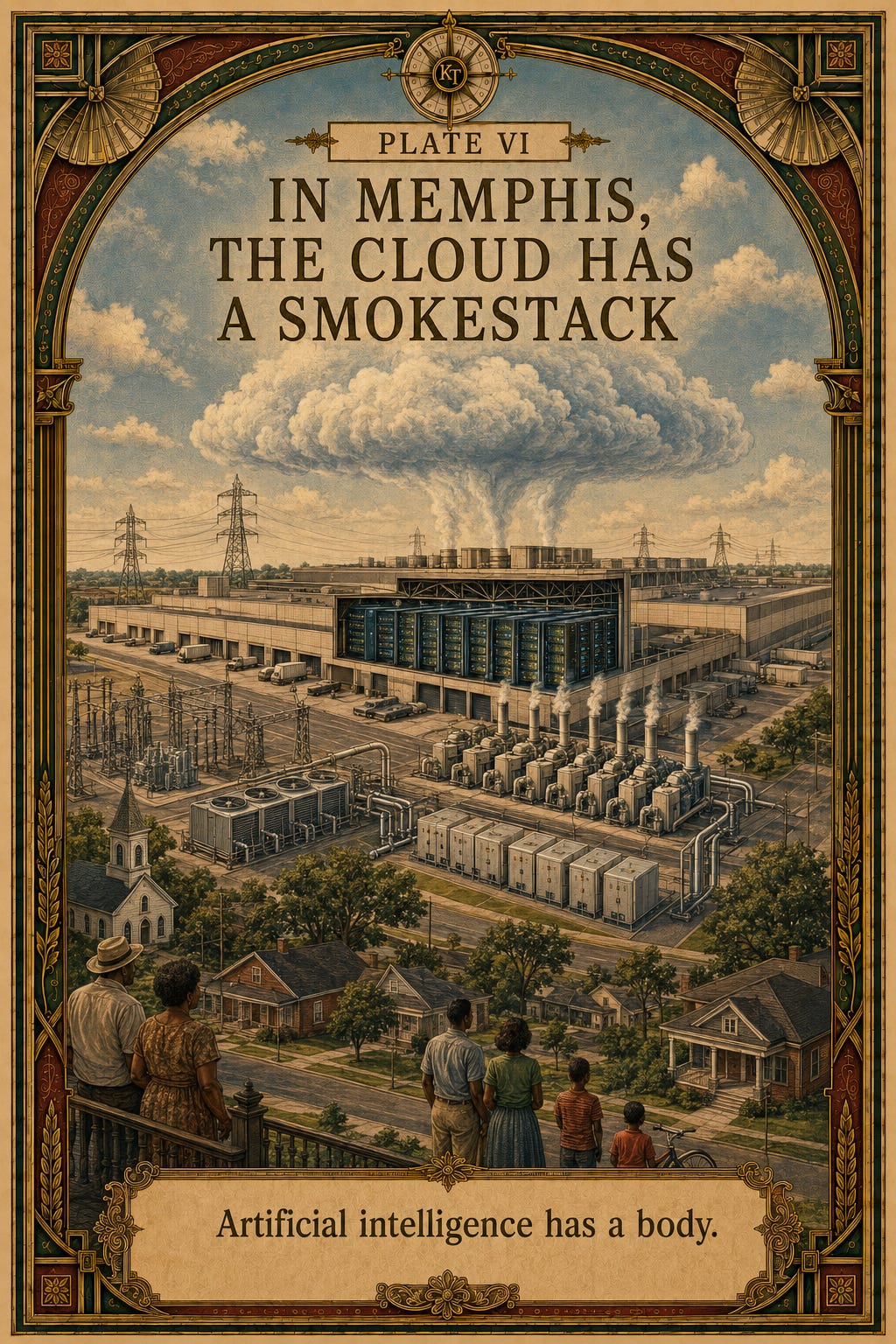
In Memphis, the cloud has a smokestack.
The environmental question is not separate from the architecture.
It is the architecture.
The turbines, substations, cooling equipment, wastewater systems, transmission lines, server halls, and surrounding neighborhoods are all parts of the same building project.
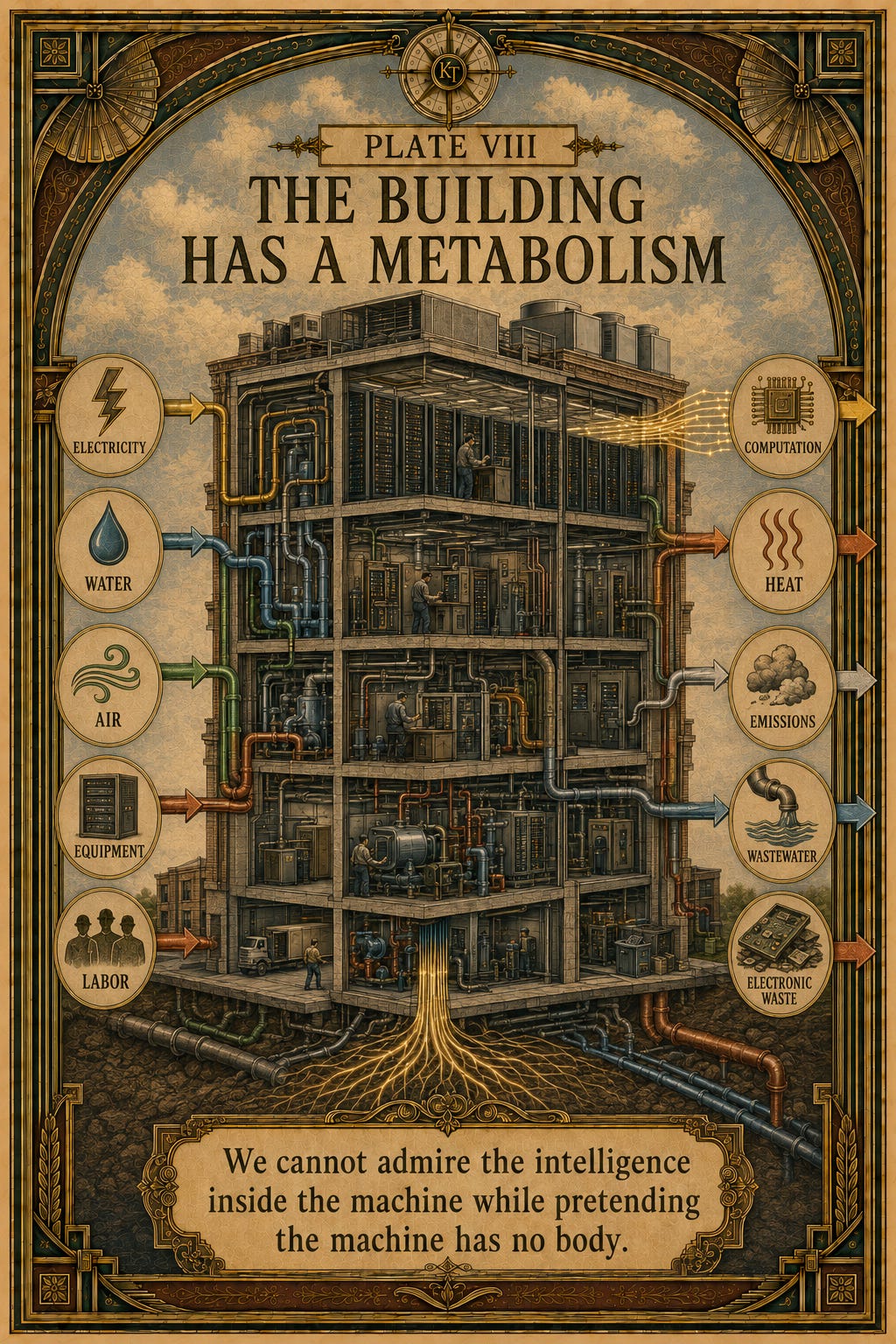
We cannot admire the intelligence inside the machine while pretending that the machine has no body.
Nor can we track sustainability solely by searching for a name on the property deed.
Elon Musk may not personally hold title to every parcel, turbine, warehouse, or transmission line associated with the complex. Buildings of this scale are assembled through corporations, subsidiaries, utilities, leases, public agreements, and layers of financing.
Musk may not own every brick.
He controls what the bricks are doing.
Legal title is only one form of responsibility.
If the ownership of the cloud is layered, then its environmental accounting must follow those layers.
Who owns the building?
Who operates the equipment?
Who purchases the electricity?
Who owns the generators?
Who controls the cooling system?
Who receives the tax benefit?
Who pays for new transmission infrastructure?
Who receives the output?
Who absorbs the pollution?
Who reports the numbers?
And who verifies them?
These questions are not arguments against data centers.
They are the ordinary questions we should ask of any major industrial system.
A civilization reveals itself through the buildings it chooses to construct.
The pyramids revealed one civilization.
The cathedrals revealed another.
The railroads revealed another.
The skyscrapers revealed another.
What do data centers reveal about us?
They reveal that memory has become industrial.
They reveal that intelligence requires infrastructure.
They reveal that the supposedly weightless digital world is one of the largest physical building projects of our time.
They also reveal that our familiar measures of architecture are no longer sufficient.
We cannot evaluate these buildings only by looking at their façades.
We need to examine their metabolism.
How much electricity enters?
How much water enters?
How much heat leaves?
How much carbon is released?
How much new renewable power is created?
How much equipment is discarded?
What does the host community receive in return?
A data center may purchase renewable-energy certificates and describe its operations as powered by renewable energy. But does the facility actually add new clean generating capacity to the grid? Is its electricity renewable at the hour it is consumed, or merely balanced by renewable purchases at some other place and time?
A cooling system may be described as efficient. But does it consume potable water in a drought-prone region? Does it use reclaimed water? How much evaporates? How much returns to the watershed?
A bank of generators may be described as emergency equipment. But how frequently is it tested? How frequently does it operate? What fuel does it burn, and what does it release into the surrounding air?
A facility may create local tax revenue. But does the community pay for new substations, transmission lines, generating capacity, roads, and water infrastructure? Do residential customers subsidize electrical expansion built principally for enormous corporate loads?
A data center may employ hundreds of construction workers while it is being built. How many permanent workers remain after it opens?
And what happens to the waste heat?
Thousands of processors generate an extraordinary amount of it. Must all that heat simply be expelled into the atmosphere? Could it warm nearby housing, public buildings, schools, greenhouses, or water systems?
These are architectural questions.
They are planning questions.
They are civic questions.
They are questions about what it means to place an enormous machine inside a living community
.
The windowless wall is not necessarily sinister.
There are legitimate reasons for discretion. Data centers contain critical infrastructure, private records, financial systems, medical information, and the machinery upon which governments and businesses depend.
We do not need signs directing every passerby to the server room.
Security requires a certain degree of invisibility.
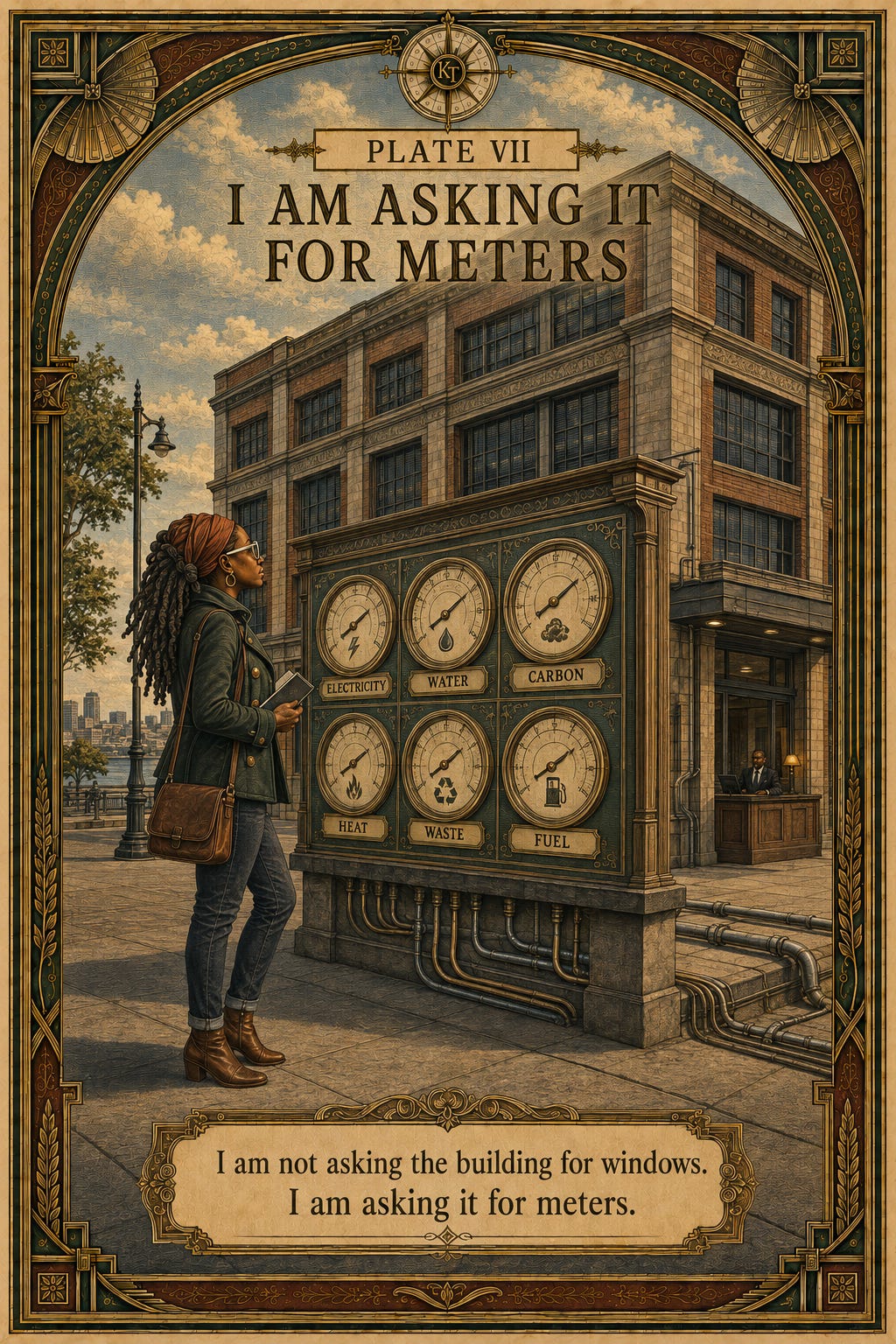
But sustainability requires disclosure.
I do not need to know precisely which rack contains my medical records.
I do want to know how much water the building used to keep that rack cool.
I do not need a tour of its electrical rooms.
I want to know where its electricity comes from.
I do not need its security plan.
I want its emissions report.
I am not asking the building for windows.
I am asking it for meters.
Machines have owners.
Machines have operators.
Machines have inputs and outputs.
Machines can be measured.
And if they can be measured, they can be evaluated.
But communities are not machines.
Cities are not machines.
Democracies are not machines.
They are living systems.
Messy.
Adaptive.
Interdependent.
Vulnerable.
Unpredictable.
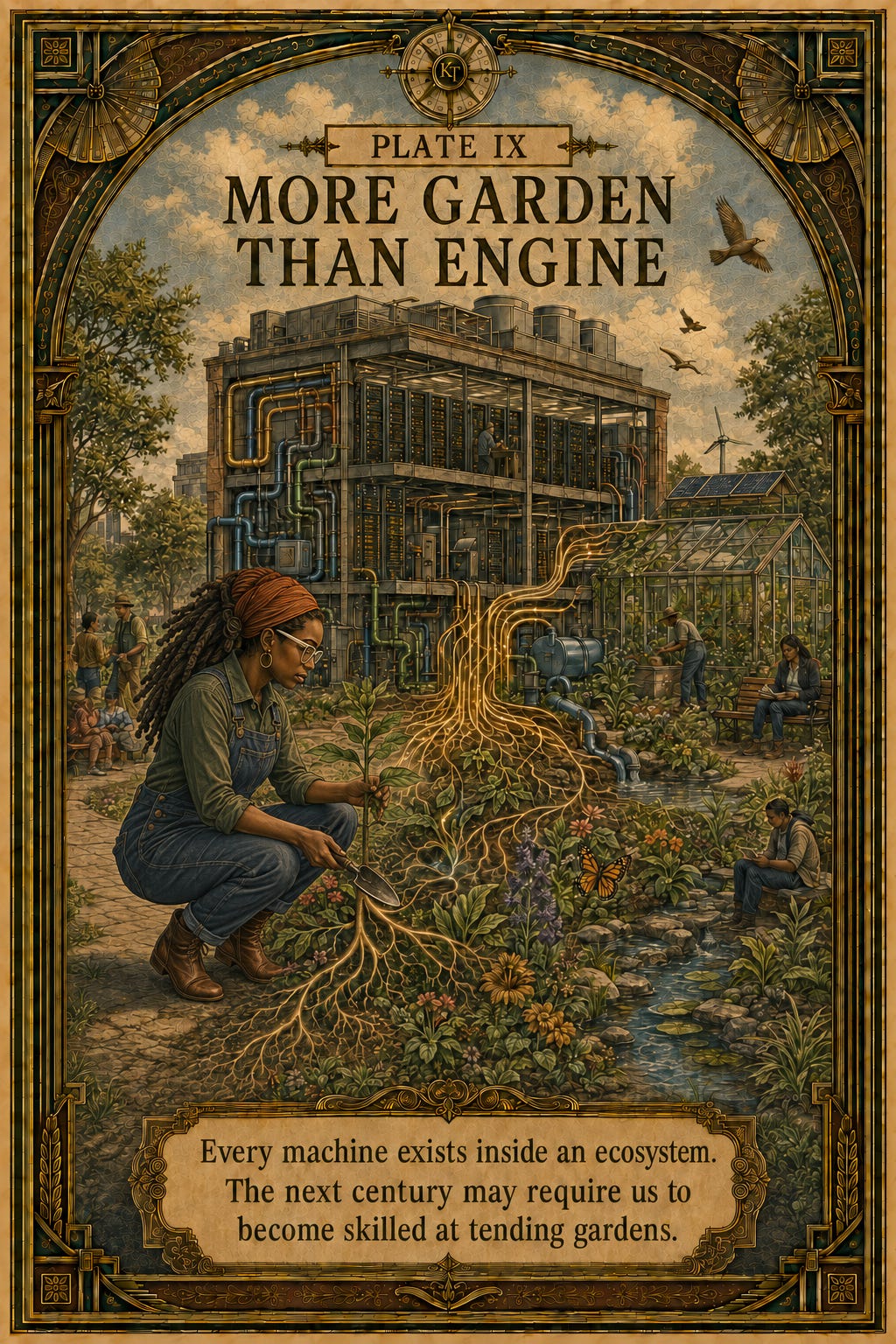
More garden than engine.
More ecosystem than assembly line.
A garden cannot be optimized in the same way as a machine. It must be observed, tended, pruned, nourished, protected, and sometimes allowed to grow in directions the gardener did not anticipate.
It requires patience.
It requires humility.
It requires an understanding that no single organism constitutes the whole.
For two centuries, we have become extraordinarily skilled at building machines.
The next century may require us to become skilled at tending gardens.
That does not mean abandoning technology. It means remembering that every machine exists inside an ecosystem.
The machines must live somewhere.
They must draw electricity from somewhere.
They must use water from somewhere.
Their equipment must be manufactured somewhere.
Their waste must go somewhere.
Their heat must travel somewhere.
Their buildings must stand beside someone.
The most important buildings may have no windows.
That is all right.
But their environmental accounting should be transparent.