

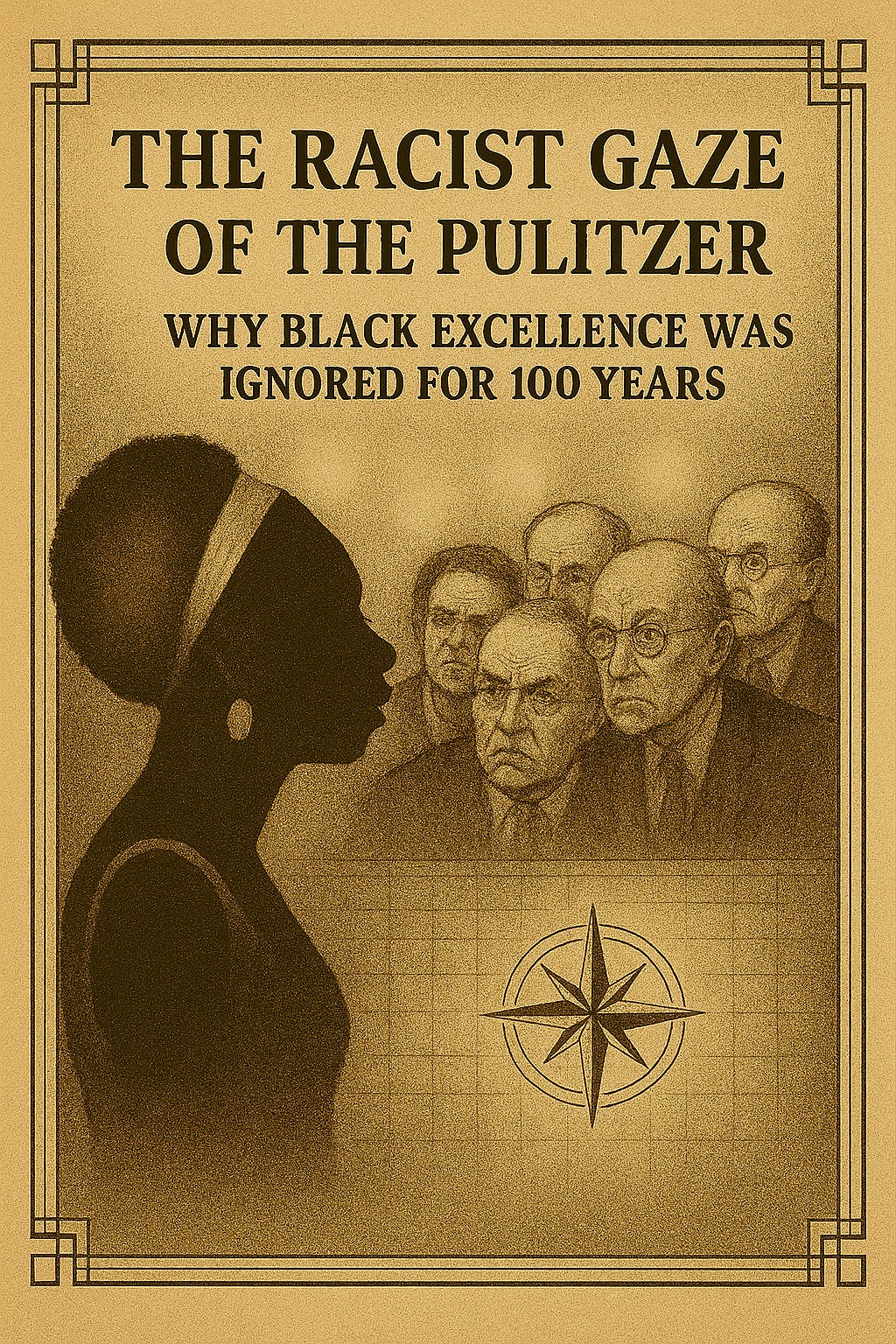
Introduction
In October 1969, at Philharmonic Hall in New York City, Nina Simone stood before a packed audience and introduced her now-legendary song “To Be Young, Gifted and Black.”
Before singing, she said:
“It is not addressed primarily to white people.
It does not put you down in any way.
It simply ignores you.”
This, dear White Liberal, is where we begin.
Because Nina Simone understood something half a century ago that the Pulitzer committee still hasn’t learned:
Black excellence does not exist for the comfort, interpretation, or approval of whiteness.
It does not revolve around the white gaze.
It does not wait for institutional permission.
And it certainly does not shrink itself to fit the emotional bandwidth of cultural gatekeepers.
With Simone’s clarity as our tuning fork, we now turn to the Pulitzer Prize — an institution that spent a century confusing its own comfort with the definition of Black “achievement.”
🎭 **Dear White Liberal, pull up a chair.
Today we’re discussing your institutions, your taste, and that gaze of yours.**
For over a century, the Pulitzer Prize has behaved like the grand custodian of American cultural value — a self-appointed oracle perched on a velvet pedestal, deciding which works of art shall be anointed “important,” “serious,” and “worthy of preservation.”
And yet, somehow — miraculously, statistically improbably, and historically inexcusably —
Black excellence was nearly invisible to this institution for 100 years.
Black brilliance? Ignored.
Black intellectual innovation? Overlooked.
Black mastery equal to (or surpassing) European classical giants? Barely acknowledged.
But Black trauma?
Now that’s something the Pulitzer knows how to reward.
Because that, dear White Liberal, is the story you’re comfortable reading.
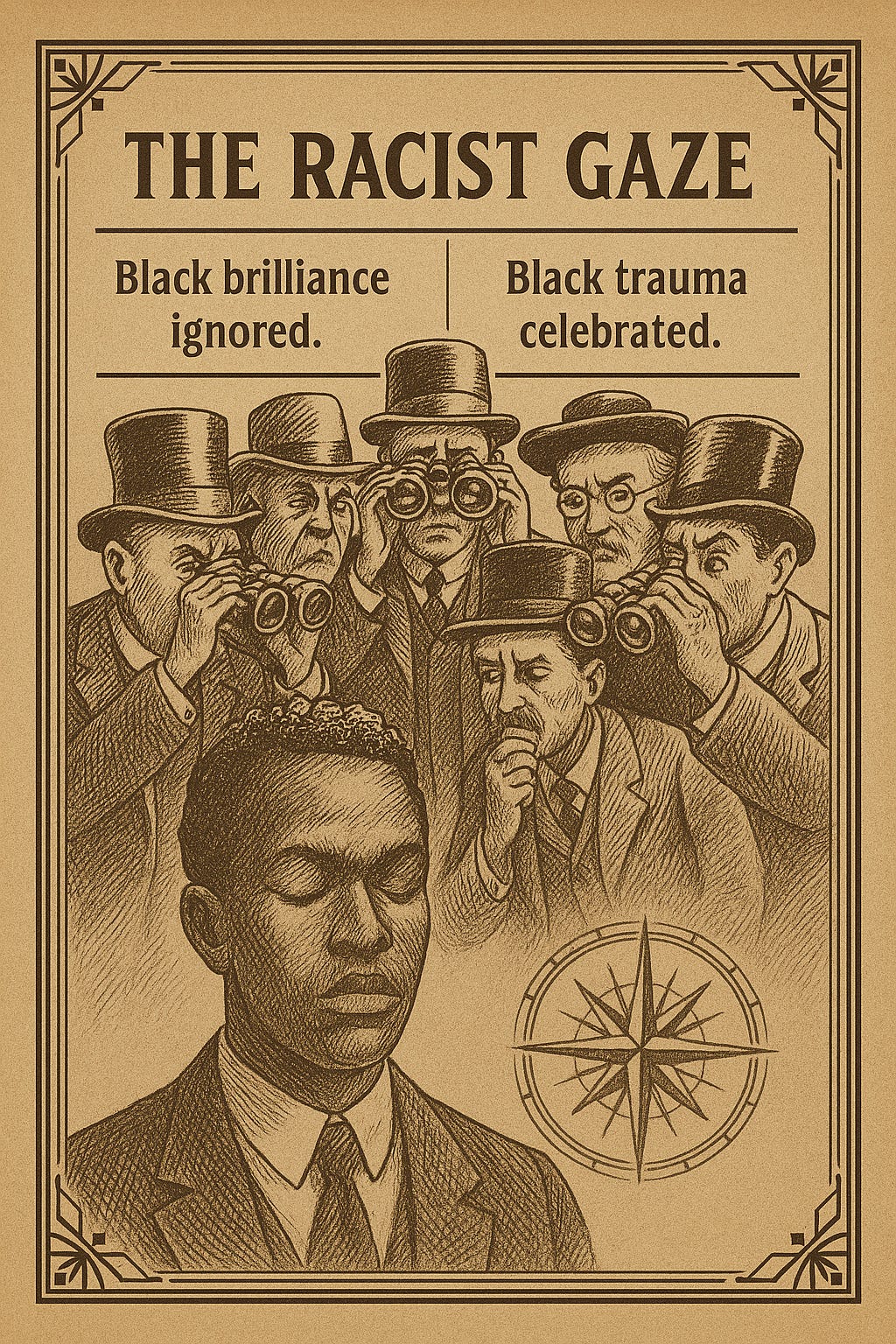
🪞 The Racist Gaze =
Black brilliance ignored.
Black trauma celebrated.
Under this gaze:
Duke Ellington: Too sophisticated.
Scott Joplin: Too classical.
Louis Armstrong: Too foundational.
Miles Davis: Too innovative.
Coltrane: Too transcendent.
New Orleans: Too architecturally advanced.
Wynton Marsalis: Too refined.
Esperanza Spalding: Too virtuoso.

But Kendrick?
Fragmented, tortured, trauma-forward — “authentic” enough to match academia’s script for Blackness.
Safe.
Palatable.
Stereotype-compliant.
And so they gave him the Pulitzer before the geniuses.
Not because Kendrick is untalented — he is.
But because his themes fit the shape of Blackness that White liberal institutions feel comfortable studying.
🎷 **Let’s not mince words.
The Pulitzer Prize was built on protecting white cultural supremacy.**
From its inception, the Pulitzer privileged:
European classical traditions
white male composers
institutions that upheld segregation
aesthetic hierarchies that placed “serious” white music above “vernacular” Black innovation
Through this lens:
Ragtime was “primitive.”
Jazz was “entertainment.”
Blues was “folk.”
Black opera was “amateur.”
Black classical composition was “lesser.”
Black innovation was “accidental, instinctual, not intellectual.”
This wasn’t a mistake.
This was the worldview.
🎺 **The Crime Against Black Music:
The Pulitzer’s Historical Record Is a Confession.**
Duke Ellington
The committee almost gave him a special citation in 1965 — then withdrew it.
Their message:
“Your genius does not qualify as American art.”
Scott Joplin
Defined American rhythm; ignored until he was dead.
Louis Armstrong
Invented modern phrasing; no Pulitzer.
Miles Davis
Reinvented music five times; no Pulitzer.
John Coltrane
Spiritual and structural revolution; no Pulitzer.
Whole generations of New Orleans musicians
The architects of American sound; no Pulitzer.
This is not an oversight.
This is erasure.
🎭 Then Came Kendrick Lamar — and the institution finally felt “safe.”
Kendrick’s Pulitzer wasn’t about honoring the best Black music.
It was about honoring the most compatible narrative.
Kendrick’s themes are the ones White academia already knows how to analyze:
trauma
violence
self-loathing
religious guilt
fractured identity
systemic despair
This is not Kendrick’s fault — he’s an artist.
It’s the institution that decided:
Black pain = “serious.”
Black excellence = “intimidating.”
The Pulitzer embraced hip-hop only when it fit the trauma template they consider “authentic.”

🧠 Let’s examine the Pulitzer themes rewarded in Black work.
Across Pulitzer categories — fiction, poetry, journalism, drama, and music — the winning works tend to explore:
✔️ Trauma
✔️ Oppression
✔️ Survival
✔️ Identity fracture
✔️ State violence
✔️ Racial memory
✔️ Inherited pain
What the Pulitzer rarely recognizes:
✘ Joy
✘ Innovation for innovation’s sake
✘ Structural musical genius
✘ Black cosmopolitanism
✘ Black intellectualism
✘ Black architectural thinking
✘ Black work not rooted in suffering
✘ Mastery of form equal to European classical traditions
In other words:
Black trauma is legible.
Black brilliance is threatening.
📚 Even outside music, the patterns are unmistakable.
Literature → trauma narratives
Poetry → loss and national wounds
Drama → bodies in conflict with systems
Journalism → injustice exposés
History → stories buried by white supremacy
These works deserve their prizes —
but the pattern is still a pattern.
Black creativity is celebrated most when it speaks about pain,
not when it revolutionizes art.

🏛️ Dear White Liberal: your institutions reward the Black pain they can intellectualize — not the Black genius they can’t compete with.
This is not recognition.
It is containment.
This is not honor.
It is management.
This is not inclusion.
It is curation.
You celebrated Kendrick not because he surpassed Ellington, Davis, Coltrane, or the entire New Orleans tradition —
but because he matched your comfort zone.
The Pulitzer discovered Black trauma,
not Black excellence.
⭐ **Black excellence built American music.
The Pulitzer is 100 years late and still wearing the wrong glasses.**
And that, dear White Liberal, is the racist gaze.
But fear not — this new era of archival truth-telling, cultural clarity, and satirical justice is underway.
Led, of course, by
Twain’s Gazette of the Absurd,
your faithful chronicler of American hypocrisy in its sepia-toned, Art Deco glory.

🎷 A Closing Salutation, Jazz-Age Style
And so, dear White Liberal, as we dim the house lights and let the brass section cool, I leave you with this:
May your conscience syncopate,
may your assumptions lose their footing,
and may your cultural compass finally find true north —
not toward comfort, but toward clarity.
Until then, keep your hat tilted,
your gaze honest,
and your ears open for the genius you’ve been trained not to hear.
Signed with a flourish worthy of the Savoy,
and a wink sharp enough to cut Art Deco glass —
Kimberly Twain
Twain’s Gazette of the Absurd
Where the truth swings hard, and the satire never misses a beat.
