

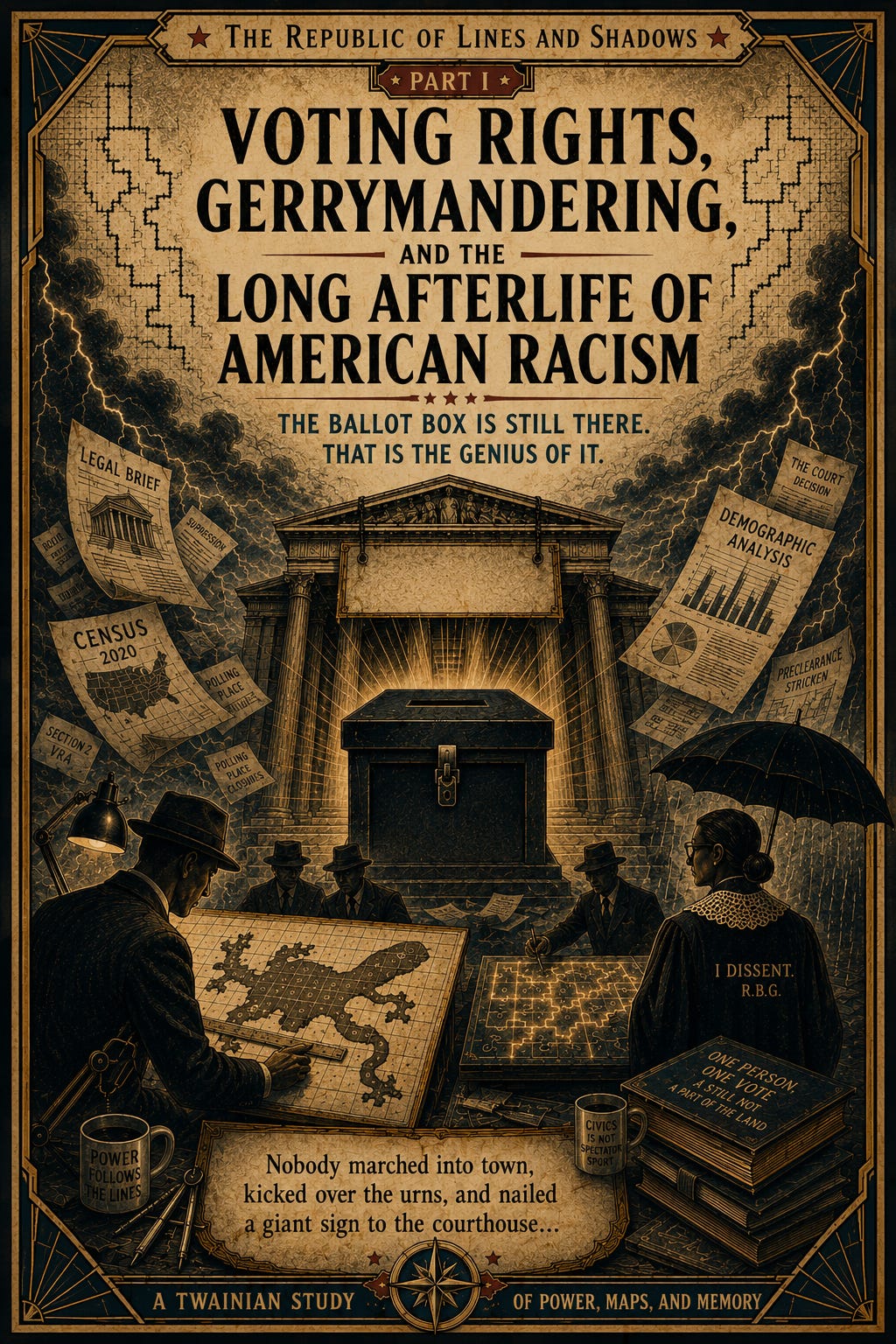
Voting Rights, Gerrymandering, and the Long Afterlife of American Racism
The ballot box is still there.
That is the genius of it.
Nobody marched into town, kicked over the urns, and nailed a giant sign to the courthouse reading:
BLACK PEOPLE, KINDLY STOP VOTING.
Modern America has better branding than that.
The language of power evolved. The hoses and snarling dogs of the 1960s gradually gave way to consultants in loafers carrying laptops full of demographic spreadsheets. The old villains used to show up sweating in sheriffs’ uniforms. The new ones arrive carrying PowerPoint presentations and speaking in the soothing dialect of “electoral integrity.”
The vote remains.
But the architecture surrounding the vote has been quietly remodeled like an old hotel where somebody keeps moving the exits around at night.
And somewhere along the way, the United States Supreme Court took a decorative sledgehammer to one of the central support beams of the Voting Rights Act of 1965.
Most Americans do not even realize this happened.
Which, from a strategic standpoint, is generally the best time to dismantle something.
⚖️
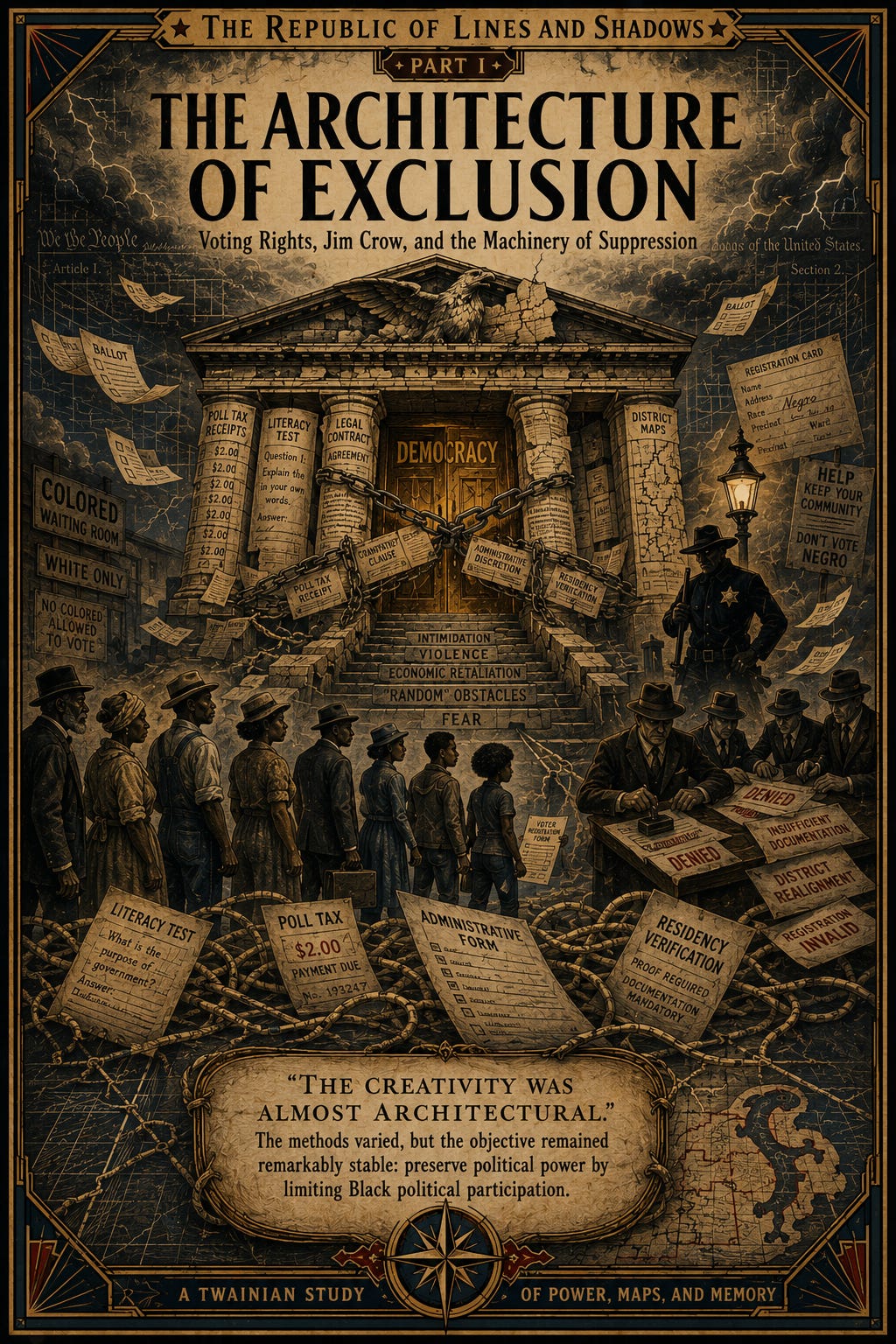
The Voting Rights Act of 1965 was one of the great achievements of the Civil Rights Movement. It emerged because Southern states had spent generations inventing increasingly elaborate ways to prevent Black Americans from voting.
The creativity was almost architectural.
Poll taxes.
Literacy tests.
Grandfather clauses.
“Random” administrative obstacles.
Violence.
Economic retaliation.
The occasional local sheriff behaving like he had been hired directly out of a Tennessee Williams fever dream.
The methods varied, but the objective remained remarkably stable:
preserve political power by limiting Black political participation.
Eventually Congress stepped in after years of marches, beatings, protests, murders, and national outrage. The country had reached the awkward realization that democracy functions poorly when entire populations are systematically blocked from participating in it.
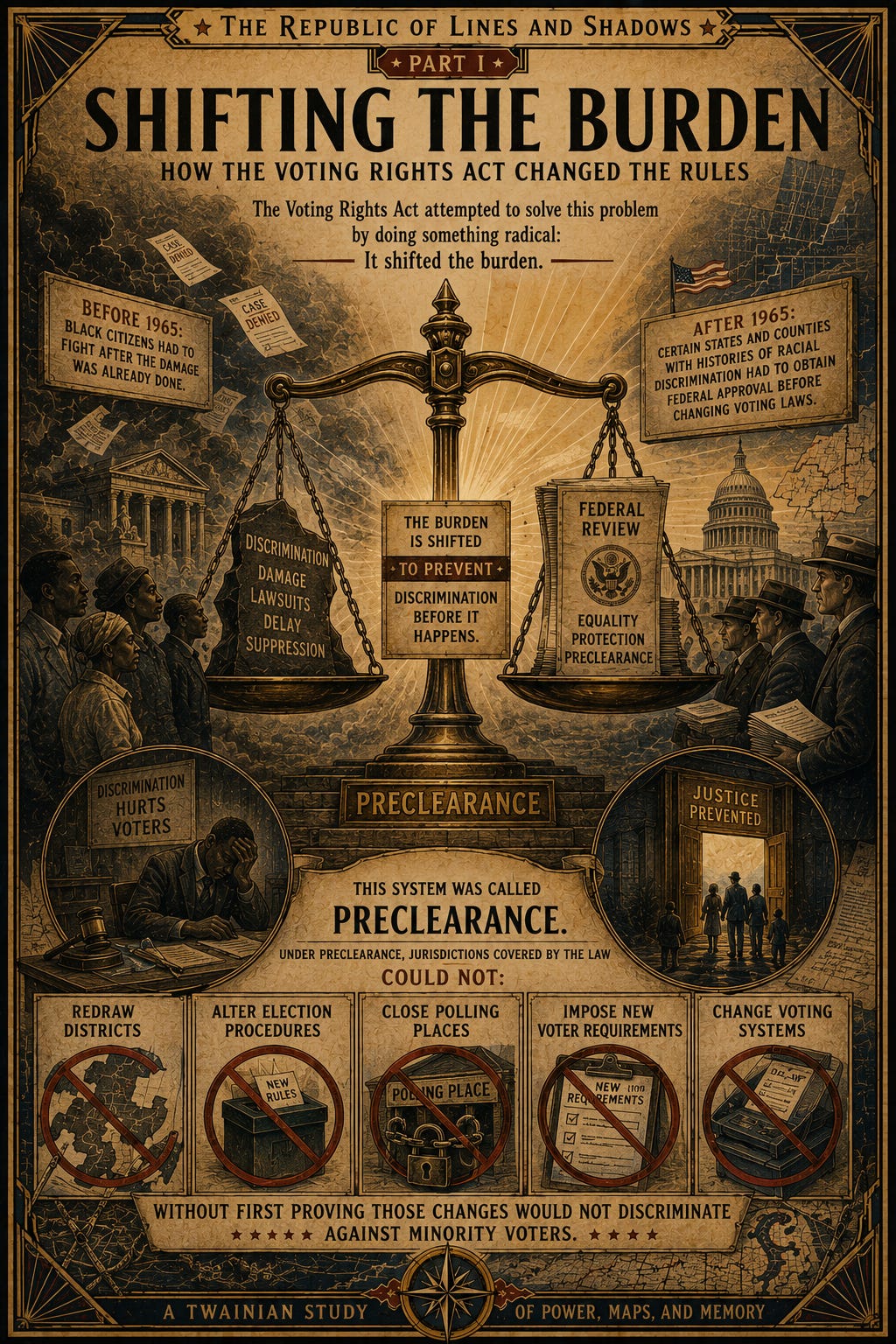
The Voting Rights Act attempted to solve this problem by doing something radical:
It shifted the burden.
Instead of forcing Black citizens to challenge discriminatory laws after the damage was already done, certain states and counties with histories of racial discrimination had to obtain federal approval before changing voting laws.
This system was called preclearance.
Under preclearance, jurisdictions covered by the law could not:
redraw districts,
alter election procedures,
close polling places,
impose new voter requirements,
or change voting systems
without first proving those changes would not discriminate against minority voters.
In effect, parts of the South were placed under democratic supervision.
Like a teenager who had repeatedly crashed the family car and was no longer allowed to “just borrow it for a minute.”
And for decades, the system largely worked.
Which is precisely why what happened next matters so much.
🏛️
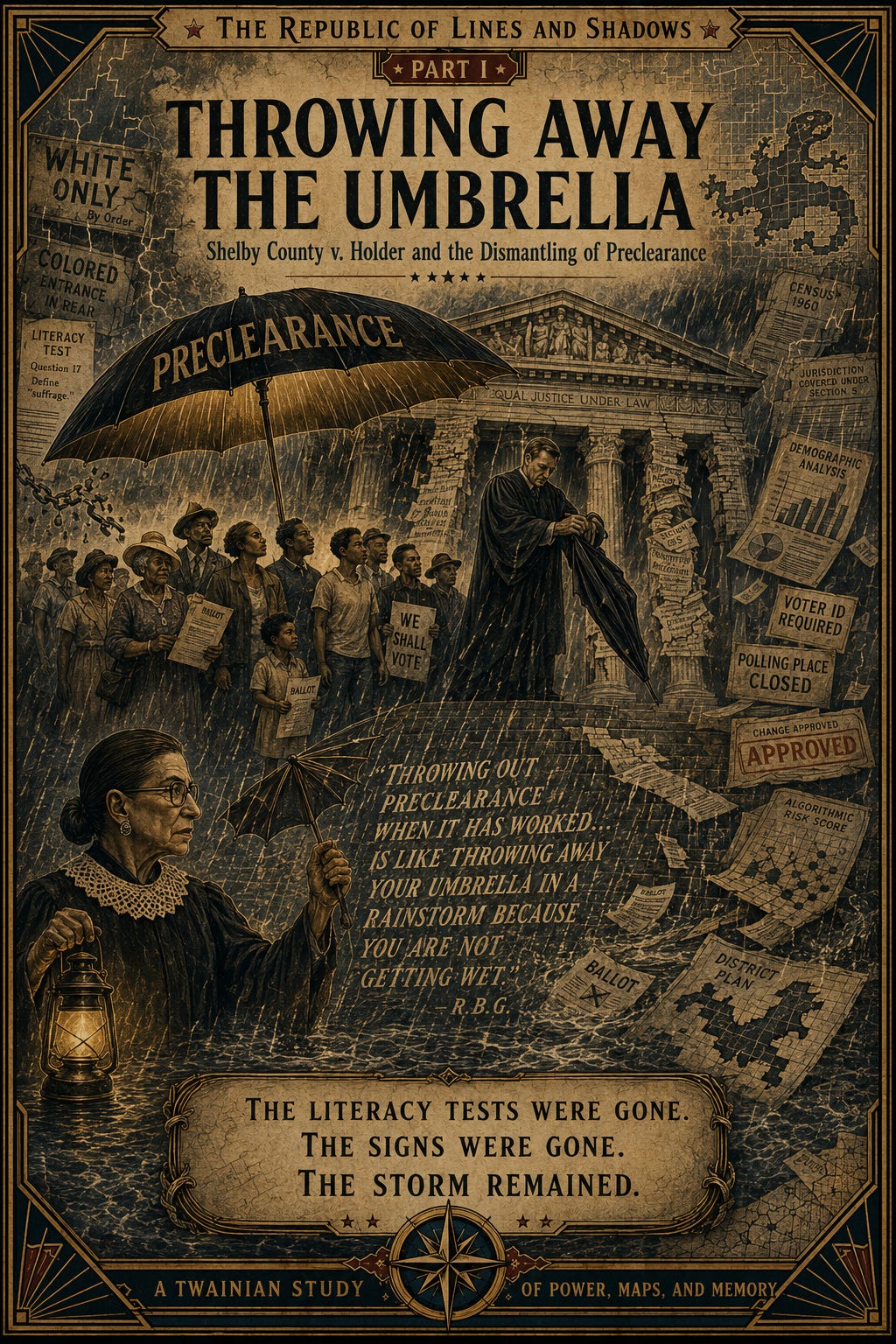
In 2013, the Supreme Court decided Shelby County v. Holder.
The case originated in Shelby County, where officials argued that the formula determining which states required preclearance was outdated.
Chief Justice John Roberts, writing for the majority, agreed.
America had changed since 1965, the Court argued. The country could no longer operate indefinitely under rules designed for another era.
And in fairness, America had changed.
The literacy tests were gone.
The “White Only” signs were gone.
Open segregationist rhetoric had become less fashionable outside certain corners of cable television and Facebook comment sections.
But critics immediately saw a problem.
Justice Ruth Bader Ginsburg issued one of the most devastating dissents in recent Supreme Court history:
“Throwing out preclearance when it has worked... is like throwing away your umbrella in a rainstorm because you are not getting wet.”
It was one of those rare legal metaphors so clean and lethal that it escaped the law books entirely and entered ordinary conversation.
The law had succeeded.
Therefore, according to the Court, perhaps the law was no longer necessary.
By that logic, one suspects the fire department should also be dissolved every time the city fails to burn down.
🌧️
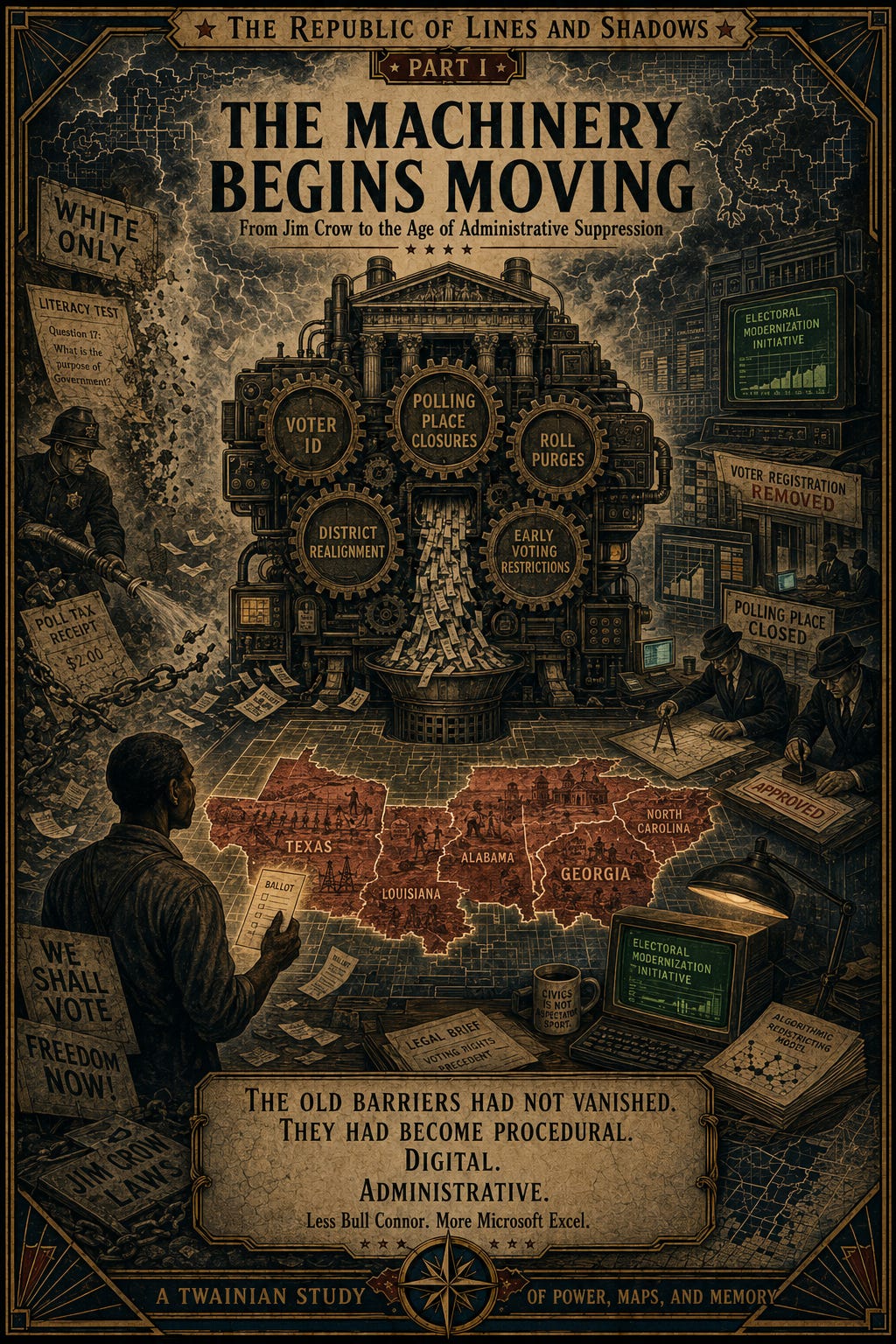
And then the machinery began moving almost immediately.
Several states previously covered under preclearance enacted:
new voter ID laws,
polling place closures,
voter roll purges,
restrictions on early voting,
and new district maps that quickly triggered lawsuits and controversy.
Many of the fiercest battles emerged in:
Texas,
Georgia,
Alabama,
Louisiana,
and North Carolina.
The geography was difficult to ignore.
These were not random states selected by throwing darts at a Cracker Barrel road atlas.
Many overlapped directly with the historical geography of slavery, segregation, and the long afterlife of Jim Crow laws.
Supporters of the changes argued they were modernizing elections and protecting against voter fraud.
Critics argued something else entirely:
That the methods had evolved, but the underlying struggle over political power remained hauntingly familiar.
The old barriers had not vanished.
They had become procedural.
Digital.
Administrative.
Less Bull Connor.
More Microsoft Excel.
💻
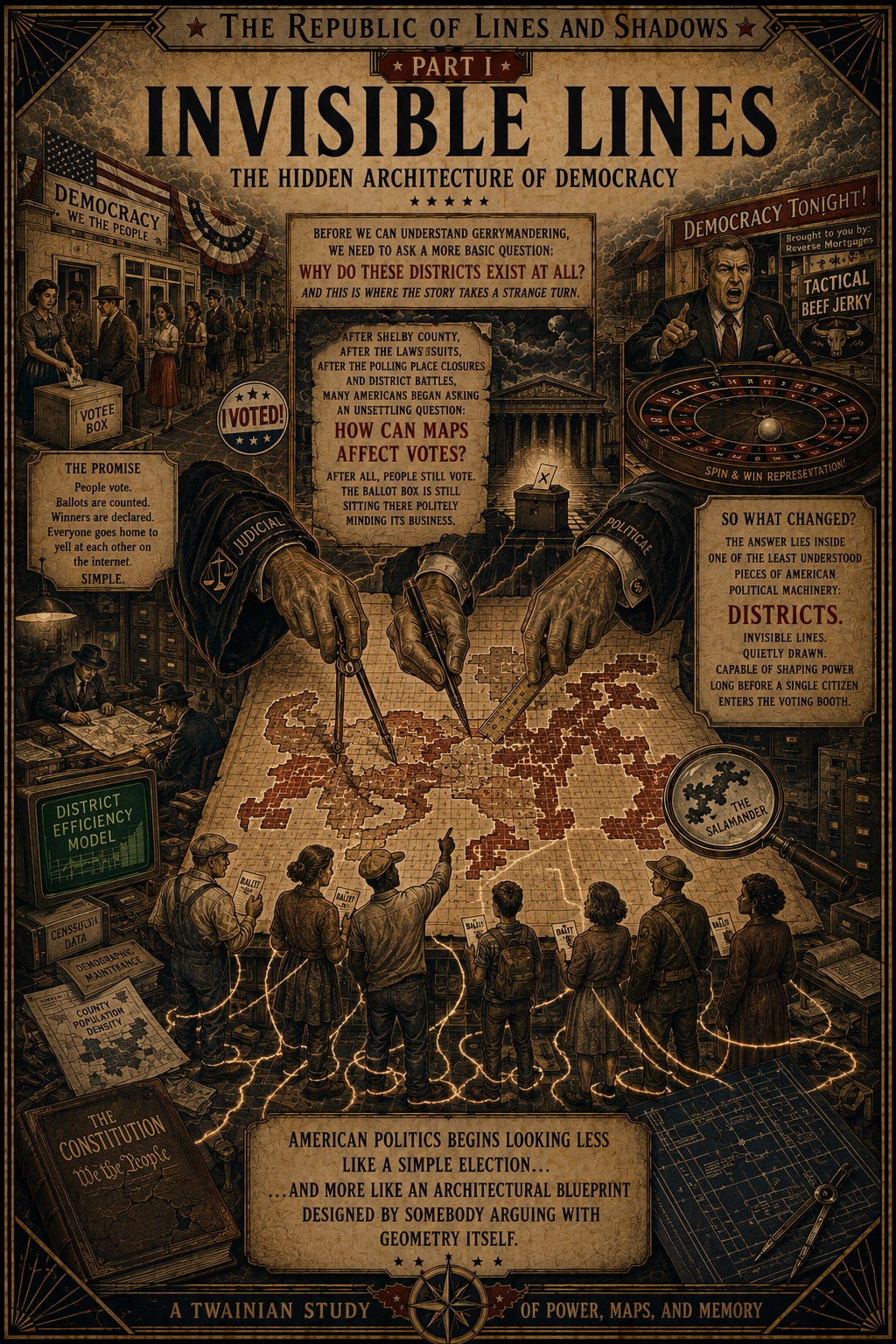
And this is where many Americans understandably become confused.
How can maps affect votes?
Why do district lines matter so much?
Why does geography itself suddenly become political?
Most citizens assume democracy functions in a fairly straightforward way:
people vote,
ballots are counted,
winners are declared,
everyone goes home to yell at each other on the internet.
Simple.
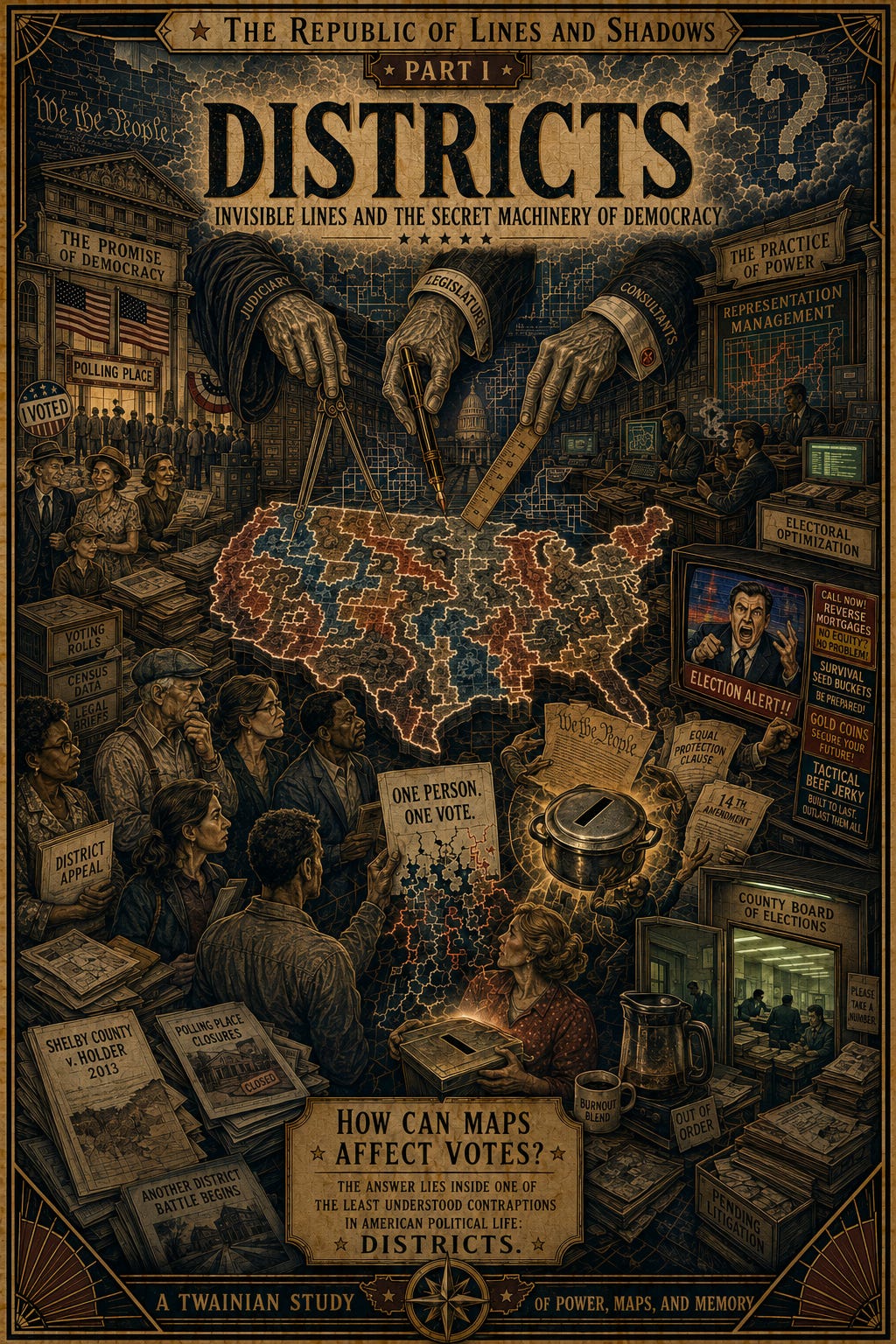
But hidden underneath modern elections is another layer of political architecture:
districts.
And once those districts can be manipulated, the relationship between voting and representation becomes far more complicated than most Americans realize.
Which naturally leads to a more basic question:
Why do these districts exist at all?
And this is where the story stops behaving politely, pours itself a stiff drink, and starts rummaging through the basement archives of the republic.
Because after Shelby County v. Holder, after the lawsuits, after the polling place closures, after the endless district battles fought by exhausted citizens carrying folders into fluorescent government buildings that smell faintly of burnt coffee and despair, many Americans began asking an unsettling question:
How can maps affect votes?
After all, people still vote.
The ballot box is still sitting there politely minding its business like some innocent little metal casserole dish caught in the middle of a constitutional bar fight.
Nobody replaced democracy with a giant roulette wheel hosted by a sweating cable news anchor screaming between advertisements for reverse mortgages, survival seed buckets, gold coins, and tactical beef jerky apparently designed to outlive the apocalypse.
So what changed?
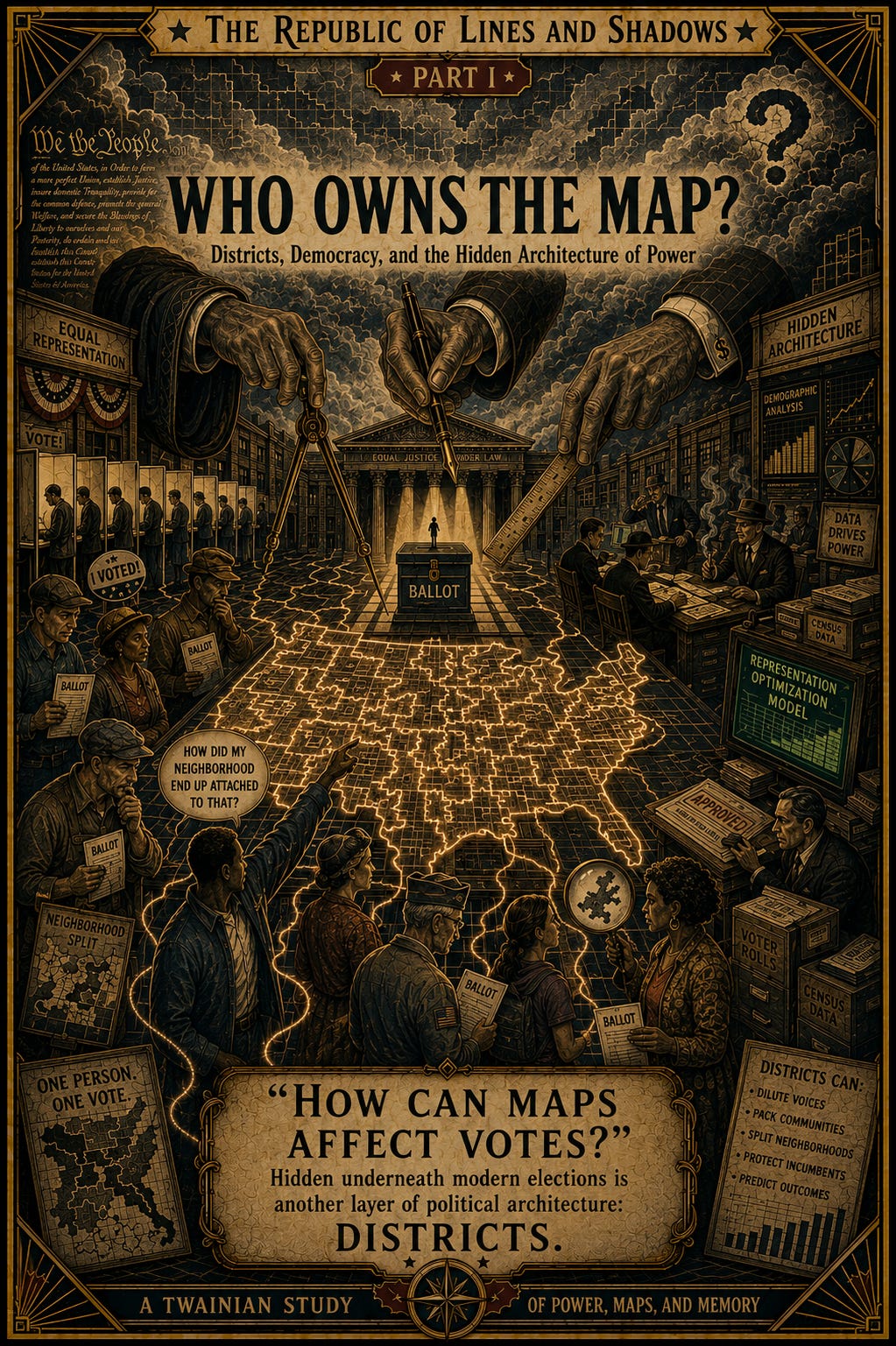
The answer lies inside one of the least understood contraptions in American political life:
districts.
Invisible lines.
Quietly drawn.
Usually by people nobody elected to become cartographic sorcerers of the republic.
And yet those lines possess astonishing power.
They can shape elections long before a single citizen enters the voting booth.
They can determine:
which communities stay together,
which neighborhoods get sliced apart like overcooked Thanksgiving pie,
which votes grow louder,
and which vanish softly into the statistical wallpaper while everyone on television keeps yelling about freedom.
And once you understand how district lines actually work, American politics begins looking less like a straightforward democratic process…
…and more like a haunted architectural blueprint drafted at two o’clock in the morning by lawyers, consultants, mathematicians, and sleep-deprived bureaucrats arguing violently with geometry beneath flickering fluorescent lights while democracy smokes nervously in the corner.
🗺️
Next: