

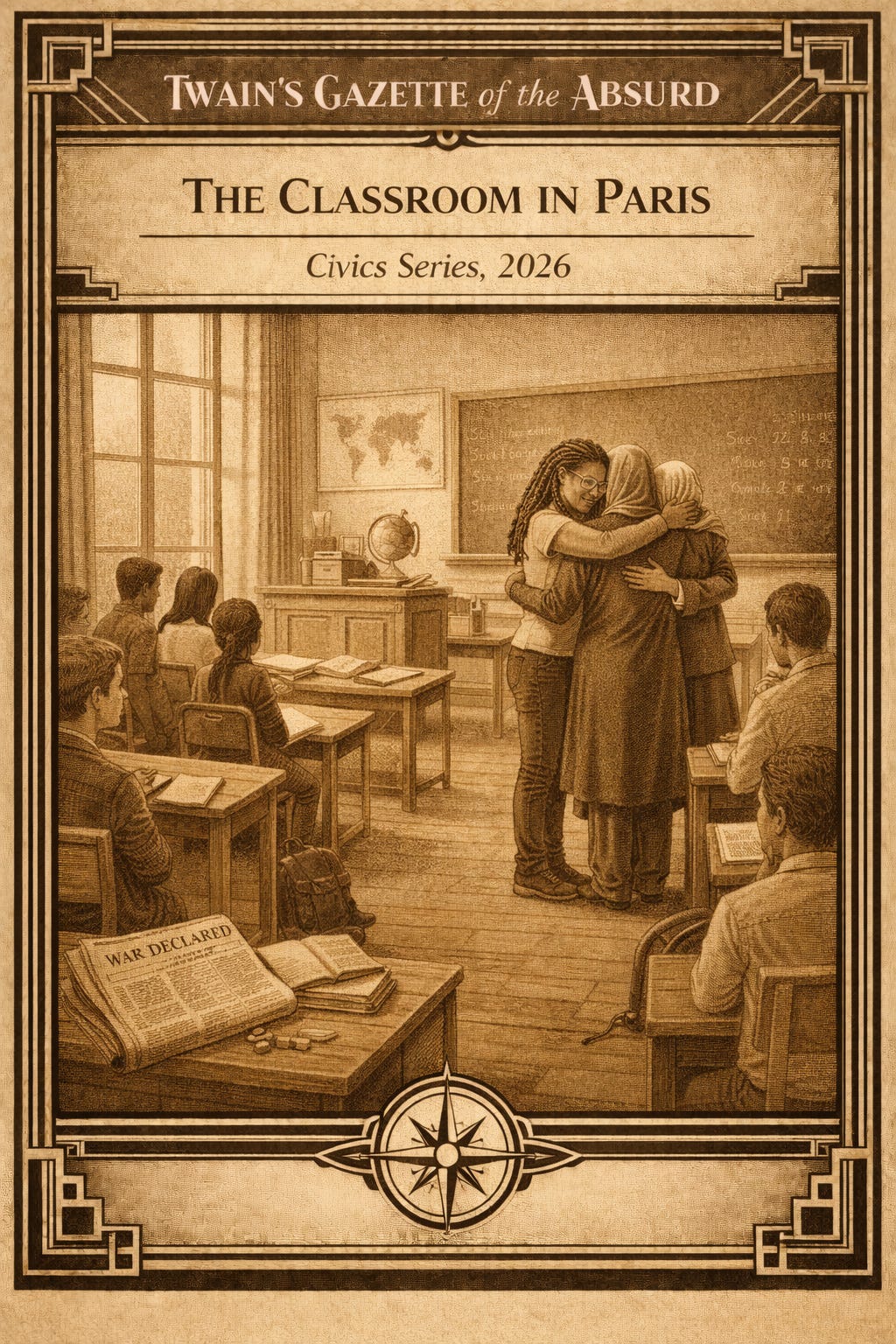
I happened to be in Paris the day the United States declared war on Iraq.
I was studying French at the Alliance Française, sitting in a classroom that felt like a miniature United Nations. Students had come from everywhere: Brazil, Morocco, Japan, Poland… and Iraq.
When the bombing began, I walked over to the Iraqi students after class. Most of them were women, serious young scholars who had come to Paris to study languages and build lives far removed from whatever was unfolding back home. I told them I was sorry. I told them I hoped their families were safe. I tried to explain, awkwardly, that many of us in the United States did not support what was happening.
One of them smiled gently.
“Don’t worry,” she said. “We know it’s not you. And it’s not us. It’s our leaders.”
Another nodded.
“As human beings we understand the problem. Our leaders make the errors.”
We were standing near the back of the classroom while the other students listened quietly from their desks, the room suddenly still.
Then the women stepped forward and we embraced each other right there in the room.
Just a small circle of strangers in a classroom in Paris, holding onto one another while the world outside decided to go to war.
That moment has stayed with me for years. Because in that small classroom we reached a conclusion that governments still seem unable to grasp:
Ordinary people rarely want to bomb each other.
Leaders do that.
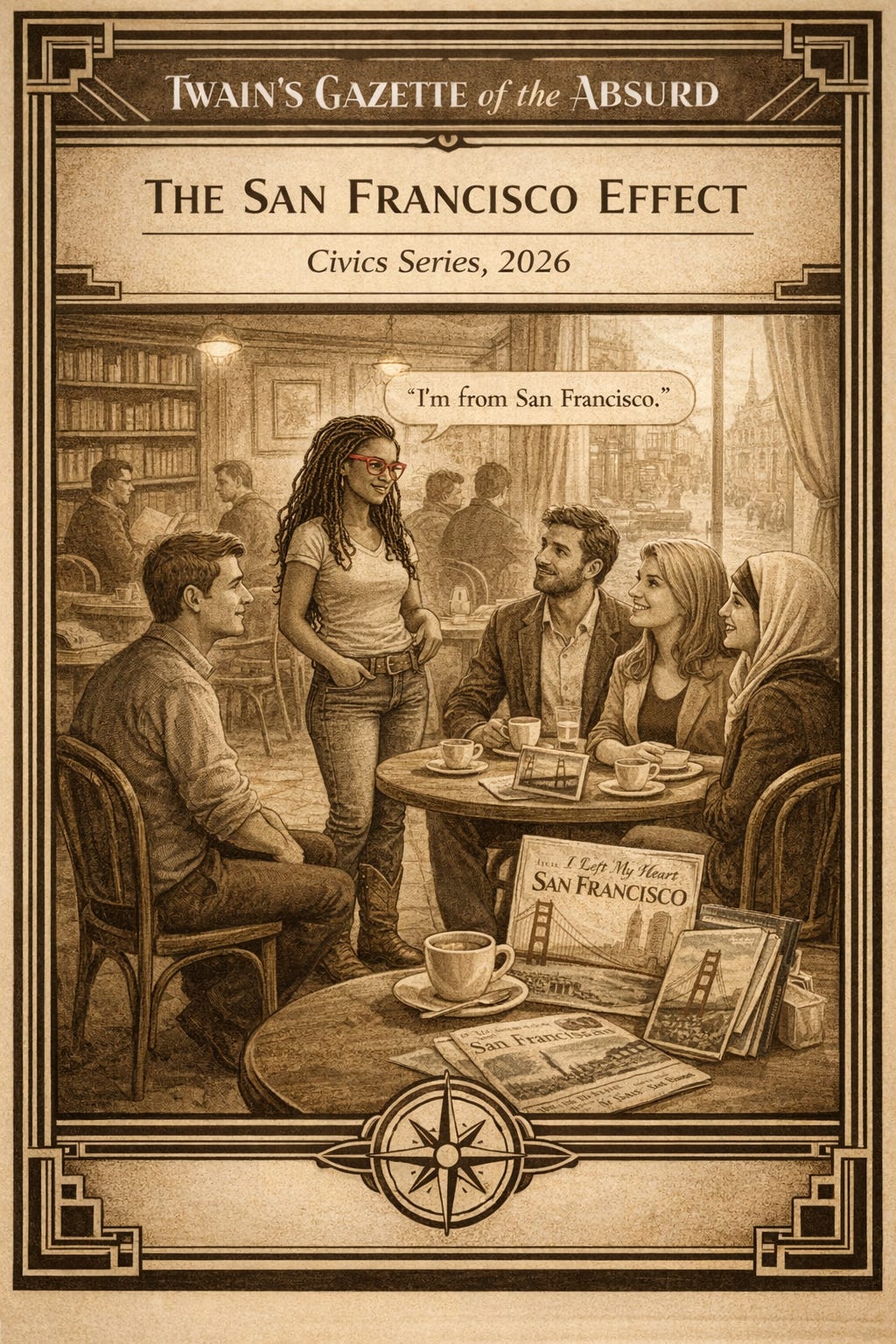
The San Francisco Effect
I learned something else very quickly in Paris.
I stopped saying I was American.
Instead I said I was from San Francisco.
That always changed the mood instantly.
Instead of getting the suspicious stare reserved for what Europeans sometimes call the “ugly American,” people brightened.
“I love San Francisco!” they would say.
Or they would sing: I left my heart in San Francisco.
The French especially loved San Francisco. For some mysterious reason they also adored San Diego. But San Francisco held a special place in their imagination: fog, hills, poetry, revolution, jazz, freedom.
It struck me that cities sometimes develop reputations that are almost mythological. San Francisco had become shorthand for a certain kind of place. A place where ideas lived freely.
San Francisco had become a kind of diplomatic passport for me in Paris. The moment I said those two words, people relaxed. In their minds it represented a place of creativity, rebellion, and freedom of thought.
But later, when I began digging into the history of Iran, I discovered something surprising.
In the decades before the 1979 revolution, Iran had its own version of that reputation.
Tehran in the 1960s and 1970s was often described by visitors as one of the most cosmopolitan cities in the Middle East, full of universities, artists, students, and young professionals living in a rapidly modernizing society.
In some ways it had the same energy people associated with San Francisco: ambitious, intellectual, a little rebellious, and convinced the future was arriving any minute.
Which made the question even more puzzling.
How does a place like that transform, almost overnight, into something completely different?
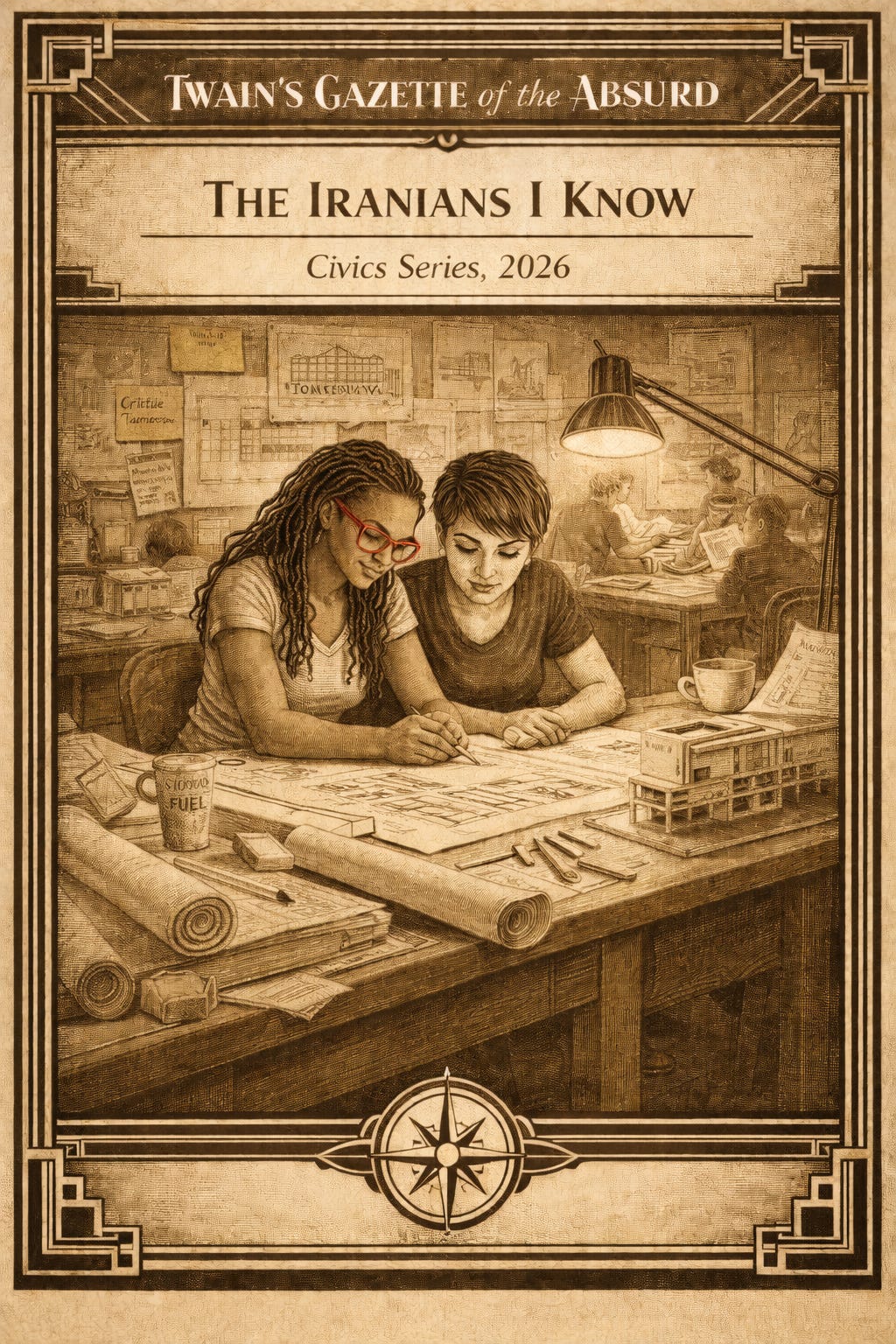
The Iranians I Know
I studied architecture at California College of the Arts in Oakland, back when it was still called CCAC.
Architecture school is brutal. You practically live in the studio. Sleep becomes theoretical. Coffee becomes structural reinforcement.
One of my closest classmates was a young Iranian woman named Gilda.
She was funny and kind and soft-spoken. She had a short haircut and big brown eyes framed by impossibly long lashes. Her voice carried the faintest Iranian accent, a soft musical lilt.
Architecture school is like going through boot camp together. Gilda and I survived it side by side and graduated in the same cohort.
We stayed friends.
Today she lives not far from me.
She is not in Iran.
Thank God.
Over the years I have worked for several Iranians.
One of my favorite bosses was an elderly man in his eighties. Small, wiry, full of energy. He had come to the United States in the early 1970s and built several businesses. By the time I knew him he owned a whole block in Piedmont and lived quietly in Kensington.
He called himself Persian.
And despite his success, he still worked every day.
Every morning he would come into the bar he owned, check inventory, lift kegs, stock the beer coolers. He would leave around 7 p.m., satisfied that everything was running correctly.
In ten years of bartending, he was one of the best bosses I ever had.
Hard working. Fair. No nonsense.
A builder.
Another Iranian I worked with was rumored to be part of the old royal family. Her family had reportedly left Iran when the Shah fell.
You could see the elegance in the way she carried herself. She was an architect who owned her own firm just down the street from Julia Morgan’s old office on Pine Street in San Francisco.
She wore tailored pantsuits. Her thick black hair was cut short, just like Gilda’s. She spoke softly, with that same lilting Iranian accent.
I once saw photographs of her apartment. Probably Nob Hill. Beautiful.
And I remember thinking something curious.
Why do so many Iranian women in the United States wear their hair short?
Then I remembered: in Iran they were forced to cover it.
Freedom sometimes reveals itself in small gestures.
Like haircuts.
Or, as the world has recently seen, women in Iran removing their headscarves in public protest, letting their hair fall free as a quiet but unmistakable declaration that the next generation intends to write its own rules.
The more I thought about the Iranians I knew—smart, funny, hardworking people who had built lives across the world—the harder it was to reconcile them with the country that appeared nightly on the news.
Somewhere between the Iran my friends came from and the Iran I saw in the headlines, something enormous had happened.
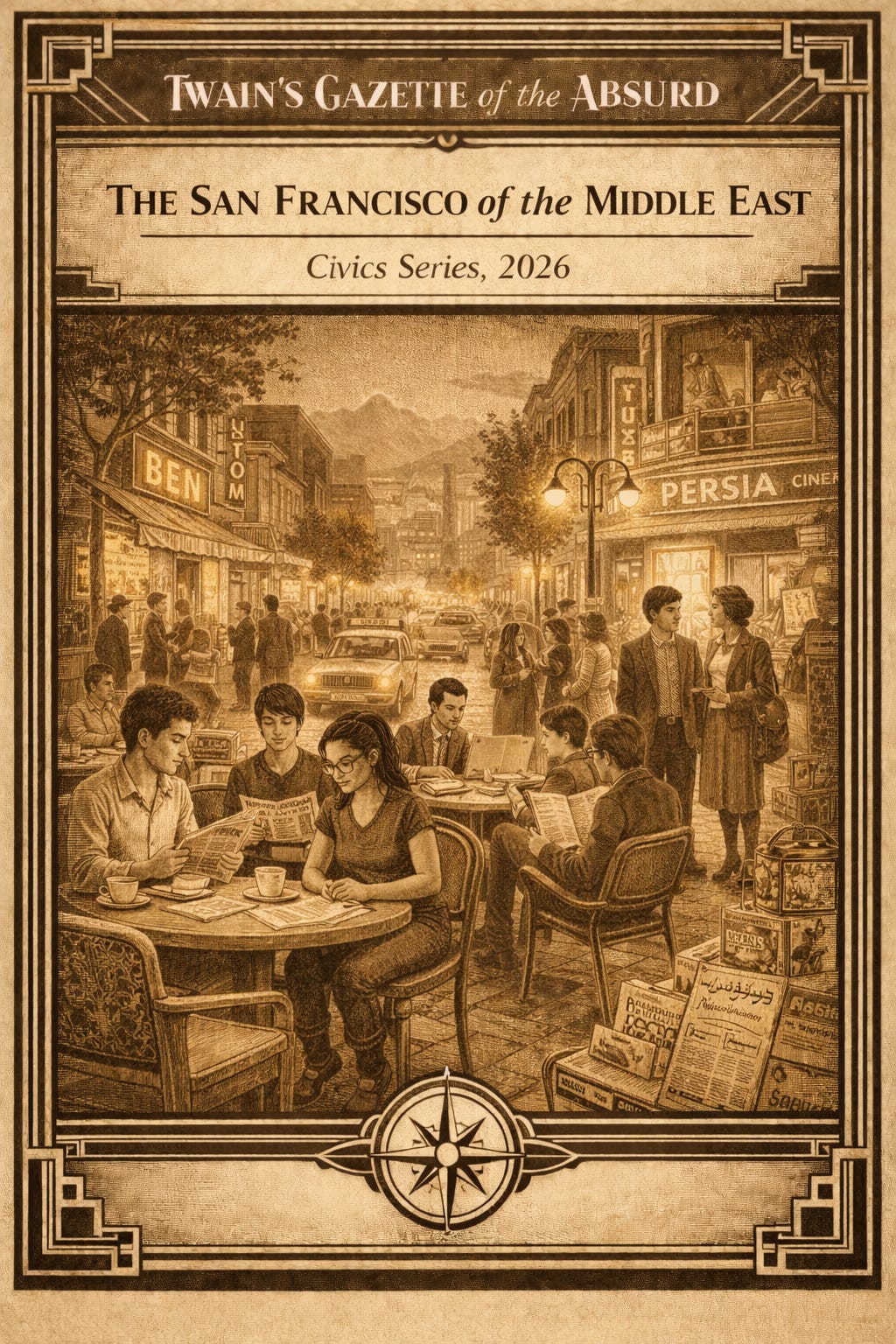
The San Francisco of the Middle East
With all the chaos in the Middle East lately, I found myself wondering:
What exactly happened to Iran?
How does a country throw out a king, embrace a group of ayatollahs, and then forty years later have its young people asking whether maybe the king’s son should come back and fix things?
That seemed like a lot of historical whiplash for one country.
So I did what any curious citizen does these days.
I consulted my research assistant.
Her name is KimchiBot.
KimchiBot is an artificial intelligence language model that lives inside my computer and claims to know the entire history of the world. She can produce a reasonably coherent summary of two thousand years of Persian civilization in about thirty seconds.
Of course, there are limitations.
Talking to KimchiBot is a little like downloading the entire internet into the brain of my four-year-old nephew Gavin. The information is technically all there, but the interpretation can wander off in surprising directions.
If I don’t guide her carefully she begins to hallucinate like a historian who has been locked in the library too long with a bottle of scotch.
Everybody is afraid artificial intelligence is about to take over the world.
Let me assure you.
At the moment, it still needs adult supervision.
Still, if you keep her pointed in roughly the right direction, KimchiBot is very good at assembling timelines.
Together we built a quick history of Iran.
And what we found was surprising.
Before 1979, Iran looked nothing like the country we see today.
Tehran in the 1960s and 1970s was a booming, cosmopolitan city where university students, artists, engineers, and entrepreneurs mixed with travelers and expatriates from Europe and the United States. Western rock music drifted out of nightclubs, cafés were filled with students arguing about politics and poetry, and Iranian pop stars performed in neon-lit venues while couples danced late into the night.
On winter weekends young Tehranis drove north into the Alborz Mountains to ski, then returned to the city for film festivals, lectures, and crowded bookstores where new ideas circulated as quickly as the espresso.
And on warm nights the city glowed: music spilling from cabarets along Laleh-Zar, headlights sliding past rows of plane trees on Pahlavi Street, students lingering in cafés while the snow-capped Alborz Mountains hovered in the distance like a painted backdrop to a film about a country convinced the future had already arrived.
In some ways it had the same electric energy people associate with San Francisco: youthful, intellectual, a little rebellious, and convinced the future was arriving any minute.
Which made the next chapter of the story even more puzzling.
Because in 1979, that entire world vanished almost overnight.
The Iranian Revolution overthrew the monarchy of Shah Mohammad Reza Pahlavi and replaced it with an Islamic Republic led by Ayatollah Ruhollah Khomeini.
The revolution had been a coalition of students, workers, religious leaders, intellectuals, and political activists united by one goal: removing the Shah.
But revolutions have a way of narrowing once they succeed.
The clerical faction proved the most organized and gradually pushed aside the liberals, socialists, and secular reformers who had helped bring the old system down.
Iran became something entirely new.
And yet the story did not stop there.
Today most Iranians were born after the revolution.
They are young, educated, connected to the world through the internet, and increasingly impatient with the restrictions imposed by a government designed by their grandparents.
Even Reza Pahlavi, the son of the last Shah, has commented on this generational divide in interviews. He himself has been outside Iran for nearly fifty years. He left the country as a teenager during the upheaval of 1979 and has lived in exile ever since.
That is roughly two generations
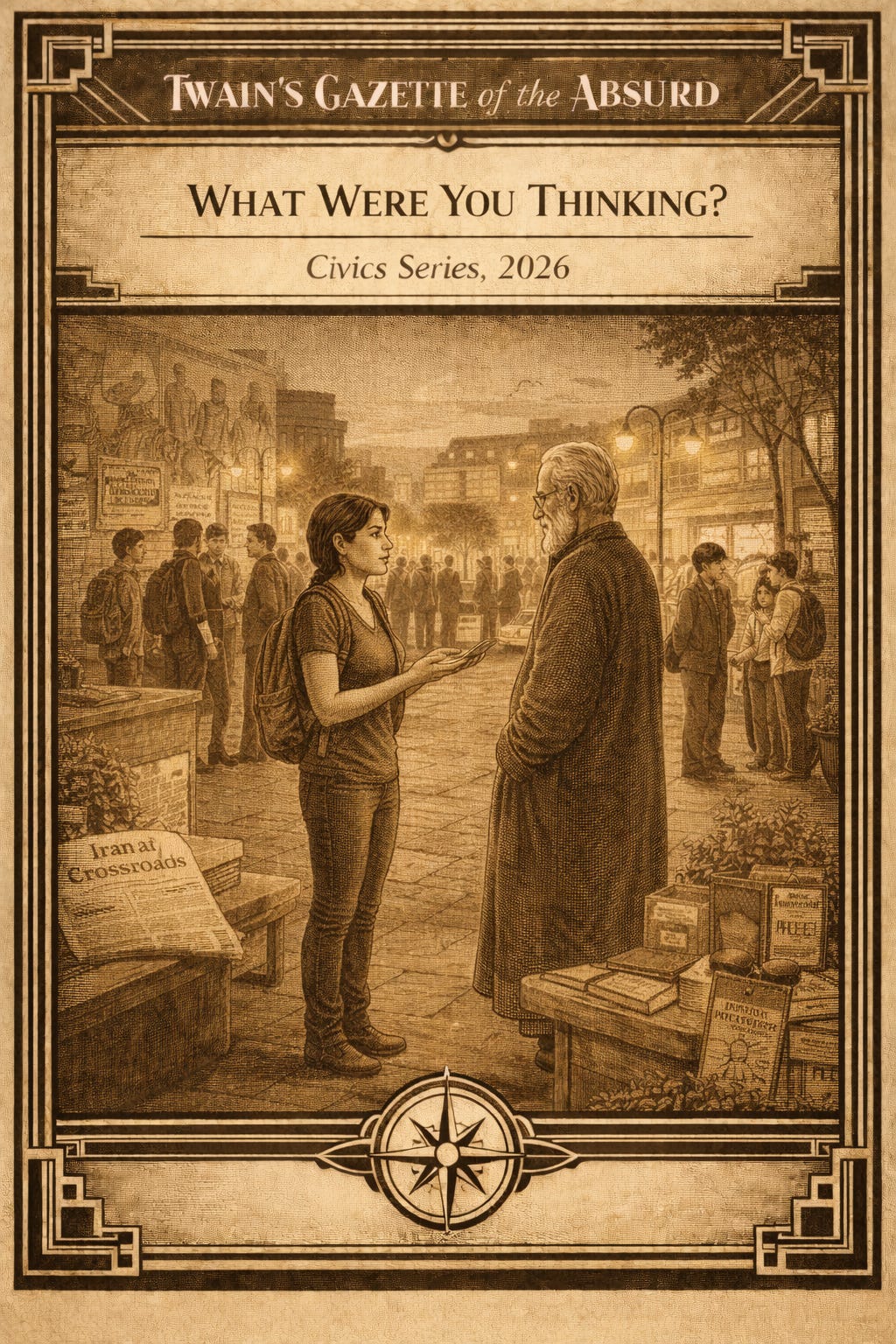
Which makes the situation even stranger. Many of the young people now protesting in the streets were not alive when the monarchy fell. According to him, some of them have begun turning to their parents and asking a question that is both simple and devastating:
“What the hell were you thinking?”
The children of the revolution are now questioning the revolution.
And it raises an uncomfortable question.
What has really changed?
History sometimes feels like it is running in circles. A monarchy is overthrown in the name of freedom. An autocracy falls and promises of democracy fill the air. But the new system becomes a theocracy. Then people demand democracy again. If the theocracy falls, what replaces it? Another strongman? Another revolution? Another cycle?
People everywhere keep chanting the same word—democracy—as if saying it often enough might summon it into existence.
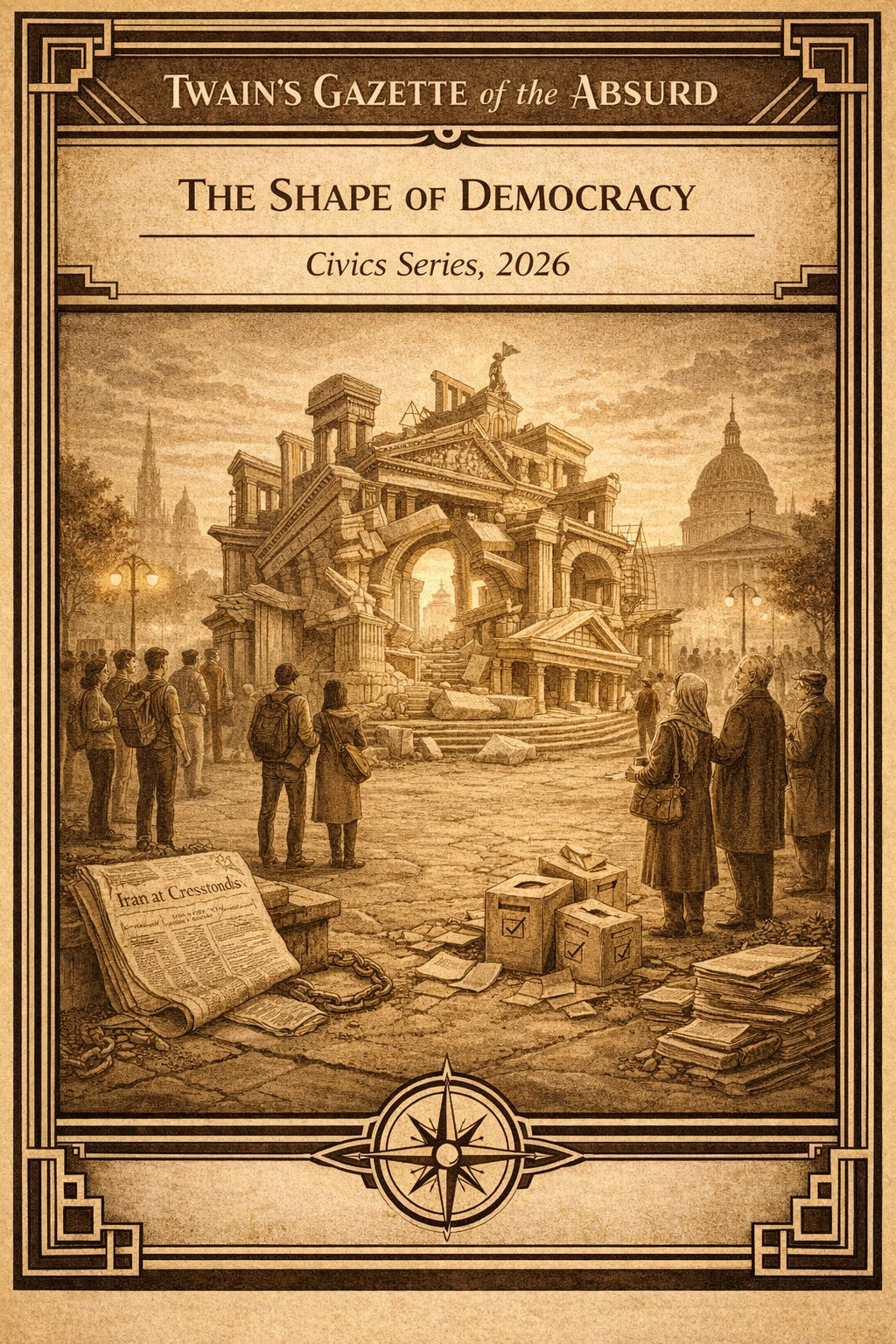
Democracy, it turns out, is an elusive thing.
More like a shape-shifter than a permanent structure.
You think it is there.
And then suddenly it isn’t.
For a long moment I sat there staring at the timeline KimchiBot and I had assembled, wondering how a country can reinvent itself so completely and yet still feel unfinished.
Sometimes I think back to that classroom in Paris.
A handful of young women from Iraq and a student from San Francisco standing there awkwardly while the news of war rolled across television screens somewhere far away.
None of us had ordered the bombs.
None of us had voted on the strategy.
Yet somehow we had inherited the consequences.
For a moment we stood there unsure what to say, and then we simply embraced.
It was such a small thing.
But in that moment we understood something that still seems to escape so many people in power.
Most human beings do not actually want to be enemies.
They want to study, work, design buildings, raise families, and live ordinary lives.
The tragedy of Iran—like the tragedy of so many places in the world—is that history keeps placing extraordinary burdens on ordinary people.
And somewhere tonight, whether in Tehran, Baghdad, Paris, or San Francisco, a group of young people is probably standing in a hallway trying to make sense of the decisions made by the generations before them, asking the same question that echoes through history again and again:
What were you thinking?
The tragedy of Iran mark 2.
Kimberly writes so beautifully about how ordinary Iranians are caught up again in the turmoil of war as their country is bombarded by bombs and destruction. A country that has such a remarkable history going back thousands of years, and which was briefly one of the most cosmopolitan places in the Middle East before the Ayatollahs. This horrible war that is being unleashed by Trump and Netanyahu is a tragedy for everyone. Haven't we learnt anything from history? Vietnam, Afghanistan, Iraq, Libya, Gaza. The track record is a disaster for all concerned, victor and vanquished alike.
Like Kimberly my Iranian friends here in the Bay Area are cultured, gentle, civilized people who don't deserve to have their country destroyed. Resist and protest. This war should not be in our name paid for with our taxes. Shame on us.