

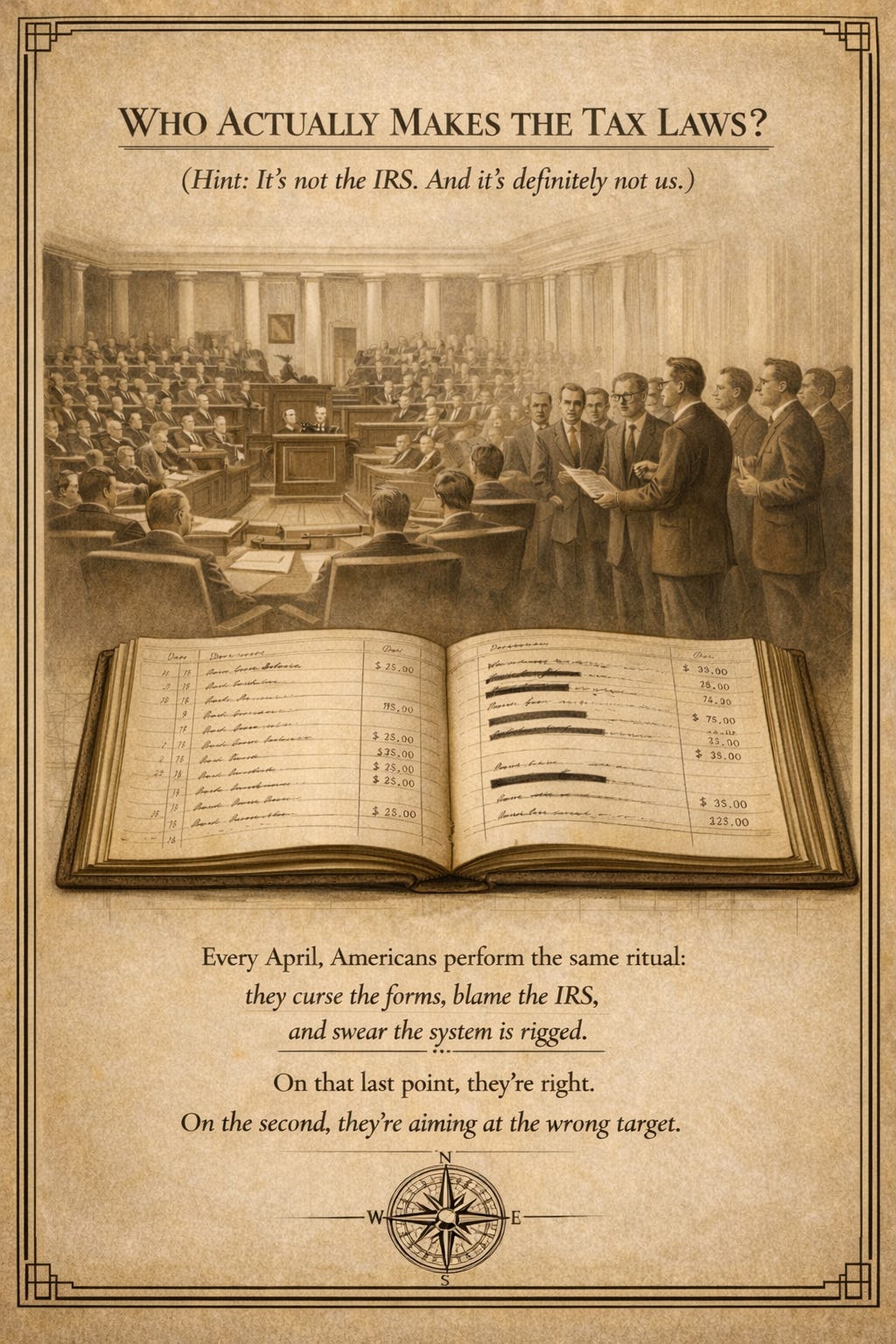
Every April, Americans perform the same ritual:
they curse the forms, blame the IRS, and swear the system is rigged.
On that last point, they’re right.
On the second, they’re aiming at the wrong target.
Let’s open the ledger.
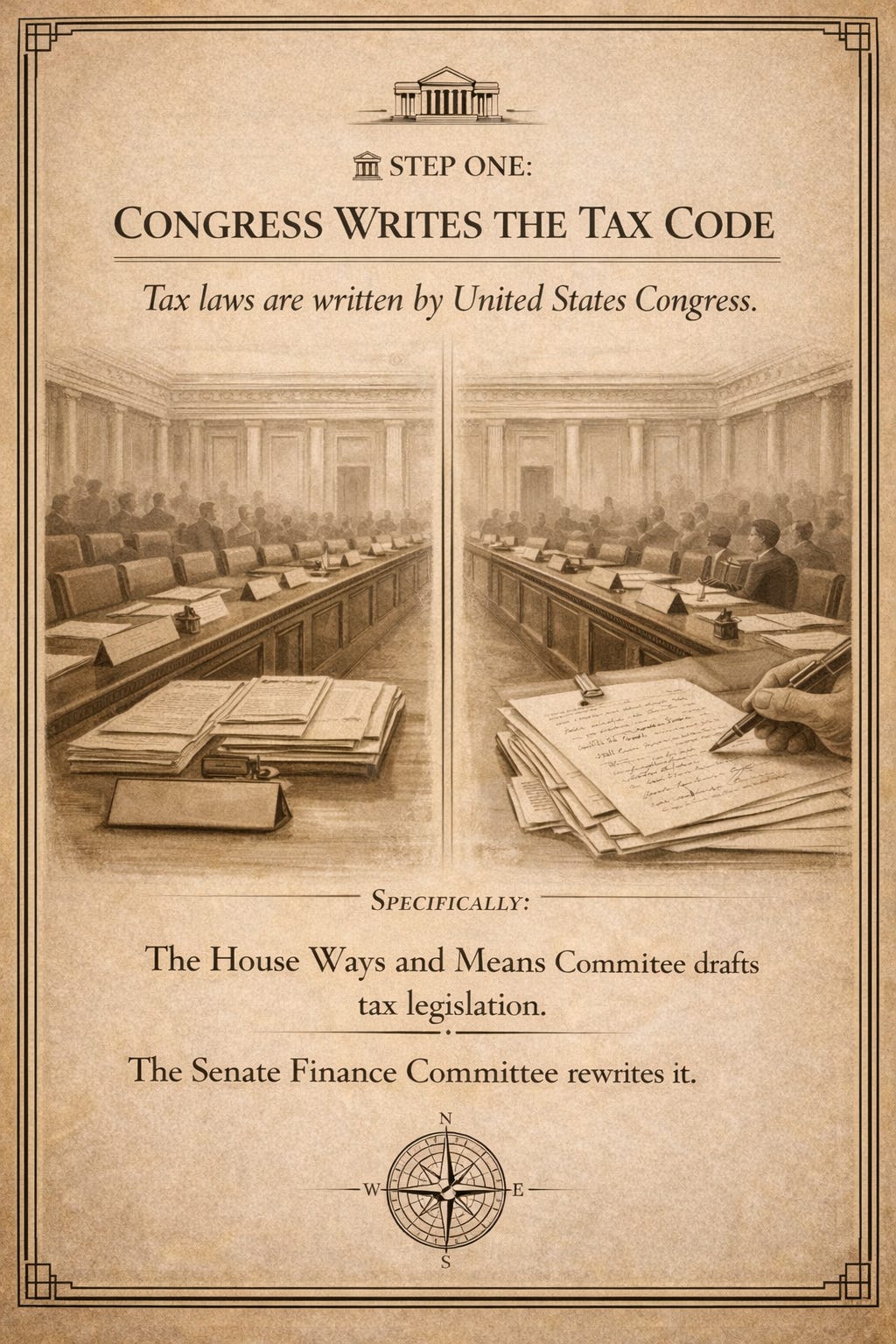
🏛️ Step One: Congress Writes the Tax Code
Tax laws are written by United States Congress.
Not accountants. Not economists. Not the IRS.
Specifically:
The House Ways and Means Committee drafts tax legislation
The Senate Finance Committee rewrites it
Lobbyists supply the footnotes
Staffers supply the commas
Deals supply the outcomes
By the time a bill reaches the floor, it already contains:
carve-outs
exemptions
credits
deferrals
“temporary” provisions that never expire
This is where complexity is born. Not accidentally. By design.
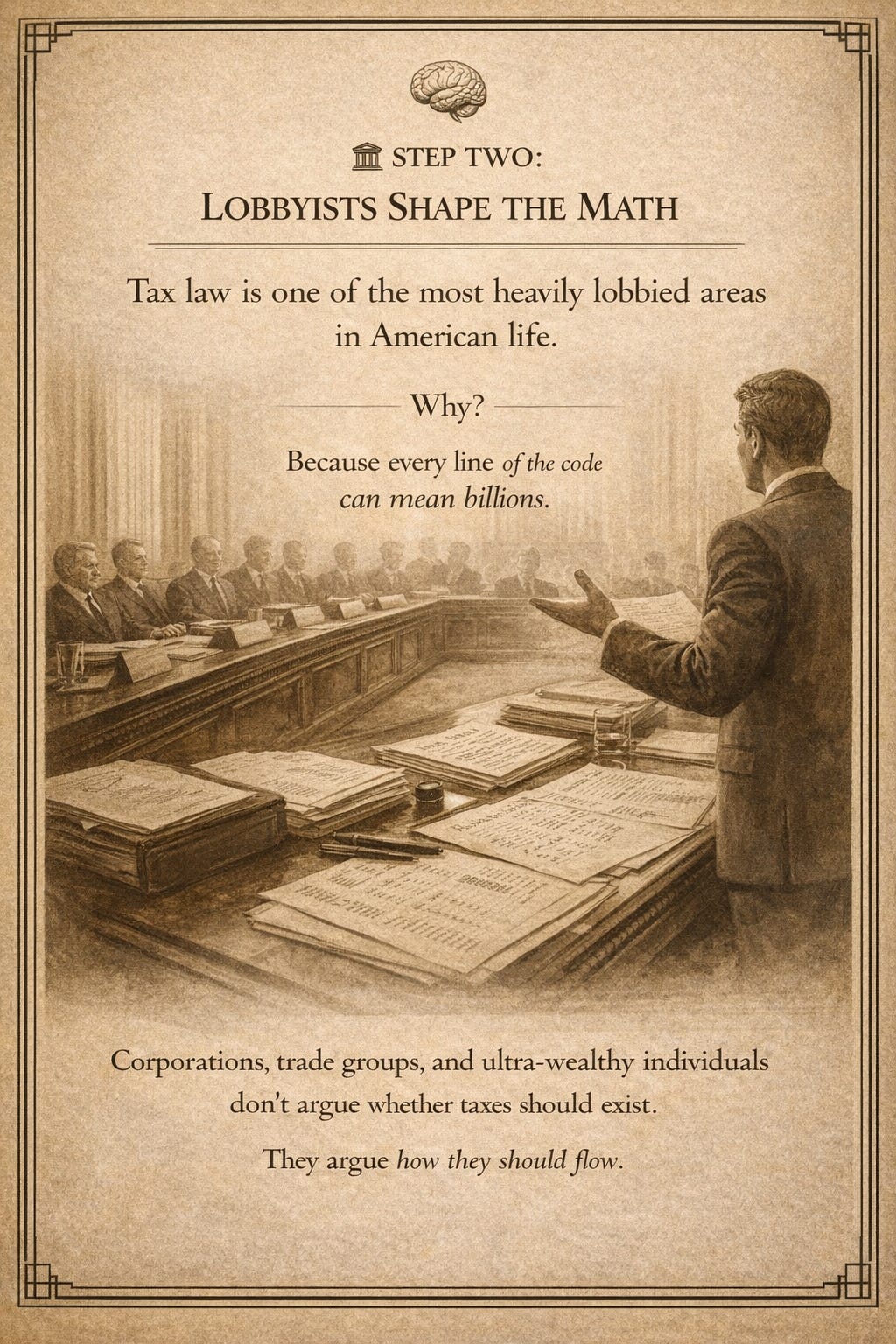
🧠 Step Two: Lobbyists Shape the Math
Tax law is one of the most heavily lobbied areas in American life.
Why?
Because every line of the code can mean billions.
Corporations, trade groups, and ultra-wealthy individuals don’t argue whether taxes should exist. They argue how they should flow.
Deductions are engineered.
Credits are negotiated.
Losses are made portable.
Income is reclassified until it behaves.
This is not cheating.
This is participation.

🏢 Step Three: The IRS Enforces, It Does Not Invent
The Internal Revenue Service does not make tax law.
It enforces whatever Congress hands it, including:
contradictions
loopholes
unfunded mandates
outdated definitions
rules written for industries that no longer exist
Blaming the IRS for the tax code is like blaming a librarian for the contents of the books.
They didn’t write it.
They’re just trying to shelve it.
🧑⚖️ Step Four: Courts Interpret the Gray Zones
When the language collapses under its own weight, the United States Tax Court steps in.
Judges interpret:
what Congress meant
what Congress said
and what Congress clearly didn’t think through
Each ruling becomes precedent.
Each precedent becomes a new layer.
The code grows thicker. The maze grows taller.

💼 Step Five: Who Benefits from the Complexity?
Not us.
Complexity rewards:
those who can hire specialists
those who can afford delay
those whose income is flexible, mobile, or abstract
Wages are visible.
Assets are negotiable.
This is why:
billionaires can pay lower effective rates than teachers
corporations can show record profits and zero tax liability
“simplification” is always promised and never delivered
The system works beautifully for those it was quietly tuned for.

🧭 The Quiet Truth
If taxes were truly about fairness, the code would be short.
If they were about efficiency, the forms would fit on a postcard.
But taxes are about power, incentives, and negotiated advantage, written in a language most people never get time to learn.
So next time someone says “the IRS did this,” remember:
The handwriting is congressional.
The margins belong to lobbyists.
The bill arrives at your door.
Tariffs will take care all of us, just not the way Trump says, more like increased bankruptcies and pain.