

🏛 I. The Machine
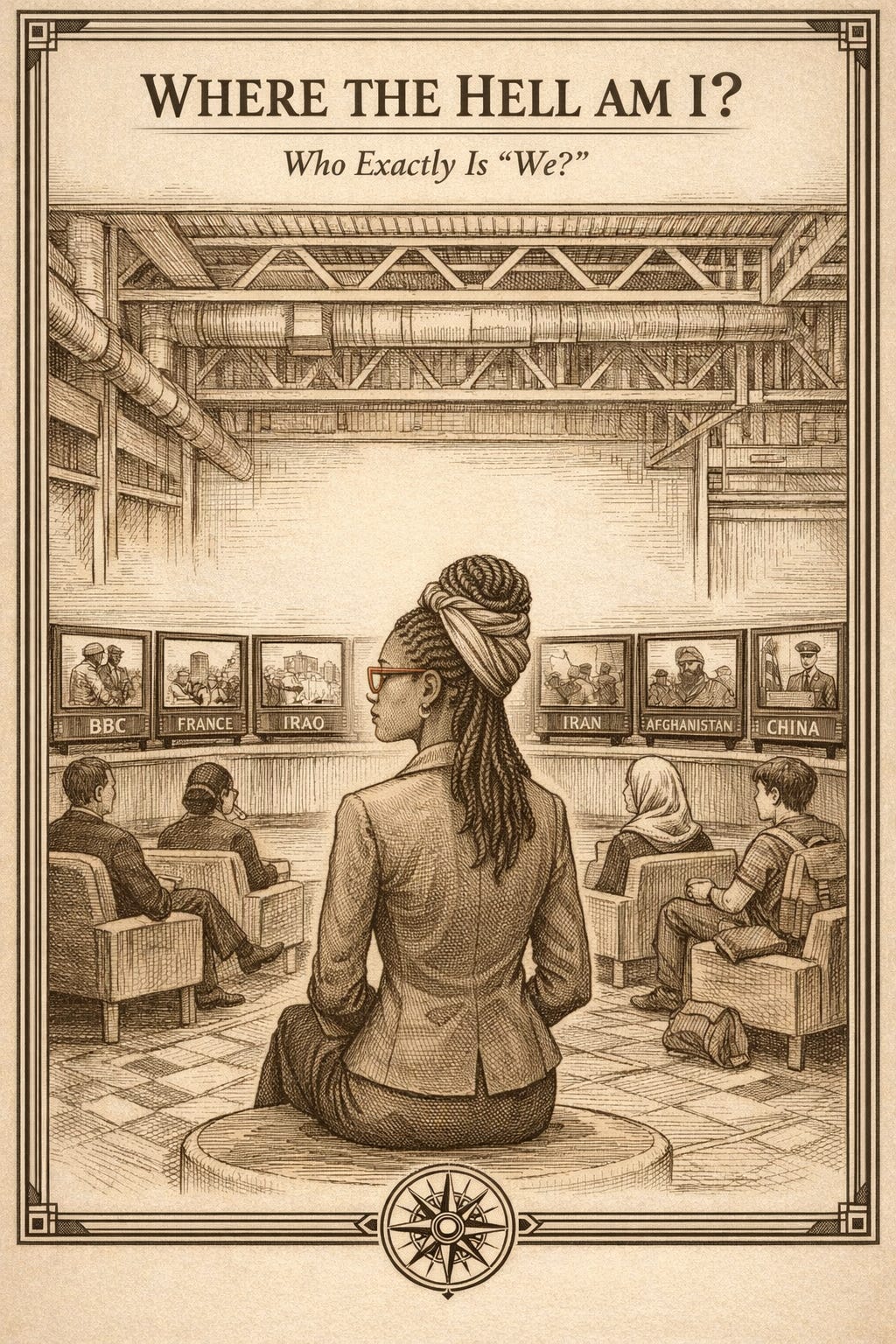
In the early 2000s, I found myself in Paris inside one of the most extraordinary modern structures ever built: the Centre Pompidou.
It is not a polite building. Its pipes and escalators live on the exterior. Its structure is visible. Its interior is vast and reconfigurable. It is less a museum than an engine.
If you enter the Pompidou, you enter a machine for knowledge.
On one of the upper floors there was an open salon filled with televisions broadcasting news from around the world. Comfortable chairs. Headphones. People from everywhere. Business suits. Students. Women in hijabs. Tourists.
Each person tuned to their nation’s narrative.
I moved from screen to screen.
The BBC.
French television.
Iraqi broadcasts.
Iranian coverage.
Afghan channels.
CCTV from China.
American networks.
Even when I did not understand the language, I understood the images.
And the images were not the same.
📺 II. The Blur
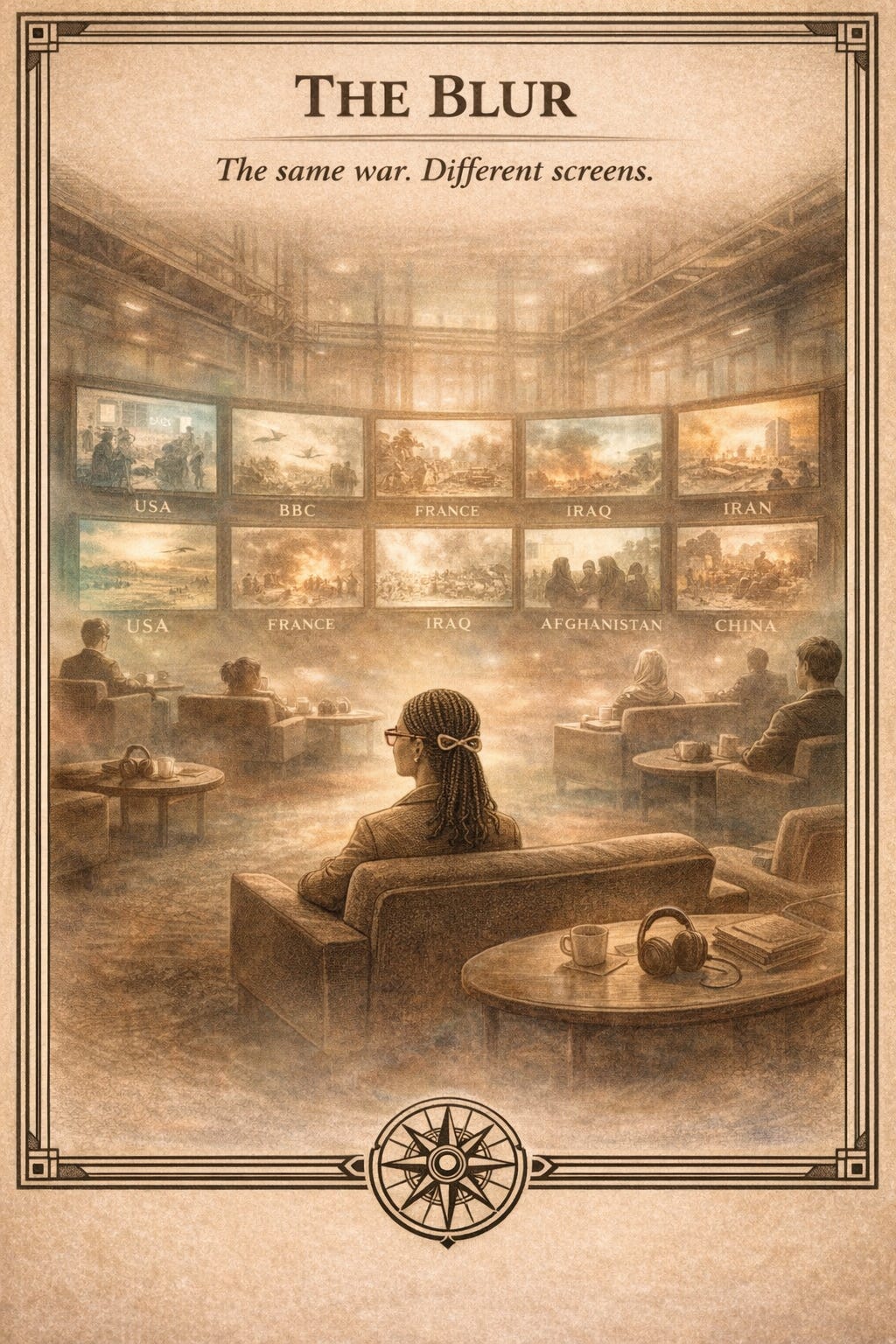
The war in Iraq looked different depending on where you were sitting.
On American television, the reporting felt disciplined. Strategic. Civilian casualties were rarely centered. Friendly fire incidents were softened. The narrative leaned toward order.
Elsewhere, grief lingered longer on the screen.
Of course, every nation frames its story.
But I had grown up believing the United States aspired to something sturdier in its journalism.
Sitting in that open room inside that exposed-structure building, the word “we” began to blur.
Who was “we” in these reports?
Whose losses counted?
Whose images were shown?
Whose were not?
It was sometime during the George W. Bush years, not long after the 2000 election and the strange, surreal drama in Florida that ended with Gore conceding. I had been in Paris when that election unfolded. Watching American politics from outside the country gave me a peculiar vantage point. The tone of the coverage. The distance. The conversations with journalists who were not performing for a domestic audience. It felt different. Less choreographed.
In Paris I spent time with a few American reporters. At one point I asked them a question that felt obvious to me: why weren’t they doing more? Why weren’t they pushing harder on what had happened? One of them, a reporter who worked for a major American paper, told me quietly that they were afraid for their jobs. This was before Jeff Bezos owned The Washington Post, before many of the media consolidations we now talk about so easily. But even then, the fear was present.
That conversation stayed with me.
Uncertainty settled in. Not anger. Not ideology. Just unease.
It was there that I listened to one of Al Gore’s 2004 lectures from UC Berkeley. His keynote that year at The New School was titled Fear: Political Uses and Abuses. His message was steady: pay attention. Educate yourself. Notice the expansion of executive power.
He asked audiences:
“Doesn’t this bother you?”
Yes.
It did.
🎭 III. A Small Theater of Understanding
When I returned to the Bay Area, I began listening to Robert Reich more closely.
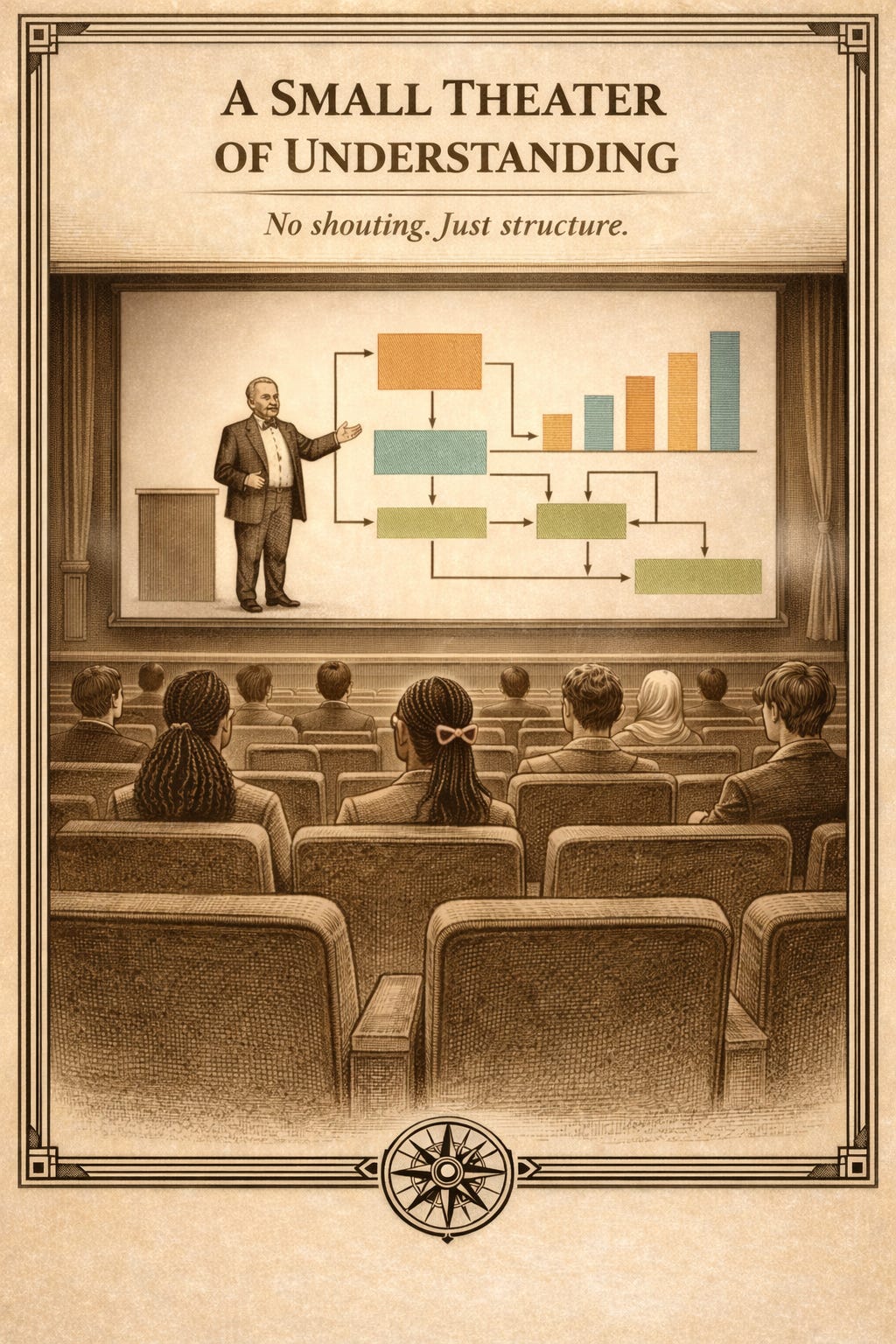
His explanations did not feel like arguments. They felt like a small theater.
He would step forward.
He would place a structure on the stage.
Executive compensation.
Corporate boards.
Stock buybacks.
Lobbying pathways.
Incentives stacked carefully like scenery flats.
No shouting.
No thunder.
Just the patient unfolding of how the set had been built.
He spoke as if pulling back curtains rather than drawing charts. You could see where each beam connected. You could see who stood in the spotlight and who worked in the wings. It was not mathematics. It was staging.
When he launched Inequality for All, I contributed to the Kickstarter campaign. It felt modest at the time. A small vote for explanation.
Later, in the California Theatre on Kittredge Street, I sat among neighbors and strangers and watched the film. The room was not grand. The seats were worn in the way of honest places. The screen flickered, and the structure of the economy appeared as something almost physical. A stage set of incentives and outcomes.
When the credits rolled, my name appeared among hundreds of others.
A small line in a long list.
I felt proud.
Not because my name was there, but because it was one among many. It suggested that understanding was not a solo performance. It was something we sat inside together.
It felt like shared effort. Like understanding might gather slowly, person by person, and in time begin to press against the beams of the structure.
For a moment, it seemed possible that if enough of us stayed in our seats, if enough of us learned how the set had been arranged, we might eventually find a way to rearrange it ourselves.
The stage did not feel inevitable.
It felt constructed.
And what is constructed can be rebuilt.
Twenty years later, the issues remain. Corporate concentration has increased. Media ownership has narrowed. Economic inequality has widened.
The diagrams were clear.
The structure did not move.
🧭 IV. The Orientation
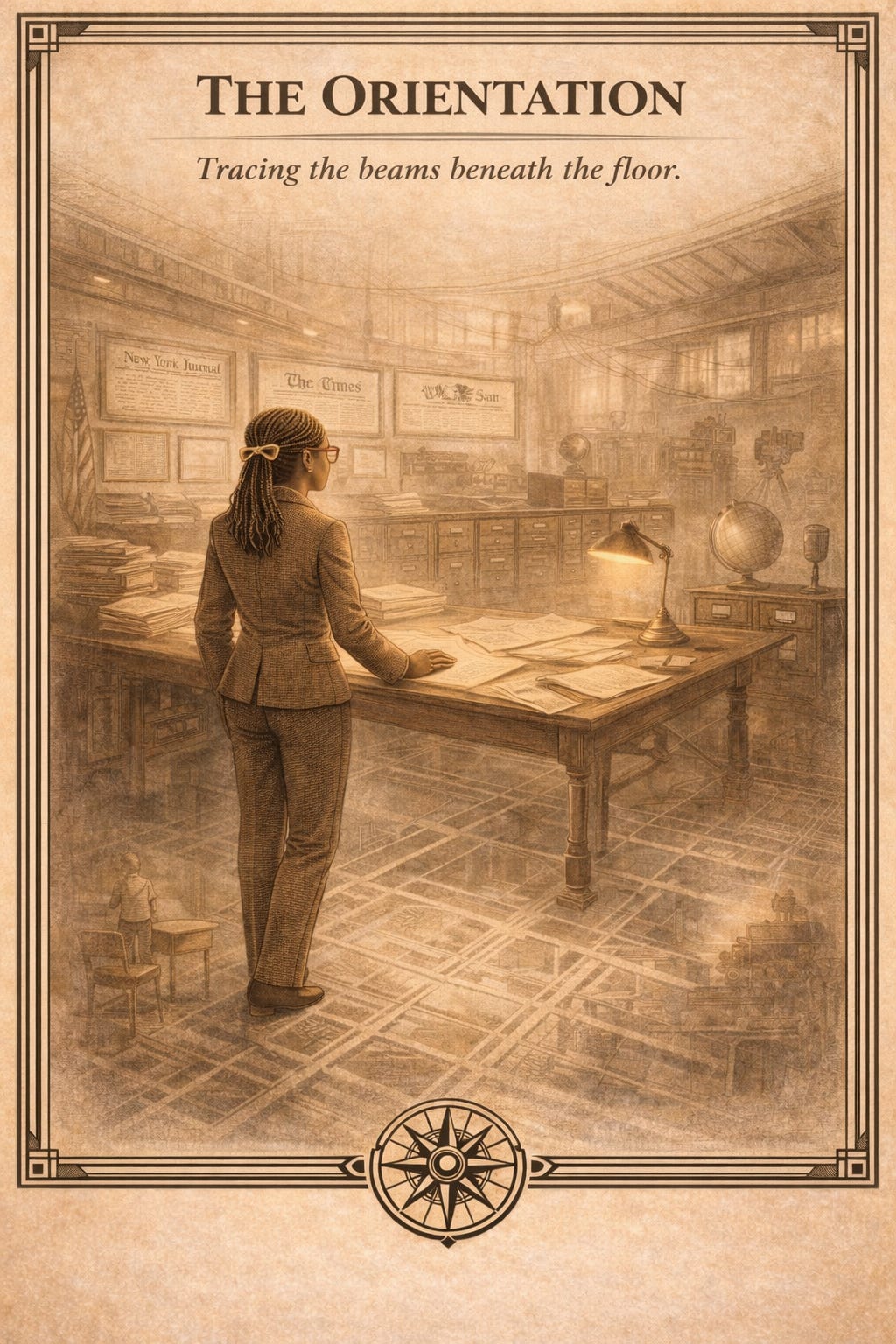
I began tracing backward.
Media consolidation.
Rupert Murdoch.
William Randolph Hearst.
Private wealth and public authority intersecting.
Then further back.
“We the People…”
Who is “we”?
The Declaration speaks of “one people.”
Who are “the people”?
I remember standing beside my desk at six years old, hand over heart, believing those words described something solid and shared.
More than six decades later, I am still asking:
Where exactly am I standing?
And how did the familiar floor plan become unfamiliar?
🧭 Where the Hell Am I? is not a lecture series.
It is an orientation.
An attempt to make the structure visible.
To trace the beams.
To steady the word “we.”
This is such an interesting set of observations about how different countries see the world around us. The description of the media room in the Pompidou Centre during the 2003 Iraq War is so powerful as it displays how diverse the views of that tragic event were seen in all their complex ways. So many aspects of American media these days resemble Pravda like conformity to the State. Murdoch has poisoned the well. Bezos has neutered the Washington Post and Larry Ellison promises the same for CNN. Where are the Ed Morrow and Walter Cronkite of our times?