

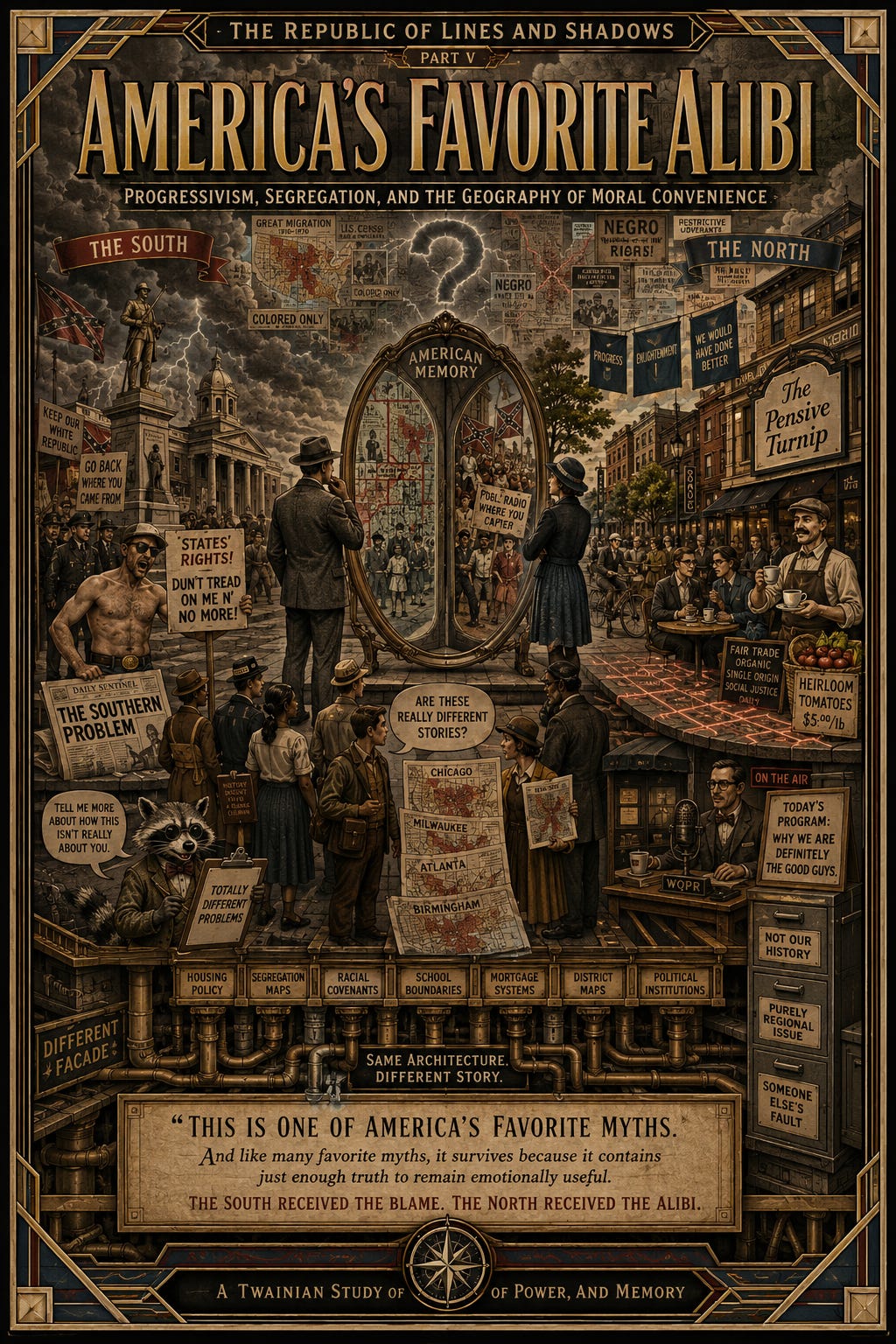
Americans often discuss racism as though it were a regional weather condition.
The South gets assigned:
thunderstorms,
Confederate statues,
and shirtless men screaming outside courthouses while holding signs misspelled with heroic confidence.
The North, meanwhile, receives:
public radio,
heirloom tomatoes,
artisanal coffee shops named things like The Pensive Turnip,
and a profound moral certainty that it would have behaved much better in 1957.
This is one of America’s favorite myths.
And like many favorite myths, it survives because it contains just enough truth to remain emotionally useful.
❄️
The American South undeniably built some of the most brutal systems of racial oppression in the nation’s history:
slavery,
segregation,
disenfranchisement,
racial terror.
No serious examination of American history can avoid that reality.
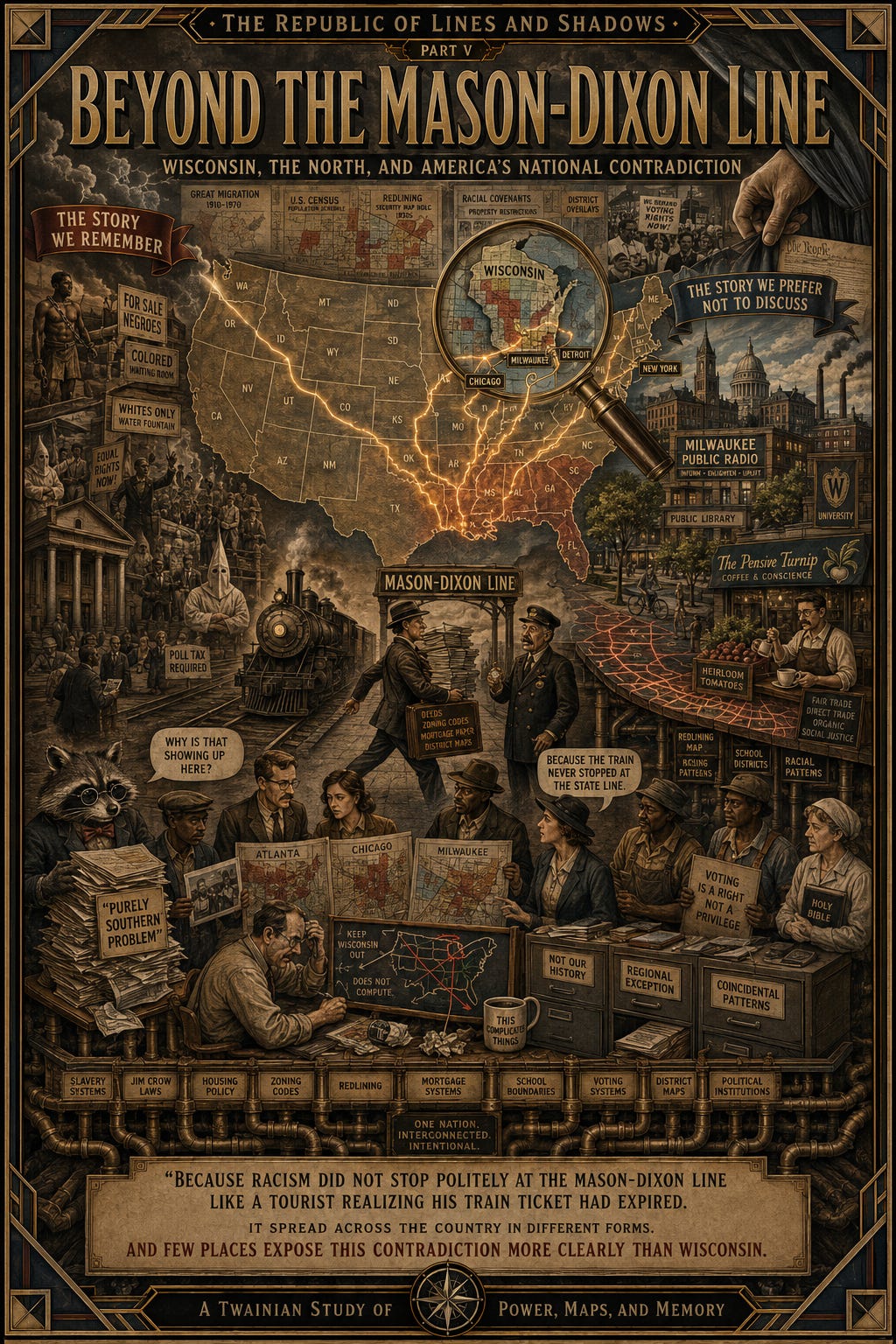
But once we move beyond the simplified morality play of “racist South versus enlightened North,” the national story becomes far more uncomfortable.
Because racism did not stop politely at the Mason-Dixon Line like a tourist realizing his train ticket had expired.
It spread across the country in different forms.
And few places expose this contradiction more clearly than Wisconsin.
🧀
Wisconsin is not usually the first state Americans associate with racial conflict.
The state’s public image tends to involve:
dairy farms,
football fans wearing cheese on their heads,
snowdrifts capable of swallowing compact cars,
and emotionally durable citizens grilling bratwursts in weather conditions that would kill a Victorian child instantly.
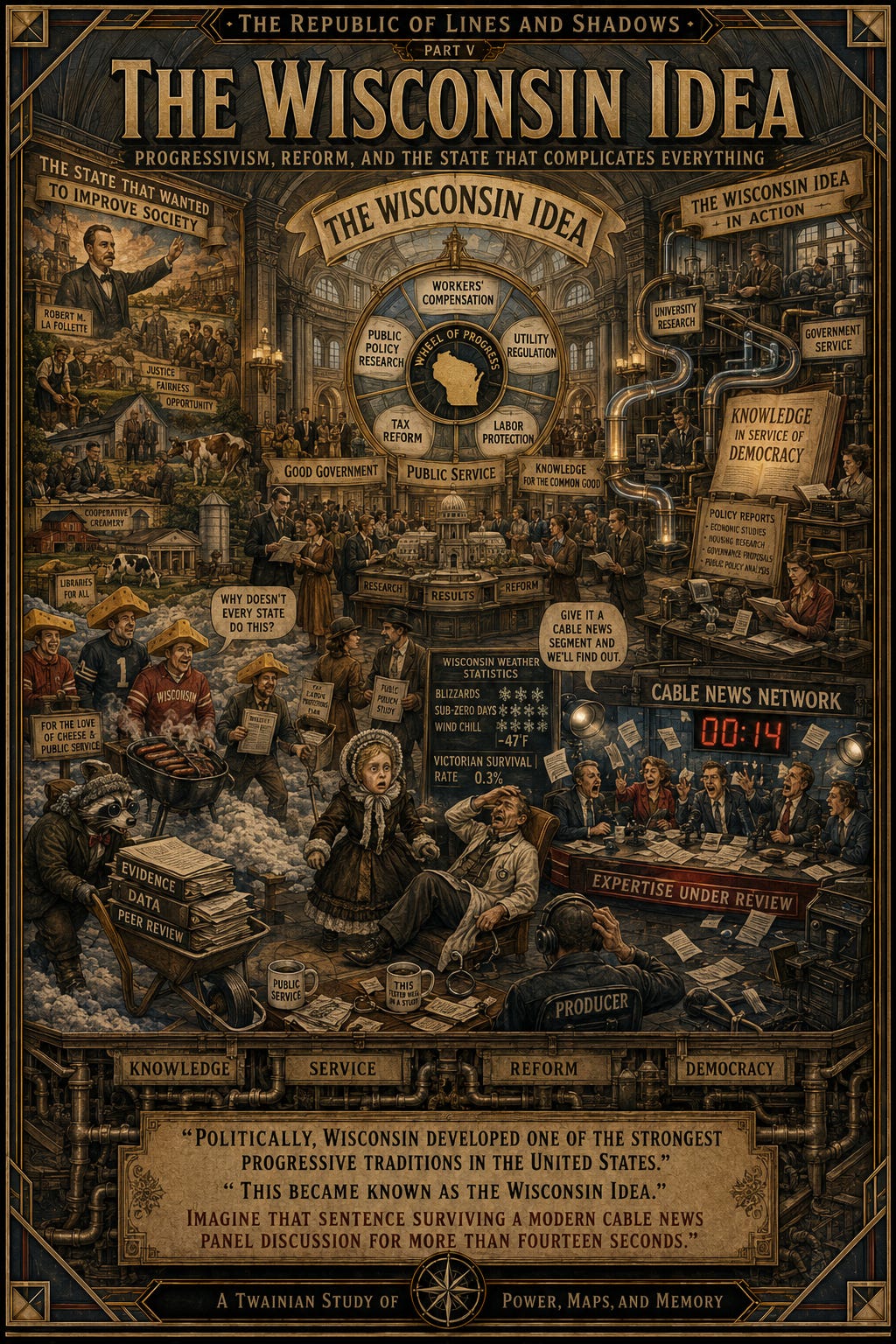
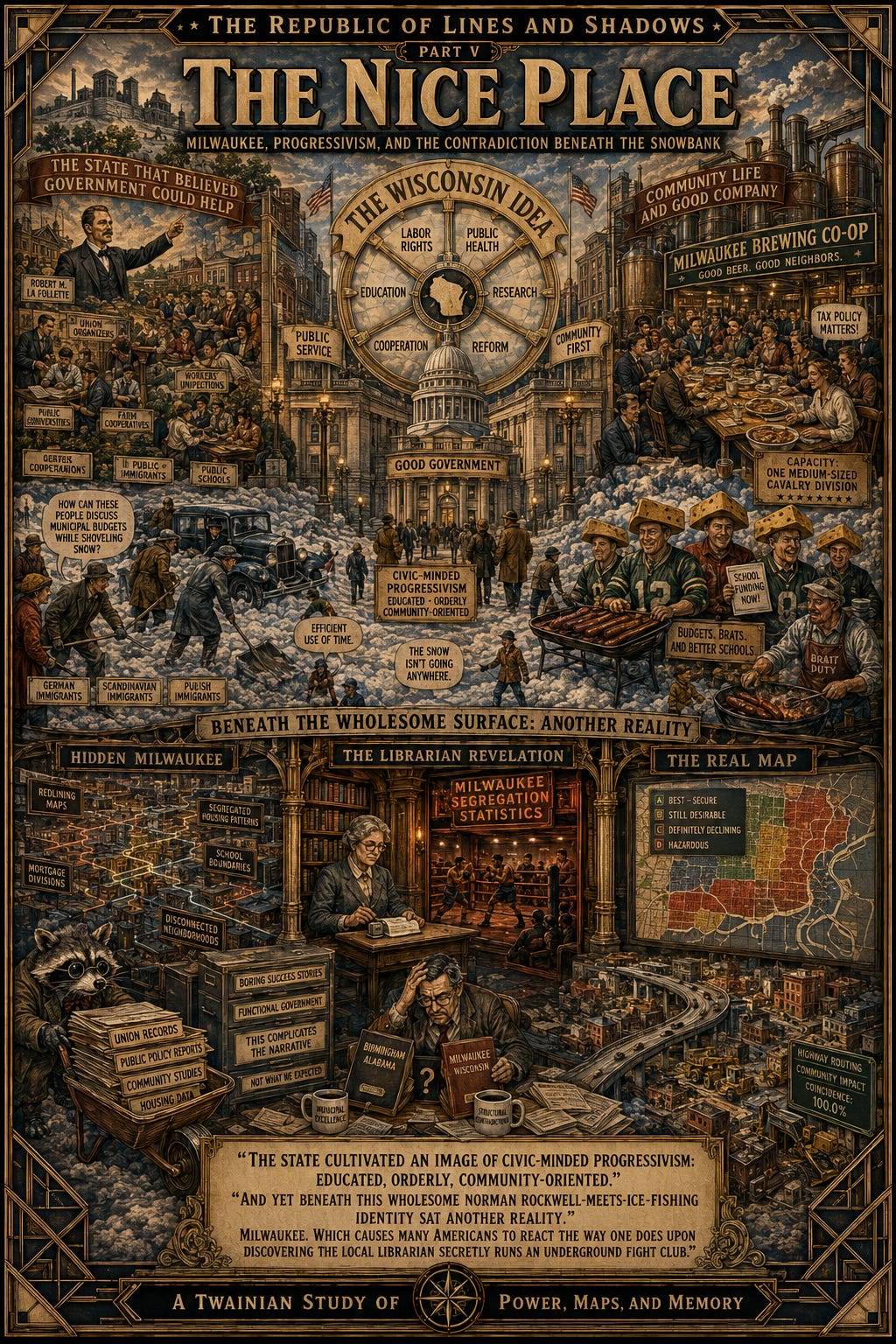
Politically, Wisconsin developed one of the strongest progressive traditions in the United States.
In the early 20th century, figures like Robert M. La Follette championed reforms against monopolies and political corruption.
Wisconsin pioneered:
workers’ compensation,
utility regulation,
labor protections,
tax reform,
and public policy research.
This became known as the “Wisconsin Idea,” the belief that universities and government should work together to improve society.
Imagine that sentence surviving a modern cable news panel discussion for more than fourteen seconds.
🏛️
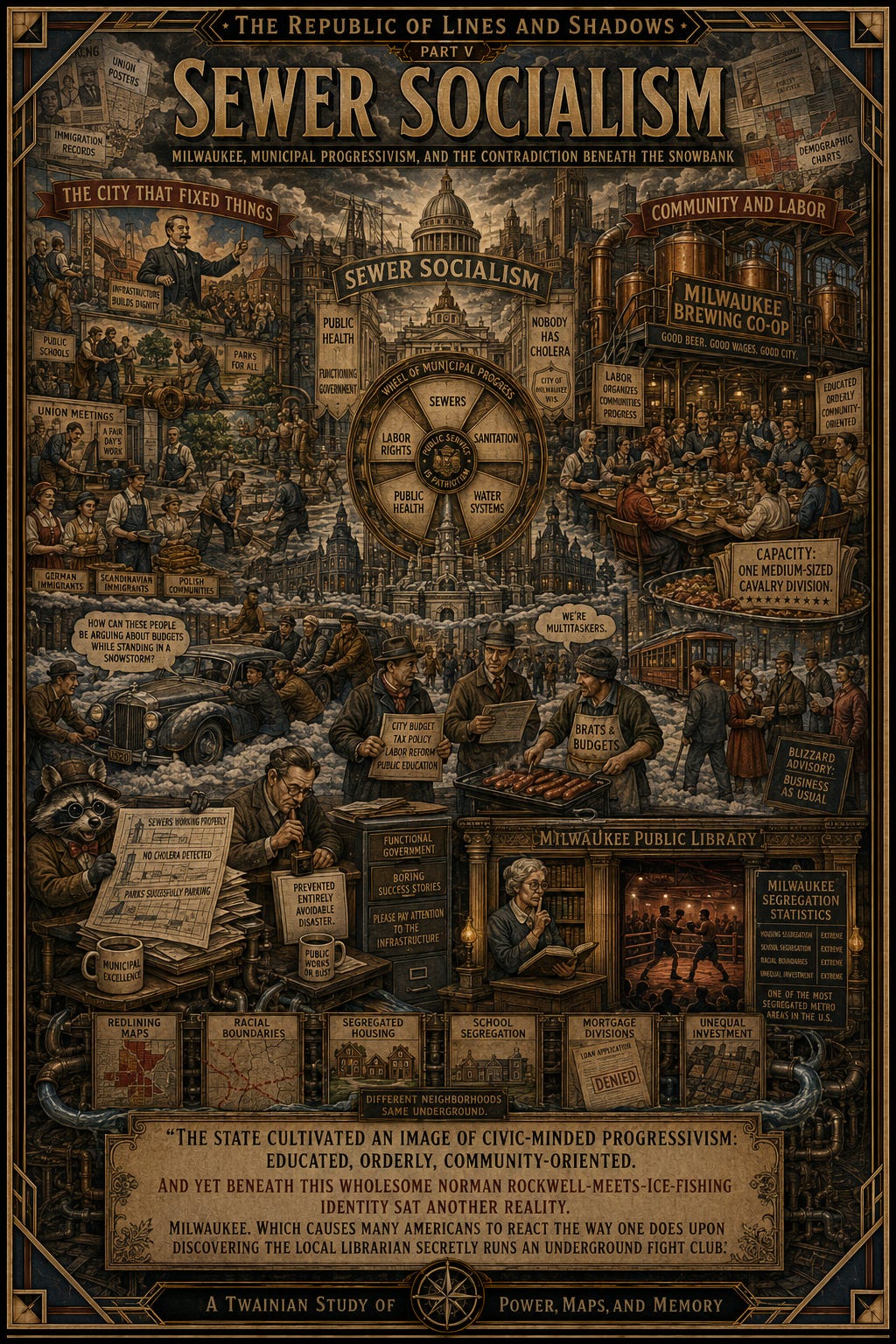
Meanwhile, cities like Milwaukee became famous for “sewer socialism,” a practical form of municipal socialism focused less on glorious proletarian revolution and more on things like:
functioning sewers,
sanitation,
parks,
and public health.
Which honestly sounds less like radical ideology and more like the bare minimum required to prevent nineteenth-century cholera from making a comeback tour.
🚽
Wisconsin also developed strong labor movements shaped by:
German immigrants,
Scandinavian immigrants,
Polish communities,
unions,
breweries,
and enough casseroles to feed a medium-sized cavalry division.
The state cultivated an image of civic-minded progressivism:
educated,
orderly,
community-oriented.
The kind of place where neighbors might debate tax policy passionately while simultaneously helping push each other’s cars out of snowbanks.
And yet beneath this wholesome Norman Rockwell-meets-ice-fishing identity sat another reality.
Milwaukee eventually became one of the most segregated metropolitan areas in the United States.
Not Birmingham.
Not Jackson.
Not Selma.
Milwaukee.
Which causes many Americans to react the way one does upon discovering the local librarian secretly runs an underground fight club.
🏙️
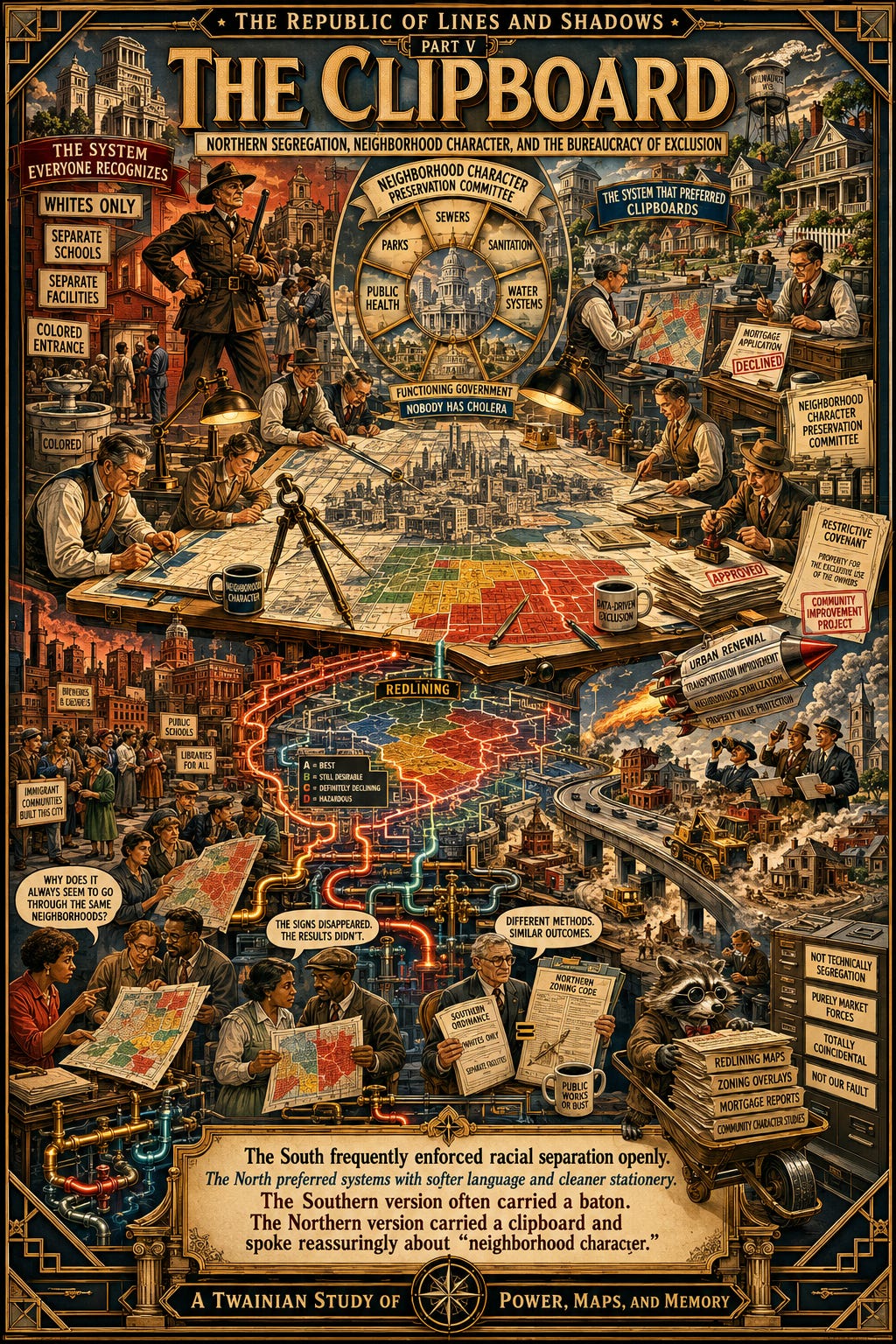
This surprises people because Northern segregation often operated differently than Southern segregation.
The South frequently enforced racial separation openly:
“White Only.”
Separate schools.
Separate facilities.
Separate entrances.
The North preferred systems with softer language and cleaner stationery:
redlining,
restrictive covenants,
discriminatory lending,
zoning,
suburban exclusion,
and infrastructure projects mysteriously bulldozing directly through minority neighborhoods with the consistency of a cruise missile programmed by a homeowners association.
The Southern version often carried a baton.
The Northern version carried a clipboard and spoke reassuringly about “neighborhood character.”
📋
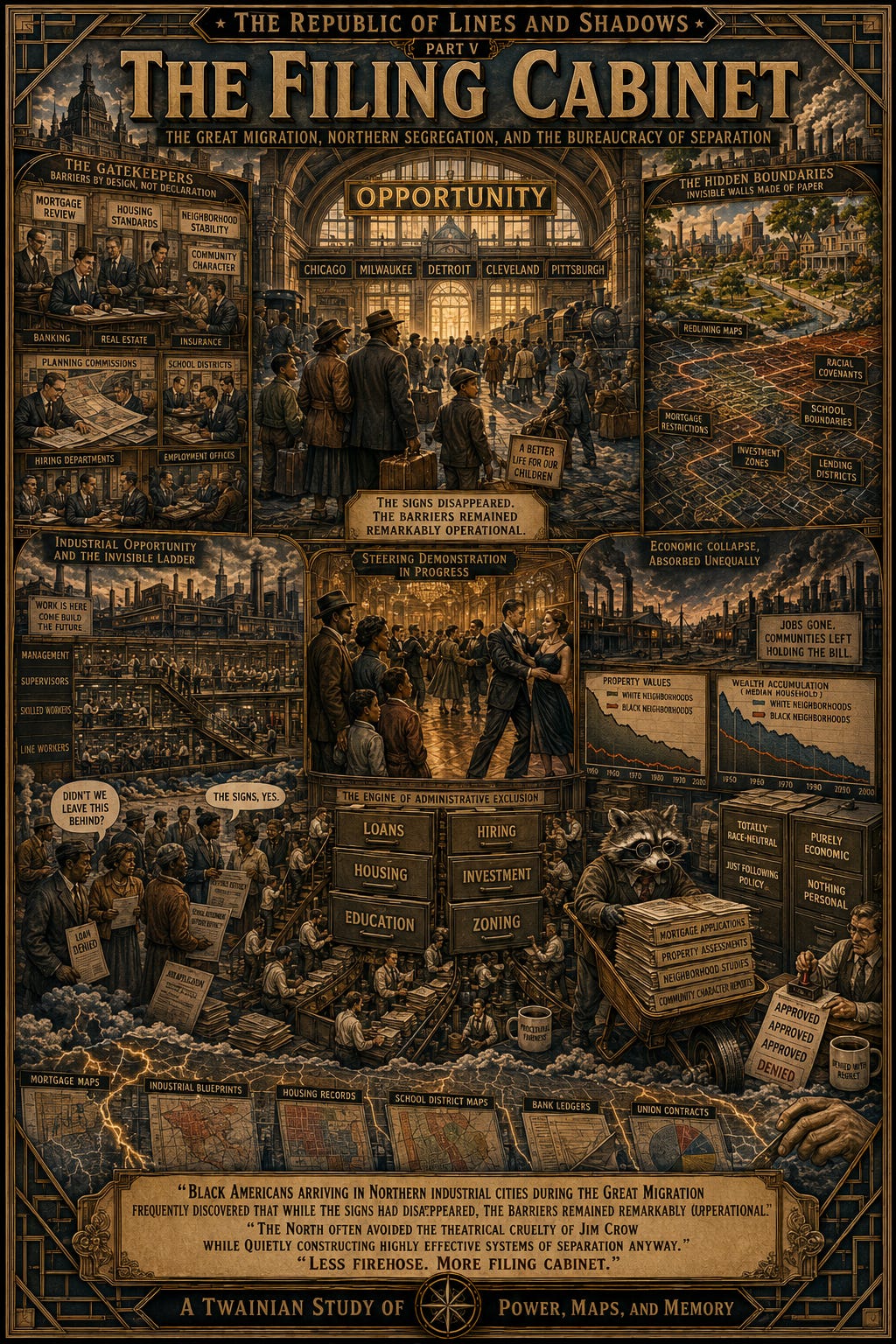
Black Americans arriving in Northern industrial cities during the Great Migration frequently discovered that while the signs had disappeared, the barriers remained remarkably operational.
Banks denied loans.
Real estate agents steered families away from white neighborhoods with the smooth choreography of ballroom dancers avoiding eye contact.
Schools remained unequal.
Factories hired Black workers while often preserving racial hierarchies inside the workplace itself.
Then, as manufacturing declined during the late 20th century, many Black communities were left absorbing economic collapse with fewer resources and less generational wealth.
The North often avoided the theatrical cruelty of Jim Crow while quietly constructing highly effective systems of separation anyway.
Less firehose.
More filing cabinet.
🗄️
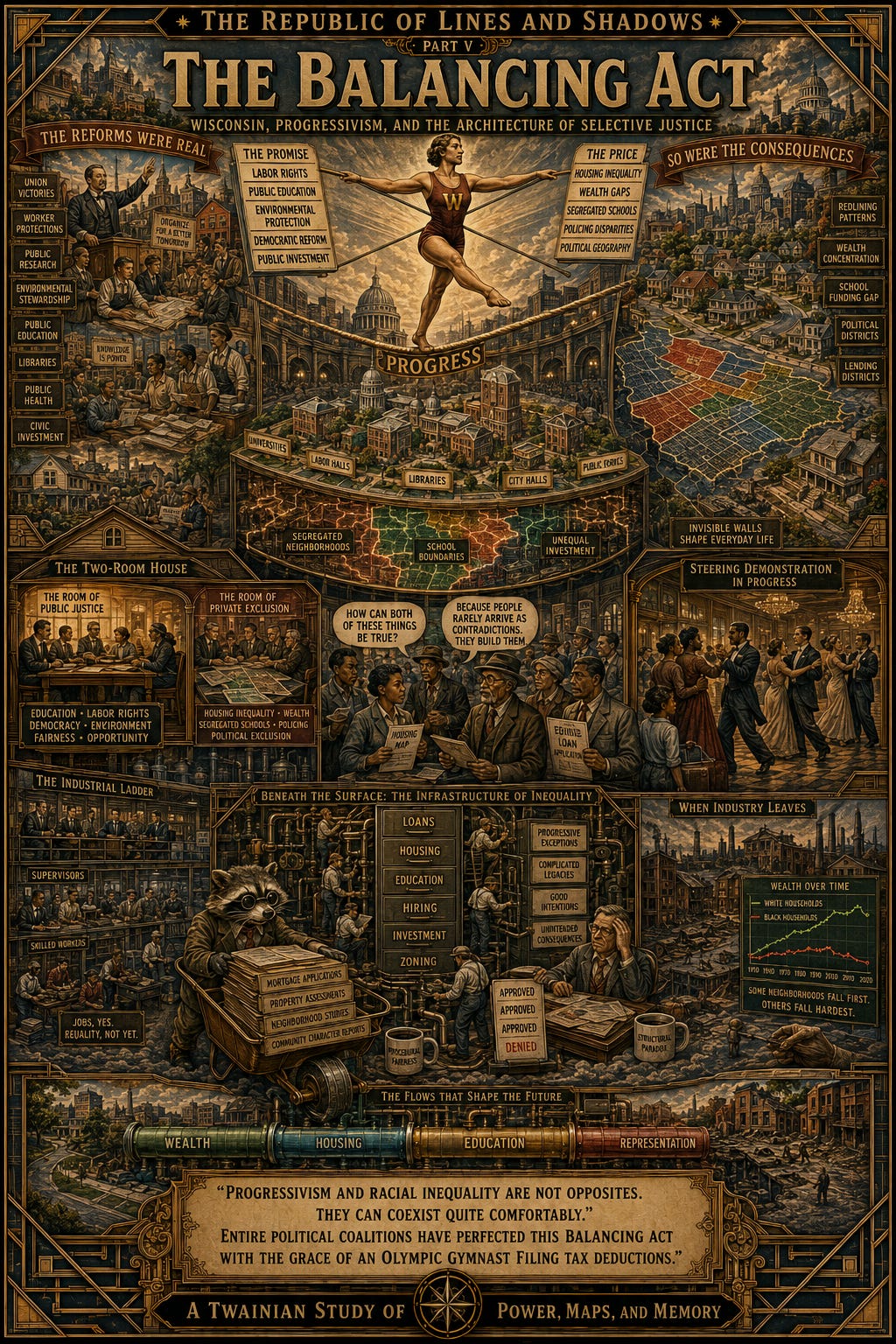
This is why Wisconsin matters so much as a case study.
It reveals something deeply unsettling about American history:
Progressivism and racial inequality are not opposites.
They can coexist quite comfortably.
A society may support:
labor rights,
public education,
environmental protections,
public investment,
and democratic reform
while still preserving racial inequality through:
housing,
policing,
wealth distribution,
school funding,
and political geography.
Human beings possess a remarkable ability to demand justice in one room while quietly preserving hierarchy in another.
Entire political coalitions have perfected this balancing act with the grace of an Olympic gymnast filing tax deductions.
⚖️
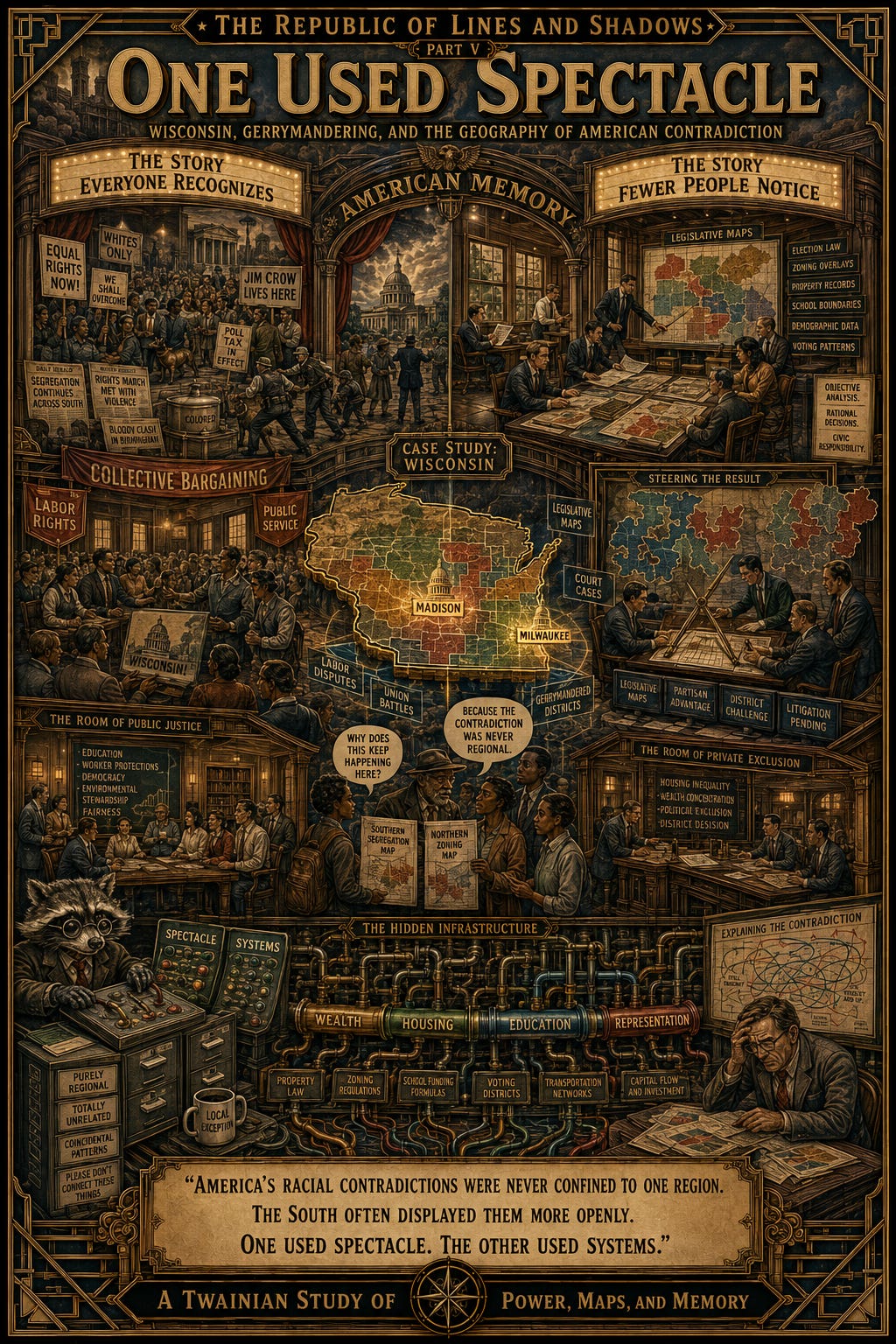
Modern Wisconsin still reflects these contradictions.
Urban centers like:
Madison
and Milwaukee
lean heavily Democratic.
Many suburban and rural regions lean Republican.
The state became nationally famous during battles over:
labor rights,
union power,
legislative maps,
and partisan gerrymandering.
Which forces a difficult national realization:
America’s racial contradictions were never confined to one region.
The South often displayed them more openly.
The North frequently buried them beneath bureaucracy, property law, zoning regulations, and smiling civic professionalism.
One used spectacle.
The other used systems.
🧊
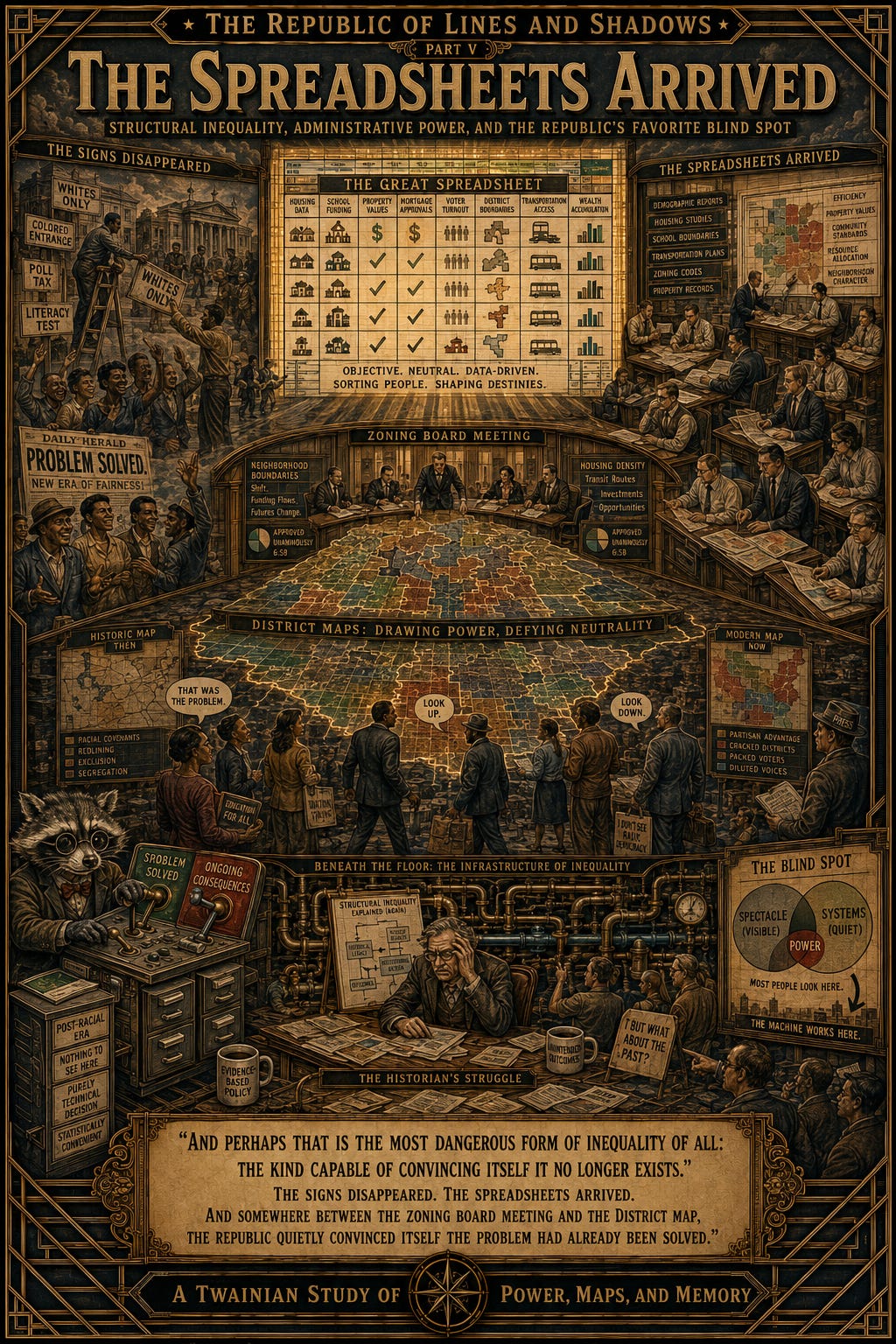
And perhaps that is the most dangerous form of inequality of all:
the kind capable of convincing itself it no longer exists.
Because once a society begins imagining racism solely as cartoon villainy from another era, it becomes extraordinarily easy to overlook the quieter machinery operating in the present.
The signs disappeared.
The spreadsheets arrived.
And somewhere between the zoning board meeting and the district map, the republic quietly convinced itself the problem had already been solved.
🧭 Fellow Travelers
If you enjoyed this essay and would like to support Twain’s Gazette, you can do so by clicking the stamp below.
Every subscription helps support the research, writing, illustrations, and historical rabbit holes that make this publication possible.
It helps keep the lantern lit.
The maps unfolding.
And the next dispatch moving steadily across the republic.
You can also support the Gazette by sharing the essay with friends, family, fellow history enthusiasts, civic obsessives, architecture lovers, and anyone who has ever looked at a district map and thought:
“That seems suspiciously complicated.”
Thank you for reading.
Thank you for traveling along.
The journey continues.
Twain’s Gazette
Architectural Worlds Through Words 🧭
“The signs disappeared. The spreadsheets arrived.” 📜
